
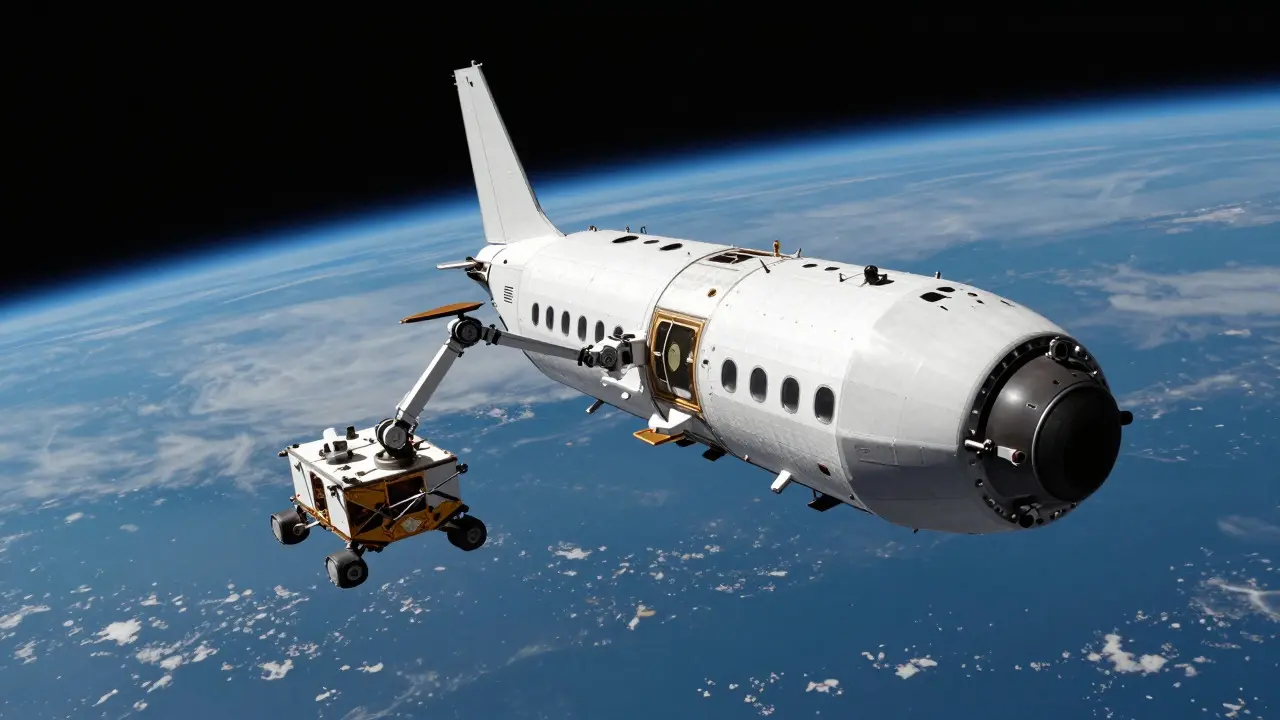
Imagine your car running out of gas in the middle of a desert. Now imagine that car is a billion-dollar satellite orbiting Earth at 17,500 miles per hour, and the only way to save it is for another robot to fly up, dock perfectly, and pump fuel into its tanks without spilling a drop. For decades, this was science fiction. Satellites were disposable; once they ran out of propellant, they were dead weight or space debris. Today, thanks to standardized **refueling interfaces**, this scenario is becoming routine.
The core challenge isn't just storing fuel; it's connecting two moving objects in a vacuum to transfer liquids or gases safely. This connection point-the refueling interface-is the critical hardware that turns on-orbit servicing from a theoretical concept into a viable business model. Without a reliable standard, every satellite would need a custom-built rescue vehicle, making repairs economically impossible. With a standard, one servicing robot can service hundreds of different satellites.
The Problem with Legacy Satellite Design
To understand why modern refueling interfaces matter, we have to look at how traditional satellites are built. Historically, spacecraft used simple fill-and-drain valves designed for a single purpose: getting fuel into the tank before launch. These valves were essentially one-way streets. Once the satellite reached orbit, these ports were sealed off forever. They weren't designed to be opened again, nor did they have mechanisms to allow another spacecraft to latch onto them.
This design forced engineers to carry massive propellant margins. If a mission needed 100 kilograms of fuel to reach its orbit and perform station-keeping maneuvers, manufacturers might load 150 kilograms just in case. That extra weight costs millions to launch. Worse, when the fuel finally ran out, the satellite’s useful life ended immediately. It couldn’t move to a higher orbit to avoid collisions, nor could it reposition itself if a competitor moved into its slot. The result? A growing cloud of non-functional satellites contributing to orbital congestion.
Early attempts at on-orbit servicing tried to solve this by using general-purpose robotic arms. Think of a giant mechanical hand trying to grab a slippery, spinning object. These systems required complex multi-joint manipulators on the servicing vehicle and specific grappling fixtures on the client satellite. The integration was messy, expensive, and often unique to each mission. There was no universal plug-and-play solution. This lack of standardization kept on-orbit servicing as a niche experiment rather than an industry standard.
Enter RAFTI: The Industry Standard
The game changed with the development of the Rapidly Attachable Fluid Transfer Interface (RAFTI), developed by Orbit Fab. Unlike previous concepts, RAFTI is not just a valve; it is a complete docking and fluid transfer system designed to be an open-license standard. First demonstrated in space during the Tenzing mission, RAFTI has evolved through Block 1 and Block 2 iterations to reach Technology Readiness Level (TRL) 8, meaning it is fully qualified for operational deployment.
As of 2024, RAFTI is baselined on over 100 commercial satellites and four U.S. Department of Defense spacecraft, including the Oracle cislunar patrol vehicle. This widespread adoption signals a shift in the industry mindset. Operators are no longer viewing refueling capability as an optional luxury but as a core requirement for mission resilience. The interface allows a servicing spacecraft to dock cooperatively with a client satellite, creating a sealed path for propellants and pressurants while simultaneously providing a mechanical latch for stability.
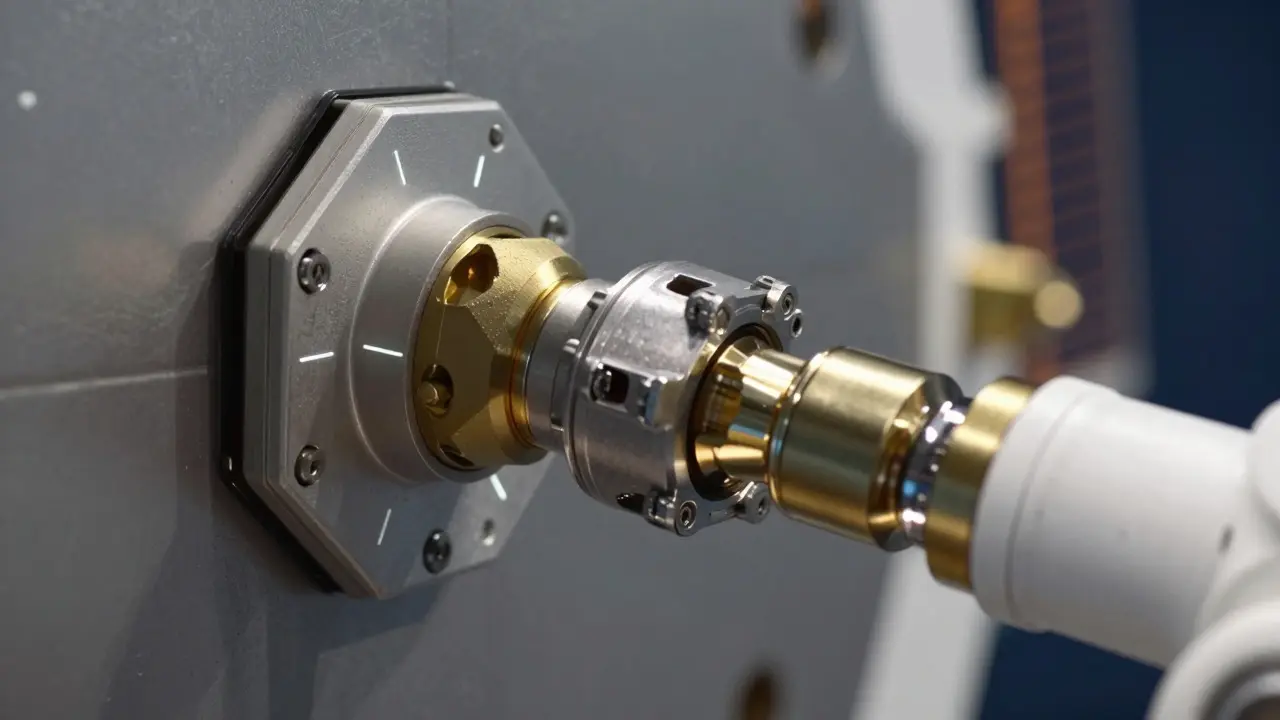
Technical Architecture: How It Works
RAFTI’s success lies in its modular three-component architecture, which separates ground operations from orbital operations while using the same physical port on the satellite. This design eliminates the need for separate hardware for pre-launch fueling and in-space refueling.
- RAFTI Service Valve (RSV): This is the passive interface mounted directly on the client satellite. It acts as a drop-in replacement for conventional fill/drain valves. Weighing approximately 500 grams and measuring about 85mm x 75mm x 45mm, it fits even on small satellites with tight mass budgets. Internally, it contains two valve cores, allowing the simultaneous transfer of two independent fluids-typically a propellant like monomethylhydrazine (MMH) and a pressurant like nitrogen or helium-through a single external port.
- RAFTI Space Coupling Half (SCH): Attached to the active servicing spacecraft, the SCH is the combination fluid transfer and grapple mechanism. It approaches the RSV, uses alignment markers and an octagonal grapple fixture to achieve soft capture, and then engages a mechanical latch to form a rigid connection. Only after this hard latch is secured do the valve cores open to begin fluid transfer.
- RAFTI Ground Coupling (RGC): Used exclusively at the launch site, the RGC allows operators to fuel the satellite using the same valve geometry. This ensures that the procedures for filling tanks on Earth are familiar to engineers, reducing training overhead and integration risk.
A key innovation within this ecosystem is GRIP, a capture and active in-space refueling nozzle developed by Orbit Fab. GRIP simplifies the servicing robot’s design by locking directly onto the RAFTI port. This means the servicing vehicle doesn’t need a complex, multi-degree-of-freedom robotic arm to manipulate tools around the satellite. Instead, it uses a dedicated electromechanical interface that mates directly with the standardized valve geometry. This cooperative docking approach places the burden of precision on the servicing vehicle, while the client satellite only needs to maintain attitude pointing and share telemetry data.
Fluid Compatibility and Operational Environments
Space is harsh. Temperatures swing wildly between sunlight and shadow, and materials must withstand intense radiation. RAFTI is engineered to operate across a temperature range of -40 °C to +120 °C, covering low Earth orbit (LEO), geosynchronous orbit (GEO), and cis-lunar space.
The interface comes in two pressure variants to handle different types of consumables:
| Variant | Primary Use Case | Compatible Fluids |
|---|---|---|
| Low-Pressure RAFTI | Chemical Propulsion Systems | Monomethylhydrazine (MMH), Unsymmetrical Dimethylhydrazine (UDMH), Water, Hydrogen Peroxide, Methanol, Kerosene, "Green" Monopropellants, Isopropyl Alcohol, Nitrous Oxide |
| High-Pressure RAFTI | Electric Propulsion & Pressurization | Nitrogen, Helium, Xenon, Krypton |
The high-pressure variant is particularly significant for the future of electric propulsion. As satellites increasingly rely on ion thrusters powered by xenon or krypton for station-keeping, the ability to replenish these noble gases in orbit extends mission lifespans dramatically. In July 2025, Orbit Fab and the European Space Agency (ESA) announced a new high-pressure RAFTI variant developed in the UK specifically for ESA missions, highlighting the interface's role in enhancing orbital defense resilience and reducing space debris.

Economic Impact and Integration
Why are satellite operators adopting RAFTI so quickly? The economics are straightforward. Orbit Fab prices a RAFTI fueling port at $30,000 USD. While this sounds like a significant upfront cost, consider that a single RAFTI unit replaces two separate conventional fill-and-drain valves (one for propellant, one for pressurant). More importantly, it adds the capability for in-space refueling without requiring additional hardware or major structural modifications to the satellite bus.
Integration is designed to be minimal. Because the mechanical and thermal interfaces mimic traditional valves, propulsion engineers can incorporate RAFTI into existing designs without redesigning tank geometries or feed lines. It is treated as a standard propulsion-subsystem change within normal design and test cycles. For operators, the learning curve involves updating procedural manuals for ground fueling and planning rendezvous sequences for orbital servicing, but the underlying physics and safety protocols remain familiar.
This standardization creates a network effect. As more satellites adopt RAFTI, the market for servicing vehicles equipped with RAFTI-compatible SCH or GRIP nozzles grows. This encourages competition among fuel delivery providers, driving down costs and increasing service availability. We are moving toward an ecosystem where "gas stations in space" are a reality, supported by common mechanical standards that allow any compatible servicing vehicle to assist any compatible client satellite.
Future Outlook: Beyond Refueling
Refueling interfaces are just the beginning. The standardization established by RAFTI paves the way for broader on-orbit servicing capabilities. Academic research, such as the 2025 ScienceDirect paper on standardized grasping for GEO spacecraft, suggests that future interfaces will integrate mechanical docking rings for payload swapping, software updates via direct connection, and even component repair.
For now, the focus remains on extending life and enabling maneuverability. By turning satellites from disposable assets into reusable platforms, refueling interfaces reduce the frequency of launches needed to replace failed spacecraft. This directly contributes to debris mitigation strategies, as fewer dead satellites are left behind. As the number of RAFTI-equipped satellites grows beyond the current baseline of 100+, we can expect to see a fundamental shift in how we manage our orbital environment-moving from a throwaway culture to a sustainable, service-oriented economy.
What is the primary function of a refueling interface like RAFTI?
The primary function is to provide a standardized mechanical and fluidic connection that allows a servicing spacecraft to dock with a client satellite and transfer propellants or pressurants in orbit. It serves as both a ground-fill valve and an in-space refueling port, eliminating the need for separate hardware.
How does RAFTI differ from traditional satellite valves?
Traditional valves are single-use, designed only for ground filling before launch. RAFTI is a dual-purpose interface that includes a grapple fixture for docking and a mechanical latch for secure fluid transfer in space. It also supports two fluid cores in one compact package, whereas traditional systems often require separate valves for propellant and pressurant.
Is RAFTI compatible with all types of satellite propellants?
RAFTI offers two variants to cover most common propellants. The low-pressure version handles chemical propellants like MMH, UDMH, and green monopropellants. The high-pressure version is designed for gases used in electric propulsion and pressurization, such as xenon, krypton, nitrogen, and helium.
What is the cost of integrating RAFTI into a satellite?
A RAFTI fueling port costs approximately $30,000 USD. This price is competitive because it replaces two conventional valves and adds in-space refueling capability without requiring major structural changes to the satellite design.
How many satellites currently use RAFTI technology?
As of recent reports, RAFTI Block 2 hardware is baselined on over 100 commercial satellites and four U.S. Department of Defense satellites, indicating strong industry adoption for both civilian and national security missions.
Does the client satellite need special robotics to accept refueling?
No. The client satellite side is entirely passive. It only needs to maintain attitude pointing and share telemetry data. The servicing vehicle handles the complex tasks of approach, soft capture, alignment, and hard latching using its own active interface (like the SCH or GRIP nozzle).
11 Responses
so we finally figured out how to put gas stations in space. brilliant. next thing you know, satellites will have cup holders and play smooth jazz while they float around.
It is actually quite fascinating how this standardizes the whole process. It feels like a necessary step for sustainability rather than just another tech gimmick. The idea of extending satellite life instead of launching new ones every few years makes a lot of sense environmentally.
Oh, wonderful. Another "innovation" that costs thirty thousand dollars per port. Who do they think they are? Charging premium prices for what should be basic engineering? And don't get me started on the environmental impact of all these extra servicing missions. Typical corporate greed disguised as progress.
I really hope this works out well for everyone involved. It seems like a solid plan to reduce space debris over time. Good luck to all the engineers working on this!
you people are missing the point entirely. it is not about the money or the environment. it is about control. who controls the fuel controls the orbit. simple as that. stop being naive.
i see where you are coming from but i think there is more to it than just control. it seems like a collaborative effort to keep space clean which is good for everyone
Actually, let's look at the technical specs here. The RAFTI Service Valve weighs only 500 grams and handles two fluids simultaneously. That is impressive miniaturization. Most people ignore the engineering marvel of having a passive interface that replaces traditional fill/drain valves without redesigning the entire bus structure. It is a drop-in solution which is why adoption is so rapid among commercial operators.
sure, it is impressive until it fails. one tiny leak in vacuum and your billion dollar satellite is toast. why risk it when you can just launch a new one? sounds like a expensive way to create more debris if things go wrong.
I am so excited about this! Imagine the possibilities for future space exploration. We could refuel probes heading to Mars or even set up permanent outposts. This is just the beginning of a new era for humanity in space!
OMG yes! This is huge!! I mean seriously, who knew we could just plug into satellites like phones?? It is going to change EVERYTHING!!! Can we please talk about how cool the robotic arms are?? They look like something from a sci-fi movie!!!
it is wild to think that we used to treat satellites like disposable lightbulbs. now we are treating them like cars that need regular maintenance. the shift from throwaway culture to service-oriented economy is really interesting. plus, the idea of a standardized 'plug' for space is kind of poetic in its own weird way.