
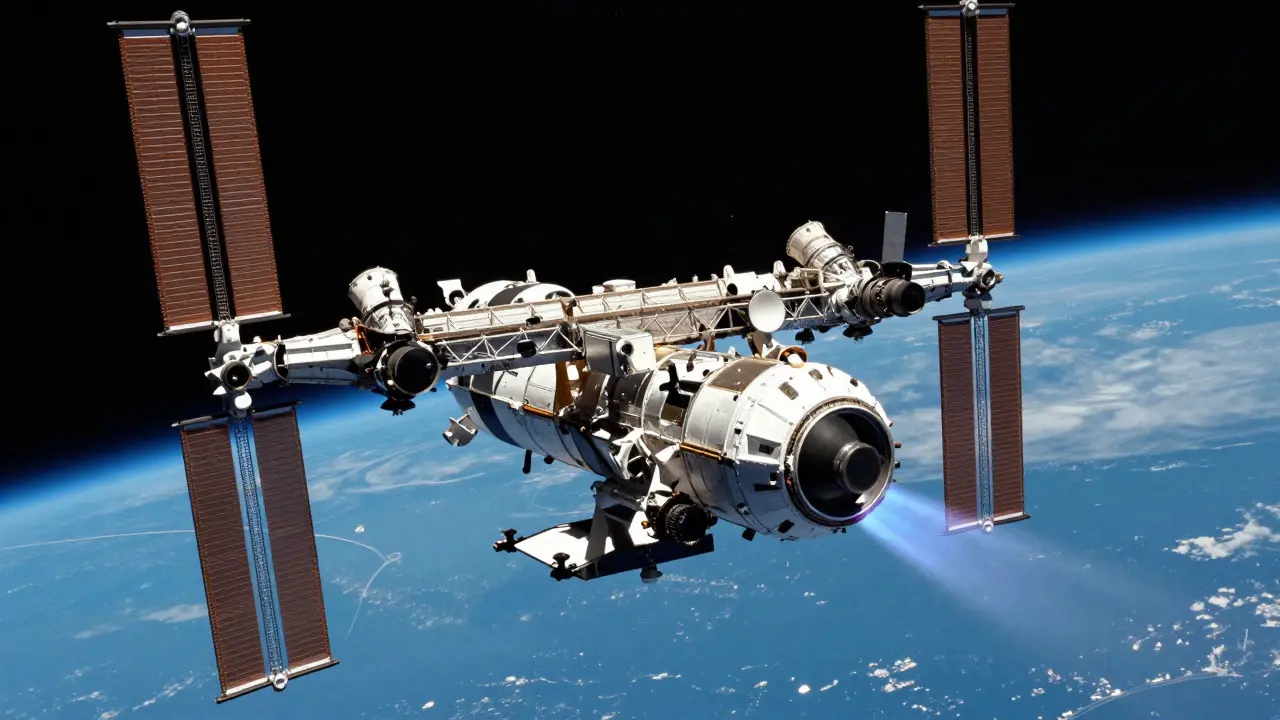
Imagine a 420-ton laboratory floating 250 miles above Earth. It sounds like it should stay there forever, right? Wrong. Without regular intervention, atmospheric drag would pull the International Space Station (ISS) down into the atmosphere within just one or two years. To keep the station aloft, mission planners rely on a complex system of reboost providers-visiting cargo vehicles that fire their engines to lift the orbit back up. While Russian Progress ships have done the heavy lifting for decades, the landscape is shifting. Today, Northrop Grumman’s Cygnus and SpaceX’s Dragon are stepping into the role, creating a more resilient network for station operations.
The Physics Behind the Burn
Before looking at who does the pushing, it helps to understand why the push is necessary. The ISS orbits at an altitude of roughly 400-410 km (about 250 miles). At this height, the atmosphere isn’t gone; it’s just very thin. Those few remaining air molecules create friction, slowly bleeding energy from the station’s orbit. This causes the ISS to lose altitude gradually. If left alone, the station would spiral inward until it hit denser air and burned up.
To counteract this decay, the station needs periodic boosts. These aren’t massive rocket launches. They are gentle, precise maneuvers designed to add velocity without shaking the delicate scientific experiments onboard. A typical reboost delivers a change in velocity (delta-V) between 0.9 and 1.7 meters per second. This might sound small, but applied to a 420-ton structure, it raises the orbit by anywhere from 0.8 km to 4.4 km. The acceleration felt during these burns is incredibly low-averaging about 0.64 mg (milli-gs)-ensuring that microgravity research continues uninterrupted.
Progress: The Workhorse of Orbital Maintenance
For most of the ISS’s life, the primary reboost provider has been the Progress cargo spacecraft built by the Russian aerospace industry and operated by Roscosmos. These uncrewed vessels dock to the aft port of the Zvezda service module, which serves as the station’s main propulsion interface. Because Progress is specifically designed for this role, it handles the majority of routine altitude adjustments.
| Provider | Docking Port | Role Status | Typical Delta-V |
|---|---|---|---|
| Progress | Zvezda (Aft) | Primary / Routine | 1.0 - 1.67 m/s |
| Cygnus | Nadir (US Segment) | Certified Backup | ~0.9 m/s |
| Dragon | Nadir (US Segment) | Emerging / Tested | Variable |
Progress burns are carefully planned events. They use open-loop guidance, meaning the thrusters fire for a prescribed duration based on pre-calculated orbital positions rather than adjusting dynamically mid-burn. Recent data shows burn durations ranging from just over five minutes to nearly twenty. For example, the Progress 81P vehicle performed a 10-minute, 30-second burn in October 2022, delivering 1.0 m/s of delta-V. Later, in January 2024, Progress 85P executed a longer 17-minute burn to provide 1.67 m/s. These maneuvers are not random; they are timed to restore altitude lost to drag and to adjust the station’s position for upcoming visitor arrivals.
Cygnus: Expanding the Provider Ecosystem
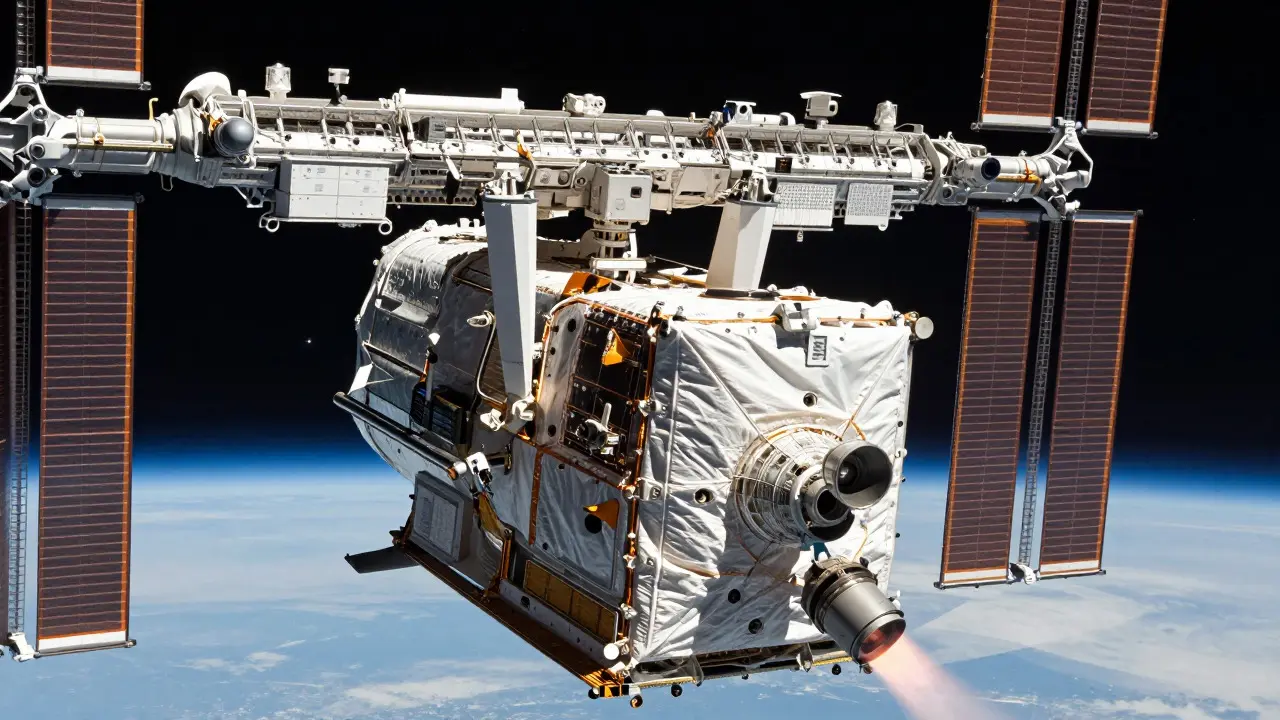
Relying on a single nation for critical station maintenance carries geopolitical and technical risks. To mitigate this, NASA and its partners have worked to certify other vehicles for reboost duties. Enter Cygnus a cargo spacecraft developed by Northrop Grumman for resupply missions to the ISS. Unlike Progress, which docks to the Russian segment, Cygnus attaches to the US segment’s nadir port. This required significant engineering work to ensure the station could handle the thrust vectors correctly.
The certification process was cautious. The first attempt in June 2022 was aborted after just five seconds as a precaution. However, engineers refined the flight limits, and a subsequent burn on June 25, 2022, successfully raised the station’s altitude by roughly 0.8 km at perigee. By March 2023, Cygnus had completed a certified operational reboost, delivering 0.9 m/s of delta-V over 15 minutes. This maneuver was part of a series designed to set up orbital conditions for a Progress arrival, proving that Cygnus can now serve as a reliable secondary provider. As of mid-2026, Cygnus is no longer experimental; it is an integral part of the station’s propulsion redundancy strategy.
Dragon and the Future of Propulsion
SpaceX Dragon a reusable spacecraft developed by SpaceX for crew and cargo transport to the ISS represents the next step in diversifying reboost capabilities. Historically, Dragon did not perform reboosts because it lacks the specific docking geometry or engine integration found in Progress. However, recent developments indicate this is changing. Analyses from late 2025 suggest that Dragon has become the latest craft to perform an ISS reboost test. This move is strategic: with the ISS scheduled for retirement around 2030, ensuring that multiple US-based vehicles can maintain the orbit reduces dependence on Russian assets during the station’s final operational years.
The challenge with non-Russian vehicles is the docking interface. Progress connects directly to the Zvezda module’s aft port, giving it direct control over the station’s attitude control thrusters. US vehicles dock to the Harmony module on the underside of the station. Using them for reboosts requires careful coordination to avoid destabilizing the station’s orientation. Nevertheless, qualifying Dragon adds another layer of security to the station’s orbital health.
Planning the Maneuvers: More Than Just Altitude
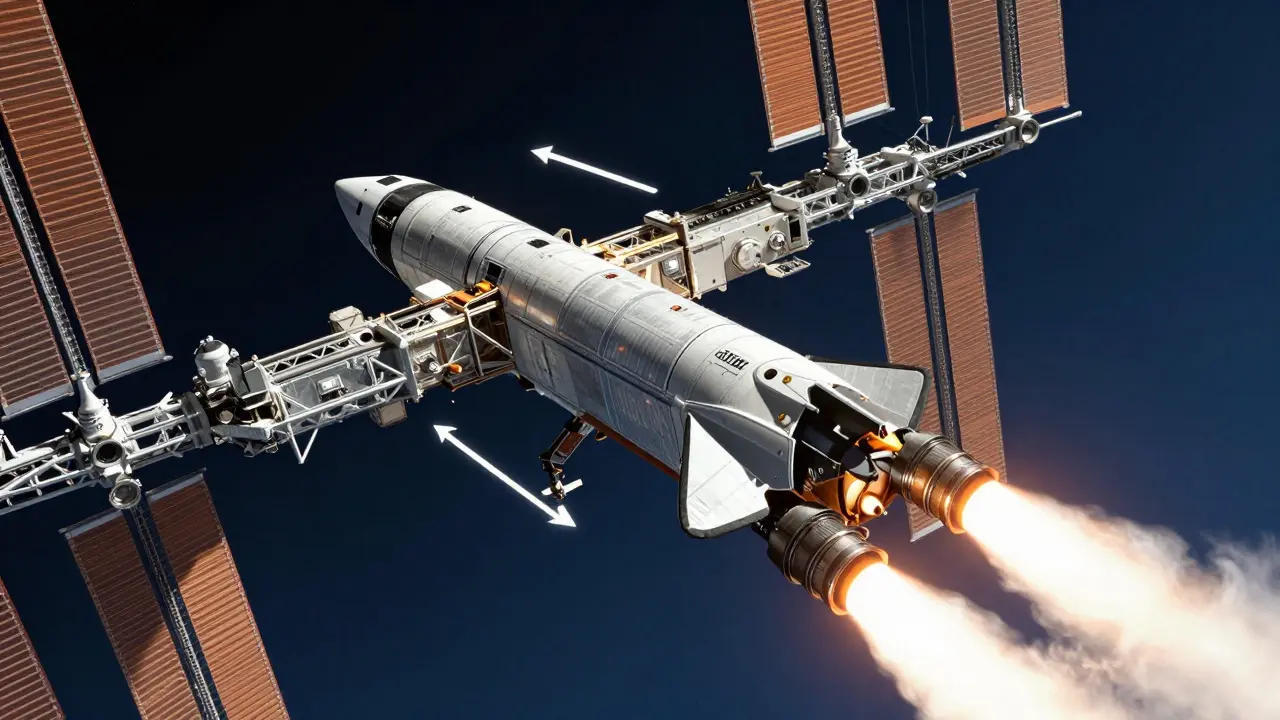
Reboost planning is a balancing act. Mission controllers don’t just fire engines when the altitude gets too low. They plan months in advance to achieve multiple objectives simultaneously. First, they must counteract atmospheric drag, which varies with solar activity. During periods of high solar flare activity, the upper atmosphere expands, increasing drag and requiring more frequent or larger boosts.
Second, reboosts are used for phasing. When a new cargo ship or crew vehicle approaches, the ISS may need to be in a specific orbital position to allow for a fuel-efficient rendezvous. For instance, a reboost in November 2025 using Progress 93 was timed specifically to position the station for the arrival of Progress 95 in April 2026. That five-month lead time highlights how long-term planning integrates propulsion with logistics.
Third, debris avoidance plays a role. If space junk poses a threat, a reboost can shift the station’s orbit slightly to miss the object. Finally, operational constraints matter. Crew workload, ongoing experiments, and power availability all influence when a burn can happen. If conditions aren’t favorable, a burn might be advanced or delayed. In October 2022, a planned Progress burn was moved up by two days because early conditions were deemed optimal, demonstrating the flexibility inherent in modern station operations.
Why This Matters for Station Operations
The shift toward a multi-provider model is essential for the longevity of the ISS. Without regular reboosts, the station would deorbit. With only Progress handling the job, any disruption in Russian launch cadence or geopolitical relations could jeopardize the station’s safety. By certifying Cygnus and testing Dragon, NASA ensures that the ISS remains operational regardless of external factors. This redundancy is particularly important as we approach the end of the ISS era. The lessons learned from integrating these different propulsion systems will also inform the design of future commercial space stations, which may not have a dedicated Russian segment to rely on.
How often does the ISS need a reboost?
On average, the ISS undergoes a reboost maneuver about once per month. However, this frequency can vary significantly depending on atmospheric drag levels, which are influenced by solar activity, and the schedule of visiting vehicles. There may be clusters of burns followed by periods of stability.
Can the ISS boost itself without visiting vehicles?
Yes, the ISS has its own thrusters on the Zarya and Zvezda modules. However, these are typically reserved for smaller attitude adjustments or emergency maneuvers. The bulk of orbital altitude maintenance is handled by visiting cargo vehicles like Progress, Cygnus, and increasingly Dragon, to conserve the station's own propellant reserves.
Does a reboost disturb scientific experiments?
Minimal disturbance is a key goal. Reboosts are designed to produce very low acceleration, typically around 0.64 mg. This is well below the threshold that would disrupt most microgravity-sensitive experiments. Engineers analyze vibration data from each burn to ensure payloads remain within safe limits.
Why is Cygnus docking to the US segment difficult for reboosts?
The US segment is not structurally designed to handle the same propulsion loads as the Russian segment. Docking to the nadir port means the thrust vector is offset from the station's center of mass. This requires precise calculation and attitude control to prevent unwanted rotation or stress on the station's truss structure during the burn.
What happens if no reboost provider is available?
If no reboost occurs, atmospheric drag will gradually lower the ISS's orbit. Over a period of 1 to 2 years, the station would descend into denser atmosphere layers, leading to increased heating and eventual reentry. Therefore, maintaining a reliable supply of reboost-capable vehicles is a critical operational priority.
11 Responses
It is absolutely pathetic that we are still relying on Russian hardware for something as critical as keeping the ISS from falling out of the sky, really.
One would think after all these years and billions of dollars, NASA could have figured out a way to be completely self-sufficient by now, but no, we just keep patching things together with whatever is available, it seems.
The fact that Cygnus had to abort its first attempt in 2022 is just another sign of how unprepared they were, honestly.
We deserve better than this half-measure solution where we are dependent on geopolitical rivals for our safety up there, it’s just embarrassing.
I guess it makes sense that they started with Progress since it was already designed for it, but I’m glad they’re diversifying now.
It feels good to see US vehicles taking on more responsibility for the station's health, even if it took a while to get right.
Hopefully, Dragon will smooth out the process even more in the future.
You people don't understand the sheer incompetence required to let a cargo ship dictate the orbit of a multi-billion dollar laboratory, it is an insult to engineering everywhere.
The Russians did it because they had to, not because it was elegant, and now we are copying their flawed model instead of innovating, which is typical.
Wake up and smell the fuel, folks.
Oh please! Don’t believe everything you read about SpaceX saving the day, they are just trying to monopolize the space industry before the government realizes what they are doing!!!
Dragon docking to the US segment is a huge security risk, who knows what backdoors they have installed in those thrusters?
It’s all part of the deep state plan to control low earth orbit, mark my words, soon we won’t be able to trust any data coming from the ISS at all!!!
Interesting read, thanks for sharing the details on the delta-v requirements.
So, here’s the thing, and I think a lot of people miss this crucial detail when they talk about reboosts, and that is that the acceleration is incredibly low, like milli-gs low, which is actually pretty amazing when you stop to think about it for a second, because most people assume that firing rockets attached to a giant metal box would shake everything apart, but it doesn’t, really.
And then you have the whole issue of solar activity, which affects drag, which means you can’t just set it and forget it, you have to constantly monitor the sun, which is wild, and then you have to coordinate with other ships arriving, which adds another layer of complexity that is often overlooked, so yeah, it’s not just pushing gas, it’s a delicate dance of physics and logistics that requires constant attention and adjustment, otherwise, you’d lose altitude faster than you can say 'atmospheric decay', which would be bad, very bad, indeed.
OMG this is so cool!! i love how dragon is finally getting involved in the reboosts, its about time they showed what theyre made of lol.
cygnus was kinda slow to catch on but im glad its certified now, less stress on progress is good news for sure!
Actually, the article misses a key point about the Zvezda module. The aft port isn't just a docking spot; it's structurally integrated with the propulsion system in a way the Harmony module simply isn't. That's why Progress burns are more efficient per unit of propellant compared to Cygnus or Dragon, which have to fight against the station's moment of inertia due to the offset thrust vector. It’s basic mechanics, but people forget that mass distribution matters immensely in orbital mechanics. Also, the open-loop guidance mentioned for Progress is risky but necessary because real-time telemetry adjustments during a burn can introduce latency issues that might destabilize the attitude control loop. So, while redundancy is good, efficiency is king, and Progress still holds the crown for raw performance in this specific role.
Wow, look at us, arguing about rocket science like we own the place. Typical American obsession with control, am I right?
Meanwhile, in India, we are launching satellites cheaper than your lunch break costs, and you guys are still figuring out how to push a tin can around without crashing into each other.
But sure, keep telling yourself that Dragon is the savior, maybe next year you’ll figure out how to land on Mars without needing a tutorial video.
To add some context to the discussion about docking ports: the reason Cygnus and Dragon dock to the nadir port is largely due to the history of the US segment design, which prioritized modular expansion over integrated propulsion interfaces. This means that every reboost from these vehicles requires precise attitude control inputs from the station's Control Moment Gyroscopes (CMGs) to counteract the torque generated by the offset thrust. It’s a clever workaround, but it does wear down the CMGs faster than direct aft-port burns would. Still, having the capability is vital for contingency scenarios, especially given the unpredictable nature of international relations affecting launch schedules.
I think it’s great that they are testing different options, it gives me peace of mind knowing there’s backup if one vehicle has issues.
Space is hard, so kudos to everyone working on this, whether it’s Progress, Cygnus, or Dragon, they are all doing important work.