

Imagine hitting a wall at 12,000 mph. Now imagine that wall is made of thin air, but it still gets hot enough to melt steel in seconds. This is the reality for any spacecraft trying to land on Mars. The vehicle doesn't just crash; it has to survive a violent ride through the Martian atmosphere, slowing down from interplanetary speeds to a gentle touchdown. The hero of this story isn't the rocket engine or the computer-it's the Thermal Protection System (TPS), specifically the aeroshell and its heat shield. Without these components, every rover, lander, and future human mission would burn up before reaching the ground.
The Anatomy of a Mars Aeroshell
An aeroshell is not just a single piece of armor. It is a two-part structure designed to protect the payload during the most dangerous phase of flight: Entry, Descent, and Landing (EDL). Think of it as a protective bubble with two distinct faces. The front part is the heat shield, which faces directly into the atmospheric flow. The rear part is the backshell, which encloses the parachute and other descent hardware.
When a spacecraft like Curiosity or Perseverance enters the Martian atmosphere, it travels at roughly 5.3 to 5.6 kilometers per second. At these hypersonic speeds, the air in front of the vehicle compresses rapidly, creating a shock wave. This compression heats the gas to extreme temperatures-often exceeding 1,480°C (2,700°F) on the surface of the heat shield. The aeroshell’s job is to manage this energy without letting it cook the sensitive electronics and scientific instruments inside.
| Component | Function | Typical Material |
|---|---|---|
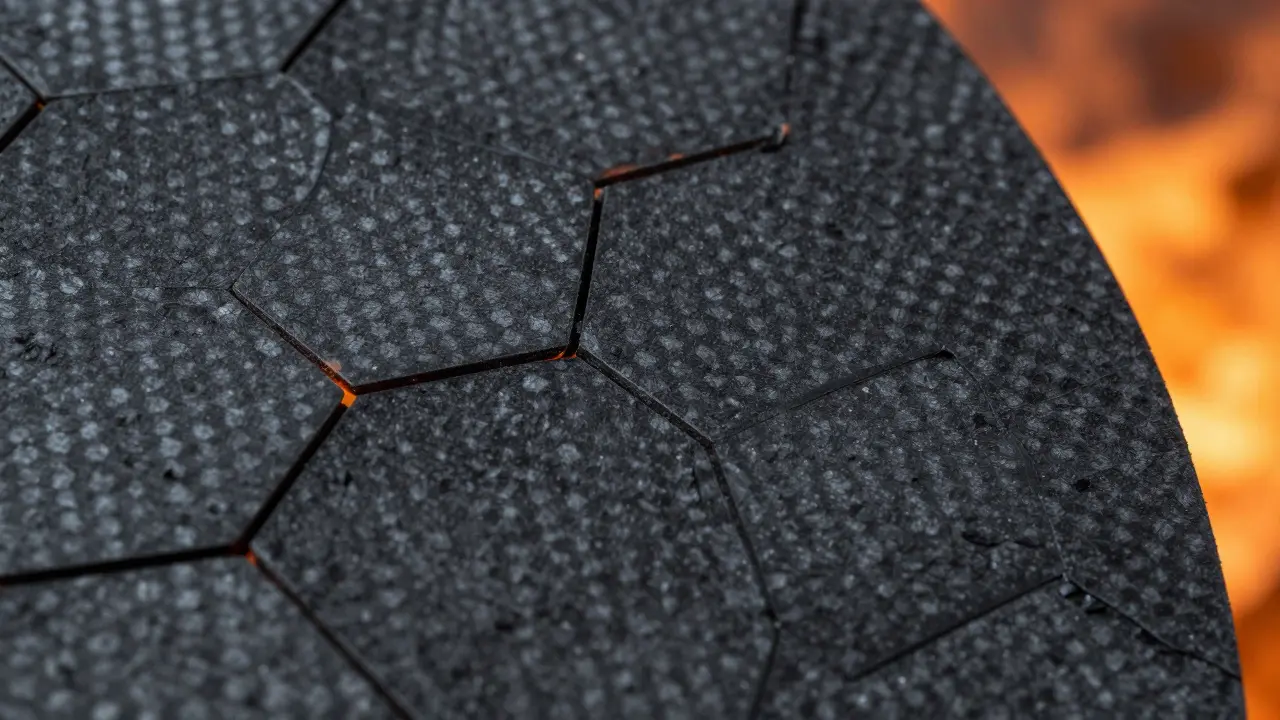
| Heat Shield (Forebody) | Faces the airflow; absorbs peak heating | PICA tiles |
| Backshell | Encloses rear; protects parachute deployment area | SLA-561V cork-silicone |
| Honeycomb Structure | Provides structural rigidity and support | Aluminum honeycomb with graphite-epoxy faces |
| Gap Fillers | Seals gaps between tiles to prevent hot gas intrusion | RTV-560 silicone adhesive |
The Materials That Save Missions
You might wonder why engineers don't just use super-thick metal plates. Metal conducts heat too well, meaning the interior would roast. Instead, Mars missions rely on ablative materials. These materials are designed to sacrifice themselves. As they heat up, they chemically break down, erode, and carry heat away from the vehicle. This process is called ablation.
The primary material used on the forebody heat shield of recent missions like Mars Science Laboratory (MSL) and Mars 2020 is Phenolic Impregnated Carbon Ablator (PICA). Developed at NASA’s Ames Research Center in the 1990s, PICA is a lightweight carbon-phenolic composite. It has a very low density-about 0.27 grams per cubic centimeter-but can withstand intense heat fluxes. For MSL, the design peak heat flux was around 234 watts per square centimeter. PICA handles this by forming a stable char layer that insulates the underlying structure while the outer layers erode.
On the backshell, where heating is less intense but the surface area is large, engineers use SLA-561V. This is a cork-silicone ablative material with heritage dating back to the Viking landers in the 1970s. It is hand-packed onto an aluminum honeycomb sandwich structure. SLA-561V is chosen for its manufacturability and ability to cover large areas reliably. For specific localized features like the backshell interface plate, a third material called Acusil-II, a silica-based ablator, is used to handle intermediate heating and complex geometries.
Designing for the Unknown: Sizing and Margins
Designing a TPS is not just about picking materials; it’s about predicting the environment accurately. Engineers use coupled aerothermal modeling to simulate the entry trajectory. They calculate how much heat will hit different parts of the aeroshell based on atmospheric density, entry angle, and vehicle shape.
For the Mars 2020 mission, the team had to balance several factors. The heat shield diameter was approximately 4.5 meters (15 feet). The TPS needed to slow the spacecraft from about 19,300 km/h to subsonic speeds. To ensure safety, designers apply significant margins. Typically, the TPS is sized to handle peak temperatures and recession depths 20-30% higher than predicted. This conservatism ensures that if the atmosphere is slightly denser or the entry angle steeper than expected, the spacecraft survives.
Instrumentation plays a crucial role in validating these designs. The MEDLI2 sensor suite on Mars 2020 included 17 thermocouples, 3 heat flux sensors, and 7 pressure transducers embedded directly into the TPS. These sensors recorded real-time data during entry, allowing engineers to reconstruct the actual aerothermal environment after landing. Post-flight analysis showed that pre-flight models were generally within ±10-20% of reality, confirming the reliability of current design methods.
Beyond Rigid Shells: Future Architectures
While PICA and SLA-561V have proven successful for robotic rovers weighing under one ton, future missions face bigger challenges. Human missions to Mars will require landing payloads of several tons. A rigid aeroshell large enough to carry such mass would be prohibitively heavy and difficult to fit inside launch vehicles.
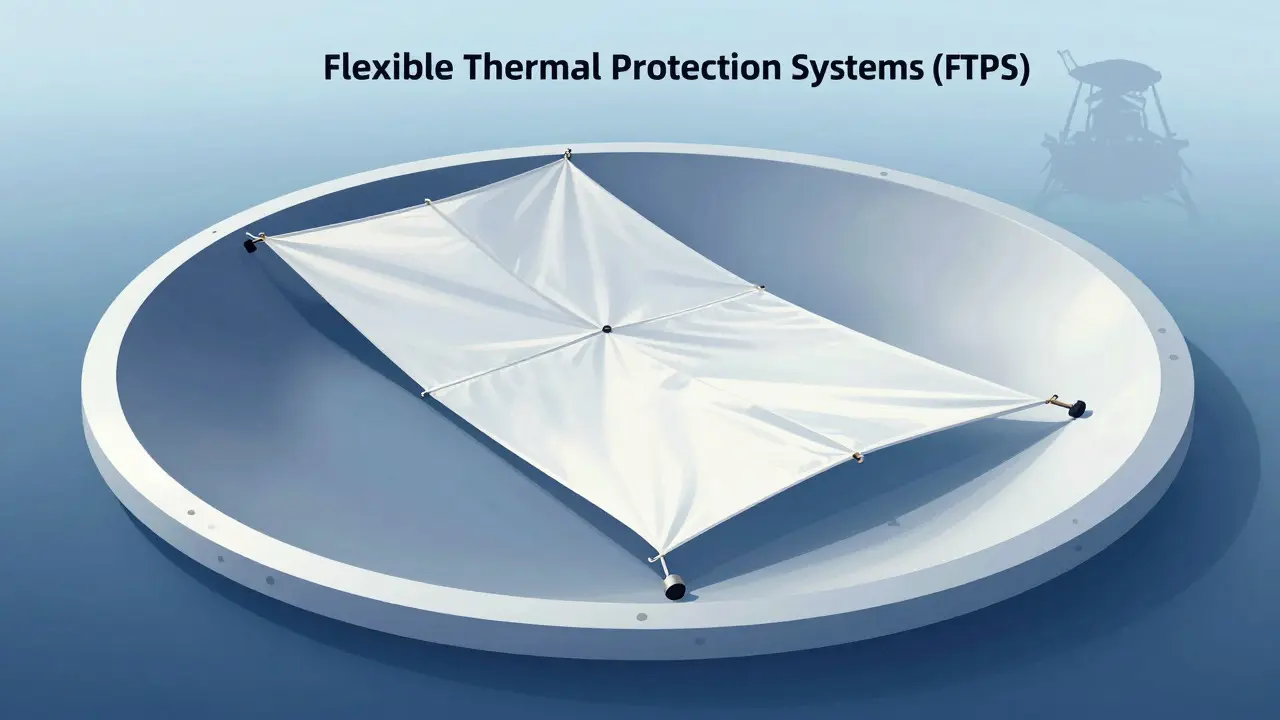
This has led to research into Flexible Thermal Protection Systems (FTPS). These systems use fabric-like materials coated with ablative layers. They can be folded for launch and deployed into larger shapes, increasing drag area without the mass penalty of rigid structures. FTPS designs must withstand peak heat fluxes of around 400 kW/m² and total heat loads of 40 MJ/m². However, they introduce new risks, such as seam integrity and deployment reliability, which are still being tested.
Another promising technology is HEEET (Heatshield for Extreme Entry Environment Technology). HEEET uses a dual-layer architecture with a high-density carbon recession layer over a lower-density insulating layer. It is mechanically interlocked, providing better performance for extreme entries, such as those planned for Venus or Saturn, but also applicable to high-mass Mars missions. Early studies suggest HEEET could reduce TPS mass by 25-40% compared to legacy materials for certain scenarios.
Ceramic Matrix Composites (CMCs) are also under investigation. Unlike ablators, CMCs do not erode significantly. They can withstand surface temperatures of 1,500-2,000°C, potentially allowing for thinner, lighter shields. However, challenges remain in oxidation resistance and joining large panels, keeping them at a lower Technology Readiness Level (TRL) than PICA for near-term Mars missions.
Why Precision Matters
The success of Mars landings hinges on the precise interaction between the aeroshell and the thin Martian atmosphere. If the TPS fails, the mission ends in fire. If it is too heavy, the payload capacity drops, limiting scientific return. Every millimeter of tile thickness and every gram of adhesive matters.
Recent refinements in material models, based on data from MSL and Mars 2020, allow engineers to optimize these designs further. By reducing uncertainties, they can shave off kilograms of TPS mass without compromising safety. This incremental improvement is vital for the next generation of explorers heading to the Red Planet.
What is the main function of a Mars aeroshell?
The aeroshell provides both thermal protection and aerodynamic braking. It shields the spacecraft from extreme heating during atmospheric entry and helps slow the vehicle down from hypersonic speeds to subsonic flight, enabling safe parachute deployment and landing.
Why is PICA used on the heat shield instead of metal?
Metal conducts heat efficiently, which would transfer dangerous levels of heat to the spacecraft interior. PICA is an ablative material that sacrifices its outer layers to carry heat away, while its low density and insulating properties keep the internal structure cool.
What is the difference between the heat shield and the backshell?
The heat shield is the front-facing component that endures the highest heat flux from atmospheric compression. The backshell covers the rear of the spacecraft, protecting the parachute and descent systems from lower-level heating and aerodynamic forces.
How does ablation work to protect a spacecraft?
Ablation works by having the material chemically decompose and erode when heated. This process absorbs heat energy and carries it away with the ejected gases, preventing the heat from conducting deeper into the spacecraft structure.
Are there newer alternatives to PICA and SLA-561V?
Yes, technologies like HEEET (for extreme environments), Flexible Thermal Protection Systems (for deployable decelerators), and Ceramic Matrix Composites (CMCs) are being developed. However, PICA and SLA-561V remain the standard for current robotic missions due to their proven flight heritage.