
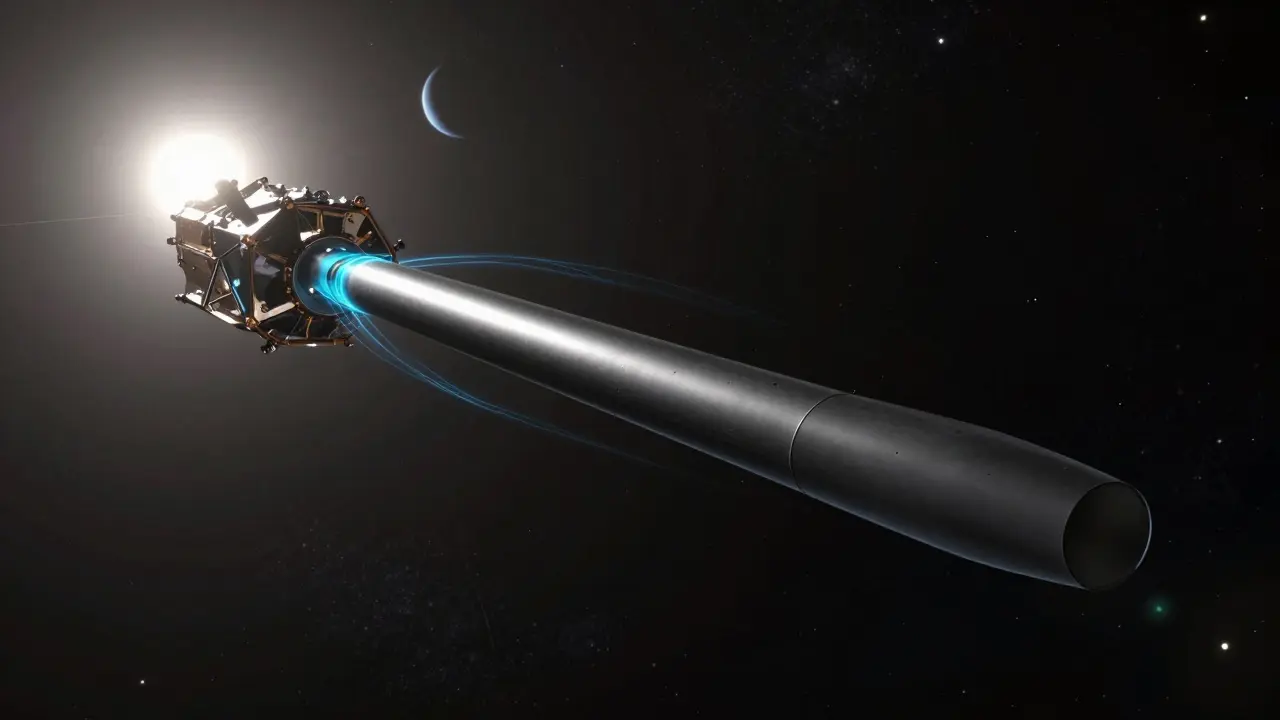
Imagine trying to listen to a whisper while standing next to a roaring jet engine. That is exactly what a spacecraft experiences when it tries to measure the faint magnetic fields of a distant planet while its own electronics are screaming magnetic noise. To get clean data, scientists can't just turn off the spacecraft-they need to physically move the sensors away from the noise. This is where Magnetometer Boom Deployment is the process of extending a structural arm to separate sensitive magnetic sensors from the spacecraft's own electromagnetic interference. By pushing the instruments far away from the main body, researchers can finally hear those cosmic whispers.
The Battle Against Magnetic Noise
Every piece of hardware on a satellite-from the batteries and wiring to the reaction wheels-generates its own magnetic field. In the world of space physics, this is known as "spacecraft magnetic noise." If a sensor is mounted directly to the hull, it mostly measures the spacecraft itself rather than the solar wind or a planetary magnetosphere. Because magnetic field strength drops off quickly as you move away from the source (following the inverse-square law), distance is the most effective tool engineers have.
To solve this, engineers use a boom. These aren't just simple poles; they are precision-engineered structures that must survive the violent vibrations of launch while remaining stiff enough in orbit to prevent the sensors from wobbling. If a boom flexes too much, it introduces new noise into the data, defeating the whole purpose of the deployment.
Engineering the Perfect Boom
Different missions require different scales of isolation. For example, the ESA's BepiColombo mission to Mercury uses a 2.5-meter boom. It's a compact but effective solution for its specific orbit. On the other hand, the Europa Clipper mission takes a much more aggressive approach with an 8.5-meter boom. Why the extra length? Because the magnetic environment around Jupiter's moon Europa is incredibly complex, and the sensors need maximum separation to ensure the spacecraft's own signature doesn't bleed into the results.
Material choice is a huge part of the puzzle. You can't use just any metal, as ferromagnetic materials would create their own magnetic interference. Many modern projects, like NASA's Composite Rolled Magnetometer and Instrument Boom, focus on composite materials. These are lightweight, rigid, and non-magnetic, allowing the spacecraft to save precious mass for fuel or other instruments without sacrificing structural integrity.
| Mission/Project | Boom Length | Primary Purpose | Key Feature |
|---|---|---|---|
| BepiColombo | 2.5 Meters | Mercury exploration | Fast deployment sequence |
| Europa Clipper | 8.5 Meters | Jupiter moon analysis | High noise suppression |
| JUICE (MAGBOOM) | Variable | Multi-instrument platform | Carries 5 separate instruments |
| Constellation Ready | Nanosat-scale | Small satellite testing | Scalable for CubeSats |
The Magic of Gradiometry
Distance is great, but it isn't always enough. This is where gradiometry comes into play. Instead of using one sensor, engineers use two or more sensors placed at different points along the boom. By measuring the difference in the magnetic field between these two points, they can calculate the "gradient."
Here is the trick: a magnetic field from a distant planet looks almost the same to both sensors, but the noise from the spacecraft changes drastically between the two. By subtracting one measurement from the other, the spacecraft's noise is cancelled out, leaving only the clean, geophysical signal. This technique allows for picotesla-scale resolution, which is essentially measuring a magnetic field billions of times weaker than the Earth's total field.
Scaling Down: Magnetometers on CubeSats
You don't always need a massive, multi-billion dollar orbiter to do this. The trend is moving toward smaller platforms. For CubeSats, engineers have developed discrete-component magneto-inductive magnetometers. These tiny sensors are incredibly efficient, consuming only about 25 milliwatts of power while using FPGA-based pulse counting to maintain high precision.
Even on a tiny satellite, the principle remains: you need a non-magnetic boom to keep the sensor away from the noisy electronics. The challenge here is the tight mass budget. Every gram counts on a CubeSat, so the booms must be ultra-lightweight yet capable of maintaining the perfect orthogonality of the measurement axes so the data doesn't get skewed.
Beyond the Physical: Digital Noise Cancellation
While booms are the gold standard, we're seeing a shift toward hybrid approaches. Some scientists are now using machine learning algorithms to identify and remove time-varying magnetic interference. Instead of relying solely on a long piece of carbon fiber, these algorithms learn the "pattern" of the spacecraft's noise and subtract it digitally. While this isn't a total replacement for a physical boom-since some noise is too strong to filter-it serves as a powerful secondary layer of protection for the data.
The Risks of Deployment
Deploying a boom in the vacuum of space is a high-stakes game. It's usually a one-shot operation; if the mechanism jams, the mission's science goals are severely crippled. Engineers have to account for several critical failure points:
- Thermal Expansion: The side of the boom facing the sun gets scorching hot, while the shaded side is freezing. This can cause the boom to warp, shifting the sensors and ruining the calibration.
- Vibrational Coupling: If the boom oscillates like a tuning fork, it can create artificial signals that look like magnetic fluctuations.
- Electrical Interference: The wires carrying the data from the sensor back to the spacecraft can themselves act as antennas, picking up noise. This requires specialized electrical isolation.
Why can't we just shield the magnetometer with a magnetic material?
Shielding a sensor with a magnetic material (like Mu-metal) would block the very signals the scientist is trying to measure. To see the external magnetic field of a planet, the sensor must be exposed to the environment, which is why physical distance (the boom) is the only viable solution.
How does the inverse-square law apply here?
The inverse-square law states that the intensity of a magnetic field from a point source decreases sharply as you move away. By doubling the distance from the spacecraft's noisy electronics, you aren't just halving the noise-you're reducing it by a factor of four, making the distant planetary signals much easier to detect.
What happens if the boom fails to deploy?
If the boom fails, the sensors remain close to the spacecraft's magnetic sources. The resulting data is often so "contaminated" by onboard noise that the primary science objectives become impossible to achieve, although some limited data might still be recovered through intense digital filtering.
Are composite booms better than metal booms?
Generally, yes. Composites are non-magnetic, which is essential to avoid adding more noise to the environment. They also offer a better strength-to-weight ratio, which is critical for maintaining structural rigidity during the high-vibration environment of a rocket launch.
How does gradiometry differ from a single sensor measurement?
A single sensor measures the total field (Planet + Spacecraft). Gradiometry uses two sensors to measure the difference (gradient) between two points. Since the planetary field is nearly uniform across a few meters but the spacecraft noise varies wildly, subtracting the two measurements cancels out the local noise.