
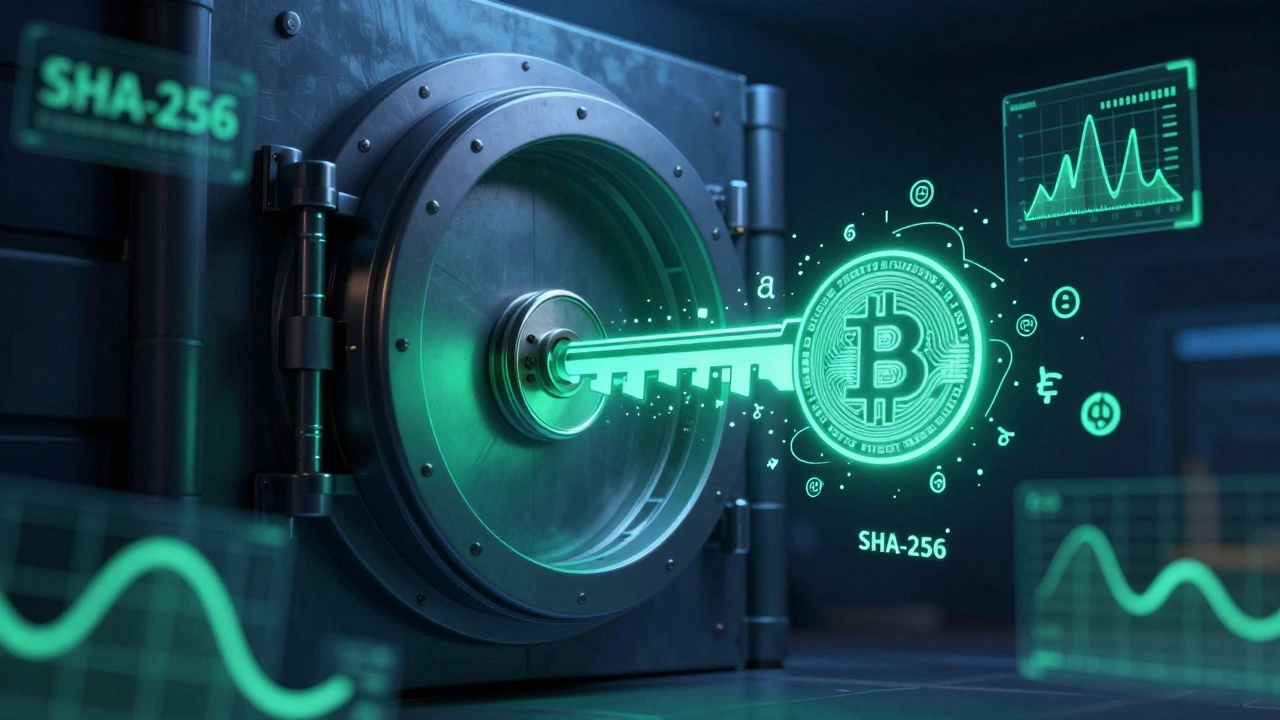
Every time you send Bitcoin or Ethereum, you’re not just clicking a button-you’re using math so strong that no computer in the world can fake it. That math is called a cryptographic signature. It’s what stops someone else from spending your money, even if they know your public address. And it’s the reason public blockchains like Bitcoin and Ethereum work without banks, governments, or middlemen.
What Exactly Is a Cryptographic Signature?
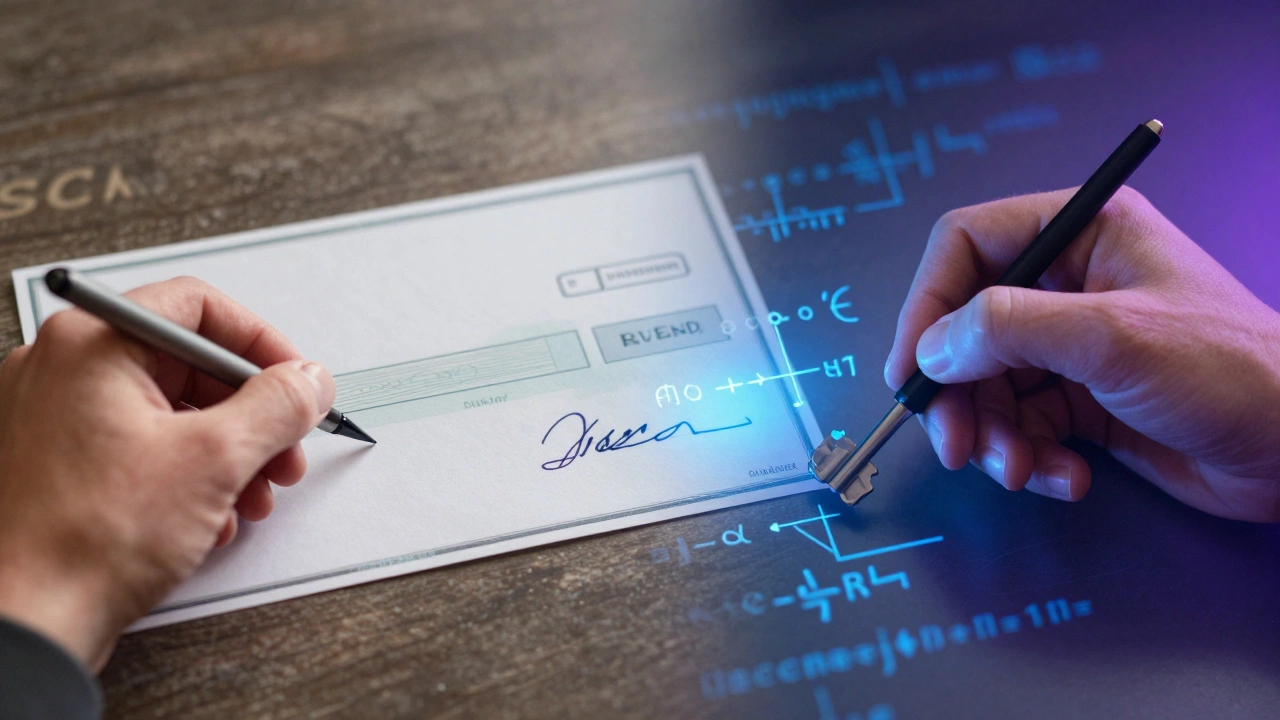
A cryptographic signature is a digital proof that you own the private key tied to a cryptocurrency address. It doesn’t reveal the key itself. Think of it like a handwritten signature on a check-but instead of ink, it’s made from complex math. When you sign a transaction, you’re saying, “I authorize this transfer using my private key,” and the network checks that claim using your public key.This system is called asymmetric cryptography. You have two keys: one private (keep it secret), one public (share it freely). The private key generates the signature. The public key verifies it. No one else can make a valid signature unless they have your private key. And if even one digit in the transaction changes-like the amount or recipient-the signature becomes invalid.
How It Works: The Four-Step Process
Here’s what happens behind the scenes when you send 0.5 ETH to a friend:
- Hash the transaction: Your wallet takes all the details-sender, receiver, amount, fee-and runs them through SHA-256. This creates a unique 256-bit fingerprint. Even changing a single comma gives you a completely different hash.
- Sign with your private key: Using the Elliptic Curve Digital Signature Algorithm (ECDSA), your wallet combines your private key with that hash. The result? A pair of numbers, usually called (r, s). This is your signature.
- Broadcast to the network: The transaction, along with your signature and public key, gets sent out to nodes across the blockchain.
- Verify by anyone: Every node takes your public key, the transaction hash, and the signature. They run the same math. If it checks out, the transaction is valid. If not, it’s rejected.
No one needs to trust you. No one needs to ask you. The math does the talking. And it’s fast. On Ethereum, verifying one ECDSA signature costs about 1,500-2,000 gas units. That’s cheaper than storing a single photo on the chain.
Why ECDSA? The Standard Behind Most Crypto
Bitcoin didn’t pick ECDSA by accident. Satoshi Nakamoto chose the secp256k1 elliptic curve because it’s fast, secure, and compact. A Bitcoin signature is only 72 bytes long. Compare that to RSA, which would need over 384 bytes for the same security level. That’s more than five times the data. On a blockchain where every byte costs money, that matters.
ECDSA became the default because it’s been battle-tested. Since Bitcoin’s launch in January 2009, it’s signed over 427 million transactions. Ethereum, which launched in 2015, uses the same curve and algorithm. Even Ripple’s JPM Coin and Solana’s early versions relied on ECDSA variants.
But it’s not perfect. In 2013, a bug in an Android Bitcoin wallet let hackers steal funds because the system reused random numbers (nonces) when generating signatures. That’s like signing 10 checks with the same pen stroke-someone could reverse-engineer your signature. The fix? Better random number generators and BIP 62’s strict DER encoding rules.
ECDSA vs. EdDSA vs. Schnorr: The New Contenders
ECDSA still dominates, but it’s not the only game in town.
EdDSA (Ed25519) is used by Monero and Solana. It’s faster, more resistant to side-channel attacks, and doesn’t need random numbers. That makes it harder to exploit. In tests, Ed25519 signatures verify 25% faster than ECDSA. But it’s newer to the blockchain scene. Bitcoin and Ethereum haven’t switched yet-not because it’s worse, but because changing the core signature scheme is risky.
Schnorr signatures arrived with Bitcoin’s Taproot upgrade in November 2021. They don’t replace ECDSA-they improve it. With Schnorr, multiple signatures can be combined into one. For a 2-of-3 multisig wallet, instead of three separate signatures (216 bytes), you get one (64 bytes). That cuts transaction size by 25%, lowers fees, and boosts privacy. Ethereum is exploring similar upgrades via EIP-6117.
Here’s how they stack up:
| Signature Type | Used By | Signature Size | Verification Speed | Multi-Sig Support |
|---|---|---|---|---|
| ECDSA (secp256k1) | Bitcoin, Ethereum | 72 bytes | Medium | Poor (each sig separate) |
| EdDSA (Ed25519) | Solana, Monero | 64 bytes | Fastest | Good |
| Schnorr | Bitcoin (Taproot) | 64 bytes | Fast | Excellent (aggregated) |
Most users won’t notice the difference. But behind the scenes, these upgrades make blockchains more scalable and private.
Why This Matters Beyond Bitcoin
Cryptographic signatures aren’t just for crypto. They’re the backbone of digital trust. The U.S. ESIGN Act (2000) and the EU’s eIDAS Regulation (2014) legally recognize digital signatures as binding-just like your handwritten name. Banks, governments, and corporations use them to sign contracts, verify identities, and secure data.
When J.P. Morgan launched JPM Coin in 2019, they didn’t invent a new system. They used ECDSA to sign token transfers between institutional clients. Same with Ripple’s On-Demand Liquidity. The tech is universal. Blockchains just made it permissionless.
Even if you never own a single coin, you’ve probably used a cryptographic signature today. When you log into your bank app, sign a document with DocuSign, or unlock your phone with a fingerprint, you’re using the same math.
The Risks: It’s Not Magic
Just because the math is solid doesn’t mean the system is foolproof. The biggest risk isn’t the algorithm-it’s the human.
If you lose your private key, your coins are gone forever. No reset button. No customer service. In 2013, a user lost 7,500 BTC (worth over $100 million today) because they forgot their password. The signature system worked perfectly. It just couldn’t recover what was lost.
Hardware wallets help. So do seed phrases. But the responsibility is yours. No one else can sign for you. That’s the trade-off for decentralization.
Also, poor implementation can break security. The 2010 Sony PlayStation 3 hack happened because developers reused nonces in ECDSA. Hackers cracked the private key from public signatures. It wasn’t the algorithm’s fault-it was sloppy code.
What’s Next? Quantum and Beyond
One looming threat is quantum computing. A powerful enough quantum computer could break ECDSA by solving the math behind elliptic curves in seconds. That’s why researchers are already working on post-quantum signatures-like those based on lattices or hash functions.
NIST picked four finalists in 2022 for standardization. But none are ready for blockchains yet. It’ll take years to test, audit, and deploy. Experts like Dan Boneh from Stanford believe ECDSA will remain secure until at least 2030. Bitcoin and Ethereum have time to upgrade before quantum becomes a real threat.
For now, the system works. It’s been running for 16 years. It’s handled trillions in value. It’s been attacked, studied, and stress-tested. And it’s still standing.
Final Thought: The Power of Math Over Trust
Before blockchain, we relied on institutions to verify transactions. Banks. Clearinghouses. Governments. They were slow. Expensive. Prone to error or corruption.
Cryptographic signatures changed that. They replaced trust with math. You don’t need to believe in a bank. You just need to believe in the numbers. And the numbers don’t lie.
That’s why, even as new chains, tokens, and protocols come and go, the core idea stays the same: if you control the private key, you control the asset. And if you can prove it with a signature, the network accepts it.
Can someone steal my cryptocurrency if they know my public address?
No. Your public address is like your email-it’s meant to be shared. You can receive funds without risk. But only the person with the matching private key can send funds out. Without the private key, no one can sign a transaction, even if they know your address.
What happens if I sign a transaction by mistake?
Once signed, the transaction is final. Blockchains don’t allow reversals. If you sent funds to the wrong address, there’s no way to undo it. That’s why it’s critical to double-check the recipient address before signing. Some wallets now show a preview of the transaction details before you confirm the signature.
Are cryptographic signatures the same as passwords?
No. A password is something you know and enter to prove identity. A cryptographic signature is something you generate using a private key, and it proves ownership mathematically. Passwords can be guessed or stolen. Private keys are nearly impossible to crack if generated properly. Signing is not typing-it’s math.
Why do some wallets ask for a seed phrase instead of a password?
Your seed phrase (usually 12 or 24 words) is a human-readable way to regenerate your private key. If you lose your wallet file or device, you can restore all your keys from the seed phrase. It’s not a password-it’s a master backup. Treat it like the original key to your house. Never share it. Never store it online.
Can I use the same private key for Bitcoin and Ethereum?
Technically, yes-both use ECDSA on the secp256k1 curve. But you shouldn’t. Each network treats keys differently. Using the same key across chains increases risk. If one wallet is compromised, both could be at risk. Best practice: generate separate keys for each blockchain. Most modern wallets do this automatically.
Is ECDSA going to be replaced soon?
Not anytime soon. ECDSA is mature, well-audited, and deeply embedded. Upgrades like Schnorr (Bitcoin) and potential EdDSA adoption (Ethereum) are improvements, not replacements. They enhance efficiency and privacy, but don’t eliminate ECDSA. For now, it remains the most trusted and widely used signature scheme in crypto.
13 Responses
Math is the real boss here. No middlemen. No begging for permission. Just you and your keys. Simple as that.
Look, ECDSA is so 2012. Everyone knows Ed25519 is the future. Bitcoin clinging to ECDSA like it's a security blanket is just embarrassing at this point. I mean, really? 72 bytes in 2024? 😒
Actually, the real magic isn't just the math-it's the fact that this system lets anyone, anywhere, with zero trust in institutions, hold real value. I've seen grandmas in rural Kenya use crypto because their bank wouldn't serve them. This isn't just tech-it's liberation. And yeah, Schnorr is cool, but don't forget the human impact. 🌍❤️
ECDSA is a trap. NSA backdoor. They coded the curve. You think Satoshi was naive? He knew. Thats why he used secp256k1 not some NIST curve. They watch. They wait. You think quantum is the threat? Nah. The real threat is the people who made the rules
Ugh. Another crypto bro lecture. I just want to send money without reading a textbook.
They say ECDSA is secure but what about the 2013 Android wallet flaw? That wasnt a glitch. That was a feature. They want you to lose your coins so they can buy them cheap. The system is rigged. Trust no one. Not even the code
It is truly remarkable how this mathematical framework transcends borders and cultures. In South Africa, where financial inclusion remains a challenge, cryptographic signatures offer a dignified path to autonomy. One does not require institutional validation to possess value. This is not merely technological advancement-it is a quiet revolution in human agency. I am deeply inspired.
Typo in the post. 'secp256k1' is misspelled as 'secp256k1' in one place. And you used 'DER encoding' without defining it. This isn't a peer-reviewed journal. You're writing for the public. Fix your grammar and your assumptions. Also 'JPM Coin' isn't a blockchain. It's a ledger. Big difference. You sound like a marketing guy
Love this breakdown! 🙌 Seriously, if you’ve ever used a digital signature for a contract or logged into your bank, you’ve already used this tech. It’s everywhere. Crypto just made it visible. Keep learning, keep trusting the math 💪🔐
Anyone who still thinks ECDSA is fine in 2024 hasn’t read the latest NIST papers. EdDSA is cleaner. Schnorr is elegant. You’re clinging to a 15-year-old standard like it’s gospel. This isn’t innovation. It’s inertia. And you call this educational?
Man I just used this same math to sign my car title online last week. No notarizer. No paper. Just my phone and a signature. That’s wild when you think about it. We’re living in the future and we don’t even notice
ECDSA? That’s a foreign system. Real Americans use something better. This whole crypto thing is just a globalist scam to weaken the dollar. You think the Chinese aren’t already building quantum machines to break this? Wake up. This is a trap for the weak minded
Thanks for the clear breakdown. I’ve been using crypto for years but never fully understood how signatures worked under the hood. This helped. And yeah, the private key responsibility is real. I keep mine offline. No cloud. No phone. Just paper. It’s a small price for control.