
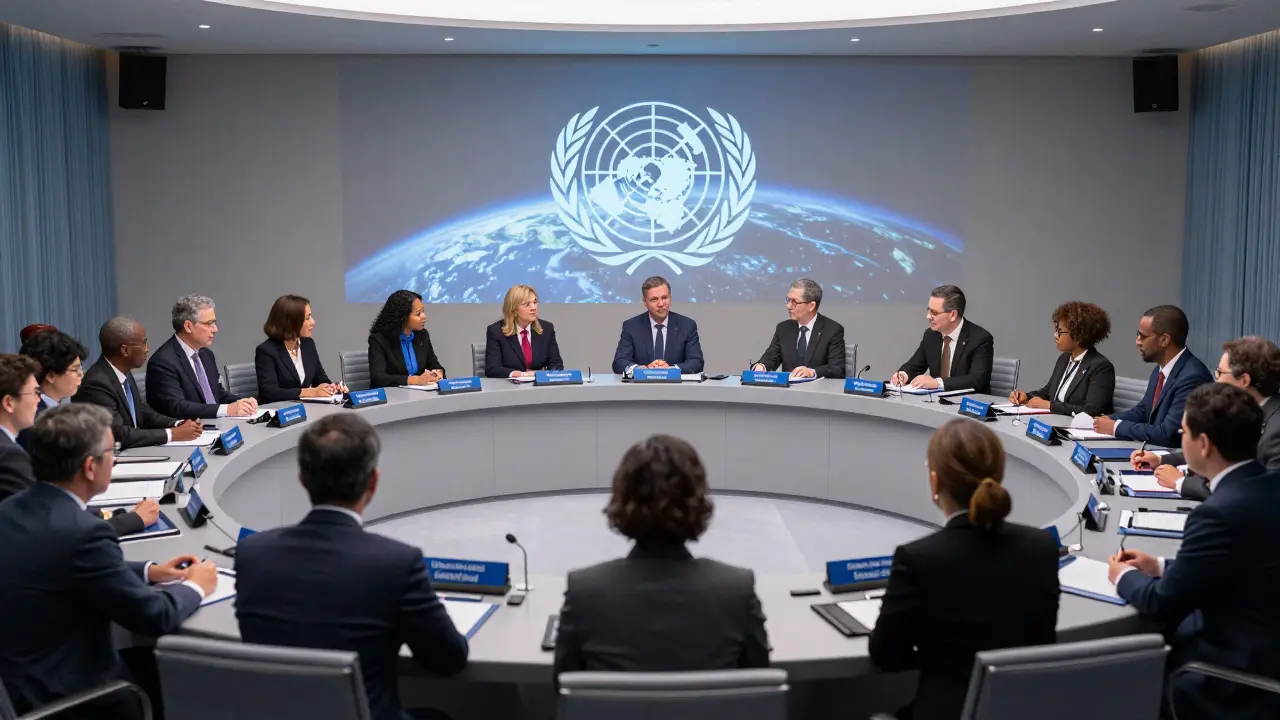
Space isn't the Wild West. It is governed by a complex web of rules, treaties, and unwritten codes of conduct that keep satellites from crashing into each other and prevent nations from claiming ownership of the Moon. At the center of this legal universe sits the Committee on the Peaceful Uses of Outer Space, also known as COPUOS. This body is the primary engine for developing international space law and norms. But how does a committee with no police force actually manage one of humanity's most strategic frontiers? The answer lies in consensus, soft power, and the urgent need to keep orbit safe.
The Origins and Structure of COPUOS
To understand where we are going, you have to look at where we started. The United Nations General Assembly established COPUOS in 1959. Back then, the space race was just heating up, and the world needed a neutral ground to discuss the legal implications of launching objects beyond Earth’s atmosphere. Over six decades later, it remains the central forum for international cooperation in space exploration.
COPUOS operates under the guidance of the United Nations Office for Outer Space Affairs (UNOOSA). Unlike other regulatory bodies, COPUOS does not have the power to enforce laws or levy fines. Instead, it functions as a diplomatic platform. Its structure is built entirely around consensus. This means every member state must agree before any official output-whether a treaty, principle, or guideline-is adopted. While this process can be slow, it ensures that the resulting frameworks have broad international legitimacy. When everyone agrees, compliance tends to follow naturally because nations don’t want to be seen as outliers breaking global norms.
The committee is divided into two main working groups: the Legal Sub-Committee and the Scientific and Technical Sub-Committee. The Legal Sub-Committee focuses on drafting binding treaties and non-binding principles, while the Scientific and Technical Sub-Committee handles issues like space debris, frequency allocation, and long-term sustainability. This dual-track approach allows technical experts to inform legal policymakers, creating a feedback loop that keeps regulations relevant to current technological realities.
From Hard Law to Soft Norms
In its early years, COPUOS produced what lawyers call "hard law." These are binding treaties that states sign and ratify. The five major space treaties negotiated under COPUOS form the backbone of international space law. The most famous is the Outer Space Treaty of 1967, which declares that space is free for exploration by all nations and cannot be claimed by any country through sovereignty, use, or occupation. Other key treaties include the Rescue Agreement, the Liability Convention, the Registration Convention, and the Moon Agreement.
However, as space activities became more complex, the limitations of hard law became apparent. Negotiating a new treaty requires years of debate and universal ratification, which is nearly impossible in today’s fast-paced geopolitical environment. This led to a shift toward "soft law"-non-binding norms, guidelines, and best practices. These instruments are flexible and easier to adopt quickly. They act as "rules of the road" that establish baseline standards of conduct without the rigidity of a formal treaty.
| Feature | Hard Law (Treaties) | Soft Law (Norms/Guidelines) |
|---|---|---|
| Binding Nature | Legally binding on signatories | Voluntary, non-binding |
| Adoption Speed | Slow (years of negotiation) | Faster (consensus-based guidelines) |
| Flexibility | Rigid, difficult to amend | Adaptable to new technologies |
| Enforcement | International legal mechanisms | Peer pressure and reputation |
| Example | Outer Space Treaty (1967) | LTS Guidelines (2019) |
This shift reflects a pragmatic understanding of modern diplomacy. As noted by policy researchers at the Aerospace Center for Space Policy and Strategy, norm development involves navigating domestic buy-in, selecting negotiating partners, and choosing diplomatic mechanisms. Soft law allows states to test the waters and build consensus gradually. If a norm proves effective and widely accepted, it can eventually be codified into harder legal instruments.

The Long-Term Sustainability (LTS) Guidelines
The most significant achievement of COPUOS in recent history is the adoption of the Long-Term Sustainability (LTS) Guidelines in 2019. These 21 guidelines address the growing threat of space congestion and debris. With thousands of active satellites and millions of pieces of junk cluttering low Earth orbit, the risk of collisions has never been higher. A single collision can create a cascade of debris-a scenario known as Kessler Syndrome-that could render certain orbits unusable for generations.
The LTS Guidelines cover critical areas such as debris mitigation, frequency spectrum management, orbital capacity planning, and technology transfer. They encourage states to register their space objects, share data on conjunctions (potential collisions), and design satellites to de-orbit safely at the end of their missions. While these guidelines are not legally binding, they represent a global consensus on responsible behavior. Major spacefaring nations, including the United States, Russia, China, and European Union members, have committed to following them.
Dr. Peter Martinez of the Secure World Foundation describes COPUOS as playing a vital role in socializing these best practices. By providing a platform where states can align their national policies with international standards, COPUOS helps reduce the risk of accidental conflicts. For example, if two satellites come close together, having agreed-upon protocols for communication and maneuvering prevents misunderstandings that could escalate into tensions.
Challenges in Consensus-Based Decision Making
Despite its successes, COPUOS faces significant challenges. The consensus requirement, while ensuring inclusivity, often slows progress on contentious issues. Disagreements frequently arise between spacefaring nations and non-spacefaring countries over topics like technology transfer and equitable access to orbital resources. Some developing nations argue that advanced space powers should share more technology to help bridge the digital divide, while developed nations worry about security risks associated with transferring sensitive capabilities.
Geopolitical tensions also complicate norm development. Competition between major powers over space capabilities has led to calls for stronger norms addressing the military dimensions of space. However, COPUOS’s mandate focuses specifically on peaceful uses, which constrains explicit engagement with military governance issues. The boundary between civilian and military space activities has blurred significantly with dual-use technologies, making it difficult to separate commercial operations from strategic interests.
Furthermore, the rise of private actors poses new questions. Companies launching mega-constellations of satellites or planning asteroid mining operations operate in a regulatory gray area. Existing norms were designed for government agencies, not commercial entities. While states remain responsible for authorizing and supervising their nationals’ space activities, enforcing compliance among private companies requires robust national legislation that aligns with international guidelines.

The Role of Multilateral Forums Beyond COPUOS
COPUOS does not work in isolation. It interacts with other multilateral forums that contribute to the broader ecosystem of space governance. The International Telecommunication Union (ITU) plays a crucial role in assigning satellite orbits and radio frequencies to prevent interference. While the ITU lacks authority over safety or security matters, its coordination is essential for managing the limited resource of spectrum availability.
Other platforms, such as the Open-ended Working Group on Threats to International Peace and Security in the Use of Information and Communications Technologies, occasionally touch upon space-related cybersecurity issues. Additionally, regional organizations like the European Union actively support the rules-based international system through COPUOS mechanisms. The EU’s endorsement of multilateral approaches reinforces the importance of inclusive governance models.
These complementary institutions highlight the fragmented nature of current space regulation. No single body possesses comprehensive authority over all aspects of space activity. This fragmentation creates both opportunities and risks. On one hand, it allows specialized agencies to focus on specific domains. On the other hand, it can lead to gaps in oversight where conflicting regulations or lack of coordination may hinder effective governance.
Future Directions: Emerging Powers and New Technologies
As we move further into the 2020s, the landscape of space governance continues to evolve. The emergence of new space powers, particularly in Asia, is changing the composition of COPUOS membership. Countries like India, Japan, and others are increasing their launch capabilities and contributing fresh perspectives to discussions on space priorities. This diversification enriches the dialogue but also introduces competing interests that must be reconciled.
Technological advancements present another layer of complexity. Private space stations, space tourism, and automated systems require updated norms that address liability, safety, and ethical considerations. Artificial intelligence applications in space operations raise questions about accountability when autonomous decisions lead to incidents. Cybersecurity threats targeting satellite networks demand enhanced cooperation among states to protect critical infrastructure.
Looking ahead, COPUOS will likely continue to serve as the primary venue for developing international space norms. Its ability to adapt to emerging challenges while maintaining broad participation will determine its effectiveness. Whether through refining existing guidelines or initiating new initiatives, the committee’s work remains indispensable for ensuring that outer space remains a domain of peace, cooperation, and sustainable development for all humankind.
What is the difference between COPUOS and the ITU?
COPUOS focuses on developing legal frameworks, principles, and norms for the peaceful use of outer space, including sustainability and debris mitigation. The International Telecommunication Union (ITU) manages the radio-frequency spectrum and satellite orbits to prevent interference between communications services. While ITU handles technical coordination of signals, COPUOS addresses broader governance and behavioral standards.
Are the COPUOS guidelines legally binding?
Most contemporary outputs from COPUOS, such as the Long-Term Sustainability (LTS) Guidelines, are considered "soft law," meaning they are voluntary and non-binding. However, earlier achievements like the Outer Space Treaty are "hard law" and legally binding on states that have ratified them. Soft law carries moral and political weight, encouraging compliance through international consensus rather than legal enforcement.
Why is consensus important in COPUOS?
Consensus ensures that all member states agree on the final text of guidelines or treaties. This inclusivity gives the resulting documents broad legitimacy and encourages widespread adoption. Although reaching consensus can be slow, it prevents divisive outcomes and fosters a cooperative environment where even smaller nations feel their voices are heard.
How do space norms help prevent collisions?
Space norms promote practices like sharing orbital data, conducting conjunction assessments, and designing satellites to de-orbit safely. By establishing common standards for tracking and communicating potential collisions, norms reduce the likelihood of accidents. They also encourage transparency, so operators know who is doing what in orbit, minimizing misunderstandings.
Can private companies influence COPUOS decisions?
Private companies do not have direct voting rights in COPUOS, as it is an intergovernmental body. However, they influence outcomes indirectly through their home governments. National delegations often consult with industry stakeholders to ensure that proposed norms are practical and technically feasible. As commercial activity grows, this liaison role becomes increasingly important.