
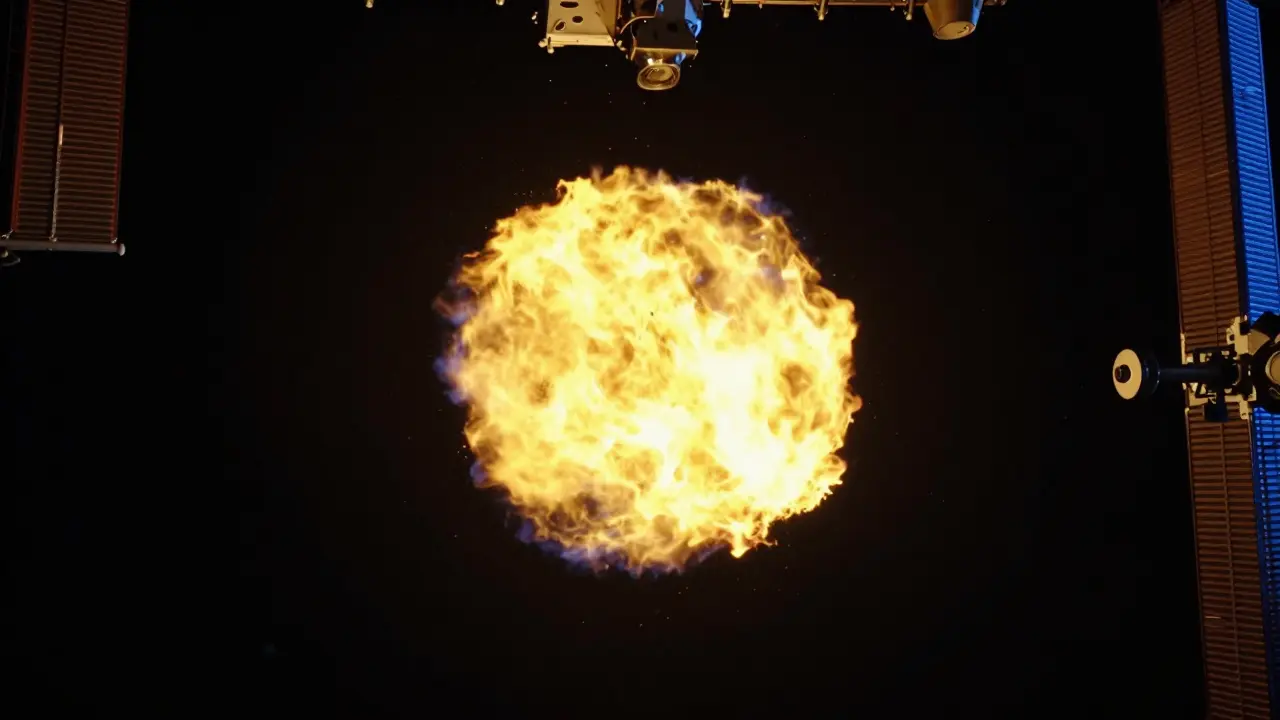
On Earth, a candle flame dances upward, flickering with a bright yellow glow. That glow? It’s soot-tiny particles of carbon glowing hot. But what happens when you take that same flame into space, where gravity doesn’t pull things down? The answer isn’t just different-it’s surprising, and it’s changing how we think about fire, pollution, and even spacecraft safety.
Why Microgravity Changes Everything
On Earth, hot air rises. Cool air rushes in from below. This movement, called buoyant convection, shapes every flame you’ve ever seen. It feeds oxygen to the fire, carries away smoke, and gives flames their teardrop shape. But in microgravity-like aboard the International Space Station-there’s no up or down. Hot gases don’t rise. Cool air doesn’t sink. Without gravity, flames become nearly perfect spheres. That’s not just a pretty shape. It’s a scientific breakthrough.For the first time, researchers can study flames without the messy distractions of gravity. No more swirling air. No more uneven heating. Just pure chemistry. This lets scientists isolate exactly how soot forms, how flames burn, and when they go out. It’s like removing all the noise to hear the signal.
The Surprising Amount of Soot in Space
You might think flames in space would be cleaner. After all, no smokestacks, no engines, no pollution-right? Actually, the opposite is true. In microgravity, soot production can be five to eight times higher than on Earth. Why?Because soot particles don’t get carried away. On Earth, rising hot gases push soot out of the flame quickly. In space, those particles sit in the flame longer. They grow bigger. They clump together. The result? A much denser, brighter, and far more sooty flame. In some experiments, the yellow glow of microgravity flames is so intense it’s hard to look at.
But here’s the twist: not all space flames make soot. Some are completely clean. It depends on the fuel, the oxygen level, and how the flame is shaped. This shows soot isn’t inevitable-it’s a product of specific conditions. And that’s the key. If we understand what makes soot form, we can design engines and burners that avoid it entirely.
What Happens When You Dilute the Fuel?
Scientists don’t just test pure fuels. They mix them with gases like nitrogen to simulate weak, low-energy flames-like those you might find in a poorly ventilated room or a spacecraft cabin. In normal gravity, these weak flames flicker and die easily. But in microgravity? They become more stable. They can burn at fuel concentrations that would be impossible on Earth.One big discovery: whether you add the inert gas to the fuel or the oxygen changes everything. Even if the flame temperature stays the same, the soot levels can swing wildly. This proves that the way gases mix matters more than just how hot the flame is. It’s not about heat-it’s about flow.
These findings are critical for spacecraft safety. A small, barely visible flame in a spaceship might seem harmless. But in microgravity, it can grow slower, burn longer, and produce more soot than anyone expected. That’s why NASA runs experiments like ACME (Advanced Combustion via Microgravity Experiments) to map out exactly how flames behave under these extreme conditions.
Droplet Fires and Explosions in Space
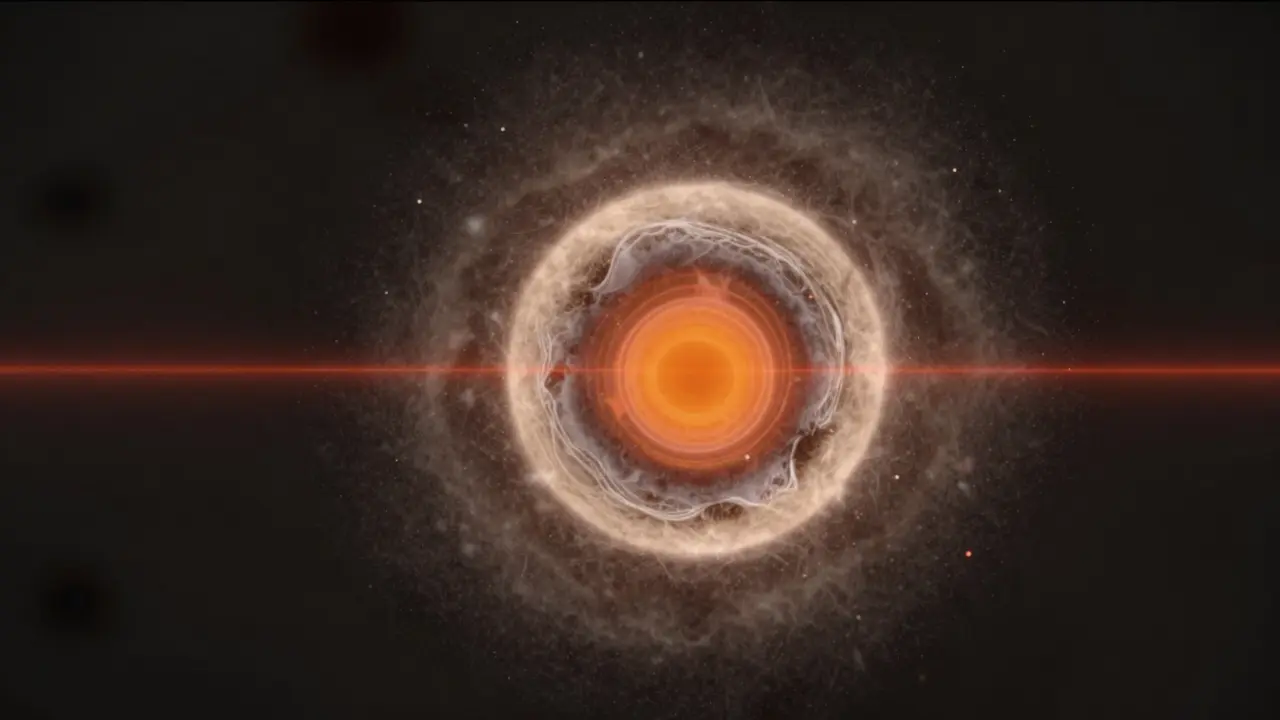
It’s not just flames from burners. Researchers also study fuel droplets-tiny spheres of liquid fuel that burn like miniature stars. In microgravity, these droplets burn slowly, evenly, and symmetrically. That lets scientists watch every stage of combustion in detail.One startling observation: some droplets explode near the end of burning. Not because they’re overpressurized. Not because of a leak. But because soot builds up inside. When enough carbon particles form, they trap heat. The temperature spikes. And boom-the droplet bursts. This was first seen in the 1980s with n-decane droplets, and it still happens today. The presence of soot literally triggers the explosion.
Even more surprising: when researchers added toluene to ethanol droplets, the flames got dramatically brighter. At 50% toluene, soot formed thick shells around the burning droplet. These aren’t just lab curiosities. They’re clues to how real fuels behave in space-and how to prevent dangerous buildups.
Why This Matters for Earth
You might think, “This is about space. Why should I care?” But the real payoff isn’t just for astronauts. It’s for everyone.The same physics that governs soot in space governs soot in car engines, power plants, and home heaters. On Earth, soot is a major health hazard. It causes lung disease, heart problems, and premature deaths. It’s also a powerful climate driver-soot particles absorb sunlight and heat the atmosphere faster than CO₂ in some cases.
By studying soot formation in the clean environment of microgravity, scientists can build far more accurate computer models. These models help engineers design burners that produce less soot. They help refine diesel engines. They improve gas turbines. They even help develop cleaner-burning fuels for aviation.
The ACME experiments are not just about fire safety on the ISS. They’re about making combustion cleaner on Earth. Every time a power plant reduces soot emissions by 10%, thanks to these space experiments, it’s a win for public health and the climate.
The Tools of the Trade
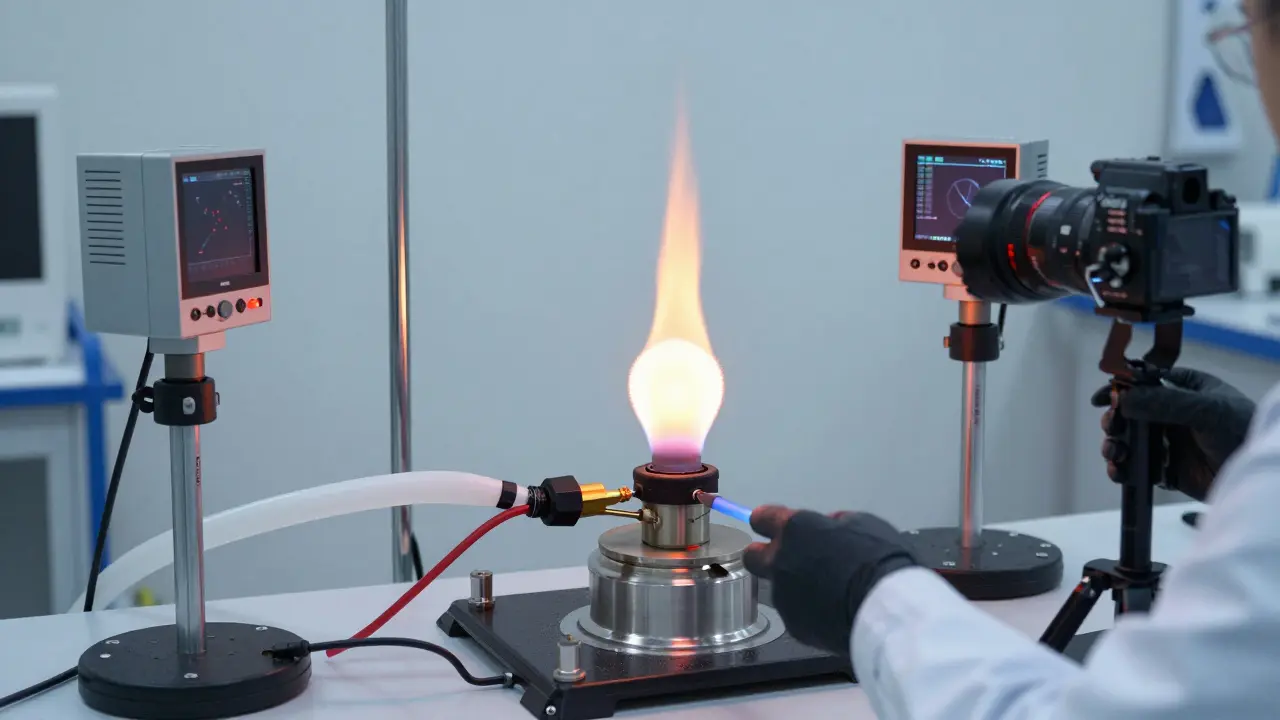
You can’t just light a match on the ISS. These experiments need precision. Researchers use coflow burners-devices that carefully control how fuel and oxygen mix. They inject ethylene or methane at exact concentrations. They use oxygen-enriched air. They monitor flame shape with high-speed cameras. They measure temperature with laser sensors. They track soot volume fractions with light-scattering techniques.On Earth, experiments last seconds. In a drop tower, you get 5 seconds of microgravity. But on the ISS? You get weeks. That’s enough time to let a flame stabilize, change fuel flow, adjust oxygen levels, and watch how soot responds. That kind of control is impossible anywhere else.
And it’s not just about watching. It’s about measuring. Every flame image, every temperature reading, every soot concentration is fed into models. These models then get tested again. The cycle repeats. Slowly, precisely, we’re building a complete picture of combustion-free from gravity’s interference.
What’s Next?
The next phase of this research involves testing “inverse flames”-where oxygen flows inward and fuel flows outward. This flips the usual setup and tests how flames behave under reversed conditions. It’s a new frontier. And it’s only possible in microgravity.Researchers are also looking at how soot particles evolve over time. Do they stick together? Do they break apart? How do they interact with gases? These aren’t just academic questions. They determine how well filters work, how engines wear out, and how fires spread.
One day, this research might lead to spacecraft that never catch fire. Or engines that burn fuel so cleanly they produce almost no emissions. Or burners in homes that never produce soot at all.
The flame in space looks strange. But the lessons it teaches are deeply human.
15 Responses
space flames are wild. just a glowing ball. no up, no down. weird.
So the fact that soot builds up in microgravity because there's no convection to carry it away? That’s such a simple idea but so profound. On Earth, we take for granted that heat rises and smoke gets swept out - but in space, everything just… lingers. Those carbon particles sit there, growing, clumping, turning into these dense little sooty cocoons around the flame. I’ve seen videos of these spherical flames - they look like tiny suns, glowing so bright you have to squint. And then you realize, this isn’t just about space. This is the cleanest, most honest look at combustion we’ve ever had. No gravity messing with the chemistry. Just pure, unfiltered reaction. If we can figure out how to stop soot from forming in this perfect environment, maybe we can design engines that don’t make it at all. Imagine diesel trucks or jet engines that burn clean because we learned from a flame floating in orbit.
Oh my god. I just watched a slow-motion clip of a fuel droplet exploding because of soot buildup, and I cried. Not because it was scary - but because it was so beautiful. It’s like nature’s own fireworks, but with science. That moment when the carbon particles trap the heat, the temperature spikes, and - boom - the droplet bursts into a silent, glowing cloud. It’s poetry. And the fact that adding just 50% toluene to ethanol creates these thick, sooty shells? That’s not just physics. That’s alchemy. We’re not just studying fire in space. We’re watching the soul of combustion, stripped bare. And it’s telling us things we never knew about the fires we light every day - in our cars, our stoves, our furnaces. This isn’t just for astronauts. It’s for all of us breathing dirty air.
Okay, but the article says 'soot production can be five to eight times higher' - that’s not even precise. Five to eight? That’s not a range, that’s a guess. And 'n-decane droplets'? Who the hell talks like that? It’s just a fancy candle. Also, they say 'no up or down' - but technically, there’s still a gravitational field, it’s just micro. You can’t say 'no gravity' - you’re not in deep space, you’re in LEO. And why do they keep calling it 'clean'? It’s not clean - it’s just *different*. Soot isn’t 'worse' - it’s just trapped. Also, 'ACME'? That’s a stupid acronym. Sounds like a cereal. And why no mention of the fact that soot in space is mostly amorphous carbon? That’s the real story. Not some poetic 'flame soul' nonsense. This whole thing reads like a NASA press release written by a poet with a thesaurus.
When I first read about flames in microgravity, I thought, 'That’s cool, but how does it help people like us?' Then I realized - every time you turn on your gas stove, every time your car idles, every time your heater kicks in - you’re burning fuel the same way these flames do. The difference? On Earth, we don’t see the full picture because gravity hides it. In space, we see the truth. Soot isn’t just pollution - it’s a sign that the combustion process is broken. And if we can fix it in space, where everything’s isolated and pure, we can fix it everywhere. I’m from a small town in India where open-fire cooking is still common. The smoke from those fires kills people. This research? It’s not just for NASA. It’s for my aunt who breathes smoke every day. If we can design a stove that burns cleaner because of what we learned from a floating flame, then this isn’t science fiction - it’s salvation.
How quaint. NASA spends millions to confirm what any first-year physics student could deduce: without buoyancy, soot accumulates. The 'surprise' here is that the public has been fed a narrative that space is somehow 'cleaner' - as if the vacuum of space magically purifies combustion. The real breakthrough? The realization that soot formation is a function of mixing dynamics, not temperature. But of course, they had to spend a decade in orbit to figure that out. Meanwhile, terrestrial combustion engineers have been optimizing fuel-air mixing for decades using CFD simulations - which, ironically, were *inspired* by microgravity experiments. So yes, space research is 'valuable,' but let’s not pretend it’s revolutionary. It’s validation. With a $2 billion price tag.
First: 'flame becomes nearly perfect spheres' - 'nearly'? That’s not science, that’s hedging. Second: 'soot production can be five to eight times higher' - 'can be'? What’s the mean? The median? The standard deviation? Where’s the data? Third: 'it’s changing how we think about fire' - no, it’s confirming what we’ve modeled since the '80s. Fourth: 'the flame in space looks strange' - yes, because it’s not in an atmosphere with gravity. Fifth: 'this isn’t just about fire safety on the ISS' - actually, it is. That’s the whole point. Sixth: 'every time a power plant reduces soot emissions by 10%' - cite the paper. Seventh: 'ACME'? That’s not a program name - it’s a marketing slogan. Eighth: 'the lessons it teaches are deeply human' - no, they’re deeply physical. Stop anthropomorphizing combustion. Ninth: this article is a masterpiece of pseudoscientific fluff wrapped in poetic language. And tenth: I’m done.
Soot in space. Explosions from silence. Flames that don’t rise. This isn’t science. It’s art. And it’s terrifying.
It’s incredible how something as simple as a flame can teach us so much about the world. I’ve always thought of fire as chaotic - but in space, it’s almost peaceful. It doesn’t rage, it just… burns. And the fact that we can use that calmness to fix the chaos here on Earth? That’s hope. I don’t care if it’s NASA or a lab in Bangalore - if this leads to cleaner air, cleaner engines, cleaner lives, then it’s worth every second of research. We’re not just studying fire. We’re learning how to live better.
Let’s cut through the fluff. The real win here isn’t the spherical flames - it’s the ability to isolate soot nucleation kinetics. In microgravity, you remove turbulence, convection, and thermal gradients - and suddenly, you’re left with the fundamental chemical pathways of soot formation. That’s gold for CFD model validation. We’ve been trying to validate soot models on Earth for 30 years, but buoyancy masks the kinetics. Now? We’ve got direct, time-resolved measurements of particle inception, surface growth, and agglomeration. That’s not 'poetry.' That’s a paradigm shift in combustion modeling. And yes - this directly feeds into next-gen diesel injectors, gas turbine combustors, and even plasma-assisted combustion. This isn’t 'space research.' It’s foundational engineering.
It is with profound admiration that I acknowledge the meticulous work conducted by NASA’s Advanced Combustion via Microgravity Experiments team. The precision with which coflow burners are calibrated, the fidelity of laser diagnostics, and the patience required to observe flame behavior over weeks - rather than seconds - represents the pinnacle of scientific rigor. The discovery that soot accumulation is not an inevitable byproduct of combustion, but a consequence of specific fuel-oxygen mixing dynamics, opens avenues for unprecedented innovation in clean energy systems. This research, while conducted in the vacuum of space, yields dividends for terrestrial environmental health, public safety, and the future of sustainable combustion technologies. The dedication of the scientists involved is not merely commendable - it is indispensable.
I find it fascinating how the absence of gravity doesn’t eliminate complexity - it reveals it. On Earth, we see a dancing flame and assume we understand it. But in microgravity, the flame becomes a mirror. It reflects the true nature of combustion, unobscured by the noise of convection. The fact that adding inert gas to fuel versus oxygen produces wildly different soot levels? That’s not just surprising - it’s humbling. It tells us we’ve been oversimplifying combustion for decades. And yet, rather than dismissing this as 'space weirdness,' we’re using it to improve our engines, our homes, our air. That’s science at its best: turning the strange into the useful. I’m not an engineer, but I feel hopeful knowing people are doing this work.
There is a grammatical error in the original post: 'That’s not just a pretty shape. It’s a scientific breakthrough.' - 'It’s' should be 'it is' for formal consistency, but I understand the intent. The science here is remarkable. The fact that soot particles linger and grow in microgravity because they aren’t carried away by buoyant flow is a textbook example of how environmental conditions alter chemical kinetics. This isn’t just about spacecraft safety - it’s about fundamental reaction dynamics. I hope more educators use these experiments to teach combustion theory. The droplet explosion mechanism, in particular, is a perfect case study in energy trapping and thermal runaway. Well-researched. Well-presented.
Interesting. I didn’t realize soot could be that dense in space. I guess I always assumed space = clean. But if the flame is just sitting there, and the particles can’t escape, then yeah - of course it builds up. Makes sense. I wonder if they’ve tried testing different fuels. Like hydrogen? Would that still make soot? Or is it only hydrocarbons? Also, how do they even light a flame in space? With a spark? Or laser? Just curious.
My grandfather used to say, 'Fire doesn’t care where you are - it just burns.' I never understood it until I saw these videos. In space, the fire doesn’t fight. It just is. And in that stillness, we learn its true nature. We’ve been trying to control fire on Earth with brute force - more air, more heat, more fuel. But maybe the answer isn’t more. Maybe it’s less. Less turbulence. Less chaos. Less gravity. Maybe the cleanest fire is the quietest one. This research reminds me that sometimes, to fix something, you have to take it away from everything you know.