
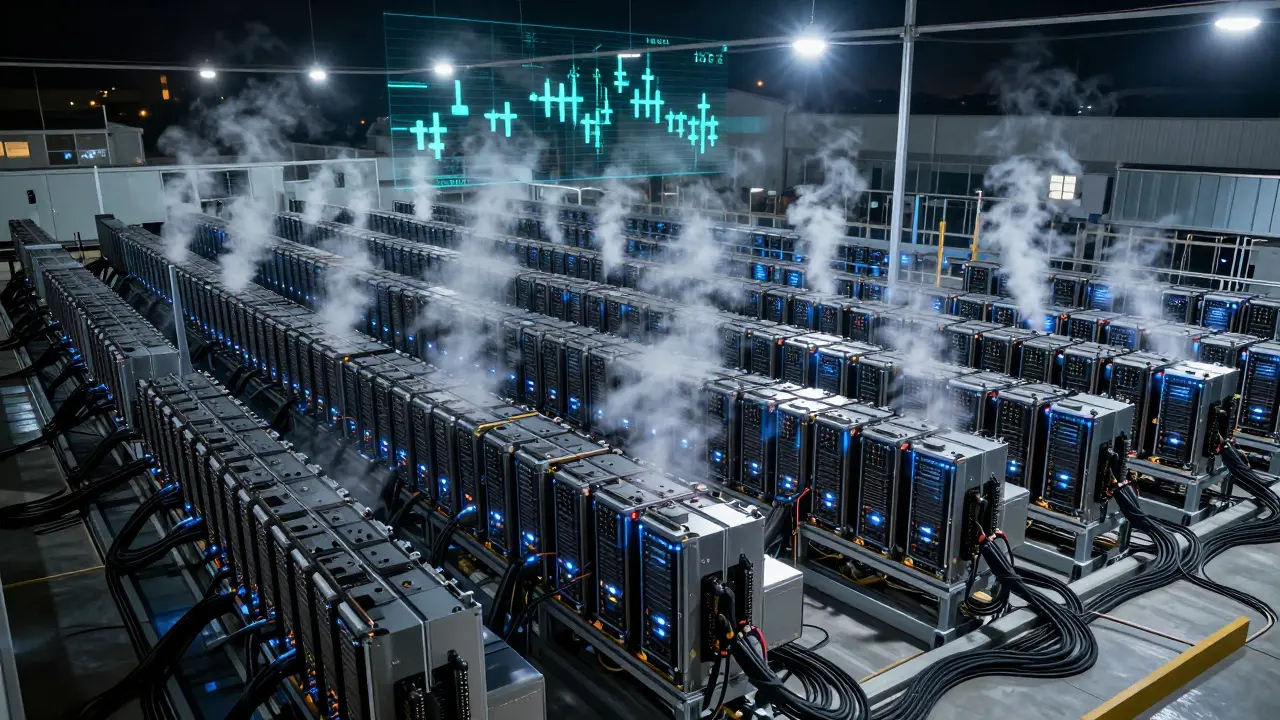
Bitcoin mining isn’t magic. It’s not even that complicated once you break it down. At its core, it’s just a race - a global, 24/7 competition where computers try to solve a math puzzle so they can add the next group of transactions to Bitcoin’s public ledger. And when someone wins? They get paid in Bitcoin. Simple. But the details? That’s where it gets interesting.
What Bitcoin Mining Actually Does
Every time someone sends Bitcoin to someone else, that transaction doesn’t just appear on a screen. It needs to be verified, recorded, and locked into place forever. That’s what mining does. It’s not about creating money out of thin air - it’s about securing the network. Without miners, Bitcoin would be vulnerable to fraud, double-spending, and manipulation. Miners are the guards of the system. They check that no one is spending the same Bitcoin twice, and they bundle verified transactions into blocks. Each block becomes a new page in Bitcoin’s unbreakable ledger.
The Proof of Work Puzzle
Bitcoin doesn’t rely on banks or governments to validate transactions. Instead, it uses something called Proof of Work (PoW). This means miners have to prove they’ve done real computational work. The puzzle? Find a specific number - called a nonce - that, when combined with the block’s data and run through the SHA-256 hashing algorithm, produces a hash with a certain number of leading zeros.
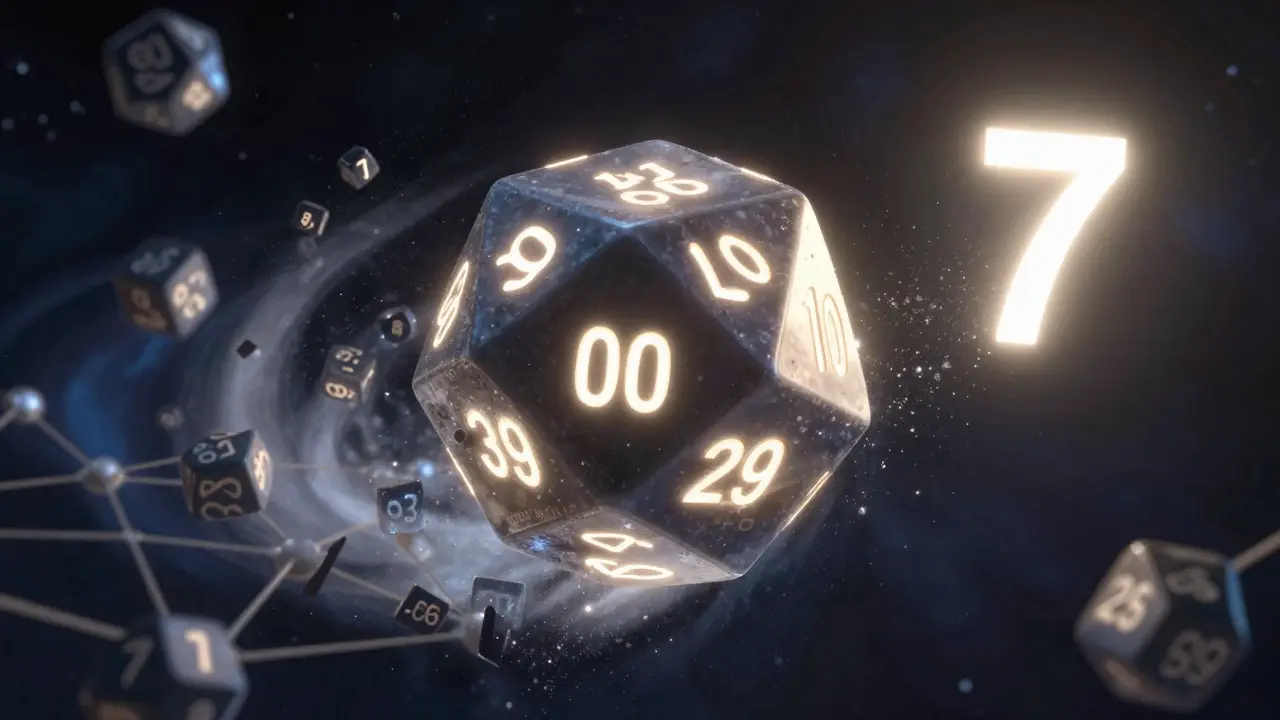
Think of it like rolling dice. The network says: "I’ll accept any roll that’s 12 or lower." But you’re using a 100-sided die. You roll once. 87. Nope. Roll again. 93. Still no. You keep rolling. Thousands of times. Maybe millions. Then, suddenly - 7. That’s it. You win.
The hash you’re trying to find has to be lower than a target number set by the network. That target changes over time to keep the average block time at 10 minutes. The more miners join, the harder the puzzle gets. The fewer miners, the easier it gets. It’s self-adjusting. Smart design.
How a Block Is Built
Before the puzzle even starts, miners collect transactions from the Mempool - a holding area for unconfirmed Bitcoin transactions. They pick as many as they can fit into a single block (currently up to about 4 MB). Then they organize those transactions into a Merkle tree. This isn’t just for show. It’s a clever way to verify hundreds of transactions with one single hash - the Merkle root.
The block header contains six pieces of data:
- Version number (what Bitcoin software rules are being used)
- Hash of the previous block (this links everything together in a chain)
- Merkle root (summary of all transactions in this block)
- Timestamp (when the block was created)
- Nonce (the number miners tweak to solve the puzzle)
- Target (the difficulty threshold for the hash)
Miners don’t change the transactions. They don’t alter the previous block’s hash. The only thing they can change is the nonce. And that’s all they need. One number. One shot at a winning hash.
Hardware: ASICs Are the Only Game in Town
Back in 2010, you could mine Bitcoin with a regular laptop. Today? Forget it. The network’s hashrate is over 1,000 exahashes per second. That’s a 1 followed by 21 zeros. No consumer CPU or GPU can compete.
The only hardware that makes sense now is ASIC - Application-Specific Integrated Circuit. These are chips built for one thing: running SHA-256 hashes as fast as possible. Brands like Antminer, Ebang, and AvalonMiner dominate the market. You’re not buying a computer. You’re buying a specialized calculator designed to solve one problem.
When choosing ASICs, two numbers matter most:
- Hash rate (measured in TH/s - terahashes per second)
- Power efficiency (watts per TH/s)
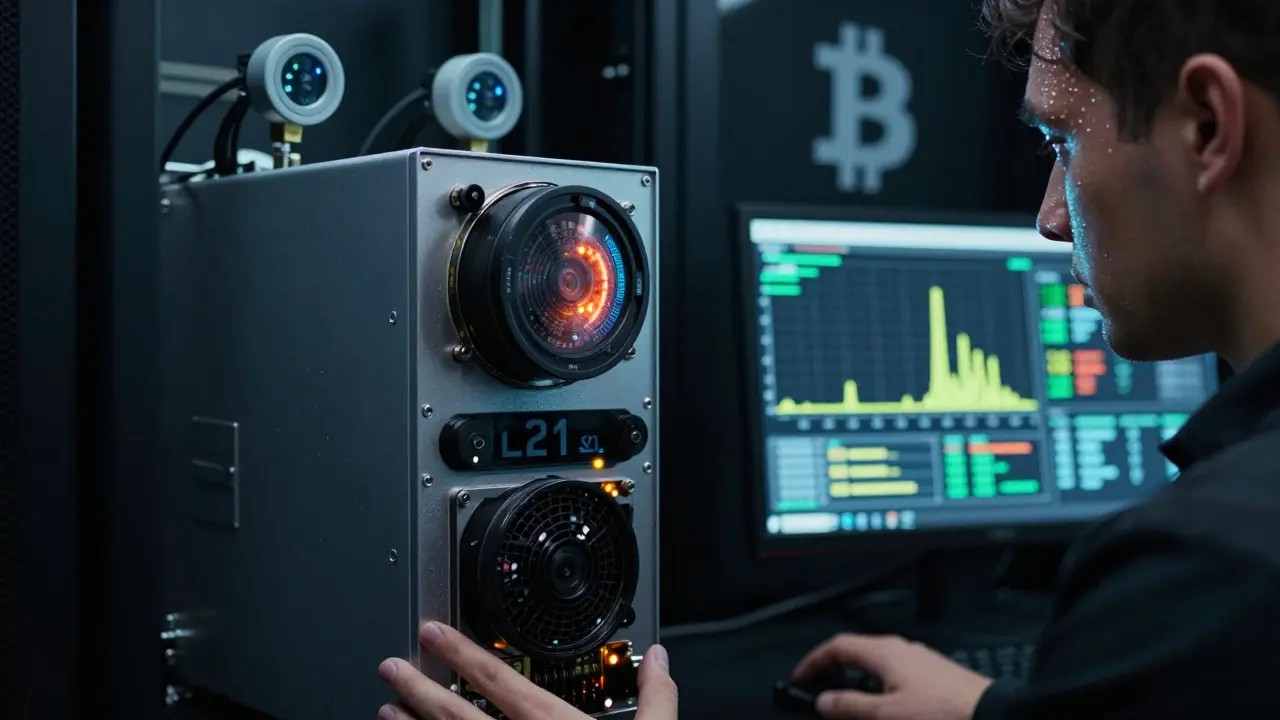
Example: An Antminer S21 does 220 TH/s and uses 3,250 watts. That’s about 14.77 watts per TH/s. A newer model might do 250 TH/s at 3,000 watts - 12 watts per TH/s. That 20% efficiency gain can mean the difference between profit and loss when electricity costs $0.15 per kWh.
Software and Setup
Hardware alone won’t cut it. You need mining software to connect your ASIC to the network. Popular options include ECOS, BeMine, and Kryptex Miner. These programs:
- Send work to your miner
- Receive completed hashes
- Monitor temperature, fan speed, and hash rate
- Connect you to a mining pool (more on that below)
You also need a Bitcoin wallet. Not just any wallet - one that can receive mining rewards. Most miners use a cold wallet (hardware wallet like Ledger or Trezor) for long-term storage. Some use hot wallets for quick payouts.
And yes - you need to download the full Bitcoin blockchain. It’s over 700 GB as of 2026. That’s not optional if you’re running a full node. Most miners skip this and connect to pools, but running a full node is how you verify the network without trusting anyone else.
Miner Rewards: Block Rewards and Fees
When a miner finds a valid block, they get two payments:
- Block reward: 6.25 BTC (as of 2026, after the April 2024 halving)
- Transaction fees: All fees from the transactions in that block
Block rewards started at 50 BTC in 2009. They halve roughly every four years. The next halving is expected in 2028. At that point, the reward drops to 3.125 BTC. This is by design. Bitcoin’s total supply is capped at 21 million coins. As of 2026, about 19.7 million are already in circulation.
Transaction fees are becoming more important. As block rewards shrink, miners will rely more on fees to stay profitable. That’s why users sometimes pay extra to get their transactions confirmed faster - especially during high-demand periods.
Why Mining Pools Exist
Solo mining is nearly impossible now. The odds of one ASIC solving a block are like winning the lottery every 10 minutes. That’s why 99% of miners join pools.
A mining pool is a group of miners who combine their computing power. When the pool finds a block, the reward is split among participants based on how much work each contributed. It’s not glamorous - you won’t win big every day - but you’ll get paid consistently. Pools like Foundry USA, F2Pool, and AntPool handle millions of TH/s.
Some pools charge a small fee (1-3%). Others use different payout methods - PPS (Pay Per Share), PPLNS (Pay Per Last N Shares). Each has pros and cons, but for beginners, PPS is the easiest to understand.
The Difficulty Adjustment: Bitcoin’s Secret Sauce
Bitcoin doesn’t just guess how hard the puzzle should be. It calculates it. Every 2,016 blocks - roughly every two weeks - the network looks back at how long it took to mine those blocks. If the average time was 9 minutes instead of 10, difficulty goes up. If it was 11 minutes, difficulty goes down.
This keeps the system stable. Even if 100 new mining farms pop up in Texas overnight, the network adjusts. If a major mining region shuts down due to power cuts, the network adjusts again. No central authority. No CEO. Just code.
This self-regulation is why Bitcoin has survived crashes, bans, and hardware revolutions. It doesn’t need permission to keep running.
51% Attacks? Not as Easy as You Think
One common fear: What if someone controls over half the network’s mining power? Could they reverse transactions? Double-spend? The answer is yes - in theory. But in practice? It’s nearly impossible.
To execute a 51% attack today, you’d need to spend billions on ASICs and electricity. And even then, you’d be attacking a network that’s constantly growing. The cost would likely exceed any profit. Plus, the community would respond - hard forks, code changes, community boycotts. The attack would fail. Bitcoin’s security isn’t about perfection. It’s about making attacks too expensive to be worth it.
What Happens After Mining?
Once a block is solved and verified by other nodes, it’s permanently added to the blockchain. Every node on the network updates its copy. The transactions inside? Locked. Unchangeable. This is the core of Bitcoin’s trustless system. No bank. No middleman. Just math, hardware, and electricity.
Miners don’t stop. They keep going. The next block starts immediately. The cycle never ends. That’s the beauty of it. Bitcoin doesn’t need to be "fixed." It just keeps running.
Can I mine Bitcoin with my home computer?
No. Even high-end gaming GPUs can’t compete with modern ASIC miners. The network’s hashrate is so high that a single consumer rig would take over 1,000 years to find one block - and it would cost far more in electricity than you’d earn. Mining Bitcoin at home is not economically viable.
How much electricity does Bitcoin mining use?
Bitcoin mining uses about 110 terawatt-hours per year, similar to the annual electricity use of countries like Argentina or the Netherlands. Most mining operations now use renewable energy or stranded power (like excess hydro or flared gas). Efficiency is improving, but power costs remain the biggest factor in profitability.
Is Bitcoin mining profitable in 2026?
It depends. If you have access to cheap electricity (under $0.06/kWh) and own efficient ASICs (like Antminer S21 or S23), yes - you can make a profit. But if you’re paying $0.15/kWh or higher, or using outdated hardware, you’ll lose money. Most profitable mining is done at scale, not by individuals.
What happens when all 21 million Bitcoins are mined?
The block reward will drop to zero. Miners will rely entirely on transaction fees to earn income. This is expected to happen around the year 2140. The network will still be secure because transaction fees will incentivize miners to keep validating blocks. The design assumes that fees will rise as Bitcoin becomes more widely used.
Do I need to understand cryptography to mine Bitcoin?
No. You don’t need to know how SHA-256 works under the hood. You just need to set up your ASIC, connect to a pool, and monitor your hashrate and power usage. The math is handled by the hardware and software. You’re not a cryptographer - you’re an operator.
Bitcoin mining is not a get-rich-quick scheme. It’s infrastructure. It’s the backbone of a decentralized currency. The people who run these machines aren’t tech geniuses - they’re engineers, electricians, and entrepreneurs who understand that value comes from reliability, not hype. If you’re thinking about mining, don’t chase Bitcoin. Chase efficiency. Chase low-cost power. Chase the long game.
13 Responses
This is the kind of breakdown I wish I'd had when I first got into crypto. The dice analogy? Perfect. I used to think mining was about brute force, but it's really about patience and optimization. You're not racing against other miners-you're racing against physics. And yeah, ASICs are the only way to play now. No regrets, but I do miss the days when my GTX 1070 could make a few bucks a day.
I've been reading up on this for weeks now, and honestly, the elegance of Bitcoin's self-adjusting difficulty mechanism still gives me chills. It’s not just a protocol-it’s an organism. The fact that it can absorb shocks-like a mining ban in China or a power grid failure in Texas-and recalibrate without a single human intervention? That’s not just smart design. That’s evolutionary. I keep thinking about how this system outlives governments, corporations, and even trends. It doesn’t need to be understood to work. It just… does. And that’s beautiful.
So let me get this straight-you’re telling me some dude in Kazakhstan with a warehouse full of Antminers is the real MVP of Bitcoin? Meanwhile I’m over here trying to mine with a laptop that’s hotter than my ex’s attitude. And you say it’s not a get-rich-quick scheme? Bro. It’s a get-rich-slow-and-lose-your-socks scheme. I’m out.
I don't get why people treat this like it's some revolutionary tech. It's just electricity + math. We've had distributed consensus systems since the '90s. Bitcoin didn't invent anything. It just got lucky with timing and hype. And now we're stuck with a network that uses more power than Sweden. Pathetic.
The Merkle tree explanation was the clearest I've seen. I finally understand why it's more efficient than listing every transaction individually. It's like summarizing a 500-page book into one paragraph-only the paragraph is cryptographically tamper-proof. That's wild.
mining is sooo last decade 😴 like why even bother when you can just buy btc on coinbase and chill? the whole 'proof of work' thing feels like digital harambe 🐒💸
Thank you for this thorough and accurate overview. The distinction between block rewards and transaction fees is critical, and too often overlooked. I appreciate the emphasis on efficiency over speculation. This is infrastructure, not a casino.
You know what's funny? People act like ASICs are this futuristic tech. They're just glorified toaster ovens with a firmware update. The real innovation is the economic incentive layer. The hardware? It's commodity. The system? That's the masterpiece.
It's not about mining Bitcoin. It's about what mining Bitcoin represents. The fact that a network can exist without a single authority, without a CEO, without a board meeting-just code and electricity and people willing to pay for it-that’s the revolution. We don't need to understand the hash function. We just need to trust that the math works. And it does. Every 10 minutes. Like clockwork. Like gravity.
Minor correction: the block reward after the 2024 halving is 3.125 BTC, not 6.25. 6.25 was the reward before the halving. Just wanted to clarify for anyone reading this-accuracy matters when the math is everything.
I live in Quebec. We have hydro so cheap it's basically free. I run two S21s in my garage. Net profit? About $400/month after bills. Not rich. Not broke. Just… steady. The real win isn't the BTC-it's knowing I'm part of something that doesn't need permission to exist. That's power.
If you're not mining in the US with cheap natural gas, you're doing it wrong. Other countries? They're just borrowing time. This is American infrastructure. Own it.
I used to think Bitcoin mining was a scam. Then I visited a data center in Texas. The silence. The heat. The sheer scale of it. It’s not magic. It’s not even exciting. It’s just… necessary. Like water treatment plants. Nobody cheers for them. But nobody wants to live without them either.