

Imagine you are piloting a Boeing 777 over the South Pacific or crossing the Arctic Circle. You have no cell towers, no ground-based radar, and your satellite link is struggling due to atmospheric interference. Your lifeline? A high-frequency (HF) radio signal bouncing off the ionosphere thousands of kilometres away. It sounds like science fiction, but it is the daily reality for long-haul aviation. And right now, as we move through the peak activity phase of Solar Cycle 25 in late 2026, that lifeline is under threat from space weather. If you think solar flares are just pretty auroras, think again-they can silence your cockpit radio for hours, forcing costly reroutes and safety compromises.
Why HF Radio Still Matters in the Satellite Age
You might wonder why airlines haven't ditched HF radio entirely for satellites. The answer lies in physics and geography. While VHF (Very High Frequency) is great for local control, it only travels line-of-sight-about 200-300 km. Beyond that, you need something that bends around the curvature of the Earth. That’s where HF comes in. Operating between 3 and 30 MHz, HF signals reflect off the ionosphere, allowing them to travel thousands of kilometres. This makes HF indispensable for transoceanic and polar routes where geostationary satellites struggle to provide coverage at high latitudes. For flights above FL300 (30,000 feet), especially on polar tracks, HF is often the primary means of voice communication with air traffic control when satellite links are congested or unavailable.
The Ionosphere: A Fragile Mirror
To understand how space weather breaks HF, you need to look up-way up. The ionosphere acts as a mirror for radio waves. It has layers, primarily the D-region (60-90 km altitude) and the F-region (above 150 km). Under normal conditions, the F-region reflects HF signals back to Earth, while the D-region absorbs lower frequencies. But this system is delicate. It relies on steady solar radiation to maintain its electron density. When the Sun throws a tantrum-via flares or coronal mass ejections (CMEs)-this balance shatters. The result isn't just static; it's a complete blackout or a severe degradation of signal quality.
Solar Flares: The Dayside Blackout
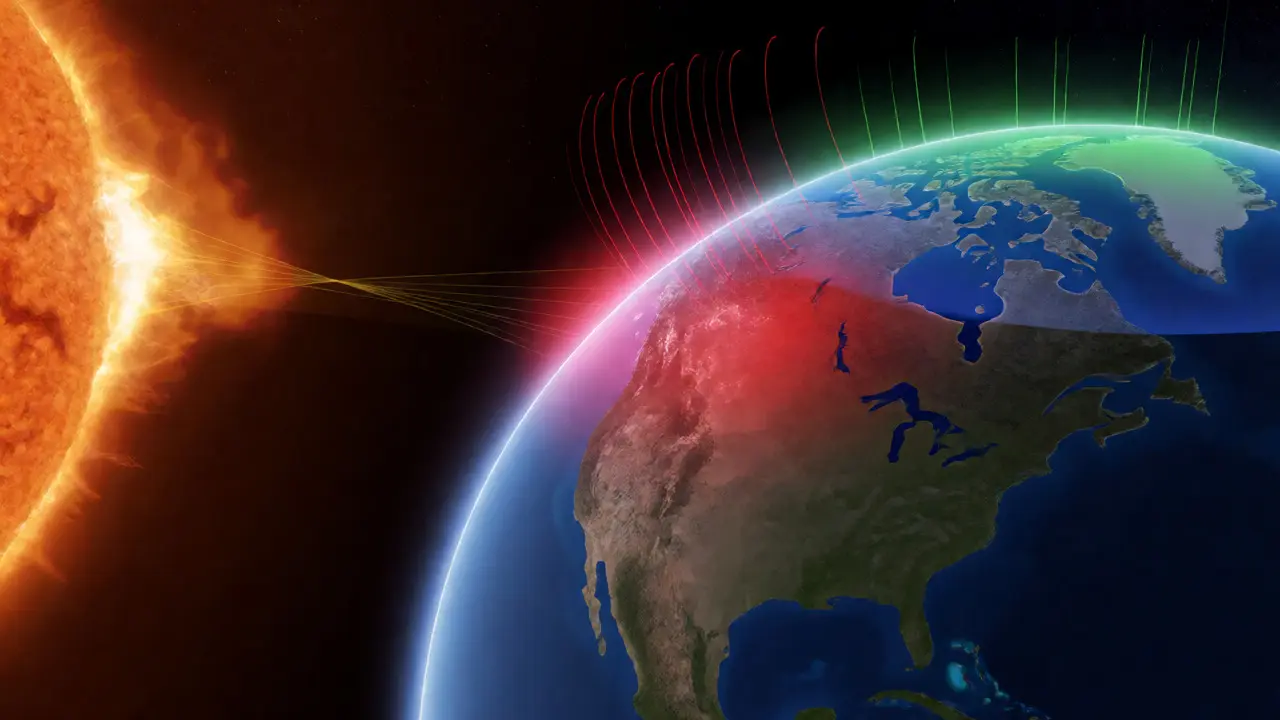
Solar flares release intense bursts of X-rays and extreme ultraviolet radiation. These reach Earth in about eight minutes. When they hit the dayside hemisphere, they dramatically increase ionization in the D-region. Instead of reflecting the HF signal, the D-region absorbs it like a sponge. This phenomenon, known as a "radio blackout," can wipe out HF communications across the entire sunlit side of the planet. According to NOAA’s Space Weather Prediction Center (SWPC), these events can last from tens of minutes to several hours. For an airline operating a flight from Los Angeles to Sydney during a flare, this means losing contact with controllers until the signal path moves into darkness or the event subsides. It’s not uncommon for pilots to report "complete loss of HF COM" on the dayside during major X-class flares.
Polar Cap Absorption: The Silent Killer of Polar Routes
If solar flares hit the dayside, Solar Energetic Particle (SEP) events target the poles. During a geomagnetic storm, charged particles funnel down along magnetic field lines into the polar regions. This causes Polar Cap Absorption (PCA), which significantly increases absorption in the high-latitude ionosphere. Unlike flares, PCA events don’t discriminate by day or night-they block HF signals regardless of sunlight. For airlines using transpolar routes to save fuel and time, this is a nightmare scenario. A Nature article published in September 2025 highlighted that SEP-driven PCA events can severely attenuate or even block HF signals for several hours, compromising safety margins and forcing diversions to lower latitudes. This isn't just an inconvenience; it adds significant fuel costs and extends flight times, impacting operational efficiency.
| Space Weather Event | Affected Region | Mechanism | Duration | Operational Impact |
|---|---|---|---|---|
| Solar Flare | Dayside Hemisphere | X-ray induced D-region ionization (Absorption) | Tens of minutes to several hours | Complete HF blackout on sunlit side; loss of ATC contact |
| Solar Energetic Particles (SEP) | Polar Caps / High Latitudes | Particle precipitation causing Polar Cap Absorption (PCA) | Several hours to days | Loss of HF on polar routes; forced rerouting to mid-latitudes |
| Geomagnetic Storm | Global (variable) | Ionospheric turbulence and scintillation | Hours to days | Reduced usable frequency set; degraded signal quality; GNSS errors |
The ICAO Space Weather Information Service (SWIS)
So, how do pilots and dispatchers know when trouble is coming? Enter the International Civil Aviation Organization (ICAO). Since the formal adoption of Annex 3 provisions, ICAO has established the Space Weather Information Service (SWIS). This isn't just a weather app; it's a standardized global advisory system. SWIS provides alerts categorized as MODERATE (MOD) or SEVERE (SEV) based on expected impacts to three key domains: HF communications, GNSS navigation, and radiation exposure. For HF specifically, advisories warn operators when degradation or loss of communication is anticipated. The goal is simple: give crews enough lead time to adjust their plans before they fly into a radio dead zone.

Procedures for Crews and Dispatchers
Knowing the problem is half the battle; managing it is the other. Current procedures, refined through ICAO seminars and FAA guidance (such as InFO 20007), emphasize dynamic adaptation. Here is what modern aviation teams actually do:
- Frequency Management: This is counter-intuitive for many. During solar flares (absorption events), crews are advised to switch to higher HF frequencies because higher energy waves penetrate the dense D-region better. Conversely, during ionospheric storms (depression events), lower frequencies may be more reliable as the reflection height changes.
- Route Adjustments: If a severe PCA event is forecast over the pole, dispatchers may choose to delay departure or reroute the flight to lower latitudes, even if it costs extra fuel. Safety takes precedence over efficiency.
- Alternate Comms: Always verify SATCOM availability. While satellites can also suffer from scintillation, they offer redundancy. VHF relays via aircraft-to-aircraft networking (like ACARS) can sometimes bridge gaps where direct ground contact fails.
- Advisory Integration: Modern flight planning systems integrate SWIS data directly into the dispatcher’s workflow. This allows for automated alerts when a planned route intersects with a predicted impact zone.
Real-World Consequences and Economic Impact
Let’s get specific. In recent years, increased use of polar routes has exposed more flights to space weather risks. A single severe space weather event can disrupt hundreds of flights. For example, during a strong geomagnetic storm, the "usable HF frequency set" shrinks. Pilots find fewer channels work reliably, leading to congestion and potential missed instructions. Airlines face tangible costs: extra fuel for detours, crew overtime, and passenger delays. The Australian Bureau of Meteorology’s Space Weather Service notes that HF is critical not just for civil aviation but for defence and emergency services in remote regions like the Outback. When HF goes down, the ripple effects extend far beyond commercial travel.
Looking Ahead: The Future of HF in Aviation
Is HF radio going away? Unlikely. Despite the rise of L-band satellite communications, HF remains the resilient backup that doesn't rely on expensive infrastructure in remote areas. However, the reliance on it is becoming more managed. We are seeing a shift toward quantitative forecasting. Instead of vague warnings, future SWIS updates aim to provide precise windows of degradation. Technologies like relative ionospheric opacity sensors are being deployed to give real-time data on absorption levels. For now, though, the human element remains crucial. Pilots must remain trained in manual HF operation and frequency switching, ensuring that when the digital links fail, they can still talk to the world.
Why does HF radio fail during solar flares?
Solar flares emit intense X-rays that rapidly increase ionization in the ionosphere's D-region (60-90 km altitude). This denser layer absorbs HF radio waves instead of reflecting them, causing a "blackout" on the dayside of Earth for tens of minutes to several hours.
What is Polar Cap Absorption (PCA)?
PCA occurs when solar energetic particles precipitate into the polar atmosphere during geomagnetic storms. This creates persistent high absorption in the polar ionosphere, blocking HF communications on transpolar routes for several hours to days, regardless of daylight.
How should pilots adjust HF frequencies during space weather events?
During solar flare-induced absorption, pilots should switch to higher HF frequencies to penetrate the dense D-region. During ionospheric storms or depressions, lower frequencies are often more effective as the reflection height drops and propagation characteristics change.
Does space weather affect satellite communications too?
Yes. While HF is most vulnerable to ionospheric absorption, space weather can cause scintillation (rapid signal fluctuations) in satellite links, particularly at high latitudes. Severe events can degrade both HF and SATCOM, making redundancy and alternate routing essential.
Who provides space weather advisories for aviation?
The International Civil Aviation Organization (ICAO) coordinates the Space Weather Information Service (SWIS). National providers like NOAA’s Space Weather Prediction Center (SWPC) in the US and the Bureau of Meteorology in Australia issue detailed forecasts and alerts used by airlines and air traffic control.