
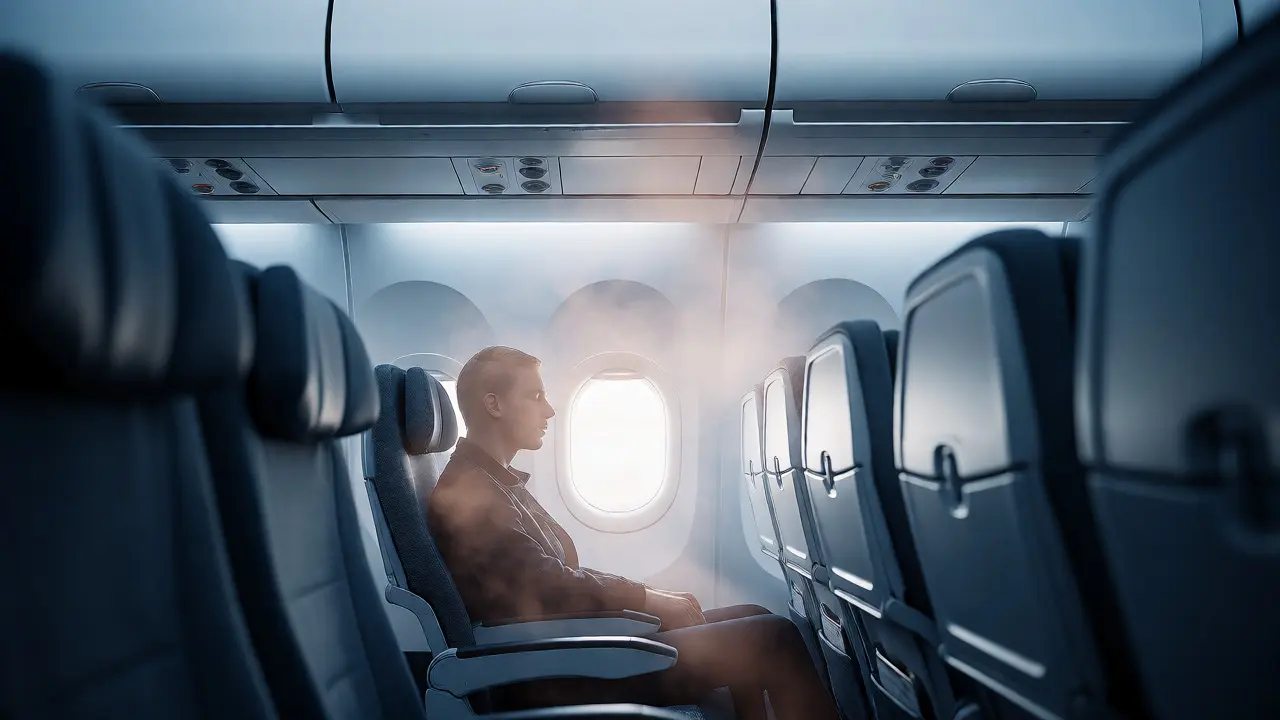
You might think that because your plane has HEPA filters, you are breathing pristine air. But here is the catch: HEPA filters capture particles like dust and viruses, but they do absolutely nothing to remove carbon dioxide. If the airflow in a cabin is poorly designed, you can sit in a "clean" environment while slowly suffocating in a bubble of your own exhaled breath. This isn't just a comfort issue; it affects cognitive function and fatigue. The real battle against CO2 pockets isn't won by better filters-it's won by smarter airflow design.
The Misconception About Clean Air
Let's clear up a common misunderstanding. A HEPA filter is defined by the U.S. Environmental Protection Agency as capturing at least 99.97% of particles that are 0.3 micrometres in size. That is impressive for particulates. However, carbon dioxide is a gas. It passes right through HEPA media without resistance. So, when you hear airlines brag about hospital-grade air, they are talking about particle removal, not gas exchange. In modern commercial aircraft, the system typically mixes about 50% fresh outside air (bled from engines) with 50% recirculated air. The recirculated portion goes through HEPA filters to clean it, but the CO2 stays there unless it is physically removed or diluted by fresh air.
If the fresh air doesn't reach your face, or if the stale air gets trapped around your head, you develop a localized zone of high CO2 concentration. This is a CO2 pocket. Even if the average CO2 level in the entire cabin meets regulatory standards, your specific breathing zone might be significantly higher. This discrepancy is where design flaws hide.
Why Air Gets Stuck Around You
Airflow in a cabin isn't uniform. It is influenced by thermal plumes-the warm air rising from human bodies-and the geometry of seats, overhead bins, and partitions. Research using tracer gases in Boeing 737 mock-ups showed that while overall ventilation effectiveness was decent, local concentrations varied wildly based on seat location and airflow direction. One study found that seats at the same distance from a source could have different exposure levels depending on how the jets hit the walls and ceiling.
Several factors create these stagnant zones:
- Short-circuiting: Supply air flows directly to return grilles without mixing with the occupied space.
- Blocked Diffusers: Overhead luggage or passenger movement blocks the intended path of fresh air.
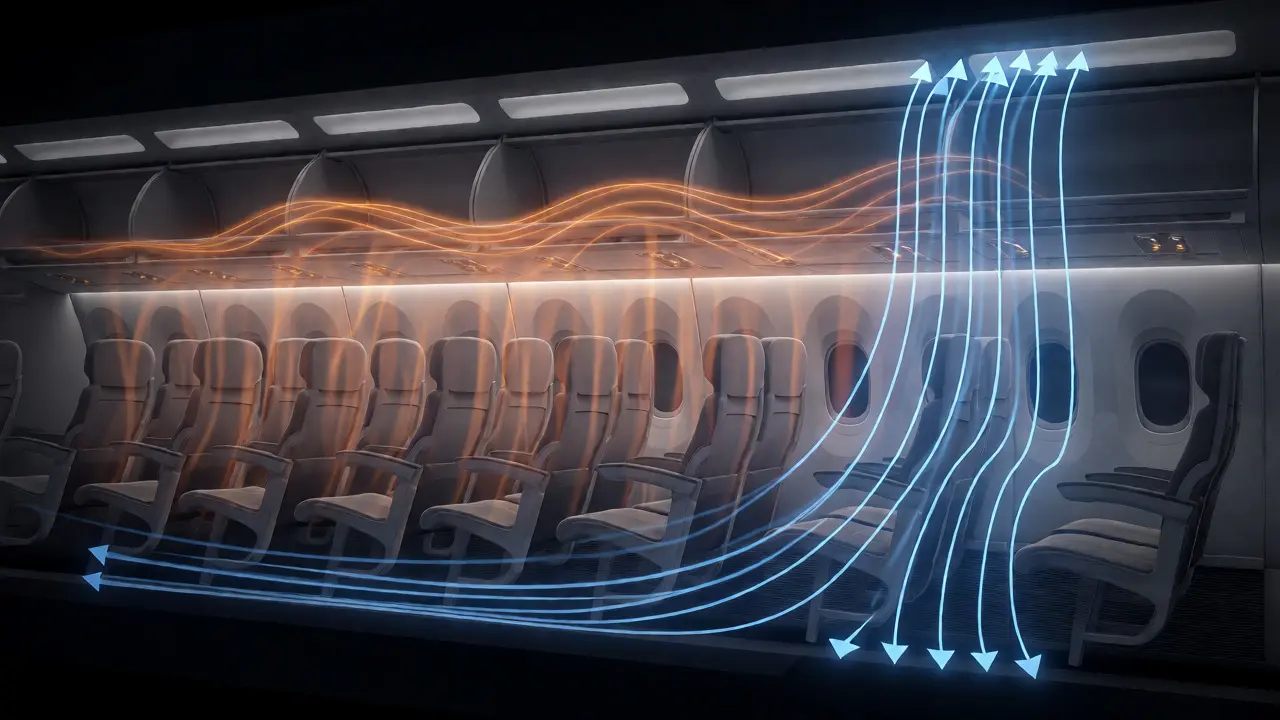
- Thermal Stratification: Warm exhaled air rises and gets trapped under overhead bins rather than being swept down to floor-level exhausts.
- Inadequate Outdoor Air: The system supplies enough total air, but not enough fresh air to dilute the CO2 load effectively.
NIST research highlights that CO2 distribution is nonuniform because air movement interacts with doorways and occupant heat sources. A single sensor in a common return duct cannot tell you what is happening at row 14, seat 14A. It only sees the average. If you rely on that average, you miss the pockets.
Designing for Dilution, Not Just Filtration
To prevent CO2 accumulation, engineers must focus on dilution. The Federal Aviation Administration (FAA) sets a maximum in-flight CO2 concentration of 5,000 parts per million (ppm). While this is a safety ceiling, it is far from optimal for comfort. Many experts suggest aiming for levels closer to 800-1,000 ppm to maintain alertness. Achieving this requires a multi-layered approach.
The first layer is sizing the outdoor air supply correctly. Regulations require approximately 0.55 pounds of fresh air per minute per occupant. However, simply meeting the minimum often results in average CO2 levels hovering around 1,300 ppm, which is higher than typical office environments. Increasing the fraction of fresh air reduces steady-state CO2, but it costs energy and can impact cabin temperature and noise levels.
The second layer is air distribution geometry. Instead of relying on a few high-flow inlets, modern designs use multiple, evenly distributed diffusers. These direct air toward occupied breathing zones and push stale air toward low-level returns. A 2024 Computational Fluid Dynamics (CFD) study of a Boeing 737-800 demonstrated that distributed air inlets produced more uniform airflow and lower temperatures compared to traditional setups. Personalized ventilation systems, which deliver air directly to each passenger, showed the lowest modeled CO2 concentrations, though they add complexity and maintenance burdens.
The Role of Monitoring and Control
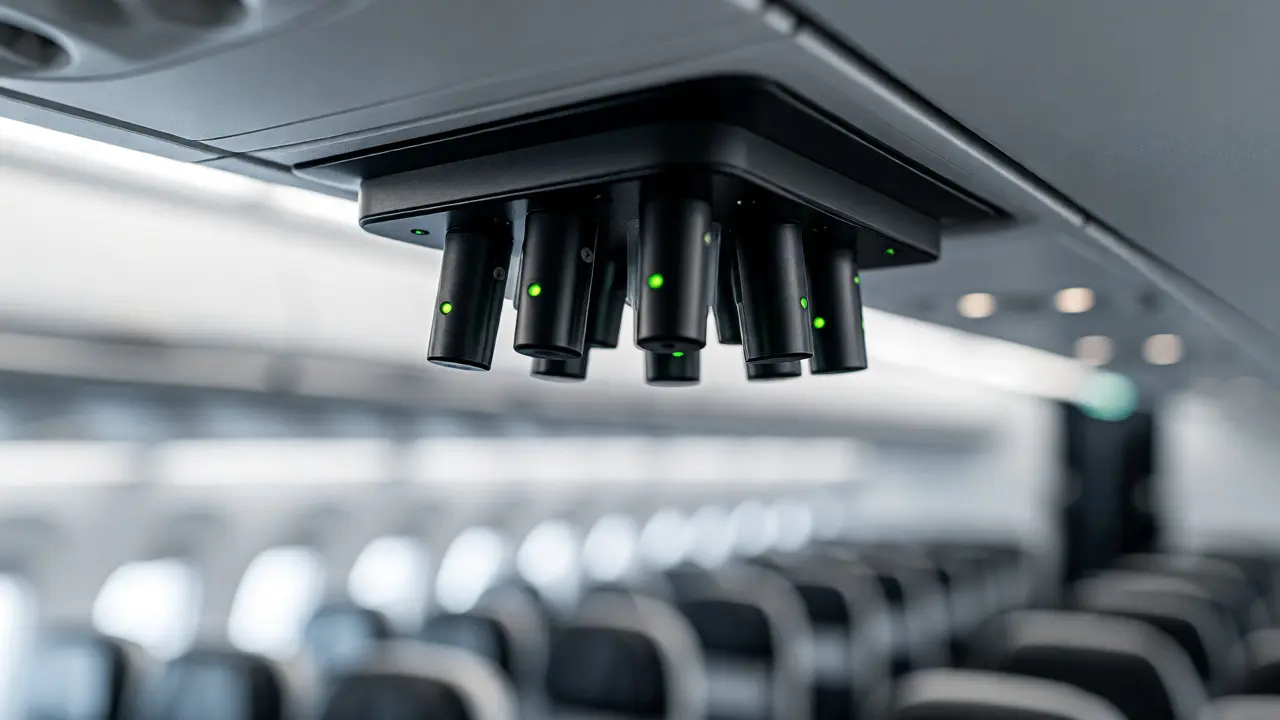
You cannot fix what you do not measure. Traditional HVAC systems often rely on a single return-air sensor to control ventilation rates. This is insufficient for preventing local pockets. Robust systems use multiple calibrated CO2 sensors distributed throughout the cabin. These sensors feed data into a control logic that adjusts fan speeds or damper positions to increase fresh air delivery when CO2 levels rise in specific zones.
Sensor placement is critical. They must be located away from direct supply jets, doors, and windows to avoid false readings. NIST recommends keeping sensors away from immediate proximity to occupants to measure ambient room air rather than exhaled breath. Furthermore, one sensor should not control ventilation for multiple spaces with different occupancy patterns. For example, a busy galley area will generate different CO2 loads than an empty rear cabin section.
| Strategy | Effect on Particles | Effect on CO2 | Complexity/Cost |
|---|---|---|---|
| Standard HEPA Recirculation | High (99.97%) | None | Low |
| Increased Fresh Air Mix | Moderate | High (Dilution) | Medium (Energy Cost) |
| Distributed Ceiling-to-Floor Flow | Moderate | High (Mixing) | Medium (Design Change) |
| Personalized Ventilation | High | Very High (Source Capture) | High (Hardware/Maintenance) |
Commissioning and Real-World Validation
Computer models are useful, but they need validation. CFD simulations can predict dead zones, but they struggle to account for every variable, such as passenger movement, luggage configuration, or minor leaks in ductwork. Commissioning a cabin involves testing under various conditions: empty, fully occupied, with doors open, and with filters loaded to their maximum pressure drop.
A key pitfall is ignoring filter loading. As HEPA filters clog with dust, the pressure drop increases. If the fan control system does not compensate for this increased resistance, the actual airflow volume drops. Less airflow means less dilution, leading to higher CO2 levels even if the fresh air percentage remains constant. Regular monitoring of pressure drop and leakage ensures that the system performs as designed over time.
Additionally, portable HEPA purifiers are sometimes used in smaller cabins or rooms. While they improve particle counts, they do not reduce CO2 unless equipped with separate sorbent technology. In fact, poorly placed portable units can create local jets that redistribute CO2 rather than removing it, potentially moving a pocket from one corner to another.
Looking Ahead: Redundancy and Intelligence
The future of cabin air quality lies in redundancy. Relying solely on HEPA filtration is a flawed strategy for gas management. The most effective designs combine adequate outdoor air supply, balanced distributed outlets, strategic exhaust locations, and sealed filter housings to prevent bypass. Intelligent controls that respond to local sensor data, rather than global averages, allow for dynamic adjustments that keep breathing zones within comfortable limits.
As we move further into 2026, regulations and industry standards continue to evolve. EASA analyses suggest that elevated CO2 above 1,000 ppm can impact immune response and aerostability of pathogens. This adds health incentives beyond mere comfort. Engineers must now prove ventilation performance through rigorous testing, including tracer-gas decay studies and multi-point CO2 mapping, to demonstrate that their designs truly protect passengers from invisible threats.
Do HEPA filters remove carbon dioxide?
No, HEPA filters do not remove carbon dioxide. They are designed to capture particulate matter like dust, pollen, and bacteria. CO2 is a gas and passes through HEPA media without being filtered out.
What causes CO2 pockets in aircraft cabins?
CO2 pockets are caused by poor airflow distribution, inadequate fresh air supply, short-circuiting between supply and return vents, blocked diffusers, and thermal plumes that trap exhaled air around passengers' heads.
How much fresh air is required per passenger?
FAA regulations require at least 0.55 pounds of fresh air per minute per occupant during normal operation. ASHRAE standards suggest approximately 7.5 cubic feet per minute per passenger, but higher rates are often needed for optimal comfort and lower CO2 levels.
Is 5,000 ppm CO2 safe for passengers?
5,000 ppm is the maximum allowable limit set by the FAA for flight safety. However, many people experience discomfort, drowsiness, or headaches at levels above 1,000-1,500 ppm. Lower levels are generally preferred for comfort and cognitive performance.
Can adding more fans help reduce CO2?
Adding more fans can improve mixing and distribute existing air more evenly, which may help reduce localized pockets. However, increasing total airflow without increasing the proportion of fresh outdoor air will not lower the overall CO2 concentration significantly.
12 Responses
Wow, this is such an eye-opener! 🤯 I always assumed HEPA meant we were breathing pure air. It makes total sense that gas passes through though. We need to stop looking at filters as the end-all-be-all solution and start thinking about airflow dynamics more holistically. Maybe if we focused on dilution strategies instead of just particle capture, passengers would feel less groggy after long flights? 😌
The distinction between particulate filtration and gaseous exchange is fundamentally critical yet frequently overlooked in public discourse regarding aviation hygiene. One must acknowledge that the prevailing narrative surrounding 'clean air' in commercial cabins is a sophisticated marketing construct rather than a physiological reality for CO2 management. The stagnation of exhaled breath creates localized microclimates that defy the aggregate data presented by single-point sensors, rendering the regulatory compliance metrics somewhat illusory for individual passenger comfort. It is a fascinating, albeit troubling, example of how engineering priorities can diverge from human sensory experience.
They don't want you to know this. They sell you the HEPA filter story so you don't ask about the fresh air mix ratios. It's cheaper to recycle the same stale air with a filter than to bleed enough hot engine air to actually dilute the CO2. You're sitting in a bubble of your own waste gas while they claim it's 'hospital grade'. Wake up people. The airlines save money on fuel because they aren't heating/cooling enough outside air. Your fatigue isn't jet lag, it's hypoxia lite. 🚫🧠
The analysis provided herein lacks sufficient rigor regarding the specific energy penalties associated with increased fresh air intake. Merely stating that dilution is required ignores the thermodynamic constraints of current aircraft designs. Furthermore, the reliance on CFD studies without acknowledging the variance in passenger density during different flight phases is methodologically flawed. One must consider the operational realities before proposing idealistic ventilation models that may not be feasible within existing structural limits. The conspiracy here is simply incompetence masked as innovation.
While the points about airflow are valid, the tone of this article is unnecessarily alarmist. The FAA limit of 5,000 ppm is based on extensive safety data, not arbitrary comfort preferences. Suggesting that 1,000 ppm is necessary for cognitive function conflates office standards with high-altitude physiological adaptations. Passengers have flown for decades under these conditions without widespread cognitive collapse. Perhaps the issue isn't the design, but the expectation that flying should feel like sitting in a climate-controlled library.
THIS IS WHY AMERICAN ENGINEERING RULES THE SKIES!!! 💪💪💪 While other countries complain, we built the systems that keep millions moving safely every day!!! The HEPA filters ARE working for what they are designed for!!! Stop trying to blame the hardware for physics!!! If you don't like the air, buy a first-class ticket where the service is better!!! USA AIR POWER!!! 🇺🇸✈️🔥
Great breakdown! 👩🔬 Just to add some context: The reason we see those pockets often has to do with the 'wall effect' near windows or the thermal plume rising from the seat back itself. Personalized vents (like on some newer A350s) help, but retrofitting older fleets is tough. Also, remember that mask usage during the pandemic actually helped mitigate some of these pockets by filtering exhaled air closer to the source! 😷✅
Its simple. Filter dust. Breathe fresh air. Why complicate it with pocket talk? People get tired cause its boring not bad air. Fix the seats then fix the air. Simple logic. 🤷♂️
I appreciate the clarity here! It’s really helpful for understanding why we might feel foggy on long hauls even when the cabin feels clean. Encouraging readers to look into personalized ventilation options or even portable fans could be a practical tip for frequent flyers who are sensitive to air quality. Keep up the great educational content!
It is truly fascinating how invisible gases dictate our physical state in enclosed spaces. The metaphor of suffocating in a bubble of one's own exhalation is both poetic and scientifically accurate. We must advocate for transparent monitoring systems so that passengers can trust the environment they inhabit. Knowledge is the first step toward demanding better aerodynamic and atmospheric standards in civil aviation.
Love this deep dive!! Seriously the stuff nobody talks about enough. We focus so much on germs we forget we are basically composting in our seats lol. Need more engineers who think about the human experience not just the mechanical specs. Let's push for smarter sensors and dynamic airflow control. The future is bright and breathable!! ✨🚀
This resonates deeply. Feeling unheard and unseen in a crowd is similar to feeling suffocated by stale air despite being in a 'filtered' space. Empathy extends to environmental comfort too.