
Imagine sending a text message. You hit send, and it arrives instantly. Now imagine that same message has to travel up to a satellite, bounce around, and come back down before you see the 'delivered' checkmark. That delay is the price we pay for connecting the unconnected parts of our planet. But where does that data actually go once it hits the ground? The answer isn't just 'the internet.' It’s a complex, high-tech facility called a ground gateway.
These gateways are the unsung heroes of satellite internet. They are the physical bridges between the vacuum of space and the fiber-optic cables running under our streets. Without them, your satellite dish is just a piece of metal pointing at the sky. In 2026, as Low Earth Orbit (LEO) constellations expand and cloud providers integrate directly with space assets, understanding ground gateway architecture is no longer just for aerospace engineers-it’s key to understanding the future of global connectivity.
The Core Function: More Than Just an Antenna
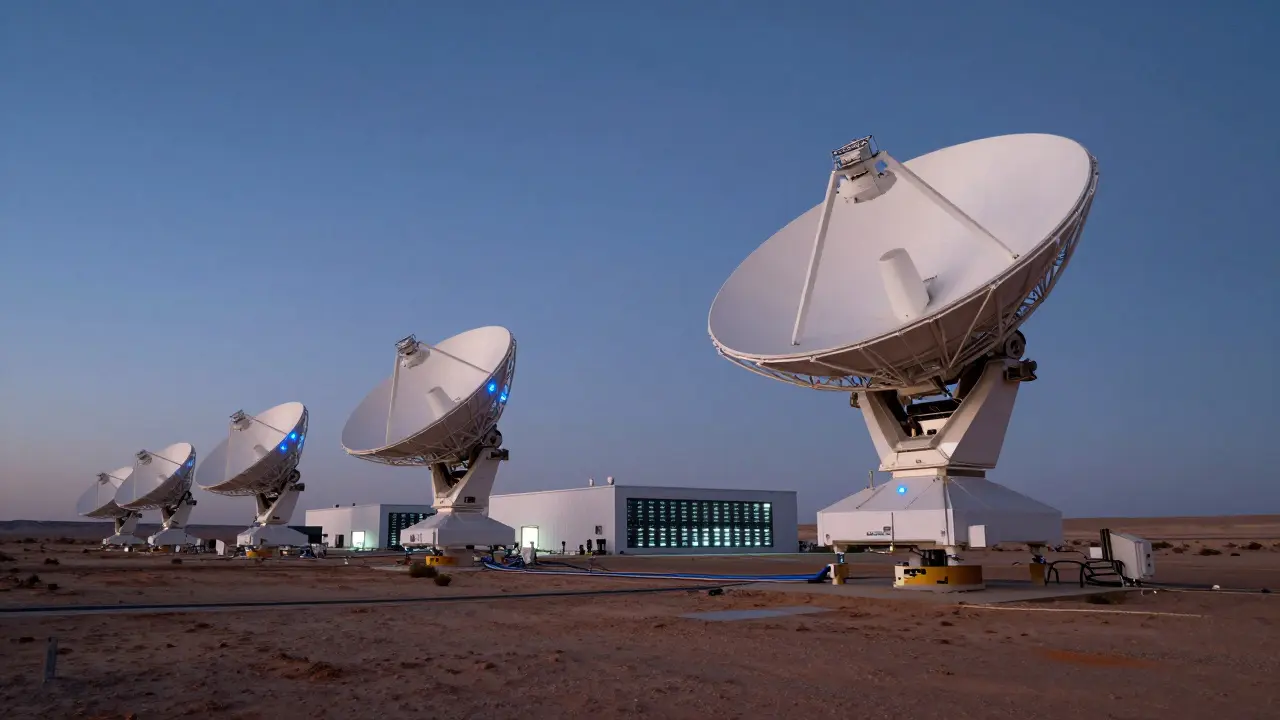
A common misconception is that a satellite gateway is simply a big dish. While antennas are part of the picture, the gateway is really a sophisticated data processing center. Think of it as a translator. Satellites speak in radio frequencies (RF). The internet speaks in Internet Protocol (IP). The gateway’s job is to catch those RF signals from space, convert them into IP packets, and inject them into the terrestrial network backbone.
In traditional systems, this process happens in large, centralized facilities known as teleports. These sites house massive parabolic dishes, often several meters wide, along with low-noise amplifiers and high-power transmitters. But the real magic happens in the baseband modems and routers inside the building. These components handle authentication, traffic routing, and quality of service (QoS) enforcement. If you’re streaming video or playing a game, the gateway ensures your data gets priority over someone else’s email download.
What exactly is a ground gateway?
A ground gateway is a specialized ground station that connects orbiting satellites to terrestrial IP networks. It contains antennas, RF equipment, and baseband processors that convert satellite signals into internet traffic.
Bent-Pipe vs. Modern Architectures
To understand why gateway design matters, you have to look at how satellites handle data. For decades, most consumer satellite internet used a "bent-pipe" architecture. This is a simple relay system. The satellite receives a signal from your home dish, amplifies it, and beams it down to a ground gateway. The satellite itself doesn’t do any thinking; it just bends the signal like a pipe. All the heavy lifting-routing, switching, security-happens on the ground.
This approach works well for Geostationary Earth Orbit (GEO) satellites, which sit 35,786 kilometers above the equator. Because they stay fixed relative to one spot on Earth, a single gateway can serve an entire continent-sized footprint. However, the distance creates a problem: latency. A round-trip signal takes at least 600 milliseconds, which feels sluggish for real-time applications like gaming or video calls.
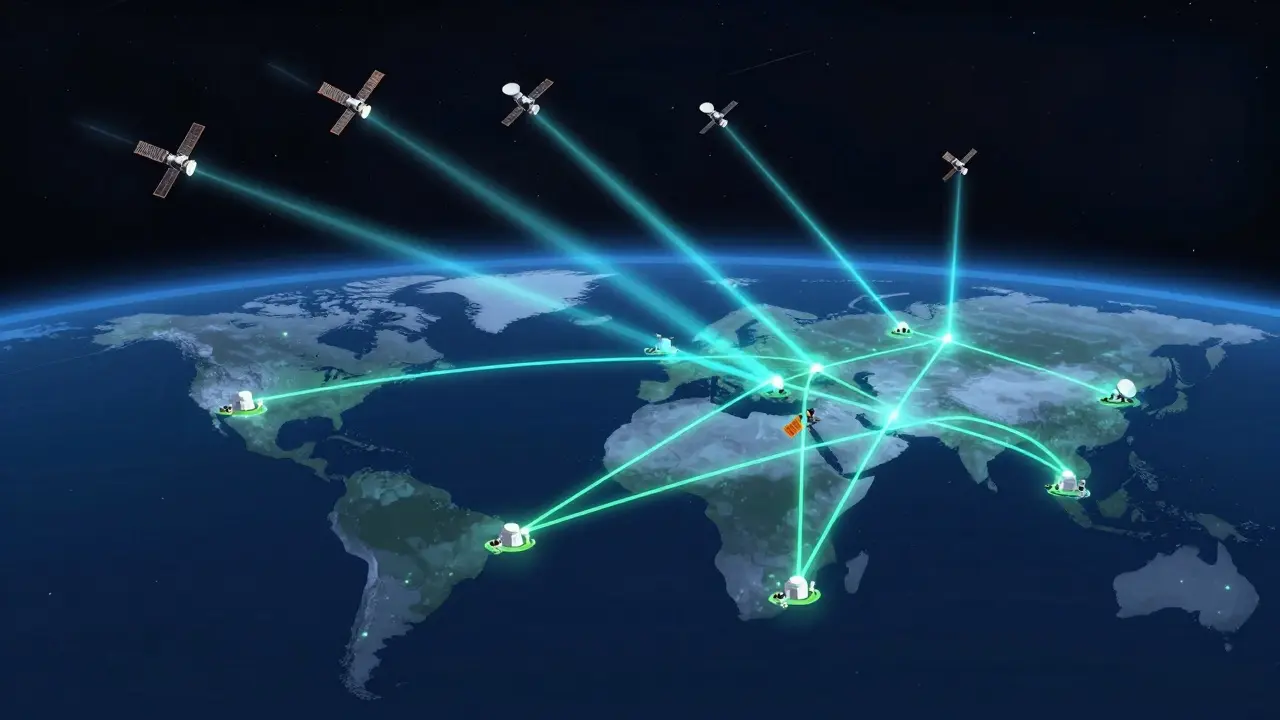
Enter Low Earth Orbit (LEO) constellations. Satellites here orbit much lower, between 500 and 2,000 kilometers. This drastically reduces latency, but it changes the gateway game. LEO satellites move fast, passing overhead in minutes. A single static gateway can’t keep up. Instead, operators need a distributed network of many smaller gateways spread across the globe to ensure there’s always a station visible to a passing satellite.
| Feature | GEO Bent-Pipe | LEO Distributed | Cloud-Managed (e.g., AWS) |
|---|---|---|---|
| Latency | High (>600ms) | Low (<50ms) | Variable (depends on region) |
| Gateway Count | Few, large sites | Many, small sites | Shared infrastructure |
| Cost Model | High CapEx | High OpEx/Logistics | Pay-per-minute |
| Primary Use | Broad coverage internet | Global broadband/mobile backhaul | Data downlink/IoT |
Site Selection: Why Location Is Everything
You might think you can put a gateway anywhere with a clear view of the sky. In reality, site selection is a rigorous engineering challenge. Operators look for specific conditions to maximize reliability and minimize costs.
First, weather matters. Rain fade-the absorption of signal by water droplets-is a major issue, especially for Ka-band frequencies used in modern high-throughput satellites. That’s why many gateways are built in dry climates with minimal rain and snow. Second, power stability is critical. A gateway needs a robust electrical supply to run high-power amplifiers and cooling systems continuously.
Third, connectivity. A gateway is useless if it can’t talk to the rest of the internet. Sites must have access to multiple Tier-1 fiber providers (like AT&T, Verizon, or Level 3) to ensure redundancy. If one carrier goes down, traffic switches to another seamlessly. Finally, land availability. Traditional gateways need acres of space for large antennas and future expansion. Newer array-based designs are changing this, but space remains a premium asset.
The Rise of Virtualized and Cloud Gateways
The biggest shift in 2026 isn’t just about better antennas; it’s about software. Enter services like AWS Ground Station is a managed service that allows customers to control satellite communications and process data directly into AWS regions without building their own ground stations. This model virtualizes the gateway layer. Instead of buying a $10 million teleport, a company schedules antenna time via an API. The data streams directly into cloud storage or compute instances.
This approach shifts the cost structure from capital expenditure (CapEx) to operational expenditure (OpEx). It’s particularly popular for Earth observation missions, IoT data collection, and scientific research. For consumer internet, however, dedicated operator gateways still dominate because they offer the continuous, high-capacity throughput needed for millions of users. But even these operators are adopting virtualization, using software-defined networking (SDN) to manage traffic flows dynamically.
Gateway Arrays: The Modular Future
Traditional gateways rely on large, mechanically steered dishes. They’re powerful but slow to move and vulnerable to mechanical failure. An emerging alternative is the Gateway Array architecture, pioneered by companies like ThinKom. Instead of one big dish, these systems use dozens of smaller, electronically steered panels. By combining their signals (aperture combining), they act like a single large antenna but with far greater flexibility.
These arrays can track multiple satellites simultaneously. Imagine a gateway talking to three different LEO satellites at once, aggregating their bandwidth. If one panel fails, the others compensate. This modularity makes scaling easier-you add more panels instead of building a new dish. It also reduces maintenance since there are fewer moving parts. As LEO constellations grow, this technology could become the standard for high-efficiency ground segments.

Integration with Terrestrial Networks
A gateway doesn’t exist in isolation. It must integrate smoothly with the terrestrial IP/MPLS core networks. This integration is crucial for Quality of Service (QoS). When a packet leaves a user terminal, it travels through the satellite link to the gateway, then onto the fiber network. The gateway acts as the anchor point for measuring performance metrics like jitter and packet loss.
Modern architectures treat the satellite link as just another access technology, similar to 4G or 5G. Routing protocols are enhanced to handle the intermittent nature of satellite links. For example, in LEO systems, links are scheduled based on satellite visibility windows. The gateway’s router knows exactly when a satellite will be overhead and prepares the path accordingly. This requires tight synchronization between space and ground segments, ensuring that data isn’t dropped during handovers between satellites.
Security and Resilience
As satellite internet becomes critical infrastructure, security is paramount. Gateways are prime targets for cyberattacks. They enforce encryption policies, segment traffic into virtual private networks (VPNs), and monitor for anomalies. Since the RF link is broadcast, eavesdropping is possible if signals aren’t encrypted. Therefore, end-to-end encryption starting at the gateway is essential.
Resilience is also built into the architecture. Redundant fiber paths, backup power generators, and geographically diverse gateway locations ensure service continuity. If a hurricane knocks out a gateway in Florida, traffic reroutes to a facility in Texas. This diversity is why operators invest heavily in site selection and disaster-proofing their facilities.
Future Trends: Space-Ground Integration
Looking ahead, the line between space and ground networks is blurring. Inter-satellite links (ISLs) using lasers allow satellites to route traffic among themselves, reducing the need for frequent ground contacts. This means gateways will focus less on constant data relay and more on strategic egress points to the internet backbone.
Network slicing, a concept borrowed from 5G, is also making its way to satellite systems. This allows operators to create virtual networks within the physical infrastructure, dedicating specific resources to emergency services, military use, or consumer broadband. Ground gateways will become smarter, programmable nodes that adapt to these slices in real-time. The result is a more efficient, flexible, and resilient global network that truly connects everyone, everywhere.
Why do LEO satellites need more gateways than GEO?
LEO satellites move quickly across the sky, staying visible to a single location for only a few minutes. To maintain continuous connectivity, a network needs many gateways distributed globally so that as one satellite moves out of range, another comes into view of a nearby gateway.
What is rain fade and how does it affect gateways?
Rain fade is the attenuation of satellite signals caused by rain, snow, or clouds. Higher frequency bands like Ka-band are more susceptible. Operators mitigate this by placing gateways in dry climates and designing systems with extra power margins to overcome signal loss.
Can I build my own satellite gateway?
For individual consumers, no. Building a functional gateway requires regulatory licenses, expensive RF equipment, and direct fiber connections to internet exchanges. However, services like AWS Ground Station allow organizations to rent gateway capacity without owning the hardware.
How do inter-satellite links change gateway requirements?
Inter-satellite links (ISLs) allow satellites to communicate directly with each other via laser. This reduces the number of times data needs to touch the ground, meaning fewer gateways are needed for global coverage, though strategic egress points remain essential for connecting to the terrestrial internet.
What is the difference between a teleport and a gateway?
The terms are often used interchangeably. Historically, 'teleport' referred to large, centralized GEO facilities. 'Gateway' is a broader term now used for any ground station connecting satellites to IP networks, including smaller LEO stations and cloud-managed virtual gateways.