

Think about this: the entire country of Argentina uses less electricity in a year than Bitcoin mining does. That’s not a hypothetical. That’s a real number from the University of Cambridge. And it’s not just Bitcoin - other proof-of-work blockchains are doing the same thing, burning through power like it’s going out of style. But here’s the good news: the blockchain world is changing. Fast. And it’s not because of regulation or public pressure alone. It’s because smarter, cleaner, and far more efficient alternatives are already here - and they’re working.
Why Bitcoin’s Energy Use Is a Problem
Proof-of-work (PoW), the original consensus mechanism behind Bitcoin and early blockchains, works like a high-stakes math competition. Miners race to solve cryptographic puzzles using powerful computers. The winner gets rewarded with new coins. Sounds fair, right? Except the losing miners? They still used all that electricity. And they did it 24/7, year after year. The energy isn’t used to move money. It’s used to secure the network. But here’s the twist: that security doesn’t require that much juice. It’s just the way the system was built. Digiconomist estimates Bitcoin’s annual consumption is over 120 terawatt-hours. That’s more than the entire country of the Netherlands. And most of that power comes from fossil fuels, especially in places like Kazakhstan and Texas where cheap coal and natural gas are easy to access. This isn’t just about climate change. It’s about opportunity cost. That electricity could be powering homes, hospitals, or electric buses. Instead, it’s locked in a global guessing game that validates transactions - transactions that could be verified in seconds with a fraction of the power.Proof-of-Stake: The Quiet Revolution
Enter proof-of-stake (PoS). No mining. No racing. No massive server farms humming in the dark. In PoS, instead of using brute computing power, validators are chosen based on how many coins they’re willing to lock up - or “stake” - as collateral. The more you stake, the higher your chance of being selected to validate the next block. If you try to cheat? You lose your stake. Simple. Elegant. Efficient. The energy difference? Staggering. Ethereum switched from PoW to PoS in September 2022 with Ethereum 2.0. The result? A 99.95% drop in energy use. That’s not a marketing claim. That’s what the network’s own data shows. Before the switch, Ethereum used as much electricity as a small country. After? It now uses less than a single household. And Ethereum isn’t alone. Cardano, Polkadot, Solana, and Avalanche all launched with PoS from day one. Together, they now make up over 60% of all active blockchains. The industry didn’t wait for permission. It just moved on.More Than Just PoS: Other Green Paths
PoS is the leader, but it’s not the only option. Some projects are going even further off-script. Take Chia Network. Instead of using processors, it uses unused hard drive space. Think of it like farming digital land. The more space you offer, the more chances you have to earn rewards. No GPUs. No cooling systems. Just a regular computer sitting on your desk. Chia’s energy use per transaction is roughly 1/100,000th of Bitcoin’s. Then there’s proof-of-space-time, proof-of-authority, and even proof-of-history. These aren’t buzzwords - they’re real alternatives with real data backing them. The blockchain space isn’t stuck on one solution. It’s experimenting. And that’s how innovation happens.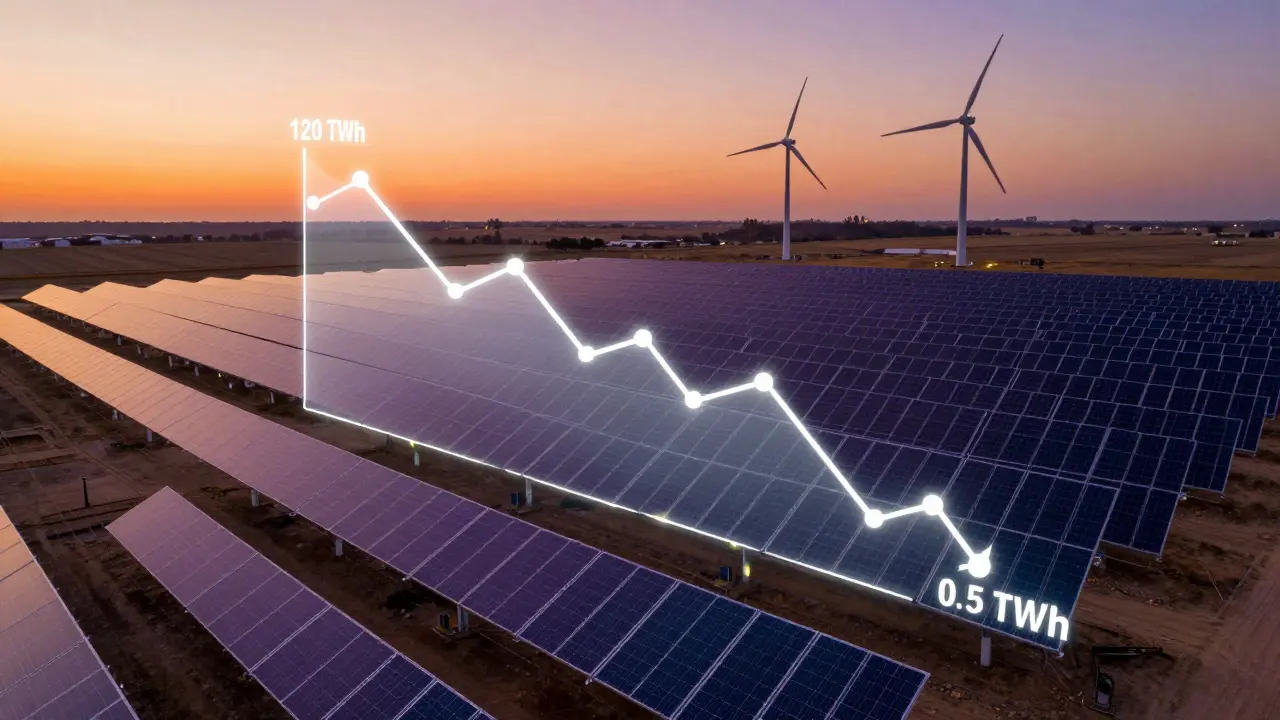
Layer 2: Making the Old Systems Greener
Not every blockchain can switch overnight. Bitcoin, for example, still runs on PoW. But that doesn’t mean it’s stuck in the past. Enter Layer 2 solutions. These are secondary networks built on top of existing blockchains to handle transactions off-chain. The Lightning Network for Bitcoin is the best-known example. It lets users send thousands of payments without touching the main Bitcoin ledger. Only the final balances get recorded. That cuts down on the number of energy-heavy transactions dramatically. Ethereum uses Optimistic Rollups and ZK-Rollups for the same purpose. These tools reduce the load on the main chain by bundling hundreds of transactions into one. The result? Lower fees, faster speeds, and a massive drop in energy use - even on a PoW network. It’s like upgrading the highway system instead of replacing every car. You don’t need to scrap the old system. You just make it work smarter.Green Mining: Powering With the Sun, Wind, and Geothermal
Some miners aren’t waiting for consensus changes. They’re changing their power source. In Iceland, geothermal energy powers mining rigs. In Texas, solar farms are being repurposed to run Bitcoin miners during the day. In Sweden, hydroelectric dams are feeding mining operations. These aren’t niche experiments. They’re growing. Projects like GreenBitcoin and SolarCoin are built on the idea that if you can’t reduce energy use, you can at least make sure it’s clean. They don’t change the PoW mechanism - they change the fuel. And that matters. A miner running on solar panels has a far smaller carbon footprint than one plugged into a coal plant. Even Bitcoin mining companies are now reporting their energy mix. Some openly claim 80%+ renewable usage. Transparency is becoming a competitive advantage.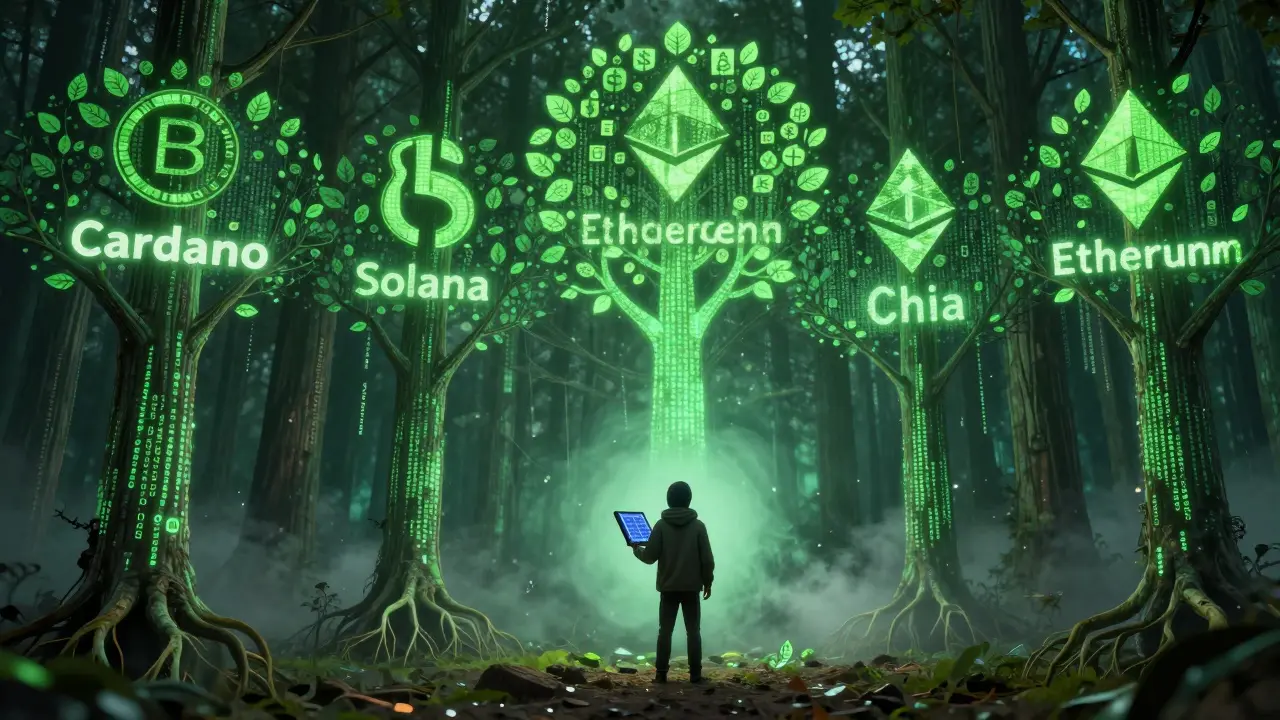
Blockchain for the Planet: Beyond Itself
Here’s the twist: blockchain isn’t just becoming greener - it’s helping other industries get greener too. In Germany, blockchain is being used to track solar energy production from rooftop panels. Every kilowatt-hour generated is recorded on a decentralized ledger. Homeowners can sell excess power directly to neighbors, with payments automatically handled via smart contracts. No middlemen. No delays. Just clean energy moving where it’s needed. In Kenya, blockchain tracks carbon credits from tree-planting projects. Farmers get paid in crypto when trees are verified as planted and surviving. It cuts fraud, increases trust, and rewards real environmental action. This isn’t science fiction. It’s happening now. The same technology once criticized for its waste is now being used to make renewable energy markets fairer, more transparent, and more efficient.What’s Next? The Future Is Already Here
The shift to green cryptocurrency isn’t a trend. It’s a transformation. And it’s accelerating. Regulators in the EU and Canada are already requiring blockchain projects to disclose energy usage. The U.S. is starting to look at energy caps for mining. China banned PoW mining outright in 2021. The pressure isn’t going away - it’s building. Meanwhile, developers are working on even leaner protocols. Data pruning. Transaction compression. More efficient consensus math. Every improvement chips away at the last remnants of waste. The bottom line? You don’t need to choose between decentralization and sustainability anymore. The new blockchains prove you can have both. If you’re looking at crypto today, ask: What’s its energy source? If the answer is “I don’t know,” or “It’s PoW,” you’re probably holding something from 2018. The future is built on stake, not servers. On sunlight, not coal. On efficiency, not excess.FAQ
Is Bitcoin going green?
Bitcoin itself still uses proof-of-work, so its core protocol hasn’t changed. But many Bitcoin miners are now switching to renewable energy sources like solar and geothermal. Some mining operations report over 80% renewable usage. Also, Layer 2 solutions like the Lightning Network reduce the number of on-chain transactions, cutting energy use indirectly. So while Bitcoin won’t switch to proof-of-stake, it’s becoming greener through external changes.
What’s the most energy-efficient cryptocurrency?
Among major cryptocurrencies, Cardano, Solana, and Polkadot are among the most energy-efficient because they use proof-of-stake from launch. Chia Network is even more efficient - using proof-of-space-time, which relies on hard drive space instead of computing power. These networks use less than 0.01% of Bitcoin’s energy per transaction. Ethereum 2.0, after its switch to PoS, reduced its energy use by 99.95%, making it one of the cleanest large-scale blockchains.
Does proof-of-stake make blockchains less secure?
No. Proof-of-stake actually improves security in some ways. In PoW, attackers need expensive hardware to overpower the network. In PoS, they’d need to buy and lock up a huge amount of the cryptocurrency itself - often billions of dollars worth. If they try to cheat, they lose that stake. The economic cost of attacking PoS is higher than the cost of attacking PoW. Ethereum’s PoS system has operated securely for over two years without a single major breach.
Can I mine cryptocurrency sustainably at home?
If you’re using proof-of-work, it’s nearly impossible to mine sustainably at home - your energy use will likely outweigh any rewards. But with proof-of-stake, you can participate by staking coins on your laptop or phone. No special hardware needed. No fans running. Just hold your coins in a wallet and earn rewards passively. It’s the closest thing to sustainable crypto participation.
Are green cryptocurrencies less valuable?
Not at all. Ethereum, the second-largest cryptocurrency by market cap, is now a PoS network and still worth hundreds of billions. Cardano and Solana are also top-10 coins with strong adoption. Value comes from utility, adoption, and network effects - not energy use. In fact, as regulations tighten and public opinion shifts, green cryptocurrencies are becoming more attractive to institutional investors and mainstream users.
15 Responses
Let me tell you something that keeps me up at night: we’re using more electricity to verify digital transactions than entire nations use to power their hospitals, schools, and public transit. And we call this innovation? It’s not just inefficient-it’s morally bankrupt. The fact that Ethereum cut its energy use by 99.95% with PoS isn’t a technical win-it’s a moral reckoning. We had the chance to fix this. We took it. And now? We’re building something that doesn’t just work, but actually respects the planet.
Every time someone says ‘but Bitcoin is decentralized,’ I want to ask: decentralized from what? From responsibility? From accountability? From basic human decency? The blockchain doesn’t need to burn the Earth to prove it’s real. It just needs to be smart.
I’ve watched this space for a decade. I’ve seen the hype, the crashes, the cults. But this? This shift to PoS? This is the first time I’ve felt real hope. Not because of price charts or moon memes. Because we finally chose the right thing. Even when it was hard. Even when it meant rewriting the rules.
And yeah, Layer 2s help. Green mining helps. But none of it matters if we don’t acknowledge the core truth: we were doing it wrong. And now we’re doing it better. That’s not progress. That’s redemption.
po s works fine for me
no need to overthink it
just stake and move on
It is important to note, however, that while proof-of-stake demonstrably reduces energy consumption, it does not eliminate the possibility of centralization risks-particularly when large stakeholders dominate validator selection. Furthermore, the claim that ‘Ethereum now uses less energy than a single household’ is statistically misleading without context: that figure refers to the network’s total annualized consumption, not per-transaction or per-user metrics. Also, the energy savings are relative to Ethereum’s previous PoW state, not to alternative consensus mechanisms like proof-of-space-time, which may be even more efficient. Therefore, while PoS is a vast improvement, it is not the final word on sustainability.
Additionally, the assertion that ‘Bitcoin is stuck in the past’ ignores the fact that Layer 2 solutions like the Lightning Network reduce on-chain load by orders of magnitude, effectively decoupling transaction volume from energy expenditure. The network’s energy use per transaction has dropped by over 90% since 2020, even without consensus change. So, while PoS is elegant, it is not the only path to efficiency.
So let me get this straight-you’re telling me that the same people who told us crypto was ‘decentralized finance’ are now saying ‘oh, but don’t worry, we’re just staking now’? Like, wow. What a pivot.
Who actually owns these validators? Are they just big exchanges with 50% of the stake? Did you see what happened with Solana when the top 10 wallets controlled 80% of the voting power? This isn’t sustainability-it’s rebranding. PoW was bad? Fine. PoS is just Wall Street with a blockchain tattoo.
And don’t even get me started on ‘green mining.’ You think a solar farm in Texas is saving the planet? That’s just fossil fuel companies pretending they’re eco-warriors so they can get tax breaks. They’re not mining with the sun-they’re mining with subsidies.
And Chia? Please. Using hard drives? That’s just trading one waste stream for another. Hard drives wear out. E-waste is the fastest-growing trash problem on Earth. You think your ‘eco-friendly’ Chia miner isn’t going to end up in a landfill in Ghana? You’re delusional.
This whole ‘green crypto’ thing is a marketing campaign. And we’re all just the gullible audience buying the hype. Wake up. The system didn’t change. It just put on a yoga mat and called itself enlightened.
Everyone here is acting like PoS is some kind of miracle cure, but nobody is talking about the elephant in the room: the environmental cost of producing and disposing of the hardware used for staking wallets, cold storage devices, and validator nodes. You think a $500 server running 24/7 for 10 years is better than a GPU mining rig? Let’s calculate the embedded carbon. Mining rigs have a lifespan of 2–3 years. Validator servers? 5–7. But they’re still silicon. Still require lithium, copper, rare earths, and water-intensive manufacturing.
And let’s not pretend that PoS eliminates energy consumption-it just shifts it. The energy used to maintain validator uptime, cooling, and network redundancy is still there. It’s just less visible. And what about the servers in data centers in Amsterdam, Frankfurt, and Singapore? Are those running on 100% renewable? Doubtful.
Also, PoS creates a wealth hierarchy. The rich get richer because they can stake more. That’s not decentralization. That’s plutocracy with a blockchain logo. And now we’re supposed to celebrate this as ‘progress’? I’m sorry, but if your solution to inequality is giving more power to those who already have it, then you’re not solving anything-you’re just polishing the cage.
And don’t even get me started on the carbon footprint of smart contracts. Every time you interact with a DeFi protocol, you’re burning gas on a chain that’s supposedly ‘green.’ How many transactions does it take to swap a token? How many times do you pay fees to move your ‘sustainable’ crypto? You think it’s zero? It’s not. It’s just hidden in the UI.
So yes, PoS uses less electricity. But it’s still built on a system that rewards hoarding, exploits labor, and externalizes environmental costs. If you’re not talking about that, you’re not talking about sustainability-you’re talking about PR.
stake your coins. chill. no mining needed.
So PoS is the new default, right? Cool. But let’s be real-most users don’t even know what staking means. They just buy ETH, hold it, and hope it goes up. The fact that the network runs on 0.01% of Bitcoin’s energy doesn’t matter to them. What matters is whether their wallet app doesn’t crash and whether they can send money to their friend in Nigeria without paying $50 in fees.
And Layer 2s? They’re the unsung heroes here. Lightning Network, zkSync, Optimism-they’re the real reason crypto can scale without melting the grid. PoS made the base layer efficient. Layer 2s made it usable.
Also, Chia’s ‘farming’ model? Genius. Why use a supercomputer when a NAS drive can do the job? It’s like turning your old external hard drive into a mini power plant. I’ve got one running in my closet. Quiet. No heat. Doesn’t even need a fan. That’s the future-tech that works with your life, not against it.
Yeah, PoS is way better. No doubt.
Bitcoin’s Layer 2 stuff is kinda cool too.
Just glad we’re moving forward.
Look, I used to think crypto was all about hype and get-rich-quick schemes. I even wrote it off as a fad. But seeing Ethereum make that switch? That changed my mind.
I’ve got a little bit staked on Cardano. Not because I think I’m gonna get rich. But because I like knowing that every time I send a transaction, I’m not burning a house’s worth of electricity for it. That feels… right.
And honestly? The fact that people are using blockchain to track solar power in Germany or verify tree planting in Kenya? That’s the stuff that matters. This isn’t just about money anymore. It’s about building systems that actually help people and the planet.
So yeah, maybe the early days were messy. Maybe Bitcoin’s energy use was insane. But we’re not stuck there. We moved. We adapted. And now? We’re building something that doesn’t have to cost the Earth.
That’s worth celebrating.
While the transition from proof-of-work to proof-of-stake represents a significant reduction in energy consumption, it is essential to recognize that the broader systemic implications of blockchain adoption remain underexamined. The assumption that energy efficiency equates to environmental sustainability ignores the lifecycle impacts of hardware production, electronic waste, and the geopolitical sourcing of critical minerals required for validator infrastructure. Furthermore, the concentration of staking power among a small number of institutional validators-many operating in centralized cloud environments such as AWS, Google Cloud, or Azure-introduces a new vector of centralization that undermines the original ethos of decentralization.
Moreover, the narrative that ‘green crypto’ is inherently superior often obscures the fact that many of these networks rely on opaque governance structures, token-weighted voting, and economic incentives that disproportionately benefit early adopters and large holders. The environmental benefit, while real, is only one dimension of a much larger ethical and structural calculus.
True sustainability in blockchain requires not just lower energy use, but also distributed ownership, transparent governance, and circular design principles that minimize resource extraction. We have made progress-but we are still in the early innings of a much longer journey.
Oh wow, so now we’re supposed to clap because they just switched from burning coal to burning electricity? That’s your idea of progress? Let me guess-you also think recycling a plastic bottle makes you a climate hero.
Here’s the truth: PoS didn’t solve anything. It just moved the pollution from mining rigs to data centers in Virginia and Singapore. Who runs those servers? Big tech. Who owns the validators? Hedge funds. Who gets rewarded? The rich. And who pays the environmental cost? The planet.
And Chia? Using hard drives? That’s not green-it’s just replacing one waste problem with another. Hard drives die. They’re filled with toxic metals. They’re not biodegradable. And guess what? No one’s tracking where all those old drives go after 3 years. You think they’re being recycled? No. They’re in a landfill in Nigeria. Again.
And don’t even mention ‘green mining.’ Solar panels in Texas? That’s just oil companies buying carbon credits to keep their name clean. They’re not saving the planet-they’re gaming the system.
This whole green crypto movement is a distraction. A shiny new toy so we don’t ask the real question: Why are we even doing this? Why do we need a decentralized ledger to send money? Why not just fix the banking system? Why not regulate corporations? Why do we keep building systems that require more and more tech just to do what a simple bank transfer could do?
You’re not saving the planet. You’re just making it look like you are.
It’s fascinating how quickly the narrative around crypto has shifted-from ‘digital gold’ to ‘digital infrastructure.’ The fact that Ethereum’s energy use dropped by 99.95% after the Merge isn’t just a technical milestone; it’s a cultural one. It suggests that decentralized systems can evolve, adapt, and even self-correct without top-down mandates.
What’s even more interesting is how this mirrors broader trends in open-source software development: the community didn’t wait for regulators or corporations to act. They built the alternative, proved it worked, and migrated en masse. That’s innovation in its purest form.
And while PoS is the dominant model now, I find the experimental protocols-like proof-of-space-time, proof-of-activity, or even hybrid models-far more compelling. They show that the ecosystem isn’t stuck in dogma. It’s exploring. Iterating. Learning.
Perhaps the real lesson here isn’t that one consensus mechanism is ‘better’ than another. It’s that crypto’s strength lies in its ability to experiment. And that’s something worth protecting.
One must, with rigorous academic scrutiny, interrogate the underlying assumptions of this article’s thesis. The assertion that proof-of-stake constitutes a ‘revolution’ is, in fact, a rhetorical overstatement grounded in superficial metrics. While energy consumption metrics are indeed reduced, the fundamental economic incentives of the system remain unchanged-namely, the concentration of validator power through capital accumulation. Furthermore, the claim that ‘Ethereum now uses less energy than a single household’ is statistically incoherent, as it conflates total network energy use with per-capita or per-transaction benchmarks. The article neglects to mention that validator nodes require continuous uptime, redundant network infrastructure, and security audits-all of which incur non-trivial energy expenditures. Moreover, the environmental impact of hardware procurement, cooling systems, and data center maintenance for PoS validators is rarely accounted for in these narratives. One is left to conclude that this piece is less an analysis and more a piece of ideological advocacy masquerading as objective reporting.
Yeah, PoS is way better than mining 😊
Also, Chia is kinda cool with the hard drive thing
Hope we keep improving 🙌
Some of you are missing the forest for the trees. Yes, hardware production has a footprint. Yes, data centers use power. But here’s the difference: we’re now at a point where we can choose to power them with renewables. We couldn’t do that with PoW. You can’t run a 50-megawatt mining farm on rooftop solar. But you can power a validator node with a solar panel on your garage. That’s not a perfect solution-but it’s scalable. It’s adaptable. It’s something we can build on.
And the fact that we’re having this conversation at all? That’s progress. Five years ago, nobody cared. Now, we’re debating how to make it better. That’s the sign of a living system-not a dying one.