
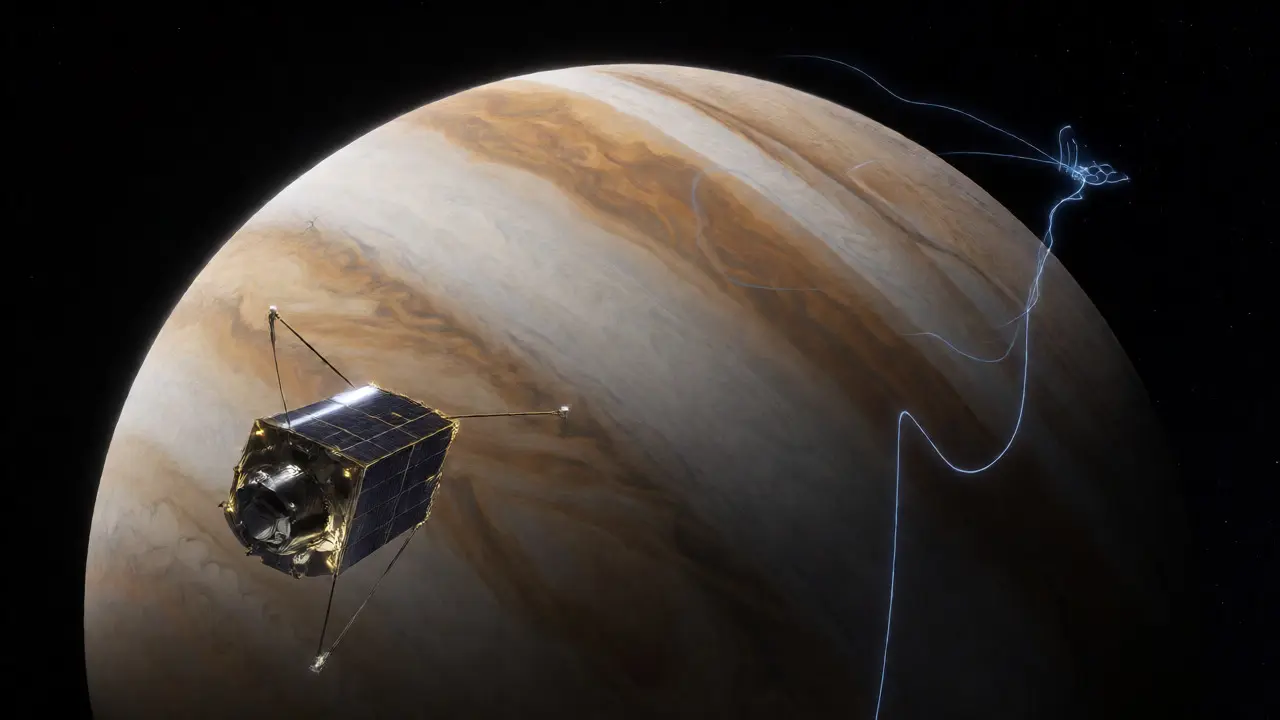
Imagine trying to weigh a cloud by watching how it tugs on a passing bird. That is essentially what scientists do when they map the gravity field of outer planets and moons. It sounds abstract, but this invisible force is our primary tool for seeing inside worlds we can never drill into. By tracking how spacecraft deviate from their predicted paths, researchers reconstruct the mass distribution beneath the clouds of Jupiter or the ice crust of Europa. This process, known as gravity field mapping, turns radio signals into maps of density, revealing hidden oceans, fuzzy cores, and the true weight of Saturn’s rings.
| Mission | Target | Status (2026) | Key Contribution |
|---|---|---|---|
| Juno | Jupiter | Extended Mission Complete | Mapped wind depth (~3,000 km) and core structure |
| Cassini | Saturn/Rings | Completed (2017) | Determined ring mass (~0.5 Mimas) |
| JUICE | Ganymede/Callisto | In Cruise (Arrival 2031) | First detailed moon orbiter gravity survey |
| Europa Clipper | Europa | In Cruise (Arrival 2030) | 49 flybys to confirm subsurface ocean |
The Physics of Listening to Mass
How does a radio wave tell us about a planet’s interior? It comes down to Doppler shifts. A spacecraft sends a coherent signal back to Earth via the Deep Space Network. As the spacecraft flies over a region with more mass-like a dense mountain range or a heavy core-it accelerates slightly. This acceleration changes the frequency of the returned signal. Even at speeds of 130,000 mph, Juno could detect velocity changes as small as 0.01 millimeters per second. These tiny wobbles are not noise; they are data points indicating where mass is hiding.
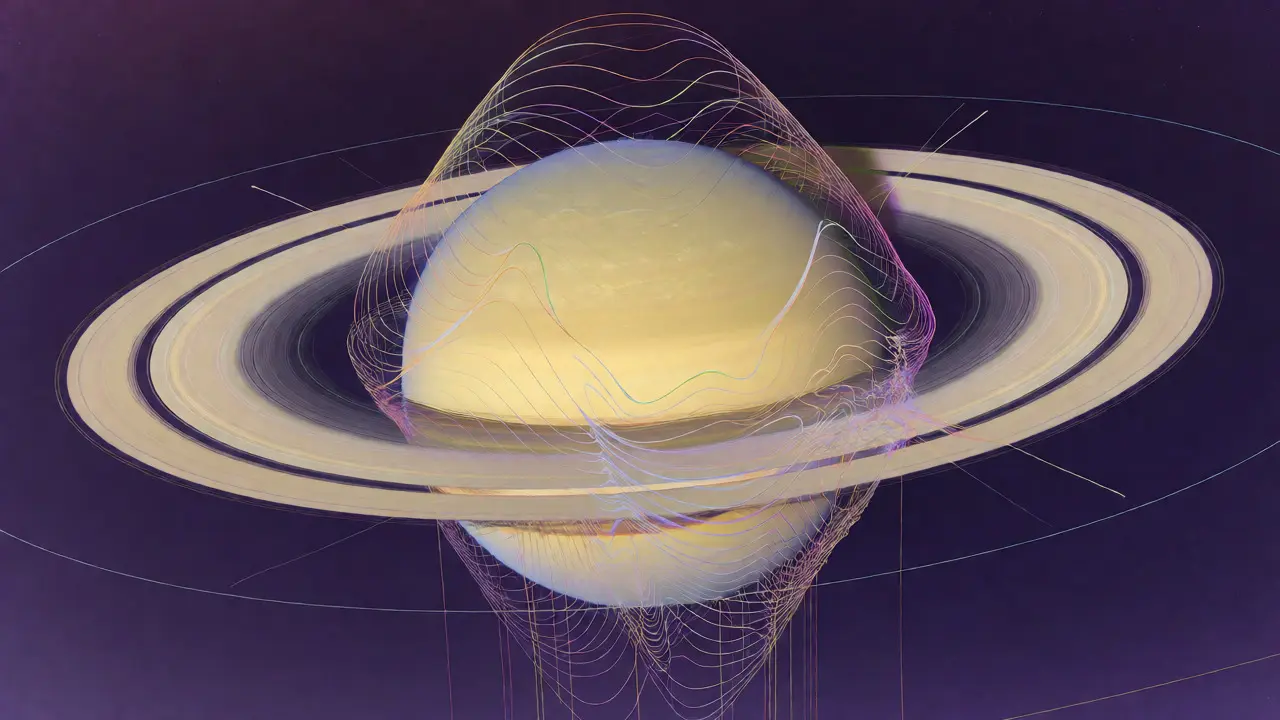
Scientists model these observations using spherical harmonics, mathematical coefficients labeled $C_{lm}$ and $S_{lm}$. Think of these as resolution settings on a camera. Low-degree harmonics give you the global shape and rotation speed, while high-degree harmonics reveal fine details like craters or localized mass anomalies. To get high-resolution maps, you need close, repeated passes. A single flyby gives you a blurry snapshot; an orbiter like Juno gives you a high-definition video loop that lets you separate static mass from dynamic effects like winds.
Jupiter: Peeling Back the Clouds
NASA’s Juno mission revolutionized our understanding of gas giants. Before Juno, we thought Jupiter’s weather layers were shallow. Juno’s precise X-band and Ka-band tracking proved otherwise. The data showed that the iconic east-west belts and zones penetrate deep below the visible cloud tops, extending approximately 3,000 kilometers (1,860 miles) inward. This isn’t just atmospheric trivia; it tells us about the planet’s internal heat flow and magnetic dynamo.
Perhaps the most controversial finding was the "fuzzy" core. Traditional models suggested a sharp boundary between a rocky core and the metallic hydrogen mantle. Juno’s gravity data suggests instead a diluted core, where heavy elements mix gradually with the surrounding fluid. This challenges formation theories, implying Jupiter might have formed differently than previously modeled, perhaps through gradual accretion rather than rapid collapse. The precision required here was immense, relying on near-polar orbits that allowed Juno to sample every latitude repeatedly.
Saturn and the Weight of Rings
If Jupiter is the king of gas giants, Saturn is its enigmatic cousin, famous for its rings. For decades, astronomers debated whether the rings were primordial leftovers from the solar system’s birth or younger debris. Cassini’s Grand Finale orbits settled the score by flying directly between Saturn and its innermost rings. This unique geometry allowed the Radio Science Subsystem to measure the gravitational pull of the rings themselves.
The result? The rings are surprisingly light, with a total mass equivalent to about half of Mimas, one of Saturn’s smaller moons. This low mass suggests the rings are relatively young, likely only a few hundred million years old, and may be disappearing as we speak. However, mapping Saturn’s body itself remains harder than Jupiter’s. Because Cassini had fewer dedicated gravity passes and limited latitude coverage, scientists could only recover harmonics up to degree 10 with confidence. This leaves gaps in our knowledge of Saturn’s deep interior structure compared to the detailed picture we have of Jupiter.
Moons with Hidden Oceans
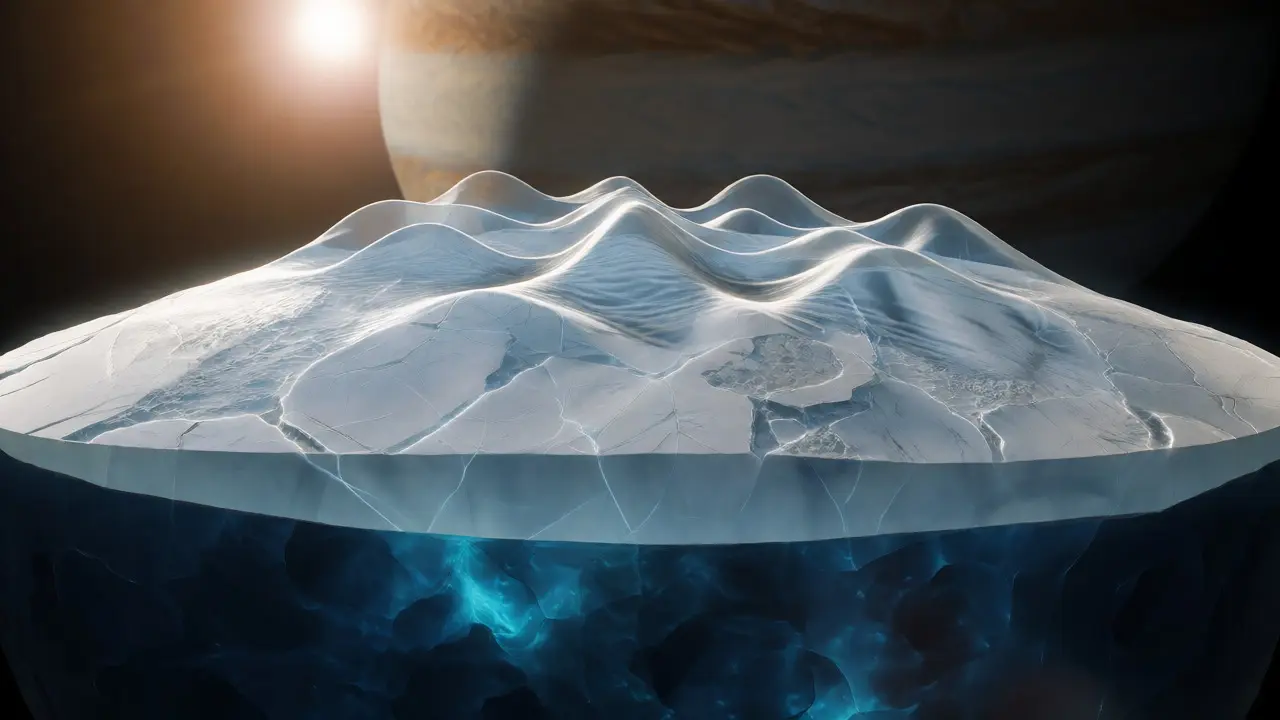
The real treasure hunt in the outer solar system is for water. Icy moons like Europa and Ganymede are suspected to hold vast subsurface oceans beneath their frozen shells. But how do you find water under miles of ice without drilling? You look for tidal deformation. As these moons orbit their giant planets, gravitational tides stretch and squeeze them. If there is liquid water underneath, the ice shell flexes more easily. This flexibility is measured by the Love number $k_2$.
Titan, Saturn’s largest moon, has already provided clues. Cassini flybys estimated Titan’s $k_2$ value at 0.616 ± 0.067, strongly supporting the existence of a global subsurface ocean. Now, ESA’s JUICE mission and NASA’s Europa Clipper aim to refine these measurements. Europa Clipper will conduct 49 flybys, some as close as 25 kilometers above the surface. This proximity allows for extremely sensitive detection of tidal bulges, helping to determine if Europa’s ocean is salty enough to support life. Unlike a lander, which stays in one spot, these orbiters and flyby missions build a global map of gravity variations, distinguishing local anomalies from global ocean signatures.
The Frontier: Uranus, Neptune, and Beyond
While we have mapped Jupiter and Saturn in detail, the ice giants remain largely mysterious. No spacecraft has orbited Uranus or Neptune since Voyager 2 flew past them in the late 1980s. Current estimates suggest that a dedicated orbiter could improve gravity field precision by roughly 1,000 times compared to flyby data. This level of detail is crucial for resolving questions about their internal layers-specifically, whether they have distinct rock-ice-gas boundaries or mixed, slushy interiors.
Proposals for a Uranus Orbiter and Probe are gaining traction, but as of October 2026, no launch date is confirmed. The challenge is operational: these missions require long cruise times, massive power supplies (since solar panels are useless so far out), and robust radiation shielding. Meanwhile, Pluto and Charon present a different puzzle. Their mutual orbit is dominated by a barycenter located outside Pluto itself. While New Horizons gave us masses and densities, we lack the high-degree harmonic maps needed to understand their internal differentiation fully. Future missions could finally reveal if Pluto has a layered structure similar to the icy moons of Jupiter.
From Data to Discovery: The Workflow
Creating these maps isn’t magic; it’s rigorous computational work. The process starts with raw radio tracking data from ground stations. Scientists use software like JPL Mirage or NASA GSFC GEODYN to integrate the spacecraft’s trajectory. They must account for every possible force: solar radiation pressure pushing on the spacecraft, thermal recoil forces, and even the gravitational pull of other moons.
Once non-gravitational forces are modeled, the residuals-the unexplained deviations-are attributed to the planet’s gravity field. Researchers then perform a least-squares fit to estimate the spherical harmonic coefficients. But the job isn’t done there. They must validate the results against independent data arcs and check for correlations. For instance, uncertainty in a planet’s rotation rate can mimic certain gravity features. This is why combining gravity data with imaging, altimetry, and magnetic field measurements is essential. Only by cross-referencing multiple datasets can scientists confidently interpret what the gravity map means for the interior structure.
Why can't we just take pictures of the interior?
We cannot see through thick atmospheres or ice shells with optical cameras. Gravity is the only force that penetrates these layers without attenuation. By measuring how mass affects the motion of nearby objects, we infer what lies beneath, much like doctors use ultrasound to see inside a body without cutting it open.
What is a spherical harmonic coefficient?
It is a mathematical term used to describe the shape of a gravitational field. Lower degrees represent large-scale features like the planet's oblateness, while higher degrees capture finer details like mountains or mass concentrations. Each coefficient corresponds to a specific spatial pattern of gravity variation.
How does gravity mapping prove the existence of subsurface oceans?
Liquid water deforms more easily under tidal forces than solid ice or rock. By measuring the amplitude of a moon's tidal bulge (quantified by the Love number k2), scientists can determine if the interior is rigid or fluid. A high k2 value indicates a flexible interior, strongly suggesting a global subsurface ocean.
Why is mapping Saturn harder than mapping Jupiter?
Cassini had fewer dedicated gravity-dedicated orbits and less diverse latitude coverage compared to Juno. Additionally, Saturn's lower density and different internal dynamics make separating atmospheric winds from deep interior signals more challenging, limiting the recovery of high-degree harmonics.
Will future missions map Uranus and Neptune?
There are strong scientific proposals for a Uranus Orbiter and Probe, which would provide unprecedented gravity data. However, as of 2026, no such mission is approved for flight. The technical challenges of long-duration travel and power generation at those distances make it a complex engineering undertaking.