
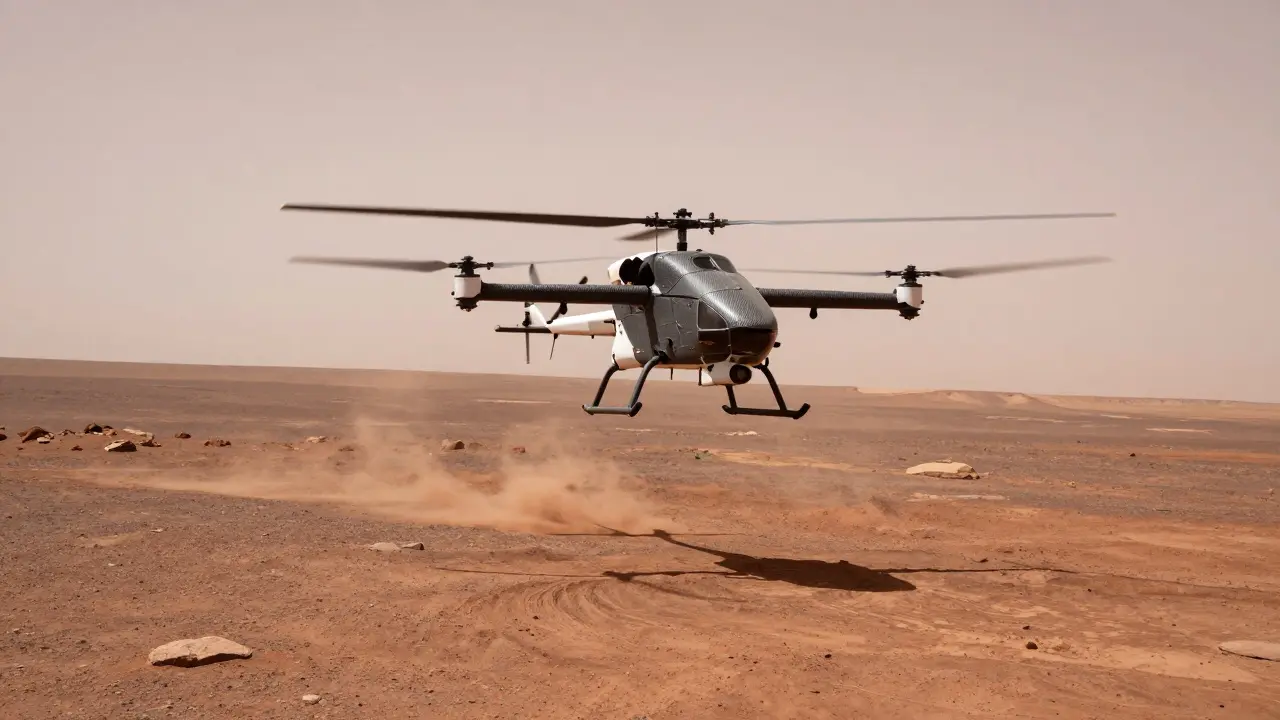
Imagine trying to fly a drone in a place where the air is so thin it feels like you're at the top of Mount Everest, but without the safety of a base camp. That was the challenge facing Ingenuity Mars Helicopter is the first powered, controlled aircraft to achieve flight on another planet. Launched as a daring experiment, it didn't just fly; it fundamentally changed how we plan to explore the Red Planet. Who would have thought a 4-pound robot could survive three years of Martian winters and dust storms while smashing every goal NASA set for it?
The Quick Lowdown on Ingenuity's Success
- Flight Record: Completed 72 flights, far exceeding the original 5-flight goal.
- Distance: Covered about 11 miles (17 km) of Martian terrain.
- Atmospheric Feat: Proved flight is possible in air that is only 1% as dense as Earth's.
- Operational Life: Stayed active for over 1,000 Sols (Martian days).
Beating the Martian Atmosphere
Flying on Mars isn't like flying in your backyard. The Martian atmosphere is an extremely thin layer of gas, primarily carbon dioxide, with a density roughly 1% of Earth's sea-level pressure . To get enough lift to leave the ground, the helicopter had to spin its blades incredibly fast-much faster than a standard drone on Earth. This technical hurdle required a precise balance of weight and power. The craft weighed only 1.8 kilograms (about 4 pounds), using a lightweight carbon fiber structure to keep mass down. By analyzing the data from its 72 flights, engineers learned exactly how much rotor speed is needed to maintain stability in such a vacuum-like environment. This effectively created a blueprint for all future space robotics designed for flight.
The Brains Behind the Flight: Autonomous Navigation
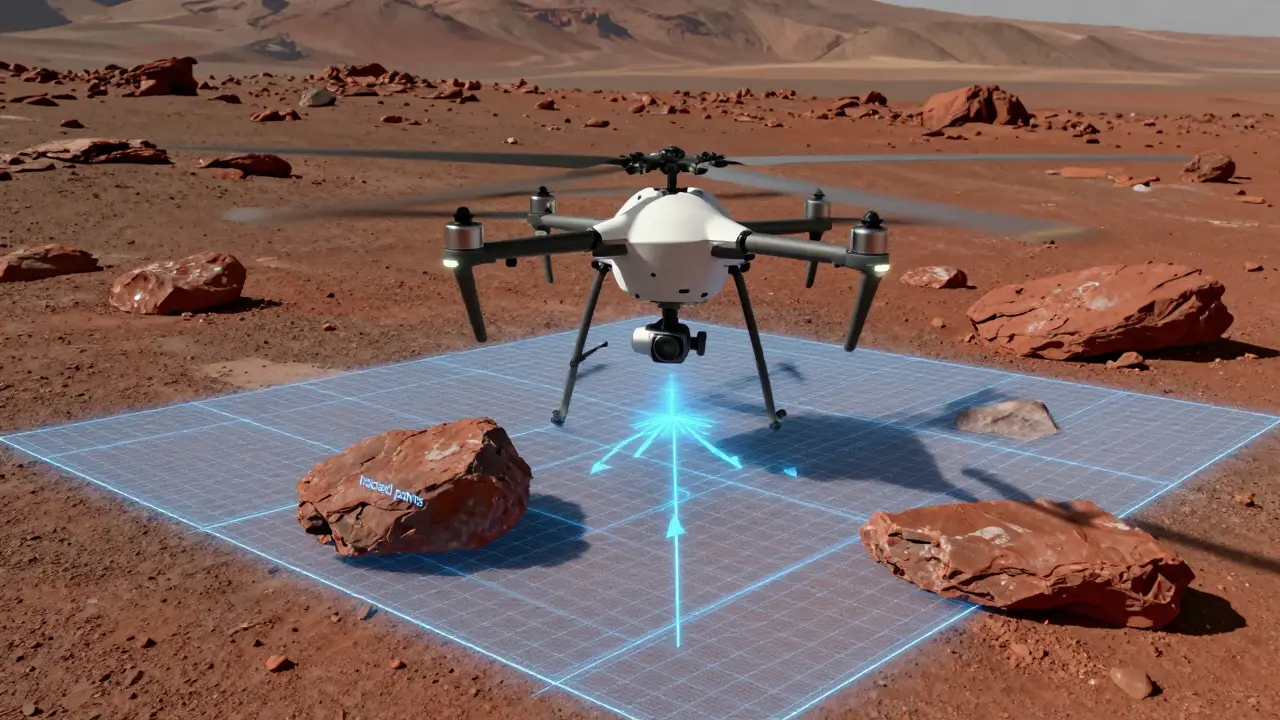
One of the biggest headaches for NASA is the communication lag. Because radio signals take several minutes to travel between Earth and Mars, you can't exactly use a joystick to fly the drone in real-time. If the helicopter started to drift toward a rock, by the time a human pilot on Earth saw it and sent a correction, the drone would have already crashed. To solve this, Jet Propulsion Laboratory (JPL) developed a system where the drone makes its own decisions. It uses a suite of sensors including a laser range finder, an inertial measuring unit, and a downward-facing camera. Through a process called visual odometry, the drone tracks features on the ground to calculate its speed and position. It essentially "sees" where it is and adjusts its flight path instantly without waiting for a signal from Earth.
| Attribute | Design Goal | Actual Achievement |
|---|---|---|
| Number of Flights | 5 Flights | 72 Flights |
| Flight Duration | 30 Days | ~3 Years (1,035+ Sols) |
| Total Distance | Minimal/Local | 11 Miles (17 km) |
| Max Altitude | 3 Meters (10 ft) | Up to 15 Feet |
From a Tech Demo to a Scout
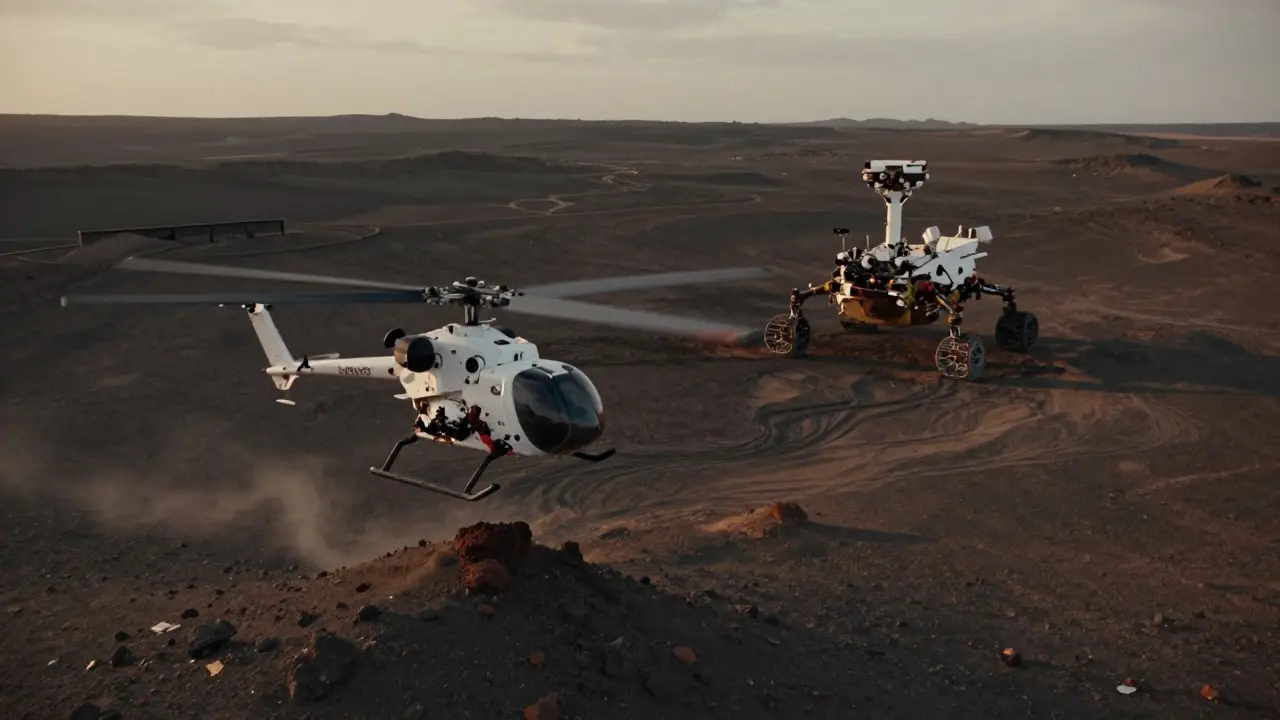
At first, Ingenuity was just a "technology demonstrator." The plan was simple: get it in the air, prove it works, and call it a day. But after the first five flights proved that powered flight was viable, the mission shifted into something much more useful. It became an aerial scout for the Perseverance rover is a car-sized planetary rover designed to seek signs of ancient life and collect rock samples in Jezero Crater . Instead of the rover driving blindly into a valley, Ingenuity would fly ahead and take high-resolution photos of the terrain. This allowed the team at JPL to spot geologic features worth visiting and avoid dangerous sand traps. This collaboration created a new paradigm for planetary exploration: the "aerial-rover duo." Why spend days driving around an obstacle when a drone can fly over it in seconds to see what's on the other side?
Overcoming Glitches and Surviving the Cold
Space is unforgiving, and the mission wasn't without hiccups. During its sixth flight on May 22, 2021, the helicopter experienced a glitch that caused it to pitch back and forth violently in mid-air. In a manned aircraft, this might have been a disaster, but Ingenuity's autonomous systems managed to stabilize the craft and land safely. This moment provided a goldmine of data. It showed engineers how to design recovery algorithms for unexpected anomalies. Furthermore, the drone's reliance on Solar Power is the conversion of sunlight into electricity using photovoltaic cells to charge onboard batteries proved its worth. Despite the freezing Martian nights, the solar panels kept the batteries topped up, allowing the drone to survive far longer than anyone expected.
What's Next for Martian Aviation?
Ingenuity officially ended its mission on January 18, 2024, but its data lives on. The lessons learned are already being baked into the next generation of aircraft, such as the Mars Sample Recovery Helicopter, which will likely be larger and more capable. We now know that we can move beyond the "slow and steady" approach of rovers. Future missions will likely feature a fleet of drones that can map entire regions, explore deep craters, and even transport small packages between different landing sites. The success of the "Ginny" (as the high school student who named it called her) has turned a sci-fi dream into a practical engineering reality.
Why was it so hard for Ingenuity to fly on Mars?
The main challenge was the atmospheric density. Mars' atmosphere is about 1% as dense as Earth's, meaning there is very little air for the rotor blades to push against to create lift. To compensate, the helicopter had to be incredibly light and its blades had to spin at much higher speeds than a typical helicopter on Earth.
How did NASA control the drone if there was a signal delay?
NASA didn't control it in real-time. Instead, they used "command sequences." Pilots at the Jet Propulsion Laboratory would plan the flight path on Earth and send the instructions to the Perseverance rover, which then relayed them to Ingenuity. The drone then executed the flight autonomously using onboard sensors and algorithms.
What happened to Ingenuity at the end of its mission?
The mission ended on January 18, 2024, after its 72nd flight. While the exact end-of-life details involved hardware degradation and the harsh environment, the drone had already far exceeded its original mission of five flights, providing years of invaluable data.
Did Ingenuity use fuel or batteries?
Ingenuity was fully electric. It used solar panels on top of its rotor blades to collect energy from the sun, which was then stored in lithium-ion batteries to power the motors and onboard computers.
How did the helicopter help the Perseverance rover?
It acted as a high-altitude scout. By flying ahead of the rover, it could take photos of the terrain to help scientists identify interesting rocks and help drivers plan the safest and most efficient routes, avoiding obstacles the rover couldn't see from its ground-level perspective.
Next Steps for Space Enthusiasts
If you're fascinated by how we're conquering the Red Planet, keep an eye on the upcoming Mars Sample Return missions. This is where the lessons from Ingenuity will be most critical, as we'll likely need aerial assets to help fetch and transport samples back to an ascent vehicle. You might also want to look into the "Dragonfly" mission, which aims to send a rotorcraft to Titan, Saturn's moon-a place with an even thicker atmosphere than Mars, making flight a totally different challenge!
18 Responses
It is truly inspiring to see how a small piece of technology can open up such massive possibilities for the future of exploration. The synergy between the rover and the helicopter is a game-changer!
Eh, it's basically just a glorified remote control toy. Everyone's acting like it's a miracle when it's just basic physics and a lot of funding.
The sheer audacity of existence... to fly in a void that rejects flight itself... is a testament to the human spirit!!! Does this not make us wonder about the very nature of our own fragility... compared to the cold, indifferent silence of Mars???
Oh wow, a 4-pound robot flew for a bit. Groundbreaking. I'm sure the billions spent on this were a great use of resources while people are literally starving. Truly an elite achievement in spending money.
First of all, the
First of all, the phrasing in this whole post is suspect. Second, you guys actually believe these
First of all,
First off, you wrote "Mars' atmosphere" which is technically fine but the whole narrative is just a cover. NASA probably just flew this thing in a vacuum chamber in Nevada and used CGI for the footage. Think about the
First off, you wrote "Mars' atmosphere" which is technically fine but the whole narrative is just a cover. NASA probably just flew this thing in a vacuum chamber in Nevada and used CGI for the footage. Think about the logistics of actually landing a rover and then a drone perfectly without a single catastrophic failure in the deployment phase. It's too convenient. They want us looking at the stars so we don't see what's happening in the bunkers. Plus, the physics of 1% density are convenient for whatever fake numbers they want to plug into their simulation to make us feel like they're doing something impressive. It's a psyop to justify the budget. Wake up people.
Stop spreading garbage theories about NASA. The data is public and the engineering is sound. Keep your delusions out of the science thread!
imagine thinking a drone is the pinnacle of tech when we cant even fix the climate here lol typical human greed wanting more land before cleaning up the mess we made
This is such a dazzling feat of engineering! Imagine the sheer ingenuity (pun intended!) required to map out those flight paths with such a massive time lag. It's like a cosmic dance of math and metal. For anyone interested in the specifics, the visual odometry mentioned is a fascinating blend of computer vision and real-time kinematics that allows the drone to essentially anchor itself to the Martian soil through pixels. It's absolutely brilliant and paves the way for more complex aerial robotics across the solar system, perhaps even on Venus if we can handle the heat!
It's just a drone. Not that deep.
honestly its cute that you think this is a big deal but like... anyone with a basic degree knows the lift coeffecient here is trivial compared to realy complex aero launcing systems. its basically a toy. i mean the asembly was probaby rushed and the solar panels are basic at best. i've seen better tech in a cheap hobbyst kit from china lol. just anothr way to waste tax payer money on something that barely flies 15 feet. so pretensious to call it a scout when it basically just hovers and looks at rocks. boring.
Whatever. Just another robot.
Way to go NASA! 🚀 This is such a huge win for science! Can't wait to see what the next version does! 🚁✨
really cool stuff man. love seeing how different countries get involved in space too. just awesome to see us pushing boundaries like this
One must consider the profound implications of autonomous navigation in extraterrestrial environments. The shift from direct human control to algorithmic decision-making represents a fundamental transition in our relationship with robotic exploration. By empowering the craft to perceive and react to its environment without terrestrial intervention, we are essentially creating a new form of synthetic intuition. This capability is not merely a technical convenience but a philosophical leap in how we extend human presence across the cosmos, ensuring that our curiosity is not limited by the speed of light.