
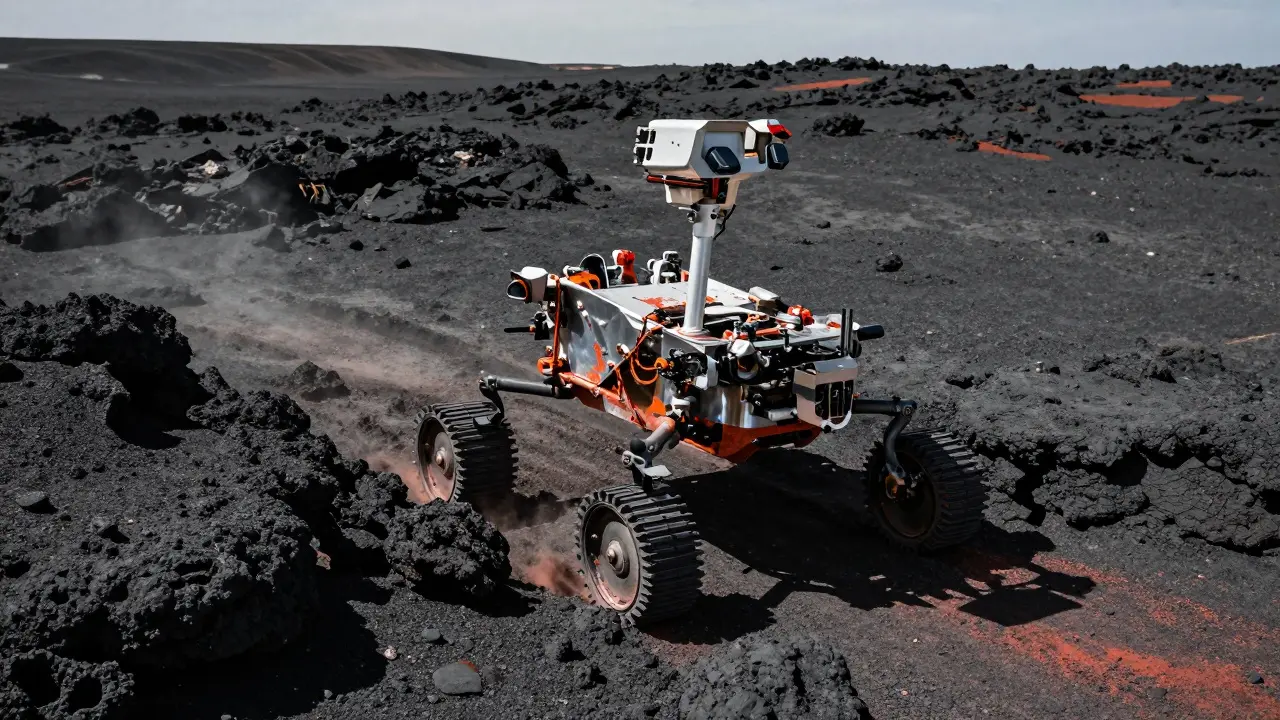
Sending a robot to Mars is a multi-billion dollar gamble. If a wheel jams or a drill snaps on a distant planet, there is no repair crew to send out. That is why engineers don't just build robots in labs; they put them through hell on Earth first. Space robotics is the field of designing and deploying autonomous or semi-autonomous machines to explore extraterrestrial environments. To make sure these machines survive, researchers use "analogs"-places on Earth that look and feel like the Moon, Mars, or the frozen moons of Jupiter.
These aren't just scenic trips. These sites are chosen because their geology, chemistry, and weather mimic the brutal conditions of space. By testing a rover in a Chilean desert or a Canadian glacier, teams can break things early and fix them before they leave the atmosphere. This process turns a theoretical design into a battle-hardened piece of hardware.
The Gold Standard of Desert Testing
When you think of Mars, you think of red dust and jagged rocks. To replicate this, NASA uses the Desert RATS (Desert Research and Technology Studies) program. Since 2008, they have operated out of the Black Point Lava Flow in Arizona. This isn't just a sandy patch; it is a complex landscape of volcanic rock and extreme heat that challenges a robot's suspension and thermal management.
The program has grown significantly since it started in 1997. What began as a small four-person team is now one of the largest annual analog missions. They run three-week exploration sprints where rovers and habitat systems are pushed to their limits. They focus on two main things: roving (getting from A to B without getting stuck) and Extravehicular Activity (EVA), which is the fancy term for when a robot or astronaut leaves their base to do science.
Beyond Arizona, the search for life requires even more specific conditions. The ARADS (Atacama Rover Astrobiology Drilling Studies) project took their gear to the Atacama Desert in Chile. Because it is the driest place on Earth, it is a perfect stand-in for the Martian surface. The primary goal here was testing a rover-mounted drill designed to hunt for biosignatures-chemical fingerprints that prove life once existed. If a drill can penetrate the hyper-arid, salty crust of the Atacama, it has a fighting chance on Mars.
Conquering the Ice: Arctic and Glacial Analogs
Not every target is a dry rock. The moons of Saturn and Jupiter, like Europa or Enceladus, are essentially giant ice balls. Testing robots for these environments requires a completely different set of tools. This is where the EELS (Exobiology Extant Life Surveyor) robot comes in. These aren't your typical wheeled rovers; they use a screw-like propulsion system to "bore" through ice and snow.
In September 2023, the EELS team hit the Athabasca Glacier in Alberta, Canada. This was the first time the 1.0 and 1.5 prototypes were tested in a natural, large-scale icy environment. The results were telling: the robots successfully climbed snowy slopes at 35-degree angles. More importantly, they proved that the specific design of the screw is the make-or-break factor for moving across unpredictable glacial surfaces.
But glaciers are just the start. For true isolation, researchers head to Devon Island (Tallurutit) in the Arctic. In the summer of 2024, an international team used this uninhabited island to test equipment. Why Devon Island? Because it offers a combination of extreme terrain and absolute isolation that mimics the psychological and physical stress of a deep-space mission. It allows engineers to see how their systems handle the "cold soak"-when components reach equilibrium with an Arctic freeze.
| Analog Site | Primary Target | Key Environmental Attribute | Focus of Testing |
|---|---|---|---|
| Black Point Lava Flow | Moon / Mars | Volcanic terrain, High heat | Mobility & EVA operations |
| Atacama Desert | Mars | Extreme aridity (Dryness) | Drilling & Biosignature sampling |
| Athabasca Glacier | Icy Moons | Natural ice/snow slopes | Screw-propulsion & Navigation |
| Devon Island | Polar Regions | Extreme isolation, Cold | System durability & Protocols |
The Path from Lab to Launch
Engineers don't just throw a robot into the Arctic and hope for the best. They follow a strict, staged validation process. If you skip a step, you risk losing a million-dollar prototype to a simple pebble.
- Laboratory Testing: Robots start on synthetic surfaces or controlled ice panels. This is where they figure out if the motor works and if the code crashes.
- Intermediate Field Tests: They move to semi-natural environments, like a local snowy mountain or a sand pit. This introduces a bit of randomness into the equation.
- Full-Scale Field Demonstrations: This is the final exam. The robot is deployed to a place like the Athabasca Glacier or the Atacama Desert to see if it can handle real-world complexity, from unpredictable slopes to telemetry lag.
These tests provide a goldmine of data. Every time a robot slips or a sensor fails, it is recorded in a telemetry log. This data is used to refine the Autonomous Navigation systems. For example, the EELS tests focused heavily on path tracking and mapping, ensuring the robot knows where it is even when the landscape looks like a blank sheet of white snow.
Leveraging Existing Infrastructure
Building a temporary camp in the Arctic is expensive. To lower the cost, agencies are using existing polar research stations. Polish polar stations, for instance, are being looked at as permanent hubs for space analog research. These facilities already have the power, housing, and communication links needed to support long-term experiments.
By using these stations, researchers can test how equipment reacts to long-term exposure to extreme cold. It is one thing for a robot to work for three hours; it is another for it to survive a polar winter. This is crucial for missions targeting the lunar south pole, where robots must survive a lunar night that lasts weeks and reaches temperatures that would freeze most electronics solid.
Why not just use simulators for space robot testing?
Simulators are great for code, but they can't replicate the "grit" of reality. Physical analogs provide unpredictable variables-like a rock shifting under a wheel or a seal leaking due to extreme temperature swings-that software simply cannot predict perfectly.
What is the most difficult part of desert analog testing?
Thermal management is usually the biggest headache. In places like Arizona or the Atacama, robots have to deal with intense solar radiation and heat that can fry internal circuits, mimicking the harsh sun exposure on the Martian surface.
How does a screw-drive robot differ from a wheeled one?
Wheels often slip or sink in soft snow and ice. Screw-drives (like those on the EELS robot) rotate to push the robot forward, essentially drilling into the surface for grip. This allows them to climb steeper slopes and move through slush that would trap a traditional rover.
Which Earth location is most similar to Mars?
The Atacama Desert is often cited as the best analog for Mars due to its extreme dryness and lack of biological activity, while the volcanic fields of Arizona provide the best topographical match for Martian craters and plains.
What happens if a robot fails during a field test?
Failure is actually the goal of field testing. Every failure mode-whether it's a software glitch in path planning or a mechanical break in a drill-is analyzed to redesign the component, ensuring it doesn't happen during the actual space mission.
Next Steps for Engineers
If you are designing a robotic system for extreme environments, don't start with the most expensive terrain. Start in the lab, move to a controlled outdoor site, and only then seek out an analog. For those focusing on icy worlds, the priority should be testing screw-propulsion and thermal insulation. For Mars-bound teams, the focus must remain on autonomous sample collection and drilling durability in high-salt, dry soils.
14 Responses
Thermal management is indeed the critical bottleneck here. In actual Martian conditions, the diurnal temperature swing is far more aggressive than what you see in Arizona, often requiring sophisticated radioisotope heater units (RHUs) to keep the electronics from freezing during the night.
oh wow... so we're just spending billions to drive RC cars in the dirt... ground breaking stuff right here!!!
The obsession with "analogs" is frankly a bit quaint. While the Atacama is cute for a field trip, anyone with a basic understanding of planetary science knows that terrestrial geology is an imperfect proxy at best. We should be investing more in high-fidelity synthetic environments rather than playing in the sand.
Actually, calling it a "gamble" is a bit of a linguistic stretch, isn't it? It's more of a calculated risk. Also, "multi-billion dollar" should technically be hyphenated as a compound adjective. Just a little something to spice up the prose!
I completely agree with the logic here! If you don't break it in the desert, you're just waiting for it to break on Mars and waste everyone's time and money!
Why are we even talking about robots when the actual goal is to colonize? Testing a screw-drive on a glacier is just a distraction from the fundamental philosophical failure of treating space as a lab instead of a new home. This whole approach is just a slow crawl toward a goal we aren't even honest about.
I've always wondered if the telemetry lag mentioned is the most stressful part for the operators because it must be so frustrating to watch a rover potentially tip over in real-time but not be able to send the 'stop' command for several minutes, which honestly makes the whole process sound like a nightmare for anyone with a bit of anxiety about their hardware.
It is quite fascinating, though one must wonder if these "analogs" are merely a cover for the actual testing of surveillance tech designed for terrestrial control. I mean, please, look at the geography of Devon Island-it is suspiciously similar to certain classified zones. Nevertheless, the engineering of the screw-propulsion is objectively impressive in its execution.
The imagery of these little screw-bots boring through the ice is just absolutely wild. It's like something out of a fever dream or a sci-fi flick from the 70s!
The focus on biosignatures in the Atacama is such an inspiring part of this research. It really highlights how the intersection of biology and robotics is the only way we will ever find a definitive answer about life beyond Earth.
Oh my goodness, the sheer scale of the isolation on Devon Island is simply breathtaking to contemplate! I can only imagine the profound loneliness and the crushing weight of the silence that the engineers must feel while they are fighting against the elements to keep their precious machines alive in that freezing void, it is truly a heroic effort of human spirit and technical brilliance!
Get rid of the lab tests and just throw it in the ice already.
I love the enthusiasm here!!! But seriously... the formatting in that table is a total mess... like, who lets a table slide without proper alignment??? Anyway, the point about the 'cold soak' is spot on because that's where most of these toys usually fail!!!
For anyone looking to enter this field, it's so important to realize that the failures mentioned aren't just bugs but are actually the most valuable part of the learning curve, so keep pushing your designs to the breaking point because that's where the real growth happens and the most robust systems are born through a cycle of constant iteration and failure.