

Have you ever wondered why your internet connection sometimes drops or slows down? A big part of the answer lies in the glass cables running under oceans and through cities. These optical fibers carry data as pulses of light, but they are not perfect. Tiny flaws inside the glass-microscopic crystals, bubbles, and impurities-scatter that light, causing signal loss. On Earth, gravity makes these defects almost impossible to avoid in certain high-performance glasses. But what if we could remove gravity from the equation entirely?
This is exactly what engineers are doing right now aboard the International Space Station. By manufacturing optical fibers in the microgravity environment of low Earth orbit, companies and agencies are producing a specific type of glass fiber called ZBLAN with far fewer defects than ever before possible on our planet. This isn't just science fiction; it is an active industrial experiment that has already produced kilometers of flawless fiber.
The Problem with ZBLAN on Earth
To understand why space is necessary, we first need to look at the material itself. Most standard internet cables use silica glass. It is robust, cheap, and works well for most applications. However, scientists have long known about a superior alternative: ZBLAN. The name comes from its chemical ingredients: Zirconium, Barium, Lanthanum, Aluminum, and Na fluoride. In theory, ZBLAN can transmit infrared light with up to 50 times less attenuation (signal loss) than silica. This would mean faster data speeds over longer distances without needing repeaters.
So why don't we use it everywhere? The problem is gravity. When molten ZBLAN cools on Earth, buoyancy-driven convection currents form. Hotter, lighter liquid rises while cooler, denser liquid sinks. This movement causes tiny crystals to nucleate and grow within the glass structure. These microcrystals act like speed bumps for light, scattering signals and weakening the fiber's mechanical strength. No matter how advanced the furnace technology on Earth becomes, gravity always creates these thermal gradients, limiting defect-free lengths to mere tens of meters.
How Microgravity Solves the Defect Issue
In the microgravity environment of the International Space Station, roughly 400 kilometers above Earth, those convection currents disappear. Without gravity pulling denser materials down, the molten glass remains stable. The temperature distribution becomes uniform, allowing the glass to cool into a homogeneous amorphous state without crystallizing.
Think of it like trying to pour a smooth layer of paint. On Earth, if the surface isn't perfectly level, the paint runs and pools. In space, the "surface" doesn't tilt relative to the fluid's weight, so it spreads evenly. For ZBLAN, this means the resulting fiber is virtually free of the crystal inclusions that plague Earth-made versions. The result is a clearer path for light, significantly reducing attenuation and increasing the durability of the cable.
Key Players and Milestones in Space Fiber Production
The journey to flawless fiber has been a collaborative effort involving several key organizations. Here is a breakdown of who is driving this technology forward:
| Organization | Role / Contribution | Key Achievement |
|---|---|---|
| NASA | Funding and Payload Integration | Supported multiple campaigns including the Flawless Space Fibers-1 investigation |
| Made In Space | Early Pioneer | Launched the first microwave-sized drawing machine to the ISS in 2017 |
| Flawless Photonics | Commercial Manufacturer | Produced over 11 km of ZBLAN in early 2024, marking commercial viability |
| ISS National Lab | Facility Provider | Hosts the experiments and provides logistical support for payloads |
| Physical Optics Corporation | Technology Developer | Flew ZBLAN-drawing payloads to demonstrate feasibility between 2017-2019 |
The timeline shows rapid progress. In December 2017, Made In Space sent a small fiber-drawing machine to the ISS. It successfully pulled about 100 meters of ZBLAN, proving the concept worked. Fast forward to early 2024, and Flawless Photonics executed a month-long campaign. Their equipment performed 16 separate drawing operations, producing nearly 12 kilometers of fiber. Crucially, seven of those individual draws exceeded 700 meters each. This shift from hundreds of meters to kilometers demonstrates that the process is no longer just a scientific curiosity-it is approaching industrial scale.
The Technology Inside the Drawing Tower
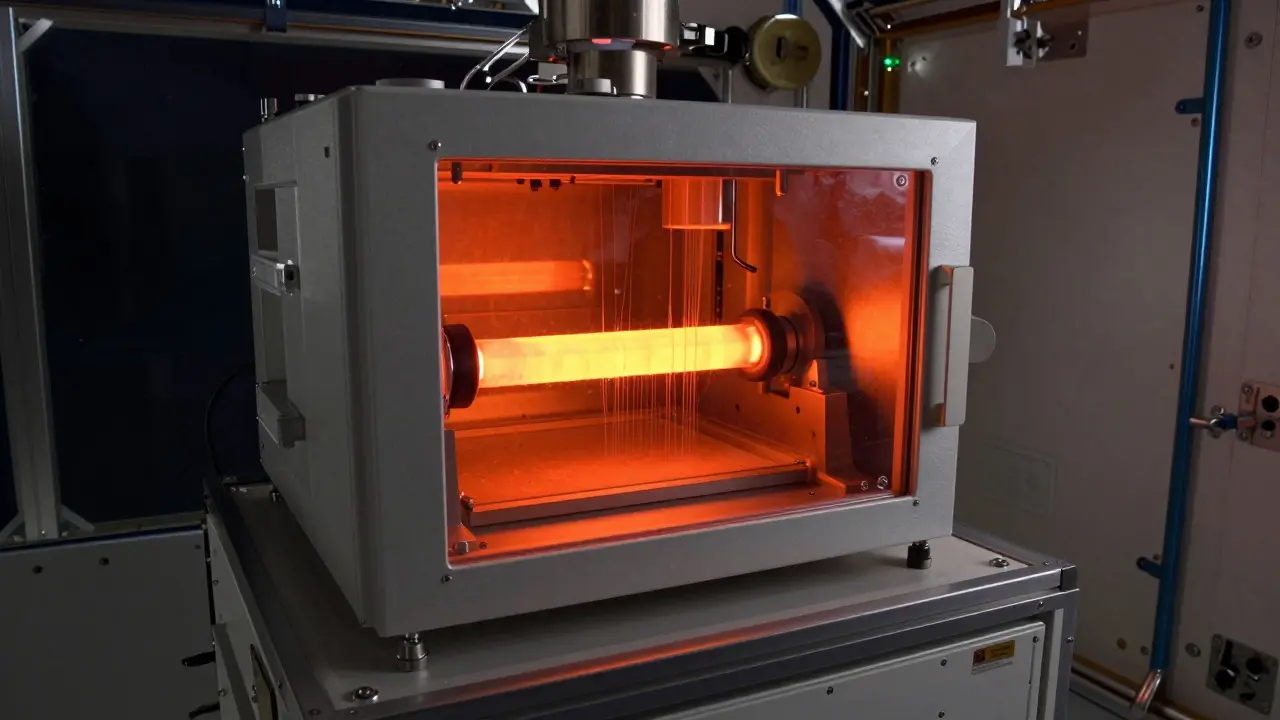
You might imagine a massive factory floating in space, but the reality is much more compact. The manufacturing systems are essentially miniaturized, automated drawing towers designed to fit inside standard ISS experiment racks. Despite their size-often described as being "a bit bigger than a microwave"-they contain complex subsystems working in harmony.
Here is how the process works step-by-step:
- Feedstock Loading: Pre-loaded rods of ZBLAN glass are inserted into the system. This feedstock must be exceptionally pure to avoid introducing external contaminants.
- Heating: A furnace heats the tip of the glass rod to temperatures exceeding 1,000 °C, turning it into a viscous liquid.
- Neck-Down and Drawing: As the glass melts, it forms a meniscus. Automated controls pull the fiber downward at precise speeds. Because there is no gravity pulling the melt down unevenly, the diameter remains consistent.
- Diameter Control: Sensors monitor the fiber thickness in real-time, adjusting the draw speed to keep variations below 1-2%. This precision is critical for maintaining optical performance.
- Take-Up Spooling: The newly formed fiber is wound onto a spool with controlled tension. Robotic arms handle this delicate task to prevent mechanical damage during storage.
Automation is key here. Astronauts have limited time, so these systems must run for weeks with minimal human intervention. Flawless Photonics and other partners have focused heavily on making these machines self-sufficient, using redundant sensors and shock-isolated mounts to withstand vibrations from visiting cargo vehicles.
Challenges and Economic Realities
While the technical success is undeniable, the economic picture is still forming. Launching materials to space costs thousands of dollars per kilogram. Bringing them back is even more expensive. Currently, there are no publicly announced retail prices for space-manufactured ZBLAN, nor are there large-scale commercial deployments in global networks.
Critics point out that while defect reduction is real, the gap between space-made and Earth-made fiber may be smaller than early hype suggested. Some analyses suggest performance improvements might be factors of 2-5 rather than 10-100 for certain wavelengths. Additionally, improved Earth-based techniques, such as faster quenching and better furnace designs, continue to narrow the quality gap.
However, proponents argue that for ultra-high-value applications, the premium cost is justified. Imagine transoceanic communication cables that require fewer amplifiers, or high-power laser delivery systems for medical or industrial use where every bit of signal clarity matters. If launch costs drop by factors of 2-3 in the late 2020s, as some predict, space-manufactured fibers could become economically competitive for these niche markets.
Future Outlook: Beyond the ISS
The International Space Station has served as the perfect testbed, but it won't last forever. As the ISS approaches the end of its operational life, the focus is shifting toward dedicated free-flying manufacturing platforms. These independent stations could offer more volume, less vibration, and continuous operation without the constraints of crew schedules.
Companies like Flawless Photonics are already building supply chains that include on-orbit production, quality inspection, and return via cargo vehicles. The goal is to move from experimental lots to reliable commercial supply. We are likely looking at a transition period throughout the late 2020s and early 2030s, where we will see the first true commercial contracts for space-made optical fiber.
For now, the message is clear: gravity is the enemy of perfect glass. By taking manufacturing to space, we are removing that enemy and unlocking the full potential of advanced materials. Whether this leads to faster internet for everyone or specialized tools for industry leaders remains to be seen, but the technology has proven its worth.
What is ZBLAN fiber and why is it special?
ZBLAN is a multi-component heavy-metal fluoride glass made from zirconium, barium, lanthanum, aluminum, and sodium fluorides. It is special because it can theoretically transmit infrared light with significantly lower attenuation (signal loss) than standard silica fiber, making it ideal for high-speed telecommunications and sensing applications.
Why does gravity cause defects in optical fiber?
On Earth, gravity causes convection currents in molten glass as it cools. Denser, cooler liquid sinks while lighter, hotter liquid rises. This movement promotes the formation of microscopic crystals and bubbles within the glass structure, which scatter light and weaken the fiber. Microgravity eliminates these currents, allowing for a smoother, more uniform cooling process.
How much fiber has been produced in space so far?
As of early 2024, campaigns aboard the International Space Station have produced over 11 kilometers of ZBLAN fiber in a single month-long trial. Earlier experiments in 2017 produced around 100 meters, showing rapid scaling from proof-of-concept to near-commercial lengths.
Is space-manufactured fiber available for purchase?
Not yet for general consumers. As of mid-2024, the product is in pre-commercial or pilot deployment stages. While companies like Flawless Photonics have demonstrated the ability to produce commercially viable lengths, there are no public price lists or widespread commercial network deployments. The focus is currently on validating performance and establishing supply chains.
Who are the main companies involved in this technology?
Key players include Flawless Photonics, which has led recent large-scale production campaigns; Made In Space, an early pioneer that launched the first drawing machine in 2017; Physical Optics Corporation; and Fiber Optic Manufacturing in Space (FOMS). These efforts are supported by NASA, ESA, and the ISS National Lab.