
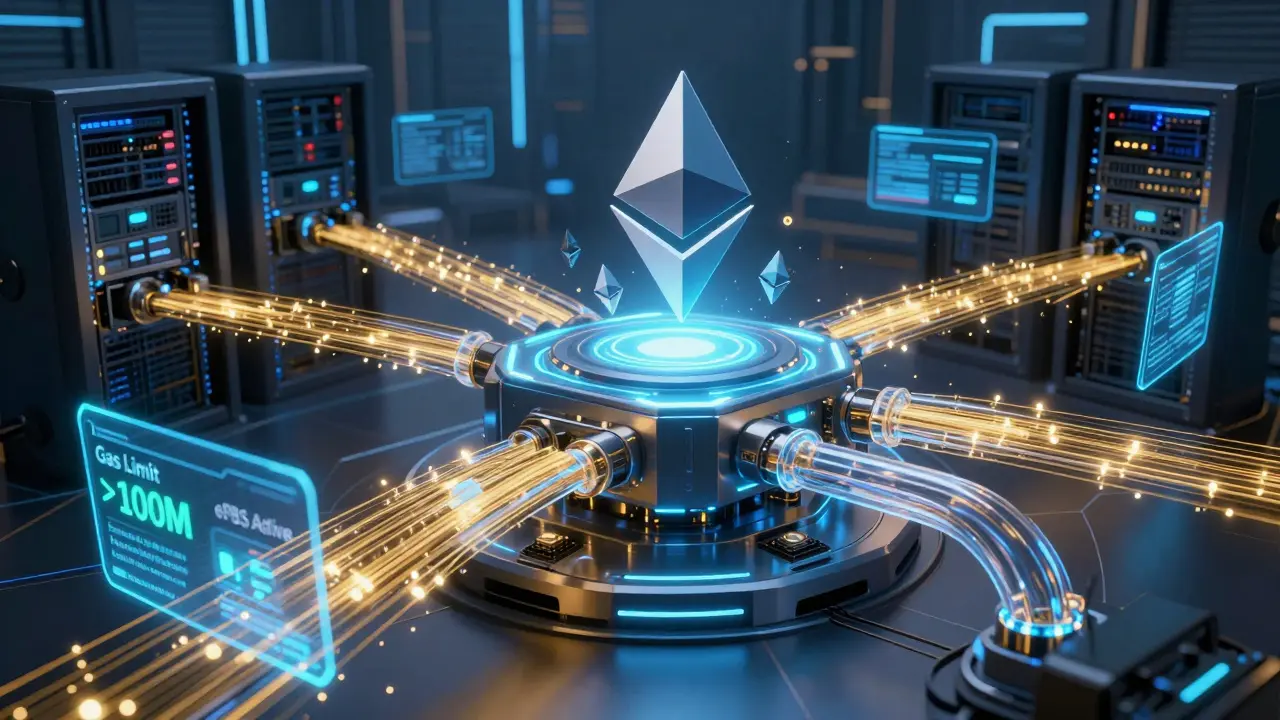
Remember when running an Ethereum node felt like a full-time job? Back in the early days of Proof of Stake, syncing the chain took forever, and storage requirements kept climbing. That era is officially over. As we settle into mid-2026, Ethereum is a decentralized blockchain platform that has evolved into a high-performance settlement layer for global applications looking drastically different than it did just two years ago. The network isn't just surviving; it's optimizing for decades, not market cycles.
The Ethereum Foundation released a comprehensive roadmap for 2026 that signals a major shift in strategy. Instead of bundling risky features into massive, infrequent upgrades, developers are pushing smaller, more frequent updates. This approach reduces risk while keeping the network improving steadily. If you've been wondering what this means for your transaction fees, wallet experience, or the stability of apps you use, here is exactly what is coming next for the network.
The Three Pillars of the 2026 Strategy
To understand where the network is heading, you have to look at the three core priorities driving development this year. These aren't random feature requests; they are interconnected goals designed to solve specific bottlenecks.
1. Network Expansion (Scaling)
This is about raw capacity. The goal is simple: handle more activity at lower costs. In 2025, the gas limit-the cap on computational work per block-was raised from 30 million to 60 million units. For 2026, the target is to push that limit toward and beyond 100 million. This increase allows the base layer to process significantly more data without clogging up the system.
2. Improving User Experience (UX)
Crypto wallets used to be clunky and confusing. The 2026 roadmap prioritizes native account abstraction. This means smart wallets will get better protocol-level support, making recovery easier and interactions smoother. Additionally, there is a heavy focus on interoperability, aiming for seamless, trust-minimized cross-Layer 2 (L2) interactions. You should soon be able to move assets between different L2 chains without jumping through hoops or trusting third-party bridges.
3. Strengthening Layer 1 (Security)
As the network grows, security becomes even more critical. This track focuses on censorship resistance and long-term protocol health. It also includes tackling technical debt-those small inefficiencies that accumulate over time and make running nodes harder. A cleaner codebase means a more robust network.
Glamsterdam: The First Half of 2026
The first major milestone of the year is the Glamsterdam upgrade scheduled for the first half of 2026 focusing on enshrined proposer-builder separation and block-level access lists upgrade. By now, in May 2026, implementation should be imminent or recently completed depending on your specific node status. This upgrade delivers two game-changing features.
First, it introduces Enshrined Proposer-Builder Separation (ePBS) a mechanism implemented via EIP-7732 that separates block agreement from processing to improve scalability and reduce centralization risks. Previously, validators had to trust external software to assemble blocks efficiently. With ePBS, this process is natively integrated into the protocol. Validators can safely outsource block assembly without compromising security. This helps Layer 1 scale by allowing validators to process more data securely.
Second, Glamsterdam brings Block-Level Access Lists mandatory access lists introduced via EIP-7928 that map dependencies upfront to enable faster syncs and parallel execution. Think of these as a roadmap for every block. They tell the network exactly which accounts and storage slots will be touched before execution begins. This enables parallel disk reads and faster syncing. For developers building state-heavy applications, this significantly lowers gas costs and improves fee predictability.
Hegotá: Cleaning Up Technical Debt
If Glamsterdam is about adding power, Hegotá the second major upgrade of 2026 focused on reducing storage overhead and advancing Verkle Trees is about cleaning house. Scheduled for the second half of 2026, Hegotá addresses the accumulated technical debt that makes running nodes difficult over time.
The headline feature expected in Hegotá is progress toward Verkle Trees a data structure designed to significantly reduce storage overhead for Ethereum nodes, promoting decentralization. Current Ethereum nodes require substantial storage space to keep up with the growing state of the network. This creates a barrier to entry, potentially leading to centralization as only those with expensive hardware can participate. Verkle Trees would dramatically reduce this storage requirement, making it easier for average users to run nodes and contributing to a healthier, more decentralized network.
| Feature | Glamsterdam (H1 2026) | Hegotá (H2 2026) |
|---|---|---|
| Primary Goal | Scaling and Efficiency | Technical Debt Reduction |
| Key Mechanism | ePBS (EIP-7732) | Verkle Trees Progress |
| Gas Limit Impact | Supports increase toward 100M+ | Indirect optimization |
| Node Requirements | Improved parallel execution | Reduced storage overhead |
| Developer Benefit | Predictable fees, faster syncs | Long-term stability |
Beyond the Code: Security and Interoperability
Upgrades are great, but what about the threats lurking on the horizon? One of the most discussed aspects of the 2026 roadmap is Post-Quantum Security initiatives aimed at preparing Ethereum against future threats from quantum computing capabilities. While quantum computers capable of breaking current cryptographic standards are still years away, the Ethereum Foundation is treating this as a priority. The focus in 2026 is largely on research and planning, laying the groundwork for quantum-resistant algorithms that will eventually be integrated into the protocol. It’s a proactive measure to ensure the network remains secure regardless of advances in computing power.
Meanwhile, the Layer 2 ecosystem continues to explode. The roadmap explicitly supports this growth by focusing on blob scaling. Originating from the Dencun upgrade in 2024, blobs allow temporary, cheap data storage. This directly reduces rollup transaction costs. The 2026 plan ensures shorter L2 settlement times and faster L1 confirmations. The goal is a cohesive ecosystem where users interact across multiple chains with minimal friction. You won't feel like you're on different networks; you'll just feel like you're using one powerful system.
What This Means for Developers and Users
For builders, Ethereum in 2026 is becoming more predictable. The shift to smaller, frequent upgrades means fewer surprise breaking changes. Block-level access lists and ePBS improve fee efficiency and Maximal Extractable Value (MEV) handling without forcing developers to rewrite their applications. Parallel execution and cleaner block production reduce execution friction, letting you focus on building rather than optimizing around network quirks.
For everyday users, the improvements are subtle but impactful. Native account abstraction means safer, easier-to-use wallets. Better interoperability means moving assets between chains feels instantaneous and secure. Lower gas costs on Layer 2s, supported by efficient Layer 1 blob usage, mean micro-transactions become viable. Whether you're buying digital art, playing a game, or sending money, the friction is dropping.
A Strategic Shift Toward Sustainability
The biggest takeaway from the 2026 roadmap is the maturity of the development philosophy. Early Ethereum was about rapid innovation, often at the cost of stability. Now, it’s about sustainable evolution. By distributing major changes across two upgrades-Glamsterdam and Hegotá-developers minimize disruption while maintaining momentum. This reflects lessons learned from the successful Pectra and Fusaka upgrades in 2025.
This isn't just about fixing bugs. It's about positioning Ethereum as the foundational payment layer for Web3. The emphasis on designing for "decades, not cycles" shows a commitment to long-term infrastructure quality. As the network prepares to handle unprecedented transaction volumes, the focus remains on decentralization, security, and usability. The road ahead is clear, and the foundation is stronger than ever.
When will the Glamsterdam upgrade go live?
The Glamsterdam upgrade is scheduled for the first half of 2026. As of May 2026, implementation is imminent or recently completed, depending on the specific deployment timeline and network conditions.
What is ePBS and why does it matter?
Enshrined Proposer-Builder Separation (ePBS), implemented via EIP-7732, separates block agreement from processing. This allows validators to safely outsource block assembly, improving scalability and reducing centralization risks by integrating builder functionality natively into the protocol.
How will Verkle Trees affect node operators?
Verkle Trees, expected to see progress in the Hegotá upgrade, will significantly reduce storage overhead for nodes. This makes running an Ethereum node cheaper and easier, lowering barriers to entry and promoting greater decentralization.
Is Ethereum ready for quantum computing threats?
Not yet fully, but preparation is underway. Post-quantum security is a key pillar of the 2026 roadmap, focusing on research and planning for quantum-resistant algorithms. Implementation is a long-term goal, but the groundwork is being laid now.
What is the new gas limit target for 2026?
The Ethereum Foundation aims to increase the network's gas limit toward and beyond 100 million units in 2026, up from the 60 million limit established in 2025. This increases computational capacity per block.