
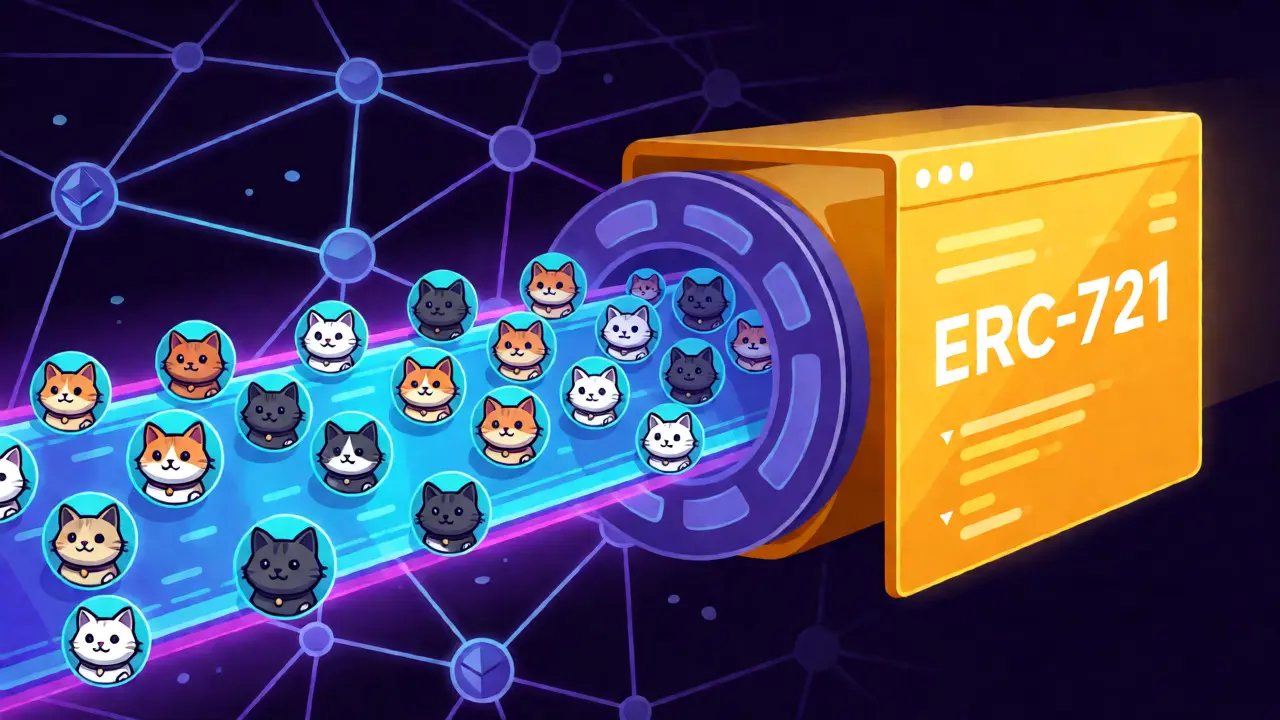
Remember when CryptoKitties clogged the entire Ethereum network in late 2017? It wasn't just a meme; it was a technical crisis. Every unique cat required its own custom code, making it impossible for wallets or marketplaces to talk to each other without heavy lifting. That chaos birthed ERC-721, the foundational Ethereum Improvement Proposal (EIP-721) that standardized how unique digital assets are created, owned, and transferred on the blockchain. If you've ever bought digital art, claimed a domain name like ENS, or held a profile picture collection, you've interacted with this standard. But what actually makes ERC-721 tick, and why does it still dominate the landscape in 2026 despite newer competitors?
The Birth of Digital Ownership
Before ERC-721, if you wanted to sell a unique digital item, you had to write a bespoke smart contract. There was no universal language for "this thing is mine." Dieter Shirley, CTO at Axiom Zen (the team behind CryptoKitties), drafted the initial proposal in late 2017 to fix this fragmentation. Co-authored with William Entriken, Jacob Evans, and Nastassia Sachs, EIP-721 was submitted in January 2018 and marked as "Final" by mid-2018. Its goal was simple: create an interface for "deeds." Unlike ERC-20 tokens, where every unit is identical and interchangeable (like dollars), ERC-721 treats every token ID as distinct. Token #1 is not equal to Token #2. This distinction is crucial because it allows one smart contract to manage thousands of completely different assets-images, music files, game swords, or real estate deeds-without confusing them.
Under the Hood: The Core Interface
You don't need to be a coder to understand the logic, but knowing the functions helps you troubleshoot when things go wrong. The standard mandates a minimal set of rules so that any wallet can display your NFTs and any marketplace can list them. Here are the critical pieces:
balanceOf(address owner): Asks the contract, "How many NFTs does this person hold?"ownerOf(uint256 tokenId): Asks, "Who owns Token #42?"transferFrom(from, to, tokenId): Moves ownership from one address to another.safeTransferFrom(...): The safety net. This function checks if the recipient is a smart contract capable of handling NFTs. If you send an NFT to a dumb contract that doesn't know how to receive it,safeTransferFromreverts the transaction, preventing your asset from being lost forever.
Approval mechanics are also standardized. You can grant permission to someone else to move a specific token via approve(), or give blanket permission to a marketplace operator via setApprovalForAll(). This is why you see those annoying pop-ups asking you to sign transactions before listing on OpenSea-the site needs approval to move your token upon sale.
Metadata and Enumeration Extensions
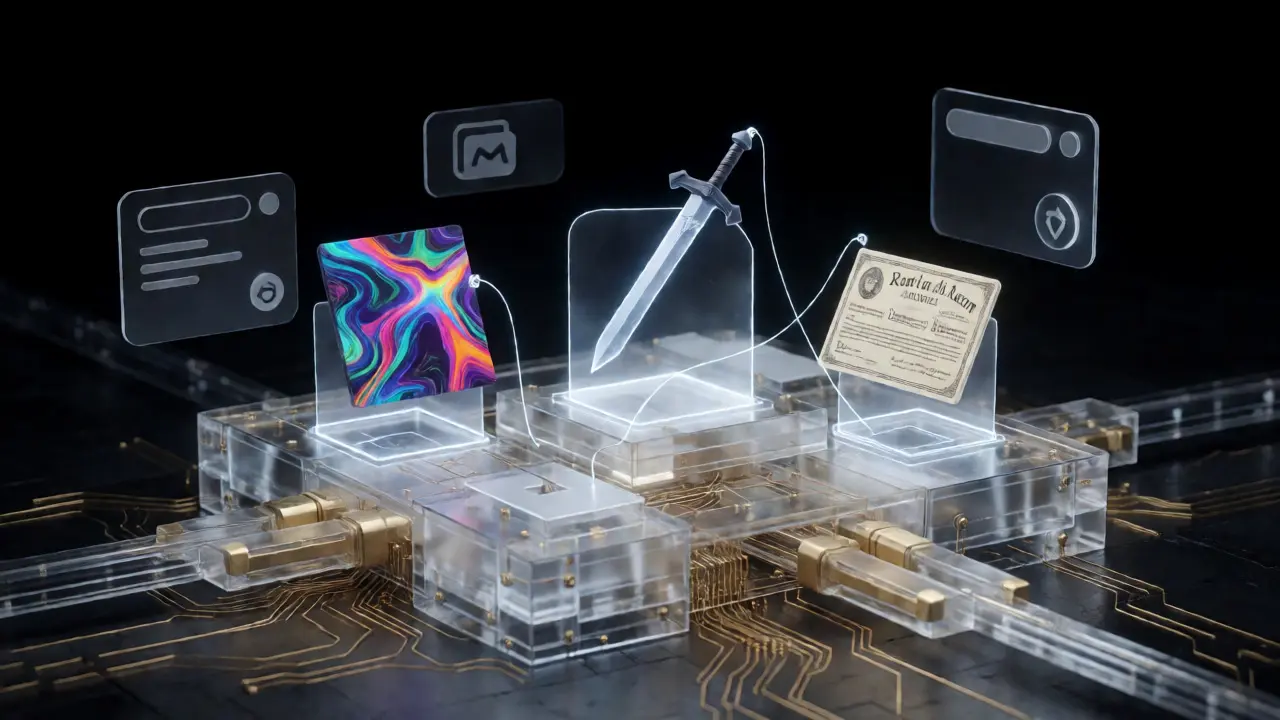
The core interface tells you who owns what, but it doesn't tell you what the thing looks like. That's where optional extensions come in. The ERC721Metadata extension adds three functions: name(), symbol(), and tokenURI(). The tokenURI is key-it points to a JSON file (usually hosted on IPFS or Arweave) containing the image link, description, and traits. Because this data isn't stored directly on the blockchain to save gas, it relies on external storage, which introduces risks if the host goes down.
Another extension, ERC721Enumerable, allows you to count all tokens (totalSupply()) and iterate through them. While useful for small collections, many modern projects skip this because iterating over thousands of tokens on-chain is expensive. Instead, they rely on off-chain indexers to build lists, keeping the blockchain lean.
ERC-721 vs. ERC-1155: Choosing Your Weapon
By 2026, ERC-1155 has become the go-to for gaming and complex ecosystems, but ERC-721 remains king for high-value collectibles. Why? Simplicity and provenance. ERC-1155 is a multi-token standard; it can handle fungible tokens (like gold coins) and non-fungible ones (like a unique sword) in a single contract. It supports batch transfers, meaning you can move ten items in one transaction, saving up to 90% in gas fees compared to moving them individually with ERC-721.
| Feature | ERC-721 | ERC-1155 |
|---|---|---|
| Token Type | Non-Fungible Only | Fungible, Semi-Fungible, Non-Fungible |
| Contract Structure | One contract per collection | One contract for multiple types |
| Batch Operations | No native support | Native batch mint/transfer/burn |
| Gas Efficiency | Lower for bulk actions | Highly efficient for bulk actions |
| Best For | Art, PFPs, Real Estate | Gaming, Tickets, Inventory |
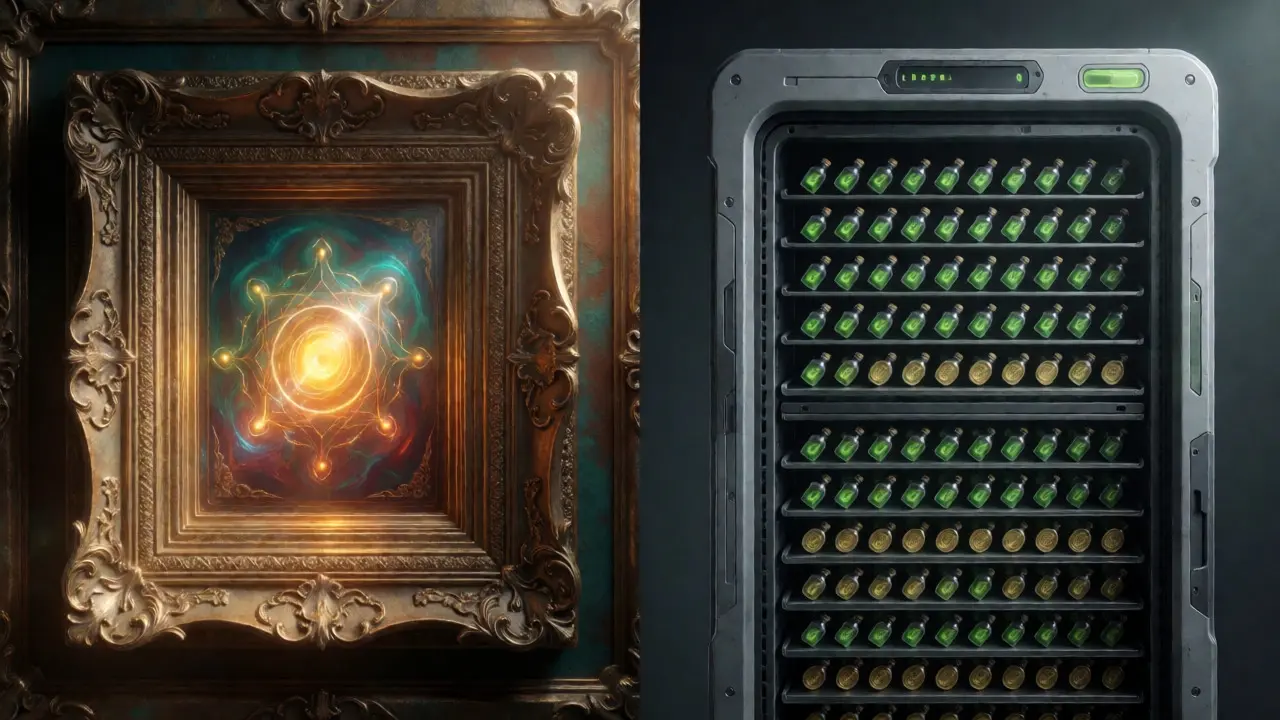
If you're launching a fine art drop where scarcity matters more than speed, stick with ERC-721. The mental model of "one contract, one unique collection" aligns perfectly with how collectors think about provenance. If you're building a game where players loot hundreds of similar potions, ERC-1155 is the obvious choice.
Security Pitfalls and Best Practices
Just because a token is on-chain doesn't mean it's safe. The biggest risk with ERC-721 isn't hacking the blockchain; it's user error and malicious contracts. Always use safeTransferFrom when sending to unknown addresses. If you use the basic transferFrom to send an NFT to a contract that lacks the onERC721Received hook, your token could get stuck there indefinitely, requiring a special rescue function to retrieve it.
Another common issue involves metadata mutability. Since tokenURI often points to a centralized server or mutable IPFS gateway, creators can change the image after you buy it. Some standards now enforce immutable URIs or hash verification, but always check if the project guarantees static metadata. In 2026, reputable projects increasingly use decentralized storage solutions like Arweave to ensure permanence, but the standard itself doesn't force this-it's a best practice, not a rule.
The Future of Unique Tokens
Will ERC-721 die out? Unlikely. It's too entrenched. Major wallets, exchanges, and regulatory frameworks have built their infrastructure around its predictable interface. While Layer-2 scaling solutions reduce gas costs, making batch operations cheaper even for ERC-721, the fundamental appeal of simplicity keeps it relevant. Developers often start with ERC-721 for its ease of implementation. It’s easier to teach, easier to audit, and universally supported. For now, it remains the backbone of digital ownership on Ethereum.
What is the difference between ERC-20 and ERC-721?
ERC-20 tokens are fungible, meaning each unit is identical and interchangeable, like currency. ERC-721 tokens are non-fungible, meaning each token ID is unique and cannot be exchanged one-for-one with another token, representing distinct assets like art or property deeds.
Why do I need to approve my NFT before selling it?
Smart contracts cannot automatically take your NFT. You must explicitly grant permission using the approve or setApprovalForAll function. This ensures that only authorized operators (like a marketplace) can transfer ownership of your token when a sale occurs.
Can I lose my NFT if I send it to the wrong address?
Yes. If you use the standard transferFrom function to send an NFT to a smart contract that doesn't implement the ERC-721 receiver interface, the token may be locked there permanently. Using safeTransferFrom prevents this by reverting the transaction if the recipient cannot handle the token.
Does ERC-721 store the image on the blockchain?
No, storing large images on-chain is prohibitively expensive. Instead, ERC-721 stores a tokenURI, which is a link to a metadata file (JSON) hosted off-chain (often on IPFS). This file contains the link to the actual image and other attributes.
Which standard is better for gaming, ERC-721 or ERC-1155?
ERC-1155 is generally better for gaming because it supports batch transfers and can manage both fungible resources (like gold) and non-fungible items (like weapons) in a single contract, significantly reducing gas costs and complexity compared to deploying separate ERC-721 contracts for each item type.
11 Responses
Oh, please. This whole "standardization" narrative is just a way for the big platforms to lock us into their ecosystems while pretending it's about interoperability.
You talk about CryptoKitties clogging the network like it was some noble technical crisis that needed fixing by committee. It wasn't a crisis; it was proof of demand! The fact that we had to have a "universal language" for ownership is exactly what killed the wild west spirit of early crypto. Now everyone just uses OpenSea because they can't be bothered to build custom interfaces anymore.
And don't get me started on ERC-1155 being the "future." It's not the future; it's a compromise for lazy developers who don't want to handle multiple contracts. If you think batch transfers are the holy grail, you're missing the point of digital scarcity entirely. Scarcity isn't about efficiency; it's about uniqueness. When you bundle unique items with fungible ones in one contract, you dilute the provenance. You turn art into inventory.
The article glosses over the real issue: metadata mutability. Sure, Arweave is nice, but most projects still use mutable URIs because it's cheaper and lets them rug pull later. They change the image after you buy it, and suddenly your "unique" asset looks like garbage. That's not a bug; that's a feature for scammers.
Also, this idea that ERC-721 is "too entrenched" to die is laughable. Entrenchment doesn't equal value. VHS was entrenched too. Just because wallets support it doesn't mean it's good design. It's bad design that got lucky because no one wanted to do the hard work of building better tools. We're stuck with this clunky interface because the alternative required actual engineering effort, which apparently scares the modern web3 dev.
I actually think the simplicity argument holds up pretty well here. I've worked with both standards and honestly the mental model for ERC-721 is just easier to teach new devs. Once you try to explain multi-token logic to someone who just wants to mint a PFP project you realize why people stick to 721. It's less code to audit and fewer edge cases to worry about when things go wrong.
I completely agree with john randall above and I feel like we really need to emphasize how much time this saves in development cycles because trying to implement a robust ERC-1155 system from scratch without existing libraries is basically asking for trouble especially when you consider the gas implications of checking balances for multiple token IDs in a single transaction versus the straightforward mapping of ownerOf in ERC-721 which is so clean and predictable that even junior devs can write unit tests for it without pulling their hair out every single day
It’s also worth noting that the ecosystem tooling around ERC-721 is unmatched right now meaning if you run into an issue there are thousands of Stack Overflow threads and GitHub issues already solved whereas with newer or more complex standards you might be debugging obscure reverts at 3 AM alone in your apartment wondering why the blockchain hates you specifically
Plus the psychological aspect for collectors is huge they understand owning one thing uniquely rather than having a stack of semi-fungible tokens where the distinction between rarity tiers gets muddy quickly when everything is stored in one giant contract dictionary
So yeah let’s keep it simple and let the games use 1155 but for art and identity 721 is still the king for good reasons not just because of inertia
You are all missing the forest for the trees and frankly your ignorance regarding smart contract security is embarrassing. The fact that you focus on developer convenience while ignoring the catastrophic failure modes of safeTransferFrom shows a lack of fundamental understanding. If a user sends a token to a contract that does not implement the receiver hook using transferFrom the token is gone forever unless a rescue function exists. Most standard contracts do not include rescue functions. Therefore your "simplicity" is actually a trap for the uninitiated. You prioritize ease of writing over safety of holding. This is why retail investors get wrecked. Stop celebrating mediocrity and start demanding better default behaviors in the EIP itself. Until the standard enforces safer defaults by default your praise for ERC-721 is merely an endorsement of user error.
WAIT A MINUTE!!!
Did anyone else notice the part about METADATA MUTABILITY???
This is HUGE!!! They admit that creators CAN CHANGE THE IMAGE AFTER YOU BUY IT?!?!? That means my NFT could literally turn into a JPEG of a monkey eating a banana while I'm sleeping!!! And the standard DOESN'T FORCE IMMUTABILITY??? So it's optional??? Optional trust in a space built on trustless tech??? That's insane!!!
They say reputable projects use Arweave... BUT WHO DECIDES WHAT'S REPUTABLE??? The same people who decide which coins pump and dump??? What if the IPFS gateway goes down??? Or what if the centralized server hosting the JSON file gets hacked??? Then my expensive digital deed is just a broken link!!! 404 Error: Ownership Not Found!!!
This isn't just a technical detail!!! It's a conspiracy to keep us dependent on off-chain infrastructure that we don't control!!! If the blockchain is supposed to be immutable why is the data pointing TO the blockchain mutable??? It makes NO sense!!! We need FULL ON-CHAIN STORAGE NOW!!! No more external links!!! No more gateways!!! Put the pixels IN THE BLOCK OR ELSE!!!
Actually, Michelle, you're conflating storage limitations with protocol intent. Full on-chain storage for high-res images is prohibitively expensive due to block size constraints and gas costs. The standard doesn't force immutability because it's a trade-off between cost and flexibility. However, you are correct that relying on HTTP URLs is risky. Best practice involves using IPFS hashes (CIDv0/CIDv1) which are content-addressed, meaning if the file changes, the hash changes. If the URI points to a mutable HTTP endpoint, then yes, the creator has power. But technically, the token ID remains unchanged. The *representation* changes. It's a semantic distinction that matters for legal claims of ownership vs. aesthetic integrity. Also, Arweave is permanent by design due to its endowment model, unlike ephemeral IPFS pinning services. Your panic is misplaced if you're buying from established projects using proper decentralized storage protocols.
I appreciate the nuance here. It seems like the tension between idealism (everything on-chain) and pragmatism (gas fees matter) is the core conflict. I wonder if L2 solutions will eventually make full on-chain storage viable for smaller assets? Maybe not for 4k video, but for SVGs or low-res pixel art? It feels like we are in a transitional phase where we accept compromises until scaling solves the cost barrier. Curious to see if any major collections attempt fully on-chain metadata in the next year.
I prefer keeping things simple and avoiding unnecessary complexity. The comparison table was helpful. I'll stick to ERC-721 for my personal collection since I don't care about batch operations. It feels more secure knowing each item has its own clear lineage.
Hey everyone! Just wanted to add that for beginners, sticking with ERC-721 is definitely the best move to start with. It builds confidence before diving into more complex standards. Don't stress about optimizing gas fees until you have a large volume of transactions. Focus on learning the basics of approvals and safe transfers first. You got this!
OMG YES!!! Savara is totally right!! Start small and dont worry about the fancy stuff yet!!! Its super important to get comfortable with signing those approval transactions without panicking!! Thats the hardest part for newbies honestly!! Once you get the hang of it its actually pretty fun watching your assets move around!!! Keep going team!! We are all figuring this out together!! Dont let the trolls discourage you!!! Their negativity is just fear disguised as expertise!!! Lets goooo!!! 🚀🔥💎
Oh wow, look at us debating gas fees and metadata mutability like we invented the internet. Meanwhile, half these projects are just copy-pasted code from a template repo with zero thought put into user experience. But sure, let's pretend this technical deep dive explains why your Bored Ape is worth $50k instead of $5. The 'mental model' argument is cute though. Collectors love their mental models almost as much as they love losing money on gas fees during a mint. Anyway, great post, very informative for those who enjoy reading documentation for fun. I certainly do.