
| Feature | How it Works / Value |
|---|---|
| Core Mechanism | Varying the spacecraft's cross-sectional area relative to velocity. |
| Fuel Requirement | Zero (Propellant-free). |
| Effective Altitude | Typically 300 km to 800 km. |
| Primary Trade-off | Slower maneuver speed vs. zero fuel cost. |
The Paradox of Drag and Speed
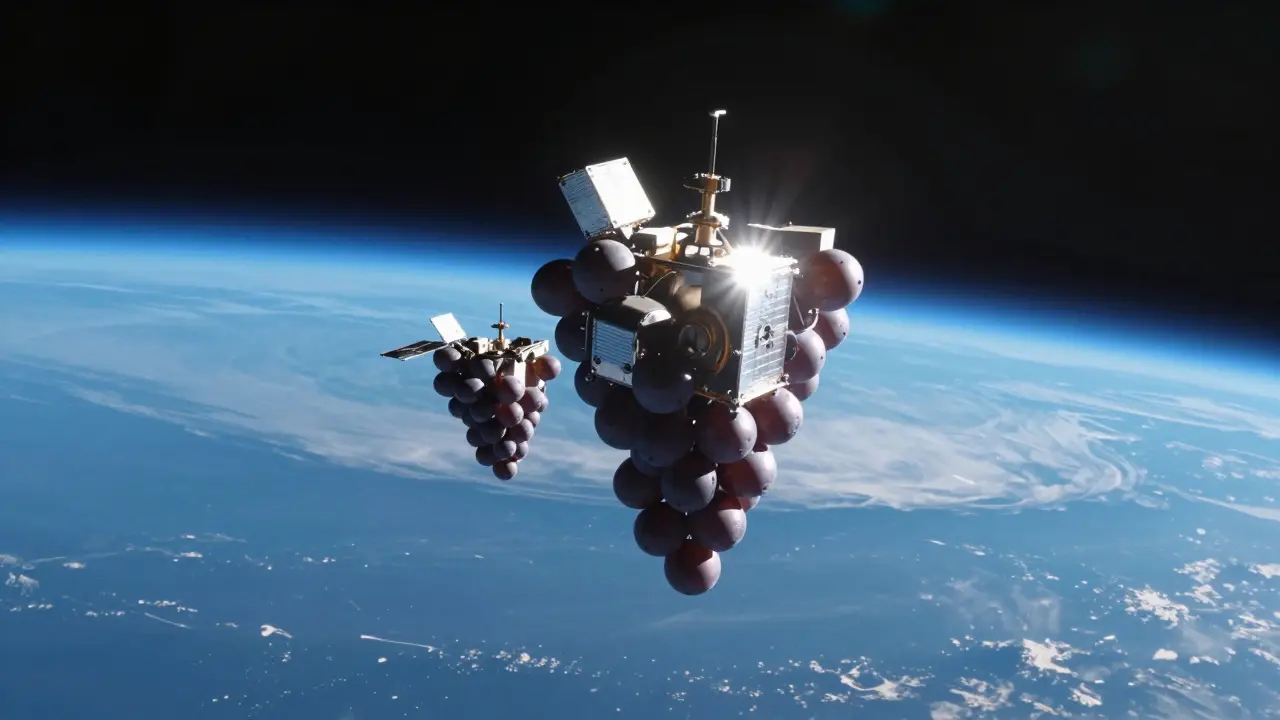
To understand how this works, we have to look at the Ballistic Coefficient. This is essentially the ratio of a satellite's mass to its area. A satellite with a low ballistic coefficient-meaning it's light but has a huge surface area-is like a sail in the wind; it catches more atmospheric particles and slows down faster. Here is where orbital mechanics gets weird. When you increase drag by pitching a satellite (like turning a solar panel flat against the direction of travel), the satellite loses energy and its altitude drops. You would think that slowing down makes you lag behind, but in orbit, the opposite happens. A lower orbit requires a higher orbital velocity to stay stable. Consequently, the satellite that "slows down" via drag actually drops into a lower, faster orbit, causing it to drift forward relative to the rest of the constellation. Once it reaches the desired spot, the operator tilts the panels back to a low-drag orientation, stabilizing the altitude and locking in the new position.Putting Theory into Orbit: Real-World Missions
This isn't just a textbook exercise; some of the biggest names in small-sat operations rely on it. Planet Labs uses this technique for its 3U CubeSats. For their Flock 2p constellation, they successfully phased satellites into a 510 km sun-synchronous orbit. Because they weren't using fuel for the initial spacing, they could dedicate more of the satellite's mass to imaging hardware rather than bulky fuel tanks and plumbing. Another great example is the CYGNSS (Cyclone Global Navigation Satellite System) mission. They used differential drag to space eight satellites at 45-degree intervals. It wasn't a fast process-it took about 95 days of commissioning to get everyone in their right slot-but it worked perfectly. Even higher up, the ORBCOMM constellation has proven the method works at 780 km, though the thinner air makes the process noticeably slower.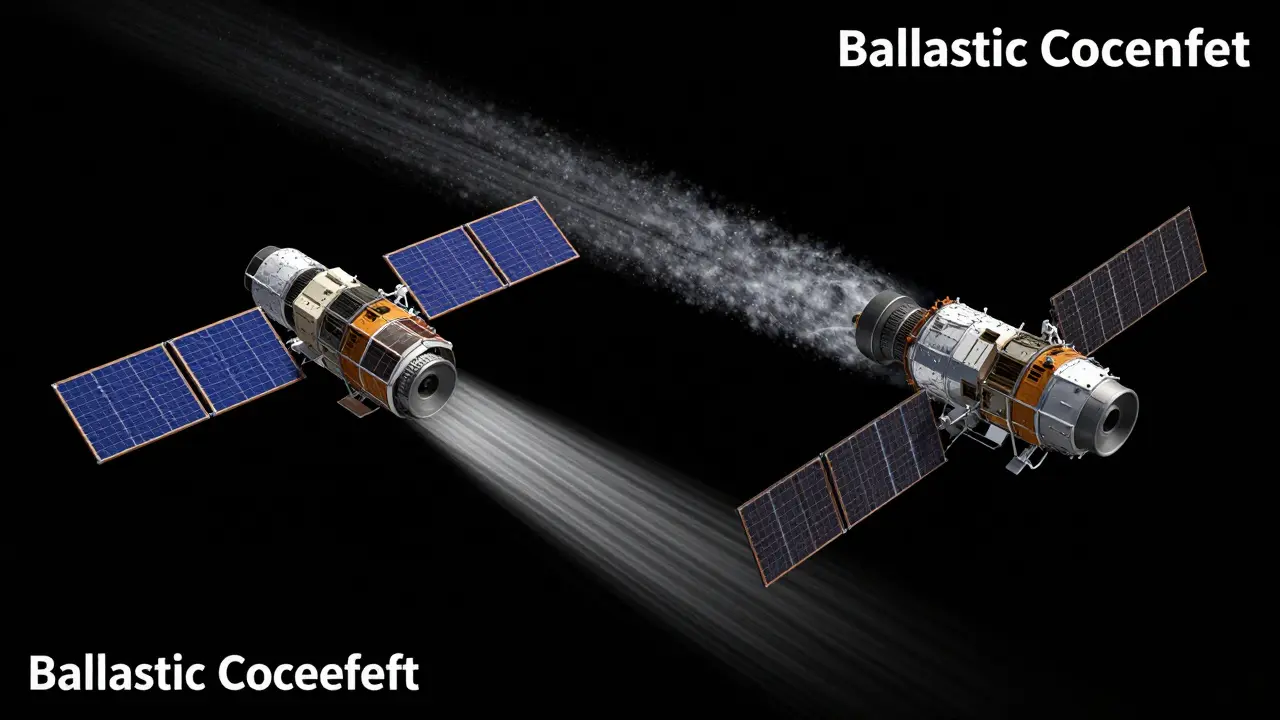
The Math Behind the Maneuvers
How do engineers actually decide when to flip a satellite? It comes down to optimization. They don't just guess; they use algorithms to minimize the "separation error," which is the gap between where the satellite is and where it should be. For a typical mission, the process looks like this:- Target Selection: The controller decides which satellite is the best candidate for which slot (since most satellites in a constellation are interchangeable).
- Drag Command Generation: The system generates a sequence of "high-drag" and "low-drag" commands. Some use discrete switches (all or nothing), while others use linear programming to allow any angle between the two extremes.
- The Drift Phase: The satellite enters a high-drag state to drop altitude and increase its drift rate relative to a reference satellite.
- The Synchronization Phase: Once the target phase separation is hit, the satellite performs a final maneuver to match the altitude of the rest of the fleet, bringing the relative phase drift rate to zero.
Where it Works and Where it Fails
Differential drag isn't a magic bullet. Its effectiveness is entirely dependent on the Atmospheric Density of the thermosphere. If there's no air, there's no drag. At altitudes below 500 km, the air is thick enough that maneuvers happen relatively quickly. As you climb toward 800 km, the air becomes exponentially thinner. At this point, you need much more aggressive attitude changes-sometimes pitching the spacecraft up to 81 degrees-just to get a usable amount of drag. Above 800 km, the technique basically stops working, and you're forced to go back to using traditional propulsion. Solar activity also plays a huge role. When the sun is active, it heats the upper atmosphere, causing it to expand and become denser at higher altitudes. This actually makes differential drag *more* effective. During solar minimums, the air thins out, and phasing takes longer. This means a mission planned during a solar peak might take 60 days to phase, while the same mission during a solar minimum might take 120 days.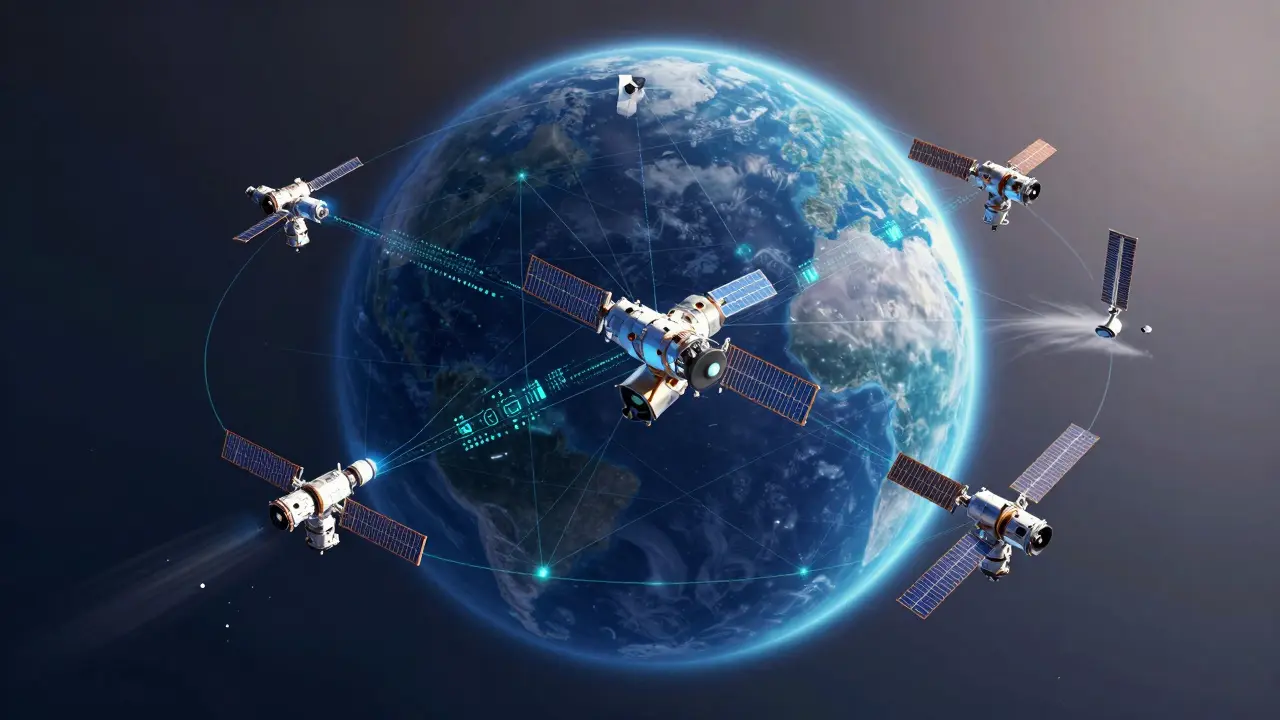
Comparing Drag to Traditional Propulsion
When choosing a deployment strategy, it's a trade-off between time and complexity. Chemical propulsion systems are fast but heavy. You need tanks, valves, and regulators, all of which are potential points of failure. Ion propulsion is incredibly efficient in terms of fuel but requires massive amounts of power and complex electronics that a tiny CubeSat simply can't carry. Differential drag removes all that hardware. Since most satellites already need an attitude control system to point their solar panels at the sun, the "engine" for differential drag is already on board. The only cost is time. If your mission can afford a few months of commissioning, avoiding the weight and risk of a propulsion system is a massive win.
The Future: Autonomy and AI
We are moving away from ground-controlled drag maneuvers. The next step is autonomous formation control, where satellites talk to each other and adjust their own drag profiles in real-time. Imagine a constellation that can detect a piece of space debris and automatically tilt its panels to drift out of the way without a human ever sending a command. Researchers are also looking into hybrid systems. By combining a very small amount of low-thrust propulsion with differential drag, satellites could handle emergency maneuvers (like rapid conjunction avoidance) with fuel and use drag for the slow, routine maintenance of the constellation. This gives operators the best of both worlds: the speed of a rocket and the efficiency of a sail.Does differential drag require any power?
Yes, but very little. While it doesn't use propellant, it does require electricity to power the reaction wheels or torque rods used to change the satellite's attitude (pitch). Since these systems are usually already active for power generation and communication, there is virtually no additional power overhead.
Can differential drag be used to de-orbit a satellite?
Absolutely. By maintaining a maximum-drag configuration, a satellite increases its rate of altitude loss, which speeds up its reentry into the atmosphere. This is a common strategy for ensuring that small satellites don't become long-term space debris.
Why is it called "differential" drag?
Because the technique relies on the *difference* in drag between two or more objects. If every satellite in a constellation increased its drag at the same time, the whole fleet would just drop in altitude together. To move them relative to one another, you must create a difference (differential) in their ballistic coefficients.
How long does phasing usually take with this method?
It varies wildly based on altitude. For a typical LEO mission, it can take anywhere from a few weeks to several months. For example, the CYGNSS mission took about 95 days to fully position its eight satellites.
Can it be used for conjunction avoidance?
Yes, but it's slow. It can work if the collision warning is given well in advance (several days). However, for emergency maneuvers that need to happen in less than 24-48 hours, differential drag is often too slow, and traditional propulsion is required.
15 Responses
This is a great way to look at orbital mechanics without getting bogged down in the heavy math. It's wild how slowing down actually makes you go faster in this context.
Purely academic. In reality, the latency of these maneuvers makes them practically useless for any dynamic mission.
The mention of the Ballistic Coefficient is spot on. For anyone trying to grasp this, just think of it as the "aerodynamics" of space. The less dense the atmosphere, the more you have to fight for every millimeter of drift.
Typical lazy writing. "Imagine launching a dozen satellites" is a bit too simplistic for a technical explanation.
love the idea of using the suns activity to speed things up its like the solar system is helping us out for free
The lack of rigorous mathematical proofs within this text is appalling. One cannot simply "imagine" orbital maneuvers; one must calculate them with absolute precision. The colloquialisms used throughout this piece are entirely inappropriate for a discussion on aerospace engineering.
Wait, if they can move satellites without fuel, why do they tell us we're running out of it? Probably just a cover for some secret government projects they're fueling in the dark. The atmospheric density changes are probably manipulated anyway.
It is fundamentally imperative that we consider the ethical implications of filling our orbit with these constellations, regardless of whether the method of spacing them is fuel-efficient or not. We are treating the celestial void as a mere dumping ground for corporate interests, and the pursuit of a "propellant-free" method is merely a cost-saving measure disguised as innovation, which ignores the long-term degradation of our orbital environment for future generations who will inherit this cosmic clutter.
Pretty neat stuff. Just a quiet way to manage a fleet.
This is such a surface-level analysis that it barely qualifies as an explanation, and the author seems to think we're all children by using a grape analogy. Honestly, who cares if it takes 95 days to phase a constellation when the actual operational utility is so marginal that you're basically just waiting around for the atmosphere to do the work for you while the hardware degrades in the harsh radiation of LEO, making the entire "fuel saving" argument a joke because you're trading propellant for actual mission lifespan.
Oh wow, we're just "tilting panels" now. Groundbreaking. Truly a philosophical triumph of waiting for things to happen slowly.
dont worry about the speed its all about the long game man... save that fuel for the real emergencies
I just feel like we are losing the human touch in space exploration when everything becomes an algorithm 😔. It's so sad that we just set a timer and wait 95 days for a satellite to drift into place while we just watch from the ground 🌌. It feels so empty and mechanical, doesn't it? 🥀
The distinction between the ballistic coefficient and the drag coefficient is omitted here, which is a glaring oversight for anyone with a basic understanding of fluid dynamics. It is quite quaint to see such a simplified version of orbital mechanics presented as comprehensive.
This is such a cool way to maximize hardware! More cameras, less fuel tanks. Love to see it.