
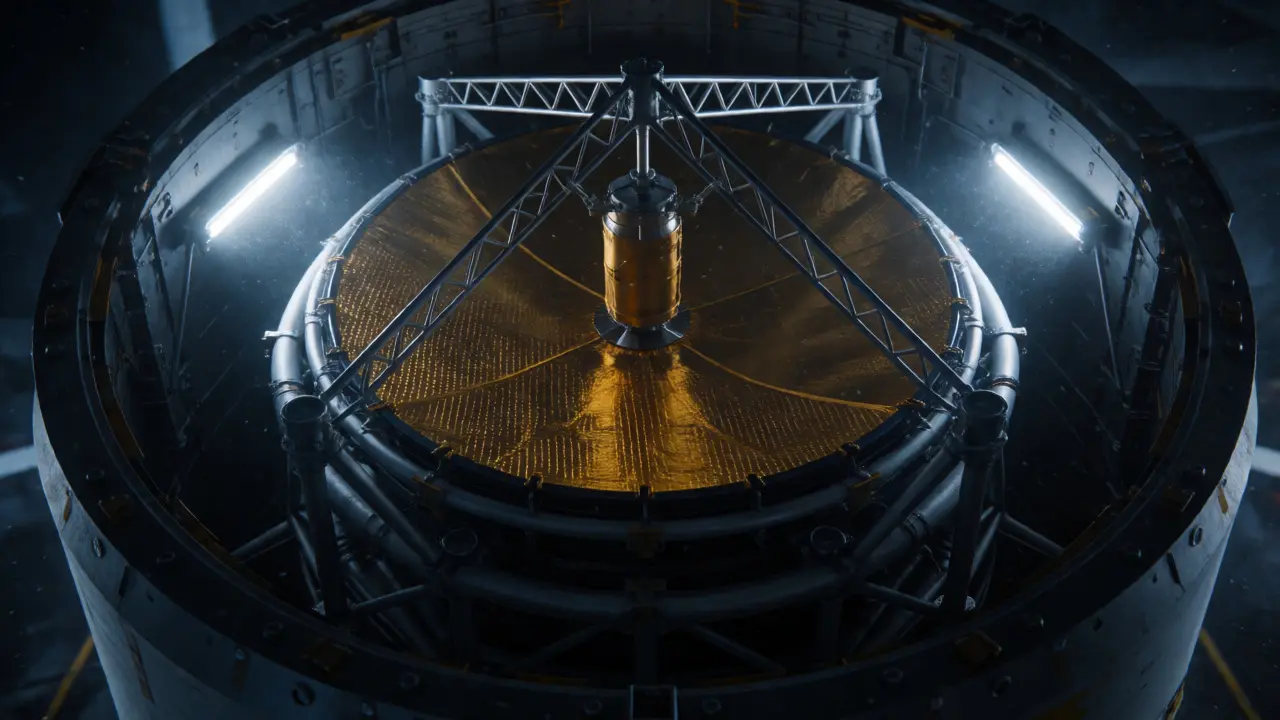
Imagine trying to fit a 20-meter-wide radio dish into a box the size of a refrigerator. Now imagine that box is blasting off on a rocket, vibrating violently, and then-once it reaches the quiet vacuum of space-the dish has to unfold itself perfectly, locking into place with millimeter precision. If it fails, your multi-million dollar mission might just be a very expensive paperweight. This is the high-stakes engineering challenge behind deployable satellite antennas. These aren't just static pieces of metal; they are complex mechanical systems designed to survive launch trauma and deploy autonomously in orbit, enabling everything from global mobile communications to deep-space exploration.
The Core Challenge: Volume vs. Performance
Why go through all this trouble? It comes down to physics and economics. Launch vehicles have strict volume limits, typically capped at fairing diameters of 4 to 5 meters. But radio frequency performance scales with aperture size. A larger antenna means higher gain, which allows satellites to transmit data faster or receive faint signals from distant spacecraft. The solution is to build large antennas but pack them tight. According to research published in *Mechanical Sciences* (Morozov et al., 2022), modern deployable structures can achieve apertures exceeding 10 meters while stowed in volumes under 1 cubic meter. That’s a massive compaction ratio. For engineers, the job is simple to state but hard to execute: maximize the deployed diameter while minimizing the stowed volume and mass, without sacrificing surface accuracy.
Three Main Architectures: Mesh, Solid, and Inflatable
Not all deployable antennas are created equal. They generally fall into three categories based on their working surface media, each with distinct pros and cons.
| Feature | Mesh Reflectors | Solid Surface | Inflatable |
|---|---|---|---|
| Typical Diameter | 3 m - 22 m+ | < 8 m | Several meters |
| Surface Accuracy | D×6×10⁻⁵ RMS | D×1×10⁻⁵ RMS | Lower (thermal distortion) |
| Mass Efficiency | Very High | Moderate | Extremely High |
| Deployment Risk | Mechanism Jamming | Hinge Failure | Puncture/Leakage |
| Best For | GEO Comms, LEO Constellations | Small/Medium Satellites | Short-duration, Experimental |
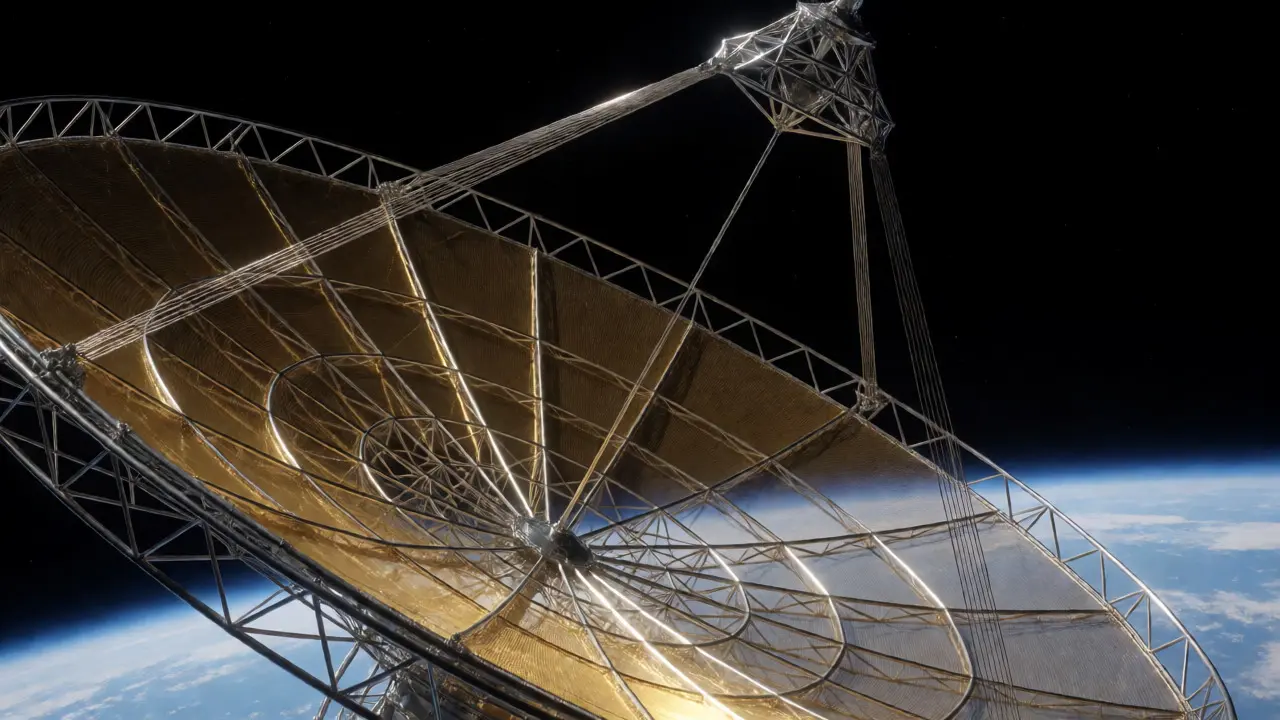
Mesh reflectors are the workhorses of the industry. Technologies like AstroMesh, developed by TRW (now Northrop Grumman), use ring-stiffened geodesic truss domes deployed by cables. They offer an incredible balance of low mass and high reliability. For instance, the 12.25-meter AstroMesh on Boeing’s Thuraya satellite deployed successfully in November 2000 and has operated flawlessly since. In contrast, solid-surface antennas use hinged metallic or composite panels. They offer superior surface accuracy-critical for high-frequency Ka-band operations-but suffer from higher mass and lower compaction ratios, limiting their practical size to around 6-8 meters.
Then there are inflatable reflectors. These use flexible membrane structures that inflate to form parabolic shapes. While they offer unmatched compaction-collapsing dishes several meters wide into packages tens of centimeters across-they face challenges with surface accuracy due to thermal distortion and vulnerability to punctures. As noted by SatNow in 2024, these are often better suited for short-duration missions or backup systems rather than primary reflectors on multi-decade geostationary satellites.
Stowage Strategies: How Do You Pack a Dish?
Packing strategy depends heavily on the antenna type and the satellite platform. For large geostationary satellites, containerized stowage is common. The antenna, mast, and separation base are packed as a single unit within the launch fairing, supported by tubular trusses. Early NASA Shuttle missions used this approach, defining procedures to restow antennas if needed. However, for modern commercial satellites, integrated structural approaches are gaining traction.
Consider Japan’s ETS-VIII mission. Its massive 19.2m × 16.7m mesh reflector was divided into 14 modules, each consisting of gold-plated molybdenum mesh and a cable network. This modular design allowed the entire system to fit inside a cylindrical stowage volume just 1 meter in diameter and 4 meters tall-a compaction factor of roughly 12-15 relative to its deployed diameter. For smaller platforms, body-mounted stowage is preferred. At the University of Toronto, researchers described wrapping AIS antennas around the spacecraft exterior onto the +Z panel, folding them beneath other components and constraining lateral motion with Delrin guiding brackets. This saves internal volume but requires careful thermal management, as the antenna becomes part of the satellite’s skin.
Deployment Mechanisms: Unfolding in Zero-G
Once in orbit, the antenna must deploy reliably. There are no hands to fix it if it gets stuck. Most systems rely on one of three mechanisms: stored strain energy, motorized hubs, or Hold-Down and Release Mechanisms (HDRMs).
- Stored Strain Energy: Common in CubeSats, this method uses composite materials like S-2 fiberglass/PEEK strips that are folded into a "rat's nest" configuration. Upon release, the material’s elasticity drives deployment. An example is a helical UHF antenna described by Ochoa et al., which deploys from a 4in×4in×2in package to a 1.37m tall structure solely via strain energy, achieving a 300:1 volume ratio.
- Motorized Hubs: Used in systems like Tendeg’s Ka-Band Parabolic Deployable Antenna (KaPDA). A small motor extends a central hub, unfolding curved ribs and tensioning a gold-coated mesh dish. This provides controlled, slow deployment, reducing dynamic loads on the spacecraft bus.
- HDRMs: These are critical safety devices. Utah State University’s work on nano-satellite antennas highlights how HDRMs restrain elements during launch vibrations (often exceeding 10g RMS) and trigger deployment only after safety conditions are met. They act as the "insurance policy" against accidental release during ascent.
Real-World Performance and Reliability
How well do these systems actually work? The track record is surprisingly strong for flagship technologies. Northrop Grumman reports a 100% on-orbit deployment success rate for AstroMesh reflectors delivered up to 2013, covering major satellites like Inmarsat-4 and Alphasat. The Alphasat reflector, with a 14m × 11m RF surface, weighed about 61 kg when stowed and deployed to a 13.7m × 11.6m shape. This reliability is not accidental; it’s the result of rigorous testing.
Oxford Space Systems outlines a multi-stage development process involving RF analysis, mechanical modeling, and extensive environmental testing. Qualification campaigns include vibration tests above 10g RMS, acoustic tests at sound pressure levels above 140 dB, and thermal-vacuum cycling from -40°C to +80°C. NASA’s 25-foot Space Simulator tested a 5m AstroMesh reflector for 36 hours under solar heating and vacuum to ensure it maintained shape and functionality. Without such validation, a single jammed hinge could mean a 50% loss in mission data return.
Future Trends: Origami and SmallSats
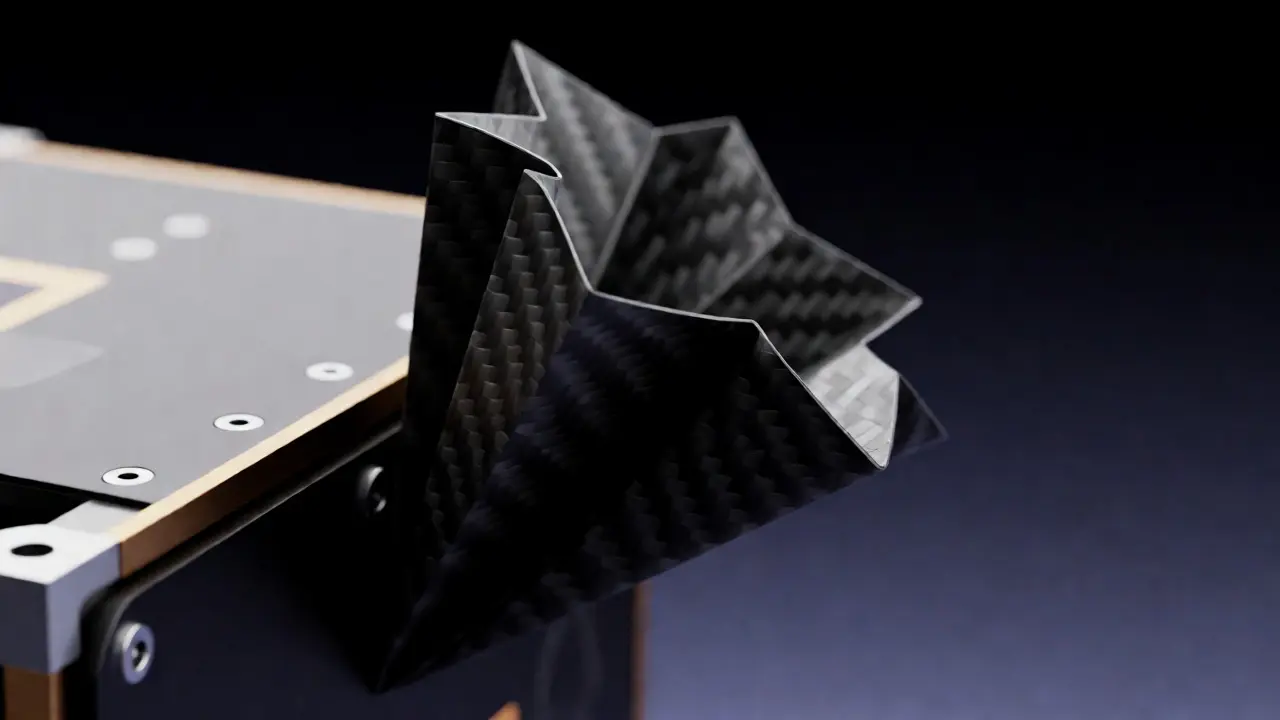
The future of deployable antennas isn't just about making bigger dishes for GEO satellites; it’s about miniaturization and new geometries. With the rise of CubeSats and LEO constellations, engineers are turning to origami-inspired designs. Research from Science Tokyo (April 2026) demonstrated a 5.8 GHz origami deployable reflectarray antenna that achieves doubly-curved surfaces from flat carbon-fiber sheets. This allows higher gain in compact 3U-6U footprints compared to traditional monopole whips.
Furthermore, scaling laws analyzed by Caltech researchers in 2024 suggest that current mesh technologies can support frequencies above 40 GHz if surface accuracy remains within D×2.5×10⁻⁵ RMS. Meanwhile, the market for satellite antennas is booming. MarketsandMarkets estimates the sector at USD 5.8 billion in 2025, growing to USD 9.6 billion by 2031. This growth is driven by demand for high-throughput links and mobile coverage, pushing innovation in lightweight, high-compaction frames like ESA’s innovative elastic deployable structures.
Frequently Asked Questions
Why are mesh reflectors preferred over solid ones for large satellites?
Mesh reflectors offer significantly better mass efficiency and higher compaction ratios. For apertures larger than 8 meters, the weight penalty of solid panels becomes prohibitive. Mesh designs, like AstroMesh, allow diameters up to 22 meters or more while keeping the stowed volume manageable for standard launch fairings.
What happens if a deployable antenna fails to open in orbit?
If a primary antenna fails to deploy, the satellite may lose its main communication link or radar capability. Depending on the mission architecture, this could reduce data return by over 50%. Some satellites have redundant antennas or can operate in a degraded mode using lower-gain fixed antennas, but often the mission's primary objective is compromised.
Can inflatable antennas be used for long-term missions?
Currently, inflatable antennas are less common for long-term missions due to risks of gas leakage, micrometeoroid puncture, and thermal distortion affecting surface accuracy. They are more frequently proposed for short-duration experiments or as secondary payloads where extreme mass savings outweigh the need for decades-long reliability.
How much does a deployable satellite antenna cost?
Public pricing is rarely disclosed because costs are negotiated case-by-case. Factors include aperture size, frequency band, qualification requirements, and production volume. Large custom mesh reflectors for GEO satellites can cost millions, while standardized Ka-band deployables for smallsats are becoming more affordable as production scales up.
What is a Hold-Down and Release Mechanism (HDRM)?
An HDRM is a device that physically restrains the antenna in its stowed position during launch vibrations and shocks. Once the satellite reaches orbit and specific safety conditions are met, the HDRM releases the antenna, allowing stored strain energy or motors to drive deployment. It prevents accidental early deployment, which could damage the satellite during ascent.
12 Responses
Overhyped fluff. The article ignores that solid surface antennas are actually superior for high-frequency applications where mesh tensioning is a nightmare to maintain over time.
Actually, you're missing the point entirely about mass constraints. For apertures larger than 8 meters, the specific mass of solid panels makes them prohibitive for launch costs regardless of frequency performance. Mesh reflectors like AstroMesh have a proven track record with Northrop Grumman reporting 100% success rates up to 2013, which is statistically significant enough to dismiss anecdotal failures. If you want high gain without launching a ton of dead weight into orbit, mesh is the only viable engineering solution for GEO comms satellites today.
Good breakdown of the trade-offs. One thing to add regarding HDRMs is that they are often pyrotechnic or shape memory alloy based and require rigorous thermal cycling tests to ensure they don't actuate prematurely during ascent vibrations. It's a critical safety layer that people overlook when focusing on the deployment mechanism itself.
YESSS this is exactly what i needed for my project!! the part about origami designs is so cool i cant believe we can fold carbon fiber like that now its mind blowing honestly. keep posting stuff like this!!!
The ETS-VIII example really highlights how far modular design has come. Dividing a nearly 20-meter dish into 14 modules to fit in such a small cylinder is impressive engineering. It gives me hope for future large-scale space infrastructure projects.
I was just thinking, like, while reading this, about how crazy it is that we rely on these tiny little motors and springs to unfold something that big in zero gravity, because if one hinge sticks or if the motor stalls, then you basically have a multi-million dollar brick floating around, and nobody can go up there and kick it or fix it, so yeah, reliability is everything here, not just performance specs.
Also, the inflation risks mentioned for inflatable antennas seem pretty real too, because micrometeoroids are no joke even at low Earth orbit, so maybe those are better for short missions like the article said.
Agreed with the points on reliability. The testing protocols described by Oxford Space Systems sound thorough enough to mitigate most risks.
Haha, imagine trying to explain 'millimeter precision' to a client who thinks space is just a vacuum cleaner waiting to suck up their money. But seriously, good read. The comparison table is very useful for quick reference. I always forget the exact RMS accuracy differences between mesh and solid until I see them side-by-side. Thanks for sharing this technical deep dive!
The market growth projection to USD 9.6 billion by 2031 is consistent with recent industry reports from Euroconsult as well. However, the article could have elaborated more on the specific regulatory challenges faced by LEO constellations regarding spectrum allocation, which indirectly affects antenna design requirements for interference mitigation.
interesting read. i liked the part about cube sats using strain energy. simple solutions are often the best.
This entire premise is flawed because it assumes we need giant dishes at all. Phased array technology is rapidly becoming cheaper and lighter, rendering mechanical deployables obsolete within a decade. We are clinging to outdated mechanical complexity instead of embracing electronic beam steering. This article is basically writing an obituary for a technology that hasn't died yet but should be buried immediately. Stop wasting R&D budget on folding metal when software-defined radio is the actual future. The nostalgia for big meshes is blinding engineers to the reality of silicon photonics integration.
It’s amazing to think about the human effort behind these machines. From the initial sketches to the final deployment in orbit, every step requires such dedication. The fact that some of these systems have been working flawlessly since 2000 is truly inspiring. It shows that careful planning and robust engineering pay off in the long run.