

Imagine building a complex financial product without needing permission from a bank, waiting for regulatory approval, or even talking to another developer. You just snap together existing digital tools like colorful bricks, and boom-your new lending platform is live. This isn’t science fiction; it’s the core promise of DeFi composability, often called "money legos".
In the world of Decentralized Finance (DeFi), composability means that independent smart contracts can interact seamlessly. One protocol’s output becomes another’s input. This open, stackable architecture has turned Ethereum and other blockchains into global factories for financial innovation. But with great power comes great complexity-and risk. Here is what you need to know about how these legos fit together, why they matter, and where the cracks might be forming as we move through 2026.
The Lego Analogy: More Than Just a Buzzword
Why "legos"? The metaphor stuck because it perfectly describes the mechanics. Traditional finance operates like walled gardens. If you want to use Bank A’s savings account as collateral for Loan B at Broker C, you fill out forms, wait weeks, and hope their IT systems talk to each other. In DeFi, protocols are built on shared standards. They expose open interfaces that anyone can call.
Think of MakerDAO as a brick that turns Ether into Dai stablecoins. Think of Compound as a brick that lends out those Dai coins for interest. And think of Uniswap as a brick that swaps tokens instantly. Composability allows a user-or an automated script-to chain these actions in one transaction: borrow Dai, lend it out, swap the rewards, and reinvest them, all atomically. No middlemen. No downtime. Just code executing exactly as written.
This concept gained traction around 2019, popularized by developers like Mariano Conti and writers like Scott Lewis. They realized that if every protocol followed common rules, the whole ecosystem would grow exponentially, not linearly. Each new "lego" didn't just add value; it multiplied the possibilities for every existing lego.
How Protocol Interaction Actually Works
Under the hood, this magic relies on three pillars: standardization, permissionlessness, and atomicity.
- Standardization: Most DeFi assets follow the ERC-20 token standard. This ensures that whether a token comes from Maker, Compound, or a random startup, your wallet and other protocols know how to handle it. It’s like USB-C ports-universal compatibility.
- Permissionlessness: Anyone can build on top of any protocol. You don’t need to ask Uniswap’s team for permission to integrate their exchange into your app. You just read their public documentation and write code that calls their functions.
- Atomicity: Transactions either fully succeed or fully fail. If one step in your multi-lego chain breaks, the entire process reverses. This prevents partial losses and keeps the system consistent.
For example, Yearn Finance doesn’t hold its own capital. Instead, it acts as a router, moving user funds between Compound, Aave, and Curve to find the highest yield. It’s a meta-lego that orchestrates other legos.
The Evolution of Money Legos
The DeFi stack has matured rapidly since its early days. Here’s a look at the foundational protocols that defined the space:
| Protocol | Launch Year | Primary Function | Composability Feature |
|---|---|---|---|
| MakerDAO | 2017 | Stablecoin Issuance | Collateralized Debt Positions (CDPs) |
| Compound | 2018 | Lending & Borrowing | Interest-bearing cTokens |
| Uniswap | 2018 | Decentralized Exchange | Constant Product AMM Formula |
| Aave | 2020 | Lending & Flash Loans | Instant, uncollateralized borrowing |
| Yearn Finance | 2020 | Yield Aggregation | Automated strategy vaults |
These protocols didn’t just compete; they collaborated implicitly. Aave’s flash loans, for instance, allowed developers to borrow millions without collateral, provided they returned the loan in the same transaction. This enabled arbitrage bots and complex strategies that were impossible in traditional finance.

Real-World Example: Alchemix and Self-Repaying Loans
To see composability in action, look at Alchemix. Launched in 2021, Alchemix created "self-repaying" loans by chaining multiple legos together. Here’s how it worked:
- User deposits Dai (from MakerDAO) as collateral.
- Alchemix immediately borrows against that Dai using Compound or Aave.
- The borrowed funds are sent to Yearn Finance vaults to earn yield.
- Simultaneously, Alchemix mints alUSD (a synthetic dollar) for the user to spend.
- Over time, the yield earned by Yearn pays down the original debt.
The user gets spending power now, and the protocol eventually repays itself. In traditional banking, structuring this would require months of legal agreements and cross-institutional coordination. In DeFi, it was a few lines of Solidity code.
The Hidden Risks: When Legos Fall Over
Composability isn’t all sunshine. The same interconnectedness that drives efficiency also creates systemic risk. If one lego has a bug, it can topple the entire tower.
Consider the bZx exploits in 2020. Attackers used flash loans from dYdX and Aave to manipulate prices on Uniswap, then drained bZx’s liquidity. Because these protocols composed so tightly, the attack vector was seamless. Losses totaled nearly $10 million across several incidents.
This phenomenon is known as "contagion risk." When protocols share collateral pools or rely on the same price feeds (like Chainlink oracles), a failure in one area can cascade. For example, if Chainlink’s ETH price feed glitches, dozens of lending platforms might liquidate users simultaneously.
Moreover, gas fees on Ethereum Layer 1 have historically been a barrier. During peak congestion in 2020-2021, executing a multi-step lego transaction could cost over $200. This made small-scale experimentation expensive and favored large players.
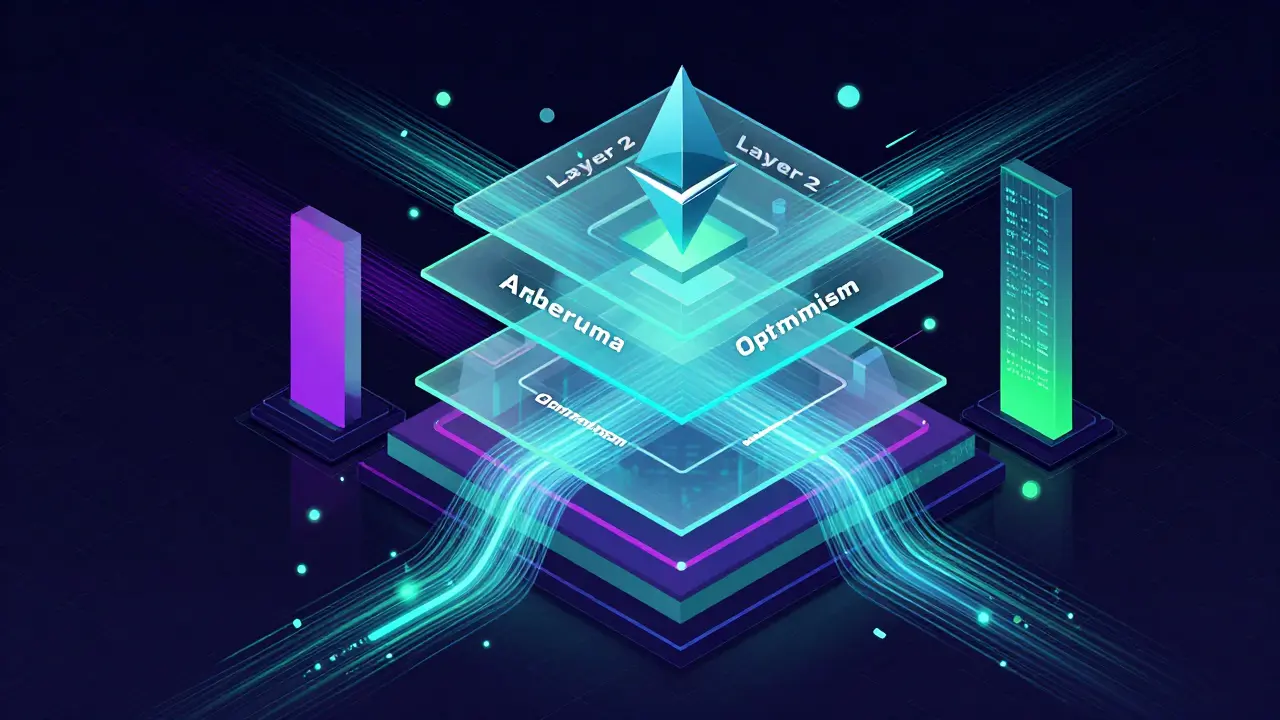
Navigating the Future: Layer 2s and Cross-Chain Legos
As we enter 2026, the landscape is shifting. To address scalability and security, the industry is moving toward two key solutions:
Layer 2 Scaling: Networks like Arbitrum and Optimism allow DeFi protocols to run cheaper and faster while inheriting Ethereum’s security. Composability works here too, but with lower friction. Users can stack legos without worrying about $50 gas fees.
Cross-Chain Interoperability: Protocols like Chainlink CCIP (Cross-Chain Interoperability Protocol) aim to connect legos across different blockchains. Imagine using liquidity on Polygon to secure a loan on Avalanche. This "cross-domain" composability could multiply the available capital pool by orders of magnitude.
However, experts warn of "ossification." As more apps depend on specific legacy protocols, those protocols become harder to upgrade. Breaking backward compatibility risks breaking downstream applications. Balancing innovation with stability remains the biggest challenge for DeFi architects.
Who Should Care About Money Legos?
If you’re an investor, understanding composability helps you evaluate risk. Are you putting money into a standalone protocol, or a complex stack dependent on five other projects? The latter offers higher potential yields but carries greater fragility.
If you’re a developer, composability is your superpower. You don’t need to build a lending engine from scratch. You can focus on unique user experiences or novel financial products by leveraging existing infrastructure. Tools like Hardhat and OpenZeppelin contracts make integration easier than ever.
For regulators, the challenge is clear. How do you oversee a system where no single entity controls the flow of funds? The decentralized nature of legos makes traditional compliance difficult, prompting ongoing debates about liability and oversight.
What exactly are "Money Legos" in DeFi?
Money Legos is a metaphor for DeFi protocols that are designed to be interoperable. Like physical Lego bricks, these smart contracts have standardized interfaces that allow them to snap together. One protocol’s output (e.g., a token) can be used as another protocol’s input (e.g., collateral), enabling complex financial products to be built quickly without prior coordination.
Is DeFi composability safe?
Composability introduces both opportunity and risk. While it enables efficient capital reuse, it also creates systemic vulnerability. A bug or exploit in one protocol can cascade through connected protocols, leading to widespread losses. Security audits, formal verification, and circuit breakers are essential to mitigate these risks.
How does composability differ from traditional finance APIs?
Traditional finance relies on closed APIs controlled by central entities (banks, brokers). Integrations require permission, lengthy negotiations, and are subject to unilateral changes. DeFi composability is permissionless and programmatic. Any developer can interact with any protocol directly via smart contracts, ensuring transparency and immutable access.
What role do Layer 2 networks play in composability?
Layer 2 networks like Arbitrum and Optimism reduce transaction costs and increase speed on Ethereum. This makes composing multiple protocols economically viable for smaller users. Without L2s, high gas fees often rendered complex multi-step transactions prohibitively expensive.
Can I build my own DeFi application using money legos?
Yes. Developers can use tools like Hardhat, Truffle, and libraries from OpenZeppelin to interact with existing protocols like Uniswap, Aave, or Compound. By importing Application Binary Interfaces (ABIs), you can call external contract functions directly, allowing you to build custom financial products in weeks rather than months.