
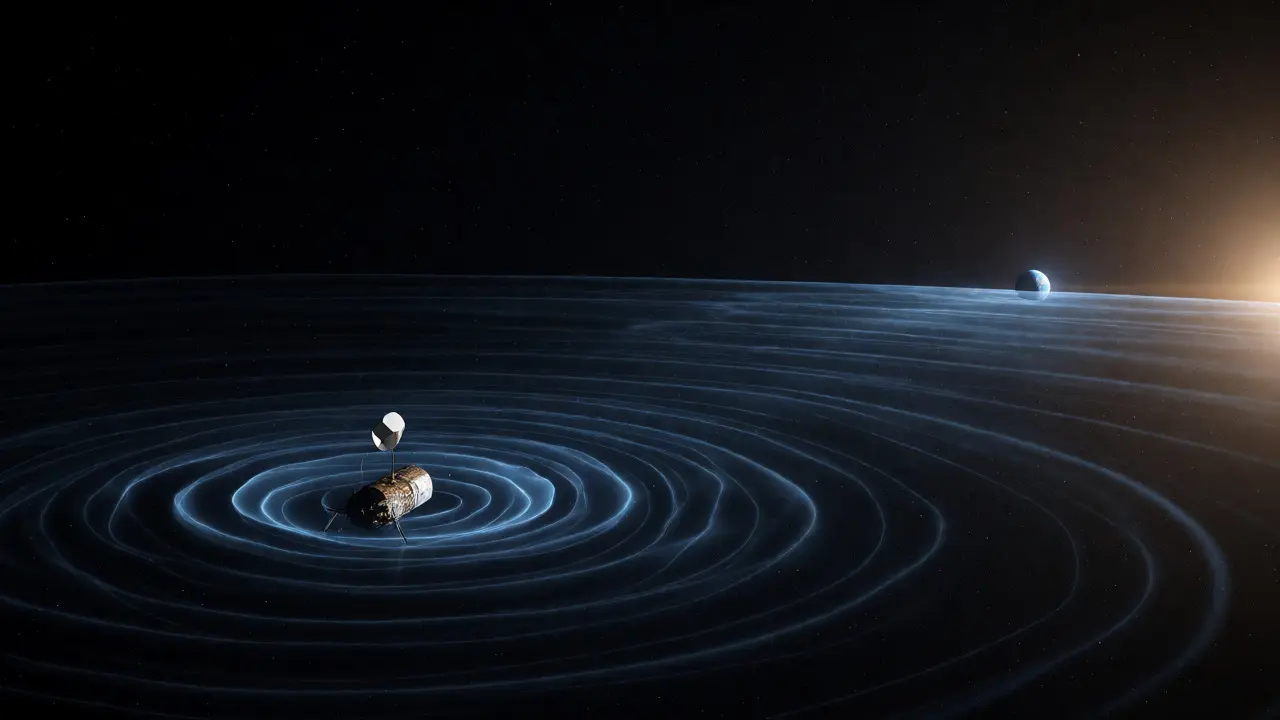
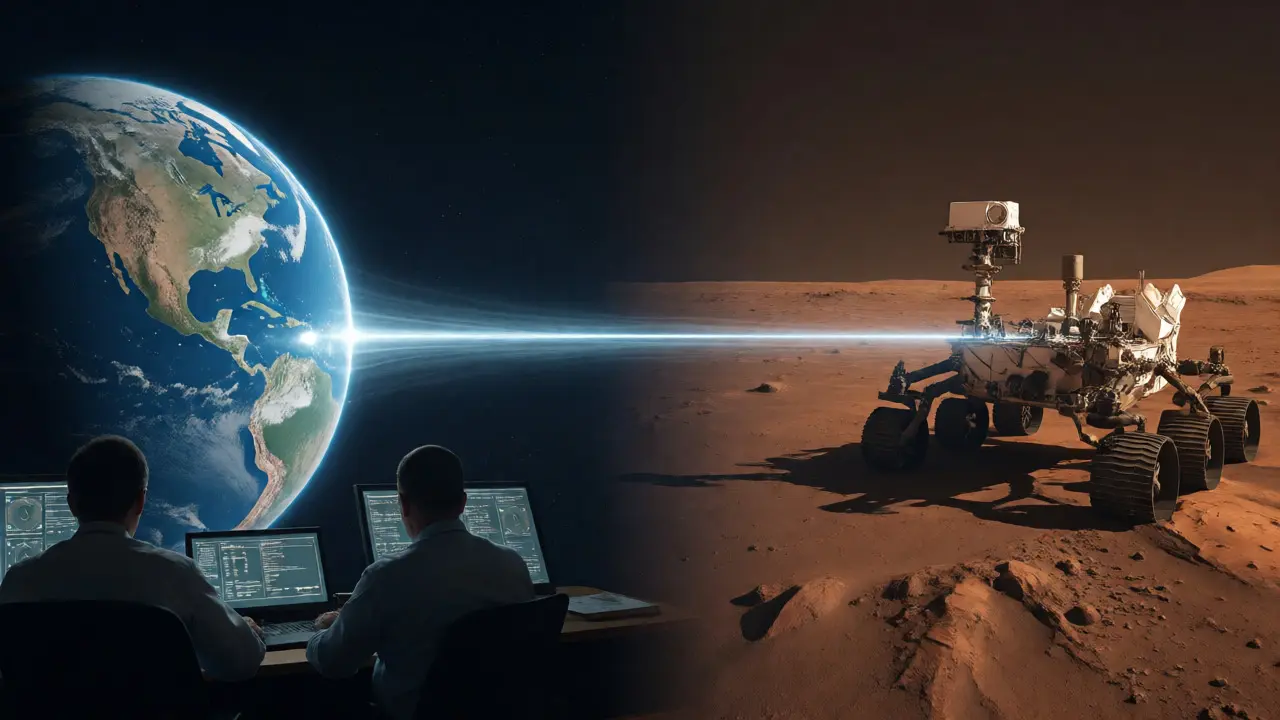
You send a text message to a friend in London. It arrives instantly. You feel like you’re talking right now. Now imagine sending that same message to a rover on Mars. You hit send. Then you wait. And wait. Four minutes later, your message lands. If they reply immediately, you won’t see it for another four minutes. Eight minutes total for a simple "hello." That’s the reality of deep space communication. It isn’t just about having a good phone plan; it’s about fighting physics. Two main enemies stand in the way: the weakening of the signal as it travels, and the stubborn slowness of light itself.
The Inverse-Square Law: Why Signals Fade
Think of a flashlight in a dark room. Up close, the beam is bright and intense. Move ten feet away, and the circle of light gets bigger, but dimmer. The energy hasn’t disappeared; it’s just spread out over a larger area. Radio waves work the same way. This is the inverse-square law. As distance doubles, the signal strength drops to one-quarter. Triple the distance, and it’s down to one-ninth. For spacecraft millions or billions of miles away, this drop-off is brutal.
Engineers use a formula called the Friis transmission equation to calculate this loss. It shows that for every doubling of distance, you lose about 6 decibels (dB) of signal power. That sounds small until you realize deep space distances are massive. A typical spacecraft transmitter might pump out only 20 watts-less than a modern laptop charger. By the time those radio waves reach Earth, they are incredibly faint. NASA’s Deep Space Network (DSN) antennas sometimes pick up signals that are a billionth of a billionth of a watt. To put that in perspective, that’s billions of times weaker than what powers a digital wristwatch.
To catch these whispers, we don’t just turn up the volume. We use giant ears. The DSN uses massive dish antennas, some 70 meters wide. These dishes focus the weak incoming signal onto a sensitive receiver. But even with huge dishes, the signal is often buried in background noise from the sun, the galaxy, and our own electronics. So, engineers rely on coding. They add extra data bits to messages so receivers can detect errors and reconstruct the original information, even when the signal is barely audible above the static.
Speed Limit: The Light-Speed Barrier
Here’s the hard truth: nothing travels faster than light. In a vacuum, light moves at exactly 299,792 kilometers per second. That’s fast, sure. But space is unimaginably big. This creates an unavoidable lag known as propagation delay. You cannot engineer this away. No amount of better software, stronger lasers, or clever protocols makes the wavefront arrive sooner if the distance hasn’t changed.
On Earth, we rarely notice this because distances are short. Fiber optic cables slow light down slightly-to about two-thirds of its vacuum speed-but across continents, the delay is still just milliseconds. Your video call feels real-time. But scale that up. A signal to the Moon takes about 1.3 seconds one way. Round trip? Over two seconds. Try playing online ping-pong with someone on the Moon. You’d swing your paddle before their ball even arrived.
Mars is worse. Depending on where Earth and Mars are in their orbits, the one-way delay ranges from about 4 minutes to 24 minutes. A round-trip conversation takes 8 to 48 minutes. Imagine trying to coordinate a rescue mission via walkie-talkie with half-hour delays between each word. It’s impossible. That’s why rovers like Perseverance operate autonomously. They don’t wait for commands to avoid rocks; they drive themselves. Humans upload instructions in batches, then wait hours for confirmation.
| Location | Avg Distance | One-Way Delay | Round-Trip Delay |
|---|---|---|---|
| New York to London | ~5,500 km | ~20 ms | ~40 ms |
| Earth to Moon | ~384,400 km | ~1.3 s | ~2.6 s |
| Earth to Mars (Closest) | ~55 million km | ~4 min | ~8 min |
| Earth to Mars (Farthest) | ~400 million km | ~24 min | ~48 min |
| Voyager 1 | ~24 billion km | ~22 hrs | ~44 hrs |
Fighting Noise: The Shannon Limit
If signal strength is about how loud the whisper is, noise is the crowd shouting around it. Claude Shannon, a mathematician at Bell Labs, figured out the absolute limit of how much data you can push through a noisy channel back in 1948. His theorem says capacity depends on bandwidth and signal-to-noise ratio (SNR). More bandwidth gives you more lanes on the highway. Higher SNR means less static interference. But there’s a ceiling. Once you hit the Shannon limit, no clever coding can squeeze more error-free data through.
This is why deep space links are slow compared to your home Wi-Fi. Your Wi-Fi has high SNR and plenty of bandwidth. Voyager 1 has low SNR and limited bandwidth allocated by international treaty. Engineers constantly tweak modulation schemes-how they encode bits onto radio waves-to stay just below that theoretical limit. If they push too hard, errors spike, and the link breaks.
Radio vs. Laser: The Next Frontier
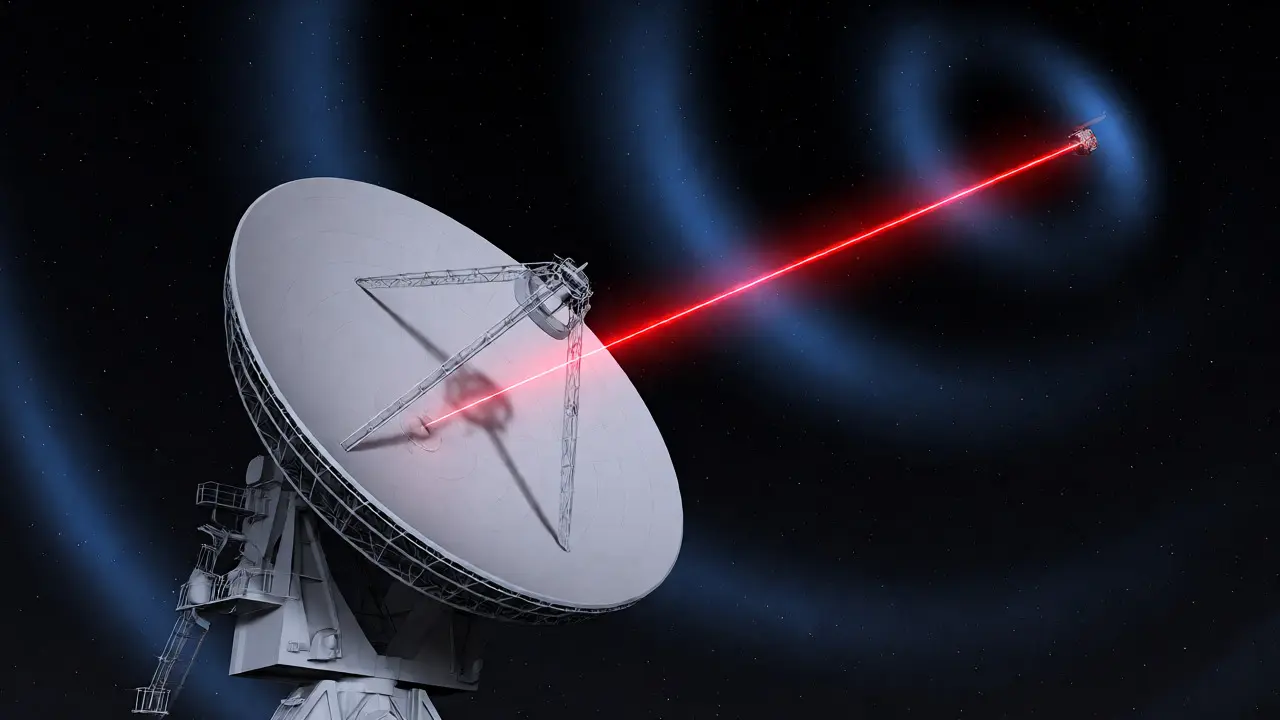
For decades, we’ve used radio waves. They’re reliable. They punch through clouds and dust reasonably well. But they have lower frequencies, which limits bandwidth. Enter optical communication. Instead of radio, we use lasers. Near-infrared light has a much higher frequency, allowing vastly more data to be packed into the same amount of time.
NASA’s Deep Space Optical Communications (DSOC) experiment proved this works. In late 2023, DSOC sent ultra-high-definition video from nearly 20 million miles away at 267 Mbps. Later, in 2024, it maintained connections from over 240 million miles away. Compare that to traditional radio links, which might manage a few kilobits per second at similar distances. That’s a thousand-fold improvement.
But lasers aren’t magic. They require precise pointing. A laser beam is narrow. If the spacecraft wobbles, the beam misses Earth entirely. Clouds also block optical signals, whereas radio passes through them easily. So, future missions will likely use both: radio for robust command and control, and lasers for dumping huge volumes of science data when conditions allow.
Real-World Engineering Hacks
Since we can’t break the speed of light, we design around the delay. One key strategy is store-and-forward networking. Data isn’t sent live. It’s recorded onboard, stored, and transmitted during scheduled windows when a ground station is visible. Commands are batched. If a problem occurs, the spacecraft enters a safe mode automatically rather than waiting hours for human input.
Another trick is using multiple ground stations. The DSN has complexes in California, Spain, and Australia. As Earth rotates, different sites take over tracking, ensuring near-continuous coverage. This doesn’t reduce delay, but it ensures we don’t lose contact entirely while waiting for the next window.
Finally, antenna size matters. Larger dishes collect more photons. The 70-meter antennas at Goldstone, Madrid, and Canberra are engineering marvels. They can track a coin-sized object from thousands of miles away. But building them is expensive and complex. Smaller, phased-array antennas are being developed to offer flexibility without the massive footprint.
Why This Matters for Future Missions
As we look toward crewed Mars missions, these constraints shape everything. Astronauts won’t be able to talk to Houston in real time. They’ll need autonomous systems for navigation, life support, and emergency response. Psychological isolation will be compounded by the communication lag. Knowing your family’s voice message took 20 minutes to arrive changes the emotional dynamic of long-duration travel.
Interstellar probes face even starker challenges. Voyager 1, now over 24 billion kilometers away, sends data back at a trickle. Each bit takes immense effort to extract from the noise. If we want to communicate with probes beyond our solar system, we’ll need either massive increases in transmitter power, gigantic receiving arrays on Earth, or perhaps quantum entanglement tricks-if they ever prove practical for messaging, which current physics doubts.
Does increasing signal strength make messages arrive faster?
No. Signal strength affects reliability and data rate, not speed. Propagation delay is determined solely by distance divided by the speed of light. A stronger signal helps the receiver distinguish the message from noise, allowing for higher data rates or fewer errors, but the first bit still arrives after the same amount of time.
Why do geostationary satellites have higher latency than fiber optics?
Geostationary satellites orbit 36,000 kilometers above Earth. A signal must travel up to the satellite and back down, covering roughly 72,000 kilometers. At the speed of light, this creates a minimum round-trip delay of about 240 milliseconds, plus processing time. Fiber optics follow direct paths on the ground, resulting in much shorter physical distances and lower latency, typically under 50 milliseconds for transcontinental routes.
Can laser communication replace radio for all deep space missions?
Unlikely in the near term. Lasers offer higher data rates but suffer from atmospheric interference (clouds) and require extremely precise pointing. Radio waves penetrate weather better and are easier to aim. Future systems will likely hybridize, using radio for critical commands and health telemetry, and lasers for high-bandwidth scientific data downloads when conditions permit.
How does the Deep Space Network handle such weak signals?
The DSN uses three key strategies: large antenna apertures (up to 70 meters) to collect more energy, cryogenically cooled receivers to minimize internal thermal noise, and advanced error-correcting codes that allow data recovery even when the signal is barely above the noise floor.
What is the biggest limitation for communicating with Voyager 1?
The primary limitations are extreme distance causing severe signal attenuation and the finite speed of light creating a ~22-hour one-way delay. Additionally, the spacecraft’s aging power source limits transmitter output, forcing very low data rates to maintain a viable link margin against cosmic background noise.
12 Responses
the inverse square law is brutal but beautiful in its simplicity. it reminds us that distance isn't just a number on a map, it's a physical barrier that eats energy. we spend so much time trying to cheat physics with better tech, like those laser links, but the fundamental limit of light speed remains untouched. it makes you wonder if our obsession with real-time communication is actually holding back our philosophical understanding of space as something vast and separate rather than just a big room
ABSOLUTELY!! The fact that NASA is spending billions on these giant dishes while private companies are trying to do it cheaper is INSANE! We need more funding for the DSN, not less! People don't realize how fragile these links are until they break! If we lose contact with Voyager because some budget cut hit the receiver cooling systems, that would be a TRAGEDY for American science! Keep those antennas pointed up and keep the money flowing!
It’s cute that you think lasers will fix everything. Clouds exist. Pointing accuracy is hard. Radio works. Stop hyping tech that isn’t ready for prime time.
I appreciate the passion here! 🌟 It really highlights how interconnected we are, even across such voids. I feel like we often forget that behind every signal drop, there’s a human team working tirelessly to bridge that gap. Maybe instead of arguing about budgets or tech specs, we can celebrate the shared human endeavor of reaching out? That sense of connection is what matters most, regardless of the delay. 🤝✨
The assertion that 'quantum entanglement tricks' might prove practical for messaging is scientifically illiterate. No information travels faster than light via entanglement; this is a common misconception among laypeople. Furthermore, the distinction between propagation delay and processing latency must be maintained rigorously. One cannot conflate the two without undermining the technical accuracy of the discussion. Precision in terminology is paramount when discussing high-stakes engineering constraints.
Oh please, spare me the lecture on precision from someone who probably thinks 'space' is just a place where astronauts go to take selfies. You clearly haven't considered the emotional toll on the engineers themselves. Do you know how stressful it is to wait 48 minutes for a reply when your mission could fail? It’s not just about physics, it’s about the drama of waiting. Your cold logic ignores the human heartbreak of silence. Everyone is always so quick to judge the scientists for wanting better comms, but have you ever tried to coordinate a rescue over a walkie-talkie with a half-hour lag? No, you haven't, because you're too busy correcting grammar.
The sheer audacity of the universe to impose such a sluggish pace upon our desires for immediacy is truly staggering. One must acknowledge that the cosmos operates on a timescale indifferent to human impatience. It is a majestic, albeit frustrating, reminder that we are but fleeting sparks in an endless dark. To expect instantaneous connection across such gossamer threads of vacuum is perhaps the ultimate hubris of our species. We build towers of glass and steel to catch whispers from the void, yet the void answers only when it pleases. How delightfully humbling.
They tell us it's the speed of light but what if it's just a software update lag? Seriously. What if the government is throttling deep space bandwidth to hide what they found on Mars? They say it's physics but it feels like control. Why does it take 20 hours for Voyager but instant for Elon's Starlink? Something fishy going on with the frequencies. Wake up sheeple.
While conspiracy theories add flavor to the discourse, it is crucial to remember that the laws of thermodynamics and electromagnetism are non-negotiable partners in this dance. The delays described are not arbitrary administrative hurdles but fundamental constraints imposed by the structure of spacetime itself. As mentors in this field, we must guide newcomers to understand that overcoming these limits requires ingenuity in data compression and autonomous decision-making, not just faster transmission media. Patience is indeed a virtue when dealing with the cosmos.
The isolation aspect hits hard. Imagine being alone with thoughts for 40 minutes at a time.
You are absolutely right to highlight the psychological component. It’s not just about the tech failing; it’s about the human spirit enduring the silence. We need to support our astronauts mentally just as much as we support their hardware. Every message sent is a lifeline, and knowing there’s a delay doesn’t make the connection any less precious. Let’s keep encouraging them to find joy in the autonomy, turning that wait time into time for reflection and growth. You’ve got this, explorers!
Wow, thanks for the deep dive into my feelings about space. Really helpful. /s