
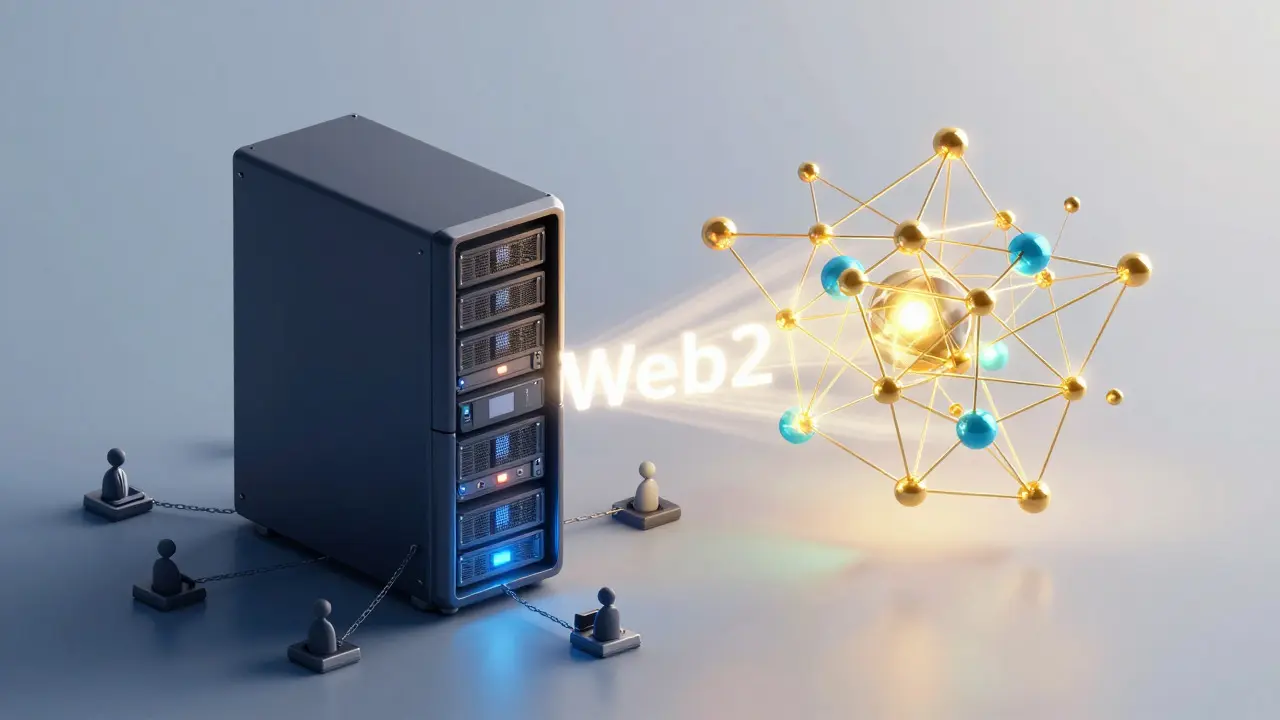
Imagine a world where no single company can shut down your favorite app, freeze your funds, or sell your data to advertisers without permission. That is the promise of dApps, or decentralized applications running on Web3 networks. Unlike traditional apps hosted on centralized servers, these programs live on blockchains, powered by self-executing code called smart contracts. As we move through 2026, the market for these applications has exploded, with projections ranging from $42 billion to nearly $82 billion depending on how you count them. But what does it actually take to build one?
What Exactly Is a dApp?
To understand building a dApp, you first need to strip away the marketing hype and look at the architecture. A standard web application (Web2) relies on a central server owned by a corporation. If that server goes down, the app stops working. If the owner changes their mind, they can delete your account. A dApp flips this model. Its backend logic runs on a distributed network of computers, known as nodes, which validate transactions and store data.
The core component of any dApp is the smart contractself-executing code stored on a blockchain that enforces rules automatically. These contracts handle everything from transferring tokens to verifying ownership of digital art. Because the code is open-source and immutable once deployed, users can audit exactly how the application works. There are no usernames or passwords; instead, you connect using a crypto walletdigital tool like MetaMask or Phantom that manages private keys and interacts with blockchains. This setup ensures that you own your data and assets, not the platform.
Choosing Your Blockchain Foundation
Before writing a single line of code, you must choose the blockchain layer your dApp will run on. This decision dictates your development language, performance capabilities, and target audience. In 2026, the landscape is dominated by a few key players, each with distinct trade-offs.
| Blockchain | Primary Language | Key Advantage | Best For |
|---|---|---|---|
| Ethereum | Solidity | Highest security and largest developer ecosystem | DeFi, Governance, High-value assets |
| Solana | Rust | High throughput (thousands of TPS) and low fees | Gaming, Real-time trading, Consumer apps |
| Polygon | Solidity | Ethereum compatibility with lower costs | NFTs, Enterprise scaling, Cost-sensitive projects |
| Avalanche | Solidity / Move | Fast finality and customizable subnets | Institutional finance, Custom ecosystems |
If you prioritize trust-minimization and composability-the ability for different dApps to interact seamlessly-Ethereum remains the gold standard. However, its historical congestion issues mean many developers now use Layer 2 solutions like Arbitrum or Optimism. On the other hand, if your dApp requires high-frequency interactions, such as a real-time multiplayer game, Solana’s monolithic architecture offers superior speed but demands rigorous optimization to avoid bottlenecks.
The Three-Layer Architecture
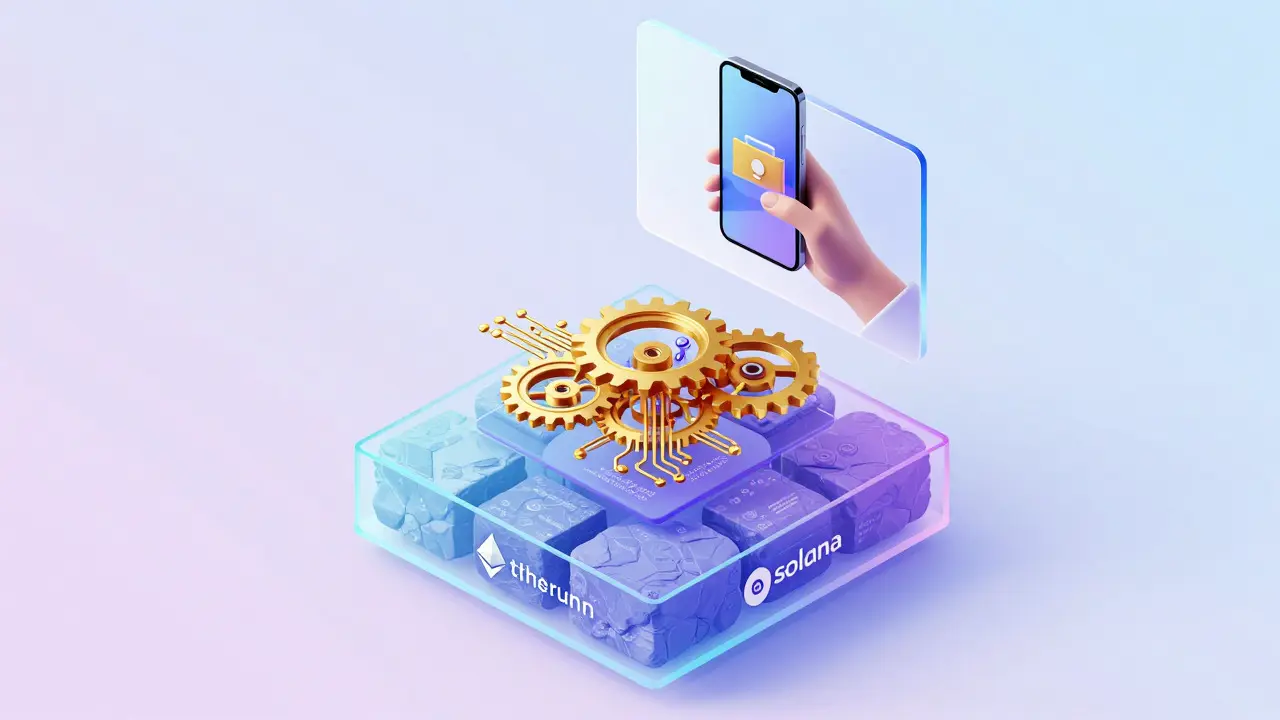
Building a dApp isn't just about coding smart contracts. You need to structure your project into three distinct layers to ensure functionality and user accessibility.
- The Blockchain Layer: This is the foundation. It handles consensus mechanisms (like Proof of Stake) and data storage. You don't build this; you select an existing chain like Ethereum or Solana.
- The Smart Contract Layer: This is your backend. Here, you write the business logic. For example, in a decentralized exchange (DEX), the contract calculates swap rates and executes trades. Developers typically use frameworks like Hardhatdevelopment environment for compiling, deploying, and testing Solidity contracts or Truffle to manage this process.
- The Client Interface: This is the frontend that users see. It looks like a regular website but uses JavaScript libraries (such as Ethers.js or Web3.js) to communicate with the blockchain via RPC endpoints. This layer triggers wallet signatures and displays on-chain data.
Development Workflow and Tools
Once you've chosen your stack, the actual building process begins. If you're targeting EVM-compatible chains (Ethereum, Polygon, Avalanche), you'll likely be writing in Solidityhigh-level programming language for implementing smart contracts on Ethereum. The workflow involves compiling your code, running unit tests to simulate various scenarios, and then deploying the bytecode to the network.
Security is paramount. Because smart contracts are immutable, a bug can lead to irreversible loss of funds. Professional teams hire specialized auditors to review their code before launch. For smaller projects, adopting formal verification tools or extensive test suites is non-negotiable. On Solana, developers use Rust, focusing heavily on concurrency and account-based state handling to maximize performance.
After deployment, you need to verify your source code on explorers like Etherscan. This transparency builds trust with users, allowing them to see exactly what the contract does. Additionally, integrating indexing services like The Graphprotocol for indexing data from Ethereum and IPFS helps your frontend query complex on-chain history efficiently.

Common Challenges and Pitfalls
Despite the excitement, building dApps comes with significant hurdles. User experience (UX) remains the biggest barrier to mainstream adoption. Asking a new user to manage private keys, buy gas tokens, and approve transactions is a steep learning curve. Successful dApps abstract this complexity wherever possible, offering intuitive interfaces that hide the underlying blockchain mechanics.
Scalability and cost are also persistent issues. During peak network activity, gas fees on Ethereum can skyrocket, making small transactions economically unviable. This is why many developers opt for Layer 2 solutions or alternative chains like Polygon. Furthermore, regulatory uncertainty looms over sectors like DeFi and NFTs. While dApps are technically permissionless, the teams behind them often navigate evolving legal landscapes regarding securities laws and KYC/AML requirements.
The Future of dApps in 2026 and Beyond
As we progress through 2026, the dApp ecosystem is maturing rapidly. We are seeing a shift from experimental prototypes to robust infrastructure serving real-world needs. DeFi continues to dominate in terms of total value locked, but gaming and social media dApps are gaining traction by leveraging play-to-earn mechanics and verifiable digital ownership.
The future points toward a multi-chain reality. Rather than betting on a single winner, developers are building cross-chain bridges and interoperable protocols that allow assets and data to flow freely between Ethereum, Solana, and others. With market forecasts suggesting growth toward $200 billion by 2035, the demand for skilled dApp developers will only increase. Whether you are building a simple token drop or a complex lending protocol, the principles remain the same: prioritize security, optimize for user experience, and embrace the decentralized ethos.
What is the difference between a Web2 app and a Web3 dApp?
A Web2 app runs on centralized servers controlled by a single company, which can modify rules or shut down access at any time. A Web3 dApp runs on a decentralized blockchain network using smart contracts, meaning no single entity controls it, and users retain ownership of their data and assets via crypto wallets.
Which programming language should I learn to build dApps?
If you want to build on Ethereum, Polygon, or Avalanche, you should learn Solidity. For high-performance applications on Solana, Rust is the primary language. JavaScript is essential for building the frontend interface that connects to the blockchain.
Are dApps secure?
dApps inherit the security of the underlying blockchain, making them resistant to censorship and single points of failure. However, vulnerabilities in smart contract code can lead to hacks. Therefore, rigorous testing, audits, and formal verification are critical steps in the development process.
How do users interact with a dApp?
Users interact with dApps using a crypto wallet like MetaMask or Phantom. Instead of logging in with a username and password, they connect their wallet to the app's interface. The wallet signs transactions, proving ownership and authorizing actions on the blockchain.
What are the main categories of dApps?
The most common categories include DeFi (Decentralized Finance) for lending and trading, Gaming for play-to-earn experiences, NFT Marketplaces for digital collectibles, Social Media for decentralized content sharing, and Supply Chain tracking for transparency.
11 Responses
They are watching us!!! Every time you connect your wallet, the deep state logs your IP address and sells it to Big Pharma. It is not about decentralization, it is about total surveillance capitalism on steroids! Wake up sheeple! The blockchain is just a honeypot for our data! They want to freeze your assets because you voted wrong in 2020!
You people are all asleep at the wheel. This article is pure propaganda designed to make you feel smart while you get rug-pulled by venture capitalists. Solidity is garbage code written by nerds who have never touched real hardware. Rust is overhyped. The whole premise of 'trustless' systems is a joke because you still trust the browser extension which is basically malware waiting to happen. I built a dApp last year and lost my shirt because the gas fees ate my lunch. It is a scam.
Actually, if you look at the architecture, the browser extension vulnerability is a client-side issue, not a protocol flaw. Using a hardware ledger like Ledger or Trezor mitigates that risk significantly. Also, gas fees on L2s like Arbitrum are fractions of a cent now, so the economic argument against small transactions is largely outdated for most use cases. The immutability is a feature, not a bug, once you understand formal verification.
I mean, look, I get what Kyle is saying, but honestly, trying to explain to your mom how to back up her seed phrase without her writing it on a sticky note is the real barrier to entry here. We keep talking about TPS and finality, but nobody is talking about the fact that UX is still terrible. You need five different approvals just to swap one token. It is exhausting. And don't even get me started on the regulatory uncertainty. One day you are compliant, the next day the SEC sues you for being a security. It is a wild west out there, folks. I just want to build a simple NFT gallery without worrying about getting indicted.
Stop whining Jeff! Just learn Rust and move to Solana lol. The speed is insane and the fees are basically free. Why are you guys still stuck on Ethereum legacy tech? It is 2026! Get with the program. I deployed a game yesterday and it was smooth as butter. No lag, no high fees. If you cant handle the concurrency model, maybe coding isnt for you. Lets gooo!
Solana goes down every other week though. Remember the outage in March? Your 'smooth as butter' game was offline for six hours. That is not production-ready infrastructure. Ethereum might be slow, but it has never had a full network halt since the DAO fork. Reliability beats raw throughput when you are dealing with financial assets. Also, your typo in 'isnt' shows you dont care about precision.
Oh wow, Chris, really flexing your knowledge here. Very impressive. I am sure the billions locked in Solana ecosystems didn't notice the downtime. But sure, let's pretend centralized cloud providers for RPC nodes don't cause issues too. Anyway, great read everyone. The table comparing chains is actually very useful for beginners. I appreciate the clear breakdown of languages. Solidity vs Rust is a classic debate but both have their place. Keep building!
This is foreign technology invading our digital sovereignty. American developers should stick to AWS and Azure where we know the rules. Blockchain is Chinese spyware in disguise. Build apps in America, for Americans. Not this globalist crypto nonsense.
Interesting perspective Brandon. Though technically Bitcoin was invented by Satoshi Nakamoto whose identity is unknown, and Ethereum by Vitalik Buterin who is Canadian-Russian. Not exactly a US-centric origin story. But I guess nationalism applies to code too.
I think we can all agree that the future is multi-chain. Instead of fighting over which layer 1 is best, interoperability protocols like Wormhole and LayerZero are making it possible to move assets seamlessly. It is exciting to see social dApps gaining traction. Finally, owning your content feels real. Great overview of the current landscape!
simple truth