
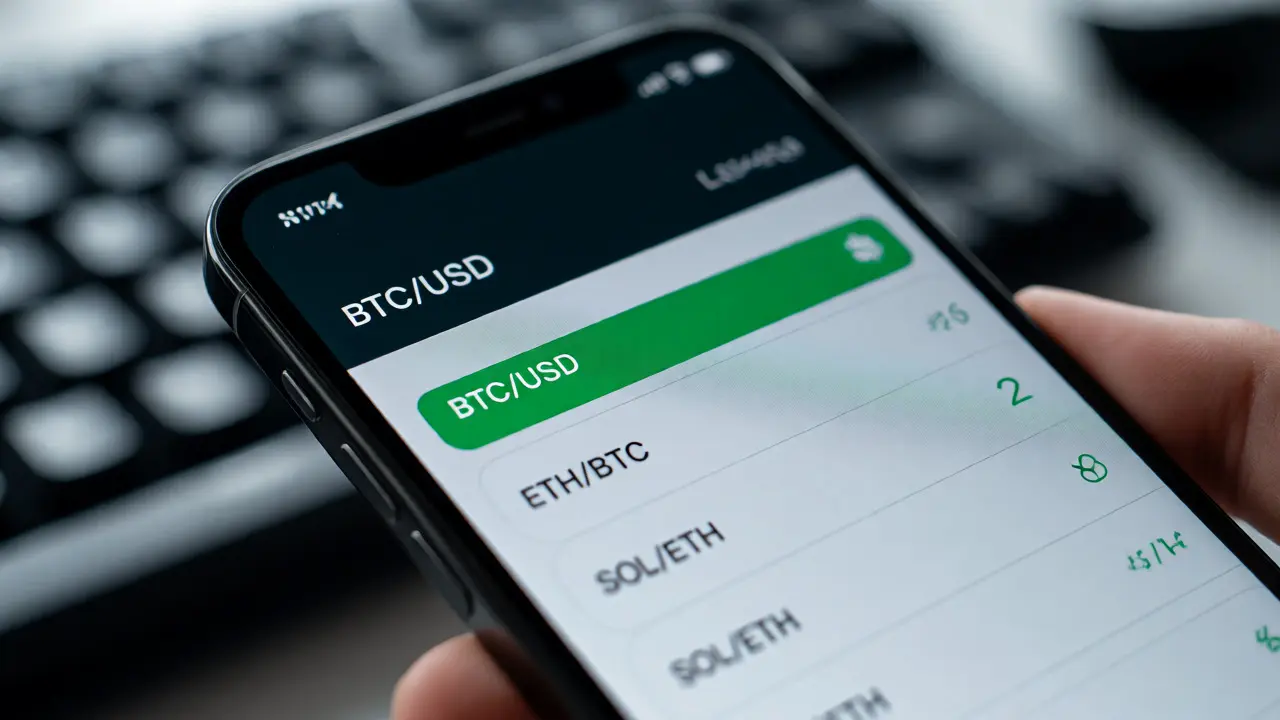
You see a chart flashing green. BTC is up 5%. You hit "Buy" on your exchange app, expecting to pay the price you just saw. But when the trade completes, you paid more than expected. Or maybe you bought the wrong thing entirely because you didn't realize ETH/BTC is a different market than ETH/USD. If this sounds familiar, you are dealing with the two most fundamental concepts in crypto trading: trading pairs and market orders. Getting these right isn't just about theory; it's the difference between a profitable trade and an accidental loss due to fees or bad execution.
Quick Summary
- Pairs define value: In any pair like BTC/USD, the first asset (BTC) is what you buy/sell, and the second (USD) is what you pay/receive.
- Market orders prioritize speed: They execute immediately at the best available current prices, but offer no price guarantee.
- Liquidity matters: Thin pairs have wide spreads and high slippage, meaning large orders move the price against you.
- DEX vs. CEX mechanics differ: Centralized exchanges use order books; decentralized exchanges (like Uniswap) use automated market makers (AMMs) where price impact scales with trade size.
- Fees vary by role: Market orders are always "takers" and usually incur higher fees than limit orders that sit on the book as "makers."
Decoding Trading Pairs: Base vs. Quote Assets
A trading pair is essentially a quoted market connecting two assets so they can be exchanged for one another. Think of it like currency exchange rates at an airport kiosk, but for digital assets. Every pair consists of two parts: the base asset and the quote asset. The convention is strict: the base asset comes first, and the quote asset comes second.
Take BTC/USD. Here, Bitcoin (BTC) is the base asset. It is the object being traded. USD is the quote asset. It is the unit of account used to measure the value of Bitcoin. When you see a price of $68,000 next to BTC/USD, it means one unit of the base asset (1 BTC) costs 68,000 units of the quote asset ($68,000). Buying means paying USD to receive BTC. Selling means delivering BTC to receive USD.
This structure changes depending on the pair type. Crypto-to-fiat pairs (like BTC/USD) link digital assets to government currencies. Crypto-to-stablecoin pairs (like ETH/USDT) link crypto to tokens pegged to fiat, often offering better liquidity or easier withdrawal options on certain platforms. Crypto-to-crypto pairs (like SOL/ETH) allow you to swap one cryptocurrency directly for another without touching fiat. This is common if you want to rotate profits from a winning altcoin into Ethereum rather than cashing out to dollars.
Be careful with notation. Different venues display pairs differently. A centralized exchange might show BTC-USD, BTC/USD, or BTCUSDT. An API might use internal codes like Kraken’s XXBT for Bitcoin. Always verify which symbol represents the asset you intend to buy. A common beginner mistake is assuming that buying "BTC" means you get Bitcoin regardless of the pair. If you buy on the BTC/ETH pair, you are paying with Ethereum, not dollars.
The Mechanics of Market Orders
A market order is an instruction to buy or sell a specific quantity of an asset immediately at the best available current price. Unlike a limit order, which sets a maximum price you're willing to pay (or minimum you'll accept), a market order prioritizes execution certainty over price certainty. You tell the exchange: "I want this amount now, whatever it costs." On a centralized exchange (CEX) like Coinbase or Binance, the market operates via an order book. This is a real-time list of resting buy orders (bids) and sell orders (asks). The highest bid is the best price buyers are offering. The lowest ask is the best price sellers are demanding. The difference between them is the bid-ask spread.
When you place a market buy order, you consume the lowest available asks first. If your order size exceeds the volume available at that lowest price, the system moves to the next lowest ask, then the next, until your entire order is filled. This process creates a volume-weighted average price (VWAP) for your transaction. Because you are taking liquidity off the book, you are classified as a "taker." Taker fees are typically higher than maker fees because you are removing depth from the market rather than adding to it.
Crucially, market orders cannot usually be canceled once submitted. They are designed for immediate execution. However, "immediate" doesn't mean instant for huge orders. If you try to buy 100 BTC in a thin market, the system might take seconds to fill across dozens of price levels. During that time, the price could shift further against you.

Slippage and Price Impact: The Hidden Costs
The biggest risk with market orders is slippage, which is the difference between the expected price and the actual execution price. Slippage happens when there isn't enough liquidity at your desired price level to absorb your entire order.
Let's look at a concrete example. Imagine the BTC/USD order book looks like this:
- Ask Level 1: $68,000 for 0.10 BTC
- Ask Level 2: $68,050 for 0.20 BTC
- Ask Level 3: $68,200 for 0.50 BTC
If you place a market buy for 0.10 BTC, you pay exactly $68,000 per coin. Simple. But if you place a market buy for 0.30 BTC, the engine fills the first 0.10 BTC at $68,000 and the remaining 0.20 BTC at $68,050. Your average cost becomes approximately $68,033.33. You paid $33 more per coin than the initial displayed price. This is price impact caused by your own order size relative to market depth.
In volatile markets or thinly traded pairs, this effect amplifies. A 2025 study of millions of market orders on major exchanges found that discrepancies between expected and actual outcomes correlated strongly with volatility and network latency. If news breaks while your order is processing, the order book might update before your trade executes, resulting in a fill price significantly worse than the last traded price you saw on your screen. Remember: the last traded price is history. The order book is the present reality.
Centralized Exchanges vs. Decentralized Swaps
How you execute a market order depends heavily on whether you are using a CEX or a DEX. On a CEX, the matching engine handles the complexity. You click buy, and the engine matches you against existing sell orders.
On a decentralized exchange (DEX) like Uniswap, there is no order book. Instead, trades occur against a liquidity pool governed by an automated market maker (AMM). Early versions of Uniswap used a constant-product formula (x × y = k). When you buy token A with token B, you remove A from the pool and add B. This changes the ratio of reserves, automatically adjusting the price. Larger trades relative to the pool's total liquidity cause larger price movements. This is known as price impact.
| Feature | Centralized Exchange (Order Book) | Decentralized Exchange (AMM Pool) |
|---|---|---|
| Execution Source | Matches against individual user sell/buy orders. | Executes against smart contract liquidity reserves. |
| Price Determination | Determined by supply/demand queue (best ask/bid). | Determined by mathematical curve based on reserve ratios. |
| Slippage Cause | Consuming multiple order book levels. | Changing the x/y ratio in the pool formula. |
| Additional Risks | Exchange downtime, withdrawal halts, custody risk. | Gas fees, MEV attacks, smart contract bugs, failed transactions. |
| Control Mechanism | Cancel order before match (if possible). | Set "Slippage Tolerance" and "Deadline" before signing. |
DEX users face unique risks. You must set a slippage tolerance. If the price moves beyond your tolerance before the blockchain confirms your transaction, the swap reverts, but you still pay the gas fee. Furthermore, malicious tokens can trap funds in pools with low liquidity. Always verify the token contract address before swapping.
Practical Workflow for Safe Trading
Don't just hit "Buy." Follow a checklist to protect your capital.
- Verify the Pair: Ensure the base asset is what you want to acquire and the quote asset is what you hold. Do you have USDT in your wallet? Then trade on the /USDT pair. Do you have USD balance? Trade on /USD.
- Check Liquidity and Spread: Look at the order book depth. Is the spread tight? For BTC/USD, it should be pennies. For obscure altcoins, it might be percentages. Wide spreads indicate poor liquidity and high potential slippage.
- Choose Order Type Wisely: Use market orders only when speed is critical (e.g., stopping a loss during a crash). For normal entries, consider limit orders to control price and earn lower maker fees.
- Calculate Size Correctly: Decide if you are specifying the amount of the base asset (e.g., 0.1 BTC) or the amount of quote currency to spend (e.g., $10,000). Most interfaces allow both, but mixing them up leads to unexpected positions.
- Review Fees: Check the taker fee rate. On some platforms, taker fees exceed 0.1%, which eats into profits quickly on small trades.
- Execute Small Tests: If you are new to a platform or pair, start with a tiny order. Verify the fill price, fees, and balance updates before committing significant capital.
Regulators like the U.S. Commodity Futures Trading Commission warn that virtual currencies are highly volatile and lightly traded assets are prone to manipulation. A market order does not protect you from flash crashes or delistings. It simply guarantees execution, often at the worst possible moment if you aren't careful.
Frequently Asked Questions
What happens if I place a market buy order but there is no liquidity?
If there is absolutely no liquidity (no ask orders), the order may remain unfilled or fail to execute depending on the exchange's rules. In most cases, if there is minimal liquidity, the order will sweep through all available asks, potentially causing massive slippage, filling at a much higher price than the last traded price.
Can I cancel a market order after submitting it?
Generally, no. Market orders are designed for immediate execution. Once sent, they match against available orders instantly. Some exchanges allow cancellation if the order hasn't matched yet (rare for true market orders), but standard practice treats them as irrevocable instructions.
Why did my market order fill at a different price than shown on the chart?
Charts often display the last traded price or a mid-price. Market orders execute against the current order book. If the spread is wide or your order consumes multiple price levels, the average fill price will differ from the single point displayed on the chart. Volatility during transmission also contributes to this discrepancy.
Is it cheaper to use limit orders instead of market orders?
Usually, yes. Limit orders that rest on the book are "maker" orders and often incur lower fees than "taker" market orders. However, limit orders carry the risk of not executing if the price never reaches your limit, whereas market orders guarantee execution.
What is the difference between BTC/USDT and BTC/USD?
The underlying asset (Bitcoin) is the same, but the settlement currency differs. BTC/USDT settles in Tether (a stablecoin), while BTC/USD settles in US Dollars. Liquidity, fees, and spread can vary significantly between the two pairs. USDT pairs often have higher volume on international exchanges, while USD pairs are common on regulated US-based platforms.
Next Steps
You now understand the machinery behind the button press. To solidify this knowledge, open your exchange interface and inspect the order book for a liquid pair like ETH/USDT. Note the spread and the depth at each price level. Place a tiny market order and observe the exact fill price versus the pre-trade price. This practical experiment will teach you more about slippage than any article can.