
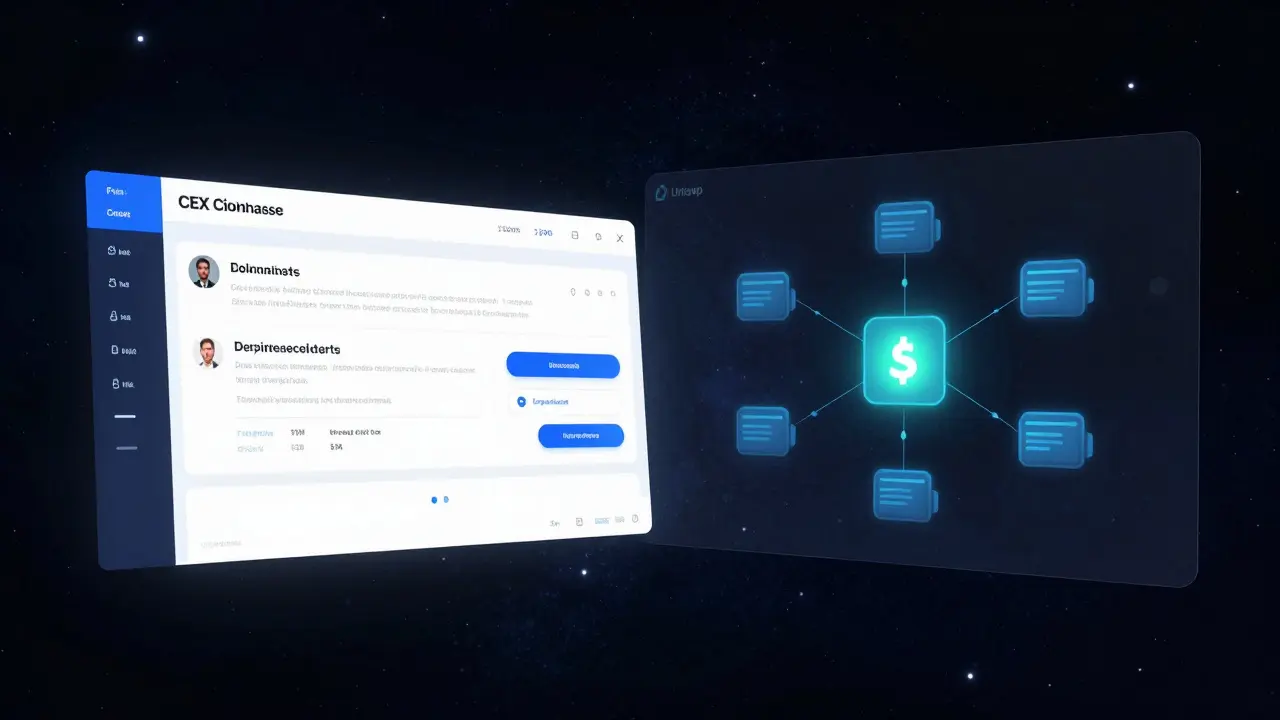
When you want to trade crypto, you have two main choices: a centralized exchange (CEX) or a decentralized exchange (DEX). They feel like the same thing - buy Bitcoin, sell Ethereum, swap tokens - but underneath, they’re built on completely different rules. One puts your money in someone else’s hands. The other lets you keep full control. Which one you pick changes everything: your security, your speed, your fees, and even what coins you can trade.
How CEXs Work: The Bank Model
Centralized exchanges like Binance, Coinbase, and Kraken operate like banks for crypto. You sign up, verify your identity with KYC (know your customer), and deposit your coins or fiat money into an account they control. When you trade, they match orders internally. No blockchain. No public ledger. Just their servers handling everything behind the scenes.This setup is fast. Trades settle in under two seconds. You can buy Bitcoin with Australian dollars using a bank transfer or credit card - Coinbase supports over 25 fiat currencies as of early 2025. Customer support is available 24/7, with Coinbase handling over 120,000 support requests per day. If something goes wrong, you can call them. If you forget your password, they can reset it.
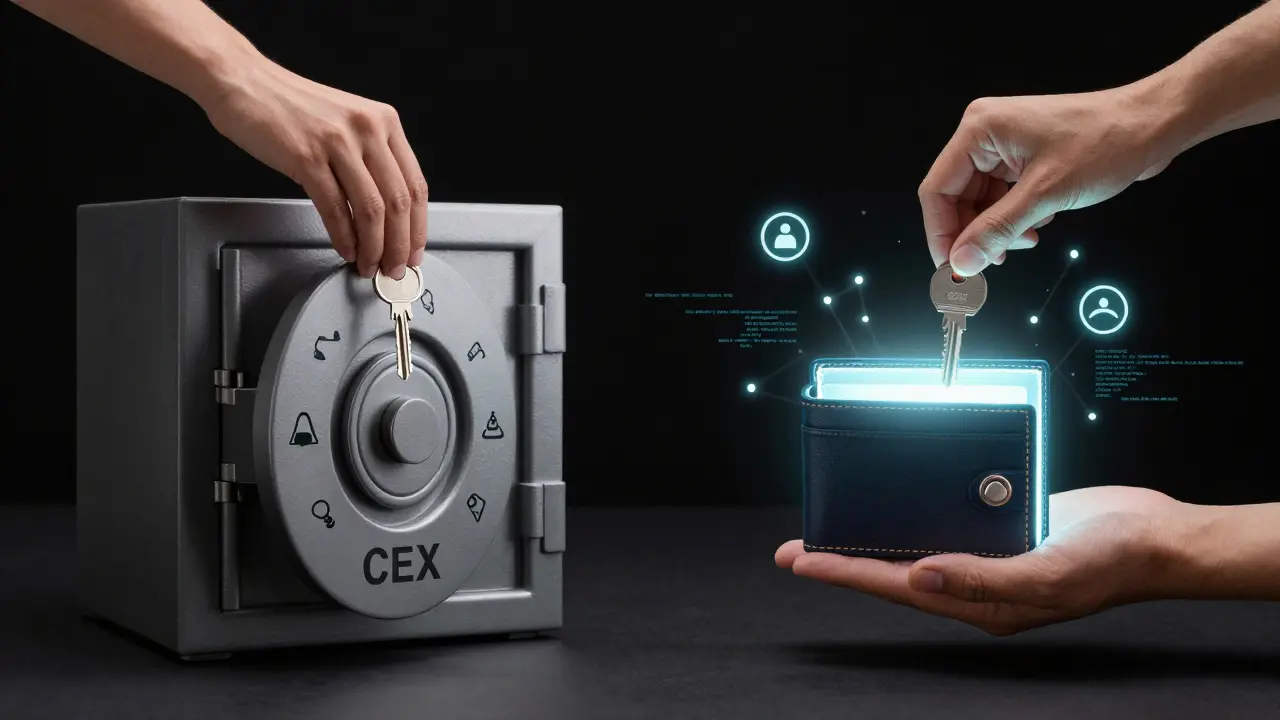
But here’s the catch: you don’t own your coins. The exchange does. That’s the famous phrase: “Not your keys, not your coins.” If the exchange gets hacked - like Binance did in 2021, losing $570 million - your funds are at risk. Even if they don’t get hacked, they can freeze withdrawals. In 2022, Binance paused withdrawals during a market crash, affecting 12 million users. That’s not a glitch. It’s by design. They control the keys. They control the money.
CEXs also dominate trading volume. In 2024, they handled 73.1% of all crypto trades - $72.1 trillion out of $98.7 trillion total. Bitcoin/USD pairs on Binance averaged $1.8 billion in daily volume. That kind of liquidity means tight spreads and fast fills, even during market spikes. For beginners, high-volume traders, or anyone using fiat, CEXs are still the default.
How DEXs Work: The Peer-to-Peer Model
Decentralized exchanges like Uniswap, SushiSwap, and 1inch run on smart contracts. No central company. No account signup. No KYC. You connect your wallet - usually MetaMask - and trade directly from your own crypto wallet. Your private keys stay with you. Your coins never leave your control.This removes counterparty risk. There’s no middleman to hack or collapse. If a DEX gets compromised - like Poly Network in 2021, losing $600 million - it’s because of a flaw in the code, not because a company got breached. But it also means you’re on your own. No customer support line. No password reset. If you send crypto to the wrong address? Gone forever.
DEXs are slower. On Ethereum, a trade takes 15-30 seconds on average. During congestion, it can stretch to 15 minutes. Gas fees? Around $1.85 per transaction in early 2025. That’s expensive for small trades. But DEXs have evolved. Uniswap V3 introduced concentrated liquidity, making capital efficiency up to 4,000x better than older versions. Now, liquidity providers earn more from less capital.
DEXs are where new tokens live. While CEXs take 30 days on average to list a new coin - vetting, legal checks, compliance - DEXs list 98% of new tokens within 24 hours. Want to trade a new DeFi token launched yesterday? You’ll find it on Uniswap, not Coinbase. DEXs also enable yield farming, airdrops, and staking directly from your wallet. Uniswap gave away $1,200 in tokens to early users in 2020. No sign-up. No form. Just smart contract logic.
Side-by-Side Comparison: CEXs vs DEXs
| Feature | Centralized Exchange (CEX) | Decentralized Exchange (DEX) |
|---|---|---|
| Custody of Funds | Exchange holds your coins | You hold your own keys |
| Account Setup | Requires KYC, email, phone | No registration needed |
| Trade Speed | Under 2 seconds | 15-30 seconds (Ethereum) |
| Fees (Taker) | 0.40%-0.60% (Coinbase) | 0.05%-1.00% (Uniswap pool-dependent) |
| Fiat On-Ramp | Yes - 25+ currencies | No - only crypto-to-crypto |
| Liquidity | $1.8B/day for BTC/USD (Binance) | $120M/day for BTC/USD (Uniswap) |
| New Token Access | 30-day vetting period | 98% listed within 24 hours |
| Support | 24/7 live agents, help center | Community forums, documentation only |
| Security Risk | Exchange hack (e.g., Binance 2021) | Smart contract exploit (e.g., 1inch 2024) |

Who Should Use What?
If you’re just starting out - buying your first Bitcoin, selling ETH for AUD, or trading daily with a credit card - stick with a CEX. Coinbase’s 4.2/5 Trustpilot rating from over 18,500 reviews shows why: users love the clean interface, instant deposits, and real human support. CEXs are the on-ramp. Nic Carter from Castle Island Ventures said it best: “CEXs provide the on-ramp for 95% of new crypto users.”
But if you’re deep into DeFi, trading obscure tokens, or care about privacy and censorship resistance, DEXs are where you belong. During Russia’s 2022 banking restrictions, DEXs kept trading while centralized platforms complied with sanctions. DEXs don’t answer to governments. They answer to code.
Experienced users on Reddit’s r/DeFi show 87% positive sentiment toward DEXs. They like the control. They like the transparency. They like that they’re not subject to exchange freezes or insider trading. A 2025 University of Zurich study found that users with technical knowledge overwhelmingly prefer DEXs. But beginners? 63% stick with CEXs because DEX interfaces are still too complex.
And then there’s the money. Chainalysis found DEX users have 4.4 times higher average wallet balances than CEX users - $8,200 vs $1,850. Why? Because DEX users aren’t just traders. They’re liquidity providers, yield farmers, and protocol participants. They’re building wealth inside DeFi, not just flipping coins.
The Future: Hybrid Exchanges and Convergence
The lines are blurring. Binance launched its own DEX integration in late 2024, letting users access Uniswap-like liquidity without leaving the CEX interface. dYdX is launching a layer-3 blockchain in Q2 2025 to slash gas fees by 90%. Hashflow, a hybrid exchange, hit $2.1 billion in monthly volume in Q1 2025 by combining CEX ease-of-use with DEX security.
Analysts agree: the future isn’t CEXs or DEXs. It’s CEXs for onboarding, DEXs for advanced trading. Gartner predicts CEXs will hold 65% market share through 2027. Messari forecasts DEX volume will grow 45% annually until 2028. Why? Because layer-2 solutions like Arbitrum and Optimism are solving the gas fee problem. More users will switch.
But risks remain. CEXs face regulatory pressure - 12 exchanges were pulled from Apple and Google stores in Q1 2025 for non-compliance. DEXs face technical risk - Ethereum Foundation found 23 critical smart contract vulnerabilities in 2024. Wash trading is still common: 37 of the top 50 CEXs engaged in it, according to the Blockchain Transparency Institute.
For now, choose based on your needs. Need fiat? Go CEX. Need control? Go DEX. Want to trade new tokens? DEX. Want to sleep easy? CEX. The best traders use both.
Can I use a DEX without a crypto wallet?
No. DEXs require a non-custodial wallet like MetaMask, Trust Wallet, or Coinbase Wallet. You need to install the wallet, secure your recovery phrase, and connect it to the DEX. You can’t sign up with an email like on a CEX. If you don’t have a wallet, you can’t use a DEX.
Are DEXs safer than CEXs?
It depends. DEXs eliminate the risk of exchange hacks because you hold your own keys. But they introduce smart contract risk. If the code has a bug, your funds can be stolen - as happened with 1inch in 2024 ($32 million lost). CEXs have better security teams and insurance funds, but they’re centralized targets. For most users, DEXs reduce one type of risk but add another.
Why are DEX gas fees so high?
Gas fees on Ethereum DEXs reflect network demand. When lots of people trade, miners prioritize higher fees. Ethereum’s base layer wasn’t built for mass trading. Solutions like Arbitrum and Optimism (layer-2s) cut fees by 90%+ and are now used by most major DEXs. If you’re paying $2 per trade, you’re likely on Ethereum mainnet. Switch to a layer-2 for cheaper trades.
Can I trade fiat on a DEX?
Not directly. DEXs only trade crypto-to-crypto. To buy Bitcoin with AUD on a DEX, you’d need to first buy USDT on a CEX, transfer it to your wallet, then swap it on the DEX. Some hybrids like Hashflow are starting to offer fiat on-ramps, but pure DEXs like Uniswap don’t.
Which is better for long-term holding?
For holding, DEXs win - if you know how to manage your keys. Storing crypto on a CEX means trusting someone else. If they freeze your account or go bankrupt, you’re stuck. With a DEX, your coins stay in your wallet, under your control. But if you lose your seed phrase? You lose everything. So only use DEXs for holding if you’re confident in your security practices.
12 Responses
CEXs are just crypto banks with worse customer service and no FDIC insurance
People act like Binance is some kind of benevolent guardian but they froze withdrawals during a crash like it was nothing
And don't even get me started on how they're the only place you can buy Bitcoin with your Visa
Meanwhile DEXs are where the real money is made
Uniswap V3 is the most efficient trading engine ever built
4000x capital efficiency? That's not innovation that's a revolution
But nope most people still cling to their CEX like a security blanket
They don't even understand that they're not holding crypto they're holding IOUs
Not your keys not your coins isn't a slogan it's a warning
And yet here we are 2025 and Coinbase still has more users than all DEXs combined
It's like people prefer being a customer over being an owner
Pathetic
It's not about CEX vs DEX it's about freedom vs convenience
Most people don't want freedom they want someone else to handle the mess
That's why airlines still exist even though you could literally fly your own plane
Same thing here
CEXs are the Uber of crypto
DEXs are the Tesla you have to maintain yourself
Both have value
But if you're not willing to learn how to drive
Don't complain when you get stuck on the side of the road
The real win isn't in the trading it's in the autonomy
Own your keys own your future
I've been using both for years now and honestly the hybrid approach is where it's at
I keep my long-term holdings in a hardware wallet connected to a DEX for yield farming
But I use Binance for quick swaps and buying ETH with my debit card
It's not about choosing one over the other it's about layering them
The beauty of crypto is that you can be both a passive holder and an active participant
Most beginners think they have to pick a side
But the real pros use the tools that fit each need
CEX for fiat on-ramps and liquidity
DEX for control and innovation
And honestly the gas fee issue is almost solved now with Arbitrum and Optimism
Why pay $2 when you can pay 10 cents?
It's not a question of which is better
It's about understanding your own goals
Just a quick note: the table in the post says DEXs have $120M/day BTC/USD volume on Uniswap
That's outdated
As of March 2025 it's closer to $280M/day on Uniswap alone
And when you add in DEXs on Arbitrum and Base the total is over $500M/day
Also the 0.05%-1.00% fee range is misleading
Most trades on Uniswap V3 are under 0.1%
Just wanted to clarify
Great post otherwise
It's funny how people treat DEXs like some kind of utopian ideal
Yes you hold your keys
But you also hold the responsibility
And for most people that's terrifying
They'd rather pay a fee to someone who knows what they're doing
Than lose everything because they sent ETH to a contract address by accident
It's not laziness
It's self-preservation
And let's be honest
The DEX interface still looks like it was designed by a grad student in 2017
CEXs have their flaws
But they're built for humans
Not crypto bros who think 'gas fee' is a personality trait
CEXs are the only real option
DEXs are for losers
USA
As a Canadian I can say this
CEXs are way more regulated here
Like really
Canada's crypto rules are tighter than the EU's
So for me
CEXs feel safer
But I still use Uniswap on Arbitrum for DeFi
It's not either/or
It's both/and
And honestly
Most Americans don't get how lucky they are
Here in Canada
We don't have 25 fiat options
We have 3
And Coinbase doesn't even support CAD on their DEX
So we're stuck
It's not about preference
It's about access
Everyone acts like DEXs are the future
But have you tried trading a new memecoin on Uniswap at 3AM
Slippage 12%
Gas fee $8
And you still got rekt
Meanwhile on Binance
Same trade
0.1% fee
1 second execution
And you're already on to the next one
Real talk
For active traders
CEXs are still king
DEXs are for moon boys and weekend degens
While I appreciate the technical depth of this analysis
I must respectfully offer a different perspective rooted in African financial realities
In South Africa
CEXs are the only viable gateway for the unbanked
Many of us have no access to traditional banking
But we have smartphones
And through Binance P2P
We can buy Bitcoin with mobile airtime vouchers
DEXs require wallet management
Which demands a level of financial literacy we simply do not yet have
So while DEXs represent innovation
CEXs represent inclusion
And that matters more than efficiency
Oh honey
You think this is about trading
It's not
This is a war
Between the technocrats
And the crypto anarchists
And guess who's winning
Not you
Not me
But the VC-funded exchanges
Who are quietly buying up DEX liquidity
And turning them into CEX clones
With their own tokens
And their own governance
It's all theater
Just like the blockchain
It's not decentralized
It's just distributed
And the real power
Is still in Silicon Valley
So go ahead
Connect your wallet
It's all part of the show
CEXs are controlled by the fed
They track everything
And they report to the IRS
DEXs are the only way out
They're the last free space left
They're not just exchanges
They're resistance
Every trade on Uniswap is a middle finger to the system
Stop using CEXs
It's not about money
It's about freedom
And if you don't get that
You're already lost
I use both
CEX for buying
DEX for trading
Simple