
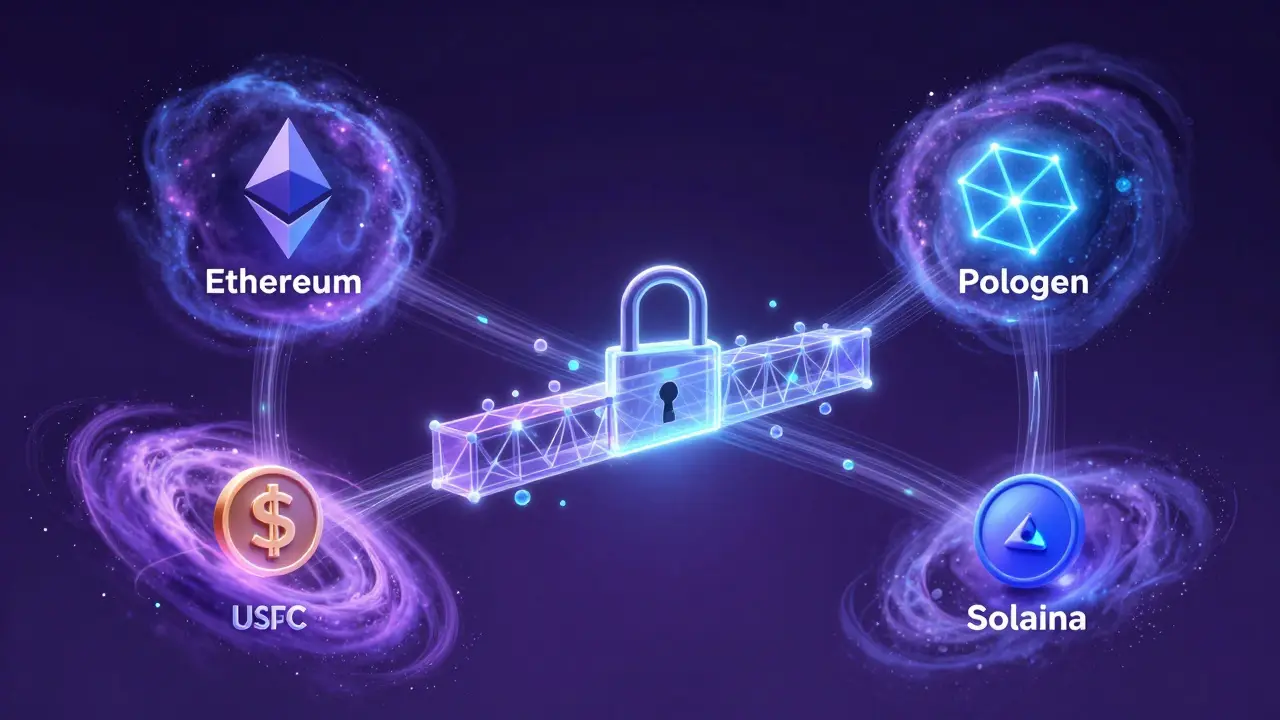
Imagine you have ETH on Ethereum, but the best yield opportunity is on Polygon. You don’t want to use a centralized exchange. You don’t want to wait days or pay high fees. You just want to move your money-safely, quickly, and without trusting a middleman. That’s where cross-chain bridges come in. They’re not just a tech gimmick. They’re the plumbing behind today’s decentralized finance world. And the best ones don’t ask you to trust anyone. They let blockchains talk to each other without needing a central authority.
How Cross-Chain Bridges Actually Work
Cross-chain bridges connect isolated blockchains. Left alone, Ethereum can’t talk to Solana. Polygon can’t send tokens to Avalanche. Each chain has its own rules, its own ledger, its own validators. Bridges bridge that gap. They do it by locking, burning, or unlocking assets on one chain and releasing equivalent value on another. There are three main ways this happens:- Lock-and-Mint: You send your ETH to a smart contract on Ethereum. It gets locked. Then, a wrapped version (like wETH) is created on Polygon. You now have ETH-like tokens on Polygon. To get your original ETH back, you burn the wETH and the contract unlocks your ETH. This is simple, but risky. All that locked ETH becomes a target. Hackers love honeypots.
- Burn-and-Mint: You burn your ETH on Ethereum. That means it’s destroyed. Then, an equivalent amount of ETH is minted on Polygon. No wrapped tokens. No locked reserves. Circle uses this for USDC. It’s safer because there’s no big pool of assets sitting idle. But it needs perfect coordination. If the burn isn’t confirmed, and the mint happens anyway? Double-spending. Chaos.
- Lock-and-Unlock: Your ETH gets locked on Ethereum. But instead of minting a new token, the bridge unlocks native ETH from a liquidity pool on Polygon. No synthetic assets. No new supply. Just movement. This is faster and cheaper, but it needs deep liquidity. If no one’s deposited ETH into the pool? You can’t get it.
Each method has trade-offs. Lock-and-mint is easy to build. Burn-and-mint is more secure. Lock-and-unlock is efficient-but only if the pool is full.
Who Makes It All Happen?
Bridges don’t work alone. Three key players keep things running:- Validators: These are nodes that confirm transactions on both chains. In a decentralized bridge, dozens or hundreds of validators must agree before a transfer is approved. If just one is corrupted, the system fails. That’s why more validators = more security.
- Relayers: They’re the messengers. They watch for events on the source chain-like a deposit-and relay that data to the destination chain. Think of them as postal workers between two countries with no diplomatic ties.
- Oracles: These feed real-world data into the system. Chainlink, for example, might confirm the price of ETH or verify that a block was finalized. Without accurate data, the bridge can’t trust what’s happening on either side.
In centralized bridges, one company runs all three roles. That’s fast, but it defeats the whole point of crypto. Decentralized bridges spread these roles across many independent actors. It’s slower, more complex, but far more resilient.
Why This Matters: Real Use Cases
Cross-chain bridges aren’t just for techies. They’re changing how people use crypto every day.- Yield Farming Across Chains: You find 12% APY on Curve on Arbitrum, but your USDC is stuck on Ethereum. A bridge lets you move it over-no exchange needed. You earn more. You keep control.
- NFTs That Move: You bought a rare NFT on Ethereum. Now you want to use it in a game on Solana. Without a bridge? You’re stuck. With one? You take it with you. That’s true digital ownership.
- DAO Voting Across Chains: A DAO holds treasury funds on Ethereum, Optimism, and BNB Chain. Members vote using governance tokens. But what if your tokens are on a different chain? A bridge lets you vote no matter where your assets live. Governance becomes unified, not fragmented.
- Lower Fees, Faster Transfers: Sending ETH on Ethereum can cost $10 and take minutes. On Polygon? $0.01 and 2 seconds. Bridges let you choose the best chain for the job-without locking up your money on an exchange.
This isn’t theoretical. It’s happening right now. Millions of dollars move across chains daily. People aren’t just holding crypto-they’re using it, trading it, farming it, and voting with it-all across networks.
The Rise of Intent-Based Bridging
The next evolution? You don’t even need to know how it works. Forget choosing between Wormhole, Multichain, or LayerZero. Forget picking a token type or checking liquidity pools. With intent-based bridging, you just say: "Move my USDC from Arbitrum to Base." The system finds the safest, cheapest, fastest path automatically. Eco Routes and similar platforms handle the rest. They monitor all bridges, check fees, track liquidity, and pick the best route in real time. It’s like Google Maps for crypto transfers. You don’t care which roads it takes-you just want to get there. This isn’t just convenience. It’s adoption. New users don’t want to learn 10 different bridge interfaces. They want to move money like they send a text. Intent-based systems make that possible.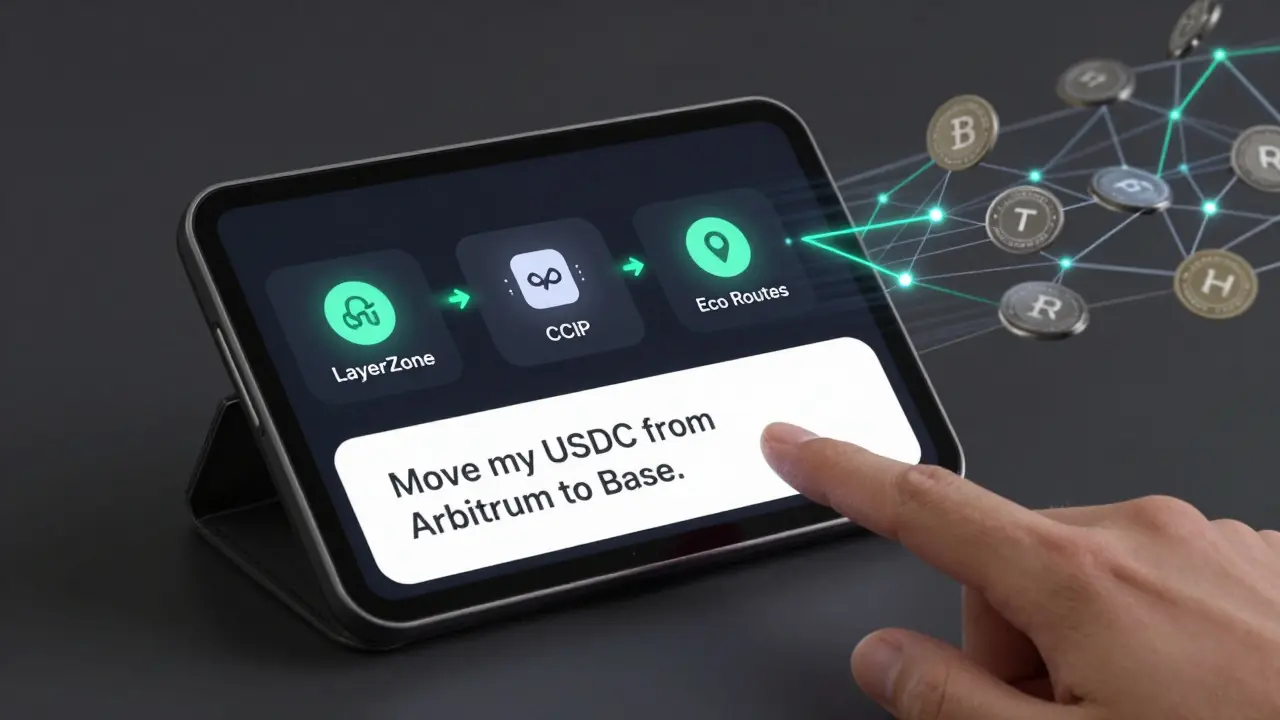
The Big Risks
None of this is risk-free. Bridges have lost over $2 billion in hacks since 2021. Why?- Locked Assets Are Honeypots: Lock-and-mint bridges hold billions in locked ETH, USDC, and other tokens. That’s a magnet for attackers. One smart contract flaw, one misconfigured validator, and it’s gone.
- Off-Chain Communication: Burn-and-mint bridges need secure messaging between chains. If that channel is compromised, tokens can be forged.
- Centralization Creep: Many "decentralized" bridges still rely on a handful of validators. If five entities control 80% of signing power? It’s not decentralized. It’s just a different kind of middleman.
The industry is responding. New standards are emerging:
- Native Asset Bridges: Instead of wrapping ETH into wETH, bridges are moving native ETH across chains. No synthetic tokens. No supply inflation. Just the real thing.
- Standardized Messaging Protocols: Projects like IBC (Inter-Blockchain Communication) and CCIP (Chainlink’s Cross-Chain Interoperability Protocol) are creating common languages for blockchains to speak. Think of them as universal translators.
- Decentralized Validation: More bridges are adopting threshold signatures and zk-proofs. These let validators prove a transaction happened without revealing private keys. It’s math, not trust.
The Future Is Interoperable
The blockchain world isn’t going to settle on one chain. There will be Ethereum for security, Solana for speed, Polygon for low fees, and new chains we haven’t even imagined yet. The only way this ecosystem survives is if they can talk to each other. Trust-minimized bridges are the answer. Not because they’re perfect. But because they’re the closest we’ve come to letting blockchains interact without needing a central gatekeeper. The next five years will see:- Bridges built into wallets-no separate interface needed.
- Native asset transfers replacing wrapped tokens entirely.
- Validators becoming staked, decentralized, and incentivized like node operators.
- Regulators finally recognizing cross-chain transfers as legitimate, not risky loopholes.
Right now, cross-chain bridges are the unsung heroes of DeFi. They’re not flashy. They don’t make headlines. But without them, crypto stays stuck. Fragmented. Useless.
With them? A true internet of value. Where your money moves where it needs to go-fast, cheap, and without asking permission.
What’s the difference between wrapped tokens and native asset transfers?
Wrapped tokens (like wETH or wBTC) are synthetic versions of an asset created on another blockchain. They’re backed 1:1 by locked assets on the original chain. Native asset transfers move the actual asset-like ETH or BTC-across chains without creating a copy. Native transfers reduce supply inflation and eliminate the risk of wrapped token exploits. They’re the future, but harder to build.
Are cross-chain bridges safe to use?
Some are, some aren’t. Bridges with large locked reserves (lock-and-mint) have been hacked repeatedly. Bridges using burn-and-mint with strong validator sets and zk-proofs are safer. Always check how many validators there are, whether they’re decentralized, and if the code has been audited. Avoid bridges with fewer than 15 independent validators.
Can I bridge any cryptocurrency?
Most bridges support major assets like ETH, USDC, WBTC, and MATIC. Newer or obscure tokens often aren’t supported. Always check the bridge’s official list of supported assets. Never try to bridge a token that isn’t listed-it could disappear permanently.
Why do some bridges take longer than others?
It depends on the chain’s confirmation time and the bridge’s security model. Ethereum takes 15+ minutes for finality, so bridges waiting for full confirmation will be slow. Solana confirms in seconds, so transfers there are faster. Also, bridges requiring more validator signatures (like decentralized ones) will be slower than centralized ones that just need one approval.
What’s the best cross-chain bridge right now?
There’s no single "best." For stablecoins like USDC, Circle’s CCIP is leading in security and native transfers. For ETH and ERC-20s, LayerZero and Synapse have strong track records. For low fees, Orbital and Multichain work well. The best bridge is the one that supports your assets, has decentralized validators, and has been audited by multiple firms. Always compare before you transfer.
10 Responses
Been using LayerZero for my USDC swaps lately and honestly? No drama. No slippage. Just works. I used to stress about bridges, but now I treat them like a vending machine - insert token, get token. No thinking required. The future is stupid simple.
It's fascinating how we've gone from needing to understand every layer of the stack - validators, relayers, oracles - to just saying, 'Move my money from A to B.' The abstraction layer is now so thick that even people who barely know what a blockchain is can use cross-chain tech. That’s not just progress, that’s normalization. And honestly, that’s what crypto needed to stop being a niche hobby and become infrastructure. The real win isn't the tech - it's the invisibility of it.
Guys, I just have to say - if you're still using wrapped tokens, you're basically leaving your keys under the mat. 🙄 I mean, come on. Native asset transfers aren't optional anymore. They're the bare minimum. And don't even get me started on bridges with less than 15 validators. That's not decentralized - that's just a fancy name for a honeypot. I've lost money before. I won't do it again. 🚫
There’s a subtle but critical distinction between "intent-based bridging" and "automated routing." The former implies a user-centric design paradigm where the interface abstracts complexity without eliminating transparency. The latter risks becoming a black box - a dangerous precedent in a space built on non-custodial principles. I’m not against convenience, but I worry we’re trading sovereignty for speed. A well-designed system should let you peek under the hood - even if you never do.
While the technical architecture of cross-chain bridges is undeniably sophisticated, one must not overlook the fundamental philosophical contradiction inherent in their existence: if blockchains are meant to be sovereign, why do we need bridges at all? This is akin to building a highway between two independent nations - the very act implies a failure of true decentralization. Perhaps the real solution is not better bridges, but fewer chains.
lol i just use wormhole and pray 😅
I love that we can finally move our NFTs between games now! 🥳 My ape went from Ethereum to Solana and now he's in a whole new world. It feels like digital ownership is actually real for the first time. I used to think crypto was just money stuff - now it’s like a whole internet of experiences. So cool.
Okay but CAN WE TALK ABOUT HOW SCARY THIS IS?? 😱 I mean, one day you’re chillin’ with your ETH on Ethereum, next thing you know - POOF - some bridge gets hacked and suddenly your life savings is a ghost. 💔 I’ve seen it happen. My cousin lost $40k on Multichain. She cried for a week. And now we’re just supposed to be like, ‘Oh, it’s just tech!’ NOPE. Not buying it. We need better safety nets. Like insurance. Or something. 💀
Appreciate the breakdown. The part about lock-and-unlock with liquidity pools really clicked for me. I always assumed bridges were just copying tokens around. Learning that you can move the actual asset without wrapping it changes how I think about ownership. Still nervous about validator centralization, but at least now I know what to look for.
It’s wild how much of crypto’s potential hinges on something so… boring. Bridges. No flashy NFTs. No memecoins. Just quiet, invisible plumbing. And yet, without it, we’re all stuck in our own little digital islands. Kinda poetic, actually. The revolution isn’t in the stars - it’s in the pipes.