

Imagine trying to send a letter from New York to London, but the post office only accepts envelopes printed in a specific font that doesn't exist overseas. You’d need a translator, a re-printer, and maybe three different agencies just to get that message across. For years, cryptocurrency users faced this exact nightmare. If you held Bitcoin, it stayed on the Bitcoin network. If you wanted to use Ethereum-based DeFi apps, you had to wrap your Bitcoin into a synthetic version, trusting a centralized company not to run away with it.
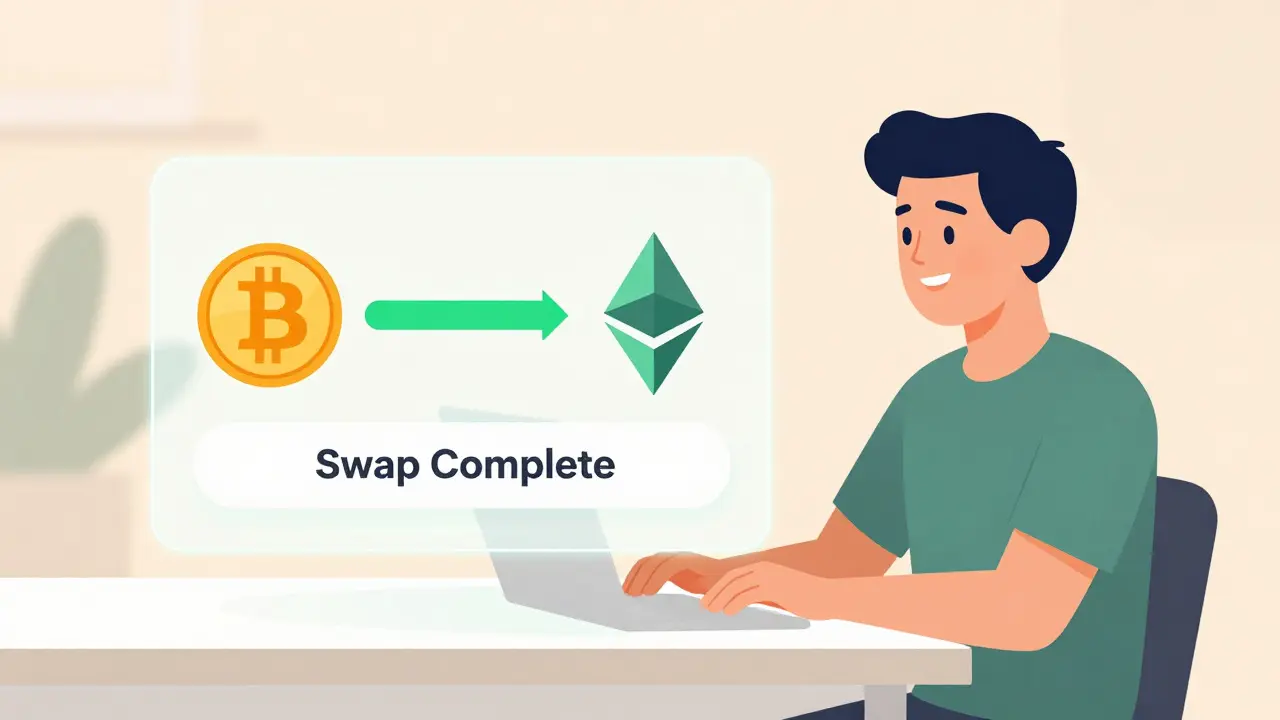
That friction is what Cross-Chain DEXs are designed to fix. These platforms allow you to swap native assets directly-like trading real Bitcoin for real Solana-without intermediaries, wrapped tokens, or giving up control of your keys. It’s not just a convenience upgrade; it’s a fundamental shift in how we think about value moving between digital islands.
The Problem with Blockchain Silos
To understand why cross-chain decentralized exchanges matter, you first have to look at the mess they’re cleaning up. In the early days of DeFi, Ethereum was the king. But as networks like Solana, Avalanche, and Polygon grew, liquidity got scattered. This fragmentation meant that if you wanted to trade a token on Chain A for a token on Chain B, you couldn’t just click “swap.”
Traditionally, you had two bad options:
- Centralized Exchanges (CEXs): You’d send your crypto to Binance or Coinbase, sell it, buy the other asset, and withdraw it back to your wallet. This works, but you lose custody of your funds during the process. If the exchange gets hacked or freezes withdrawals, you’re stuck.
- Wrapped Assets: You’d lock your Bitcoin in a smart contract and receive a “wrapped” version (WBTC) on Ethereum. While useful, this introduces counterparty risk. If the custodian holding the real Bitcoin fails, your WBTC becomes worthless paper.
Cross-chain DEXs eliminate both risks by enabling direct swaps between native assets. According to data from DeFi Llama, while single-chain DEXs dominate volume, cross-chain protocols are growing faster, capturing an increasing share of total trading activity because they offer true non-custodial freedom.
How Cross-Chain Swaps Actually Work
You might wonder how a transaction can happen between two completely different blockchains that don’t naturally talk to each other. The technology isn’t magic; it’s a sophisticated dance of locks, messages, and releases.
Most modern cross-chain DEXs use one of two primary mechanisms:
- Liquidity Pools with Native Support: Platforms like THORChain maintain pools of real assets on multiple chains. When you want to swap BTC for ETH, you send BTC to THORChain’s Bitcoin pool. The protocol detects this, takes an equivalent value of ETH from its Ethereum pool, and sends it to your address. No wrapping occurs. The assets never leave their native chains until they reach you.
- Cross-Chain Communication Protocols: Other solutions rely on infrastructure like Axelar Network or Chainlink CCIP. These act as translators. They verify a transaction happened on Chain A, send a secure message to Chain B, and trigger the release of funds there. This method is often used by aggregators to find the best price across different ecosystems.
The key technical achievement here is atomicity. An atomic swap means the transaction either completes entirely on both ends or fails completely on both ends. There’s no middle ground where your money disappears into the void. This reliability is built through complex consensus mechanisms among validator nodes who stake collateral to ensure honest behavior.
Top Players in the Cross-Chain Space
Not all cross-chain solutions are created equal. Some focus on speed, others on security, and some on the variety of assets supported. Here is how the major players stack up as of mid-2026.
| Platform | Primary Mechanism | Supported Chains | Average Finality Time | Key Advantage |
|---|---|---|---|---|
| THORChain | Native Liquidity Pools | BTC, ETH, BNB, LTC, DOGE, AVAX | 30-120 seconds | True non-custodial native swaps without wrappers |
| Axelar | General Message Passing | 15+ including Cosmos, EVM chains | Under 60 seconds | Interoperability layer for developers and aggregators |
| Chainflip | Validator-led Atomic Swaps | Ethereum, Polkadot, Solana | Variable (depends on chain) | High security via multi-party computation |
| Li.Finance | Aggregator/Bridge Routing | Wide range via partners | Fastest available route | User-friendly interface for complex routes |
THORChain remains the leader in pure cross-chain swapping volume because it holds actual liquidity rather than relying on third-party bridges for every step. Axelar, on the other hand, powers many other interfaces, acting as the plumbing beneath the surface. Choosing between them depends on whether you prioritize deep liquidity for major pairs (THORChain) or access to newer, smaller chains (Axelar-powered routes).
Security Risks: What Could Go Wrong?
Let’s be honest: cross-chain tech is complicated, and complexity breeds bugs. In 2022, cross-chain bridges were responsible for over $2 billion in stolen assets, accounting for more than 60% of all DeFi hacks. While protocols have hardened their defenses since then, risks remain.
The main vulnerabilities include:
- Smart Contract Bugs: Even audited code can have flaws. A bug in the locking mechanism could theoretically allow someone to mint fake assets.
- Validator Collusion: Many cross-chain systems rely on a set of validators to confirm transactions. If enough validators conspire, they could steal funds. This is why most protocols require validators to stake significant amounts of capital as collateral.
- Oracle Manipulation: If the price feed determining the exchange rate is manipulated, users could get unfairly priced out. Reputable projects use decentralized oracle networks like Chainlink to mitigate this.
Despite these fears, the industry has matured. Audit costs for major protocol updates have tripled since 2021, and bug bounty programs now offer millions in rewards for finding critical issues. Still, you should always start with small amounts when testing a new platform.
Practical Guide: Making Your First Cross-Chain Swap
If you’ve never used a cross-chain DEX, the interface might look intimidating compared to a simple Uniswap screen. Here is a step-by-step breakdown of what to expect.
- Prepare Gas Fees: Unlike single-chain swaps, you need gas fees on both the sending and receiving chains. If you’re sending BTC to get ETH, you need BTC for the Bitcoin network fee and usually a tiny amount of ETH already in your destination wallet to pay for the Ethereum receipt. Some platforms deduct this automatically, but it’s safer to have a buffer.
- Select Your Chains: Choose your input asset (e.g., BTC) and output asset (e.g., SOL). The platform will calculate the slippage tolerance. Cross-chain swaps often have higher slippage limits (0.5% to 1%) due to price volatility during the transfer time.
- Connect Wallets: You’ll likely need to connect two wallets or a multi-chain wallet like MetaMask or Phantom. Ensure you are connecting the correct wallet for the source chain.
- Approve and Sign: You will sign a transaction on the source chain. Watch for the status update. It may say “Waiting for confirmation” or “Bridge processing.”
- Wait for Finality: This is the hardest part. Depending on the chains involved, this can take anywhere from 30 seconds to several minutes. Do not refresh aggressively. The backend is working to synchronize the state between blockchains.
- Receive Funds: Once complete, the native asset appears in your target wallet. Check the transaction hash on both block explorers to verify success.
Costs and Slippage: Is It Worth It?
Cross-chain trading isn’t free. You’re paying for the privilege of seamless interoperability. The costs come in three forms:
- Network Fees: You pay gas on the origin chain and the destination chain.
- Protocol Fees: Most cross-chain DEXs charge a small percentage (usually 0.2% to 0.5%) for providing liquidity and security.
- Slippage: Because the process takes time, prices can move against you. During high volatility, slippage can eat into profits significantly.
So, when should you use a cross-chain DEX? Use it when you want to keep custody of your assets, avoid wrapped tokens, or trade pairs that aren’t listed on centralized exchanges. Avoid it for micro-transactions under $100, as the fixed fees and gas costs will outweigh the value. For large institutional moves, the ability to bypass CEX withdrawal limits and maintain privacy makes cross-chain DEXs increasingly attractive.
The Future of Interoperability
We are still in the early stages of this technology. As Layer 2 solutions like Arbitrum and Optimium mature, the line between “cross-chain” and “single-chain” might blur. However, the demand for true interoperability between distinct ecosystems like Bitcoin, Solana, and Ethereum shows no signs of slowing down.
Experts predict that by 2027, cross-chain DEXs could handle over 35% of all decentralized trading volume. Innovations like intent-centric architectures-where you simply state what you want (“I want ETH”) and the network figures out the best path-are making the user experience smoother. The goal is clear: a world where blockchains work together seamlessly, hiding the complexity behind a single, simple click.
What is the safest cross-chain DEX?
Safety is relative in crypto, but THORChain is widely considered one of the safest options for native swaps because it uses a proof-of-stake model with bonded validators and has undergone numerous audits. It avoids the bridge-heavy architecture that caused many past hacks. Always check the latest audit reports before using any new protocol.
Do I need wrapped tokens to use a cross-chain DEX?
No, that is the main advantage. Traditional methods required you to wrap Bitcoin into WBTC. Modern cross-chain DEXs allow you to swap native BTC for native ETH directly. The protocol handles the conversion internally without creating a wrapped derivative for you to hold.
Why are cross-chain swaps slower than centralized exchanges?
Centralized exchanges operate on internal databases, so transfers are instant ledger updates. Cross-chain DEXs must wait for blockchain confirmations on both the sending and receiving networks. This ensures security and finality but adds time, typically ranging from 30 seconds to several minutes depending on network congestion.
Can I lose my money if a cross-chain transaction fails?
In rare cases, yes, if there is a smart contract bug or a timeout issue. However, most reputable protocols have refund mechanisms. If a transaction stalls, you can often cancel it and retrieve your original assets plus gas fees. Always keep a small amount of native currency on all chains you use to cover potential recovery costs.
What is the difference between Axelar and THORChain?
THORChain is a standalone decentralized exchange focused specifically on swapping assets. Axelar is an interoperability infrastructure layer that allows different blockchains to communicate. Think of THORChain as a store where you buy goods, and Axelar as the highway system that lets trucks travel between cities. Many DEXs actually use Axelar’s technology under the hood.