

Imagine locking your car in a garage in Adelaide, but somehow, a ghost copy of your car suddenly appears in a parking lot in Sydney, and you can drive it away for free. In the world of blockchain, this isn't magic-it's a security breach. When we move assets between different networks, we rely on cross-chain bridge security is the set of protocols and safeguards that allow assets and data to move between independent blockchains without compromising the funds. However, these bridges often become the weakest link in the chain. Unlike a single blockchain where a bug might cause a small glitch, a bridge failure often leads to a total loss of funds because the bridge essentially grants authority based on external claims rather than local proof.
The Danger of Signature Replay Attacks
One of the most common ways hackers drain bridges is through a signature replay attack. To understand this, think of a digital signature as a high-security ticket. In a perfect world, that ticket only works for one specific event at one specific time. A signature replay attack happens when a bridge doesn't check if that ticket has already been used elsewhere. An attacker grabs a valid signature from a transaction on one chain (like Ethereum) and "replays" it on another compatible chain (like Binance Smart Chain).
Because many networks use the same logic (EVM compatibility), the second chain sees a valid signature and thinks, "Okay, this person locked their funds on the other side, so I'll mint new tokens for them here." The catch? No tokens were actually locked for this second transaction. The attacker essentially prints money out of thin air. This is especially dangerous right after a hard fork, where the window for replicating fraudulent transactions opens wide.
To stop this, developers need to use two simple tools: a chain ID and a nonce. A Chain ID acts like a zip code, telling the bridge exactly which network the transaction belongs to, while a nonce is a unique sequence number that ensures the same transaction can't be processed twice. If a bridge lacks these, it's basically leaving the door unlocked.
Relayer Vulnerabilities and Oracle Failures
Bridges don't just "know" what happened on another chain; they need messengers. These messengers are called relayers or oracles. A relayer is an intermediary that watches for a "lock" event on Chain A and tells Chain B to "mint" the equivalent asset. While they seem helpful, they introduce a massive point of failure. If an attacker can spoof a relayer's signature, they can trick the bridge into processing a fake transaction.
The real problem here is that many bridges rely on external claims. Instead of the destination chain verifying the state of the source chain directly, it just trusts the relayer. If the relayer is compromised or the data is modified during transmission, the bridge blindly follows the instructions. This can lead to message forgery or ordering failures, where the sequence of events is manipulated to create financial loopholes.
| Threat Type | Primary Cause | Impact | Key Mitigation |
|---|---|---|---|
| Signature Replay | Missing Chain IDs/Nonces | Duplicate asset minting | Strict chain-context validation |
| Relayer Compromise | Spoofed signatures/Fake data | Unauthorized fund release | Multi-sig relayers & decentralized oracles |
| Validator Risk | Centralized control/Key theft | Total bridge collapse | Distributed validator sets |
The Risk of Validator Compromise
Some bridges use a small group of validators to confirm transactions. While this makes the bridge fast, it creates a "honeypot" for hackers. If a bridge is managed by a single validator or a tiny group of people, compromising just one or two private keys can give an attacker full control over all the assets locked in that bridge.
This architectural choice goes against the whole point of blockchain, which is decentralization. When you have concentrated validation authority, you aren't trusting a network; you're trusting a few people not to lose their keys or be bribed. In a decentralized model, you would need to compromise a majority of a large, distributed set of validators to steal funds, which is exponentially harder than hitting one central server.
The Silent Killers: Finality and Message Ordering
Beyond the obvious hacks, there are subtle technical mismatches that can ruin a protocol. One is the finality mismatch. Every blockchain has a different idea of when a transaction is "final." If a bridge assumes a transaction is permanent on the source chain after 10 blocks, but the source chain undergoes a reorganization (reorg) and deletes those blocks, the bridge has already minted assets on the destination chain based on a transaction that no longer exists.
Then there is the problem of message ordering. Some cross-chain apps assume messages arrive in a specific order: Deposit $\rightarrow$ Borrow. If a hacker can delay the deposit message or duplicate the borrow message, they might be able to borrow funds without ever providing the required collateral. These failures are terrifying because they are often silent; there are no cryptographic errors to alert the developers until the money is already gone.
Building a Defense-in-Depth Strategy
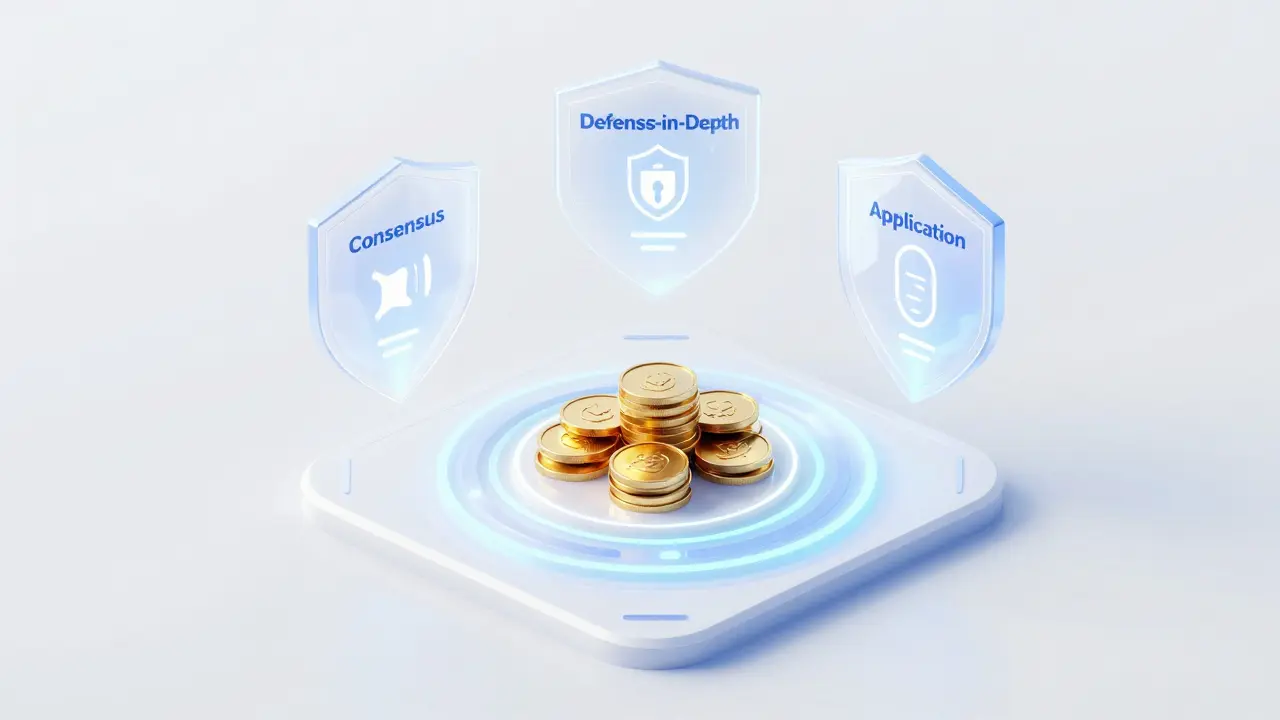
Securing a bridge isn't about fixing one bug; it's about layers. You can't just fix the signatures and ignore the validators. A robust security model looks at three specific layers:
- Consensus Layer: Addressing reorgs, chain halts, and finality assumptions to ensure the source of truth is actually true.
- Transport Layer: Ensuring messages are delivered exactly once, in the correct order, and cannot be intercepted or spoofed.
- Application Layer: Designing the smart contracts so that they don't blindly trust a single message and have "circuit breakers" to stop massive outflows of funds.
For anyone using these tools, the rule of thumb is simple: verify the audit. Look for mentions of replay protection, how the validators are distributed, and how the bridge handles finality. If a bridge is "too fast" or "too simple," it might be skipping these critical checks.
What is the difference between a relayer and a validator?
A relayer is essentially a messenger; it carries data from one chain to another. A validator is a judge; it verifies that the data the relayer brought is actually correct and authorized before allowing the bridge to execute a transaction.
Can a signature replay attack happen on any blockchain?
It primarily affects chains that share the same signature format, such as EVM-compatible chains (Ethereum, Polygon, BSC). If two chains use entirely different cryptographic standards, a signature from one usually won't be recognized by the other, making replay attacks much harder.
How can I tell if a bridge has replay protection?
Check the project's technical documentation or audit reports for mentions of "Chain ID validation" and "nonce tracking." If the audit specifically flags the absence of these features, avoid the bridge.
What happens during a finality mismatch?
A finality mismatch occurs when the destination chain thinks a transaction is permanent, but the source chain decides it wasn't. This allows an attacker to "undo" their deposit on the source chain while keeping the minted assets on the destination chain.
Are centralized bridges always less secure?
Not necessarily in terms of speed, but they are more vulnerable to single points of failure. If the central entity is hacked or turns malicious, all funds in the bridge are at risk, whereas decentralized bridges require multiple parties to be compromised.
9 Responses
u forgot to mention that some bridgees also suffer from logic errors in the smart contracts themselfs, not just the relayer signatures. like when the mint function doesnt check if the burn event actually happened on the other chain properly. its basic stuff really
oh yeah because trusting a few random guys with private keys is totally the peak of decentralization lol great plan
The sheer audacity of believing that a mere audit can safeguard one's digital wealth is quite staggering, considering that the systemic fragility of cross-chain architecture is an inherent flaw that no amount of "nonce tracking" can truly eradicate from the consciousness of a determined adversary who views these protocols as nothing more than fragile glass houses waiting to be shattered by a single well-placed stone of exploitation.
Honestly, this is just so stressful to read. Every time I think I've found a safe way to move my funds, some new vulnerability pops up and I just feel like we are all doomed to lose everything in a giant flash crash anyway!
Imagine thinking a "circuit breaker" is going to save you when the funds are already gone in a millisecond. It's like putting a screen door on a submarine and calling it a "defense-in-depth strategy" while the water is already filling your lungs. Absolutely whimsical logic.
The cognitive dissonance required to trust these so-called intermediaries is truly a marvel of modern delusion, for one must practically surrender their entire sense of rational caution to believe that a distributed validator set is anything other than a slower, more expensive way to realize that you've been played by a sophisticated syndicate of actors who operate in the shadows of our collective ignorance.
This is a fantastic breakdown of the risk vectors! I wonder if implementing ZK-proofs for state transitions could completely eliminate the need for trusting relayers in the first place by letting the destination chain verify the source state mathematically.
They want us to trust "distributed validators" but we don't even know who runs the nodes. Probably some offshore entities controlled by the same people who want to crash the dollar. The whole bridge concept is just a way to trap liquidity for the big players.
It's really disappointing that the industry prioritizes speed over basic safety. We should hold these developers to a much higher moral standard because losing a retiree's life savings due to a "finality mismatch" is simply unacceptable in any civilized society.