
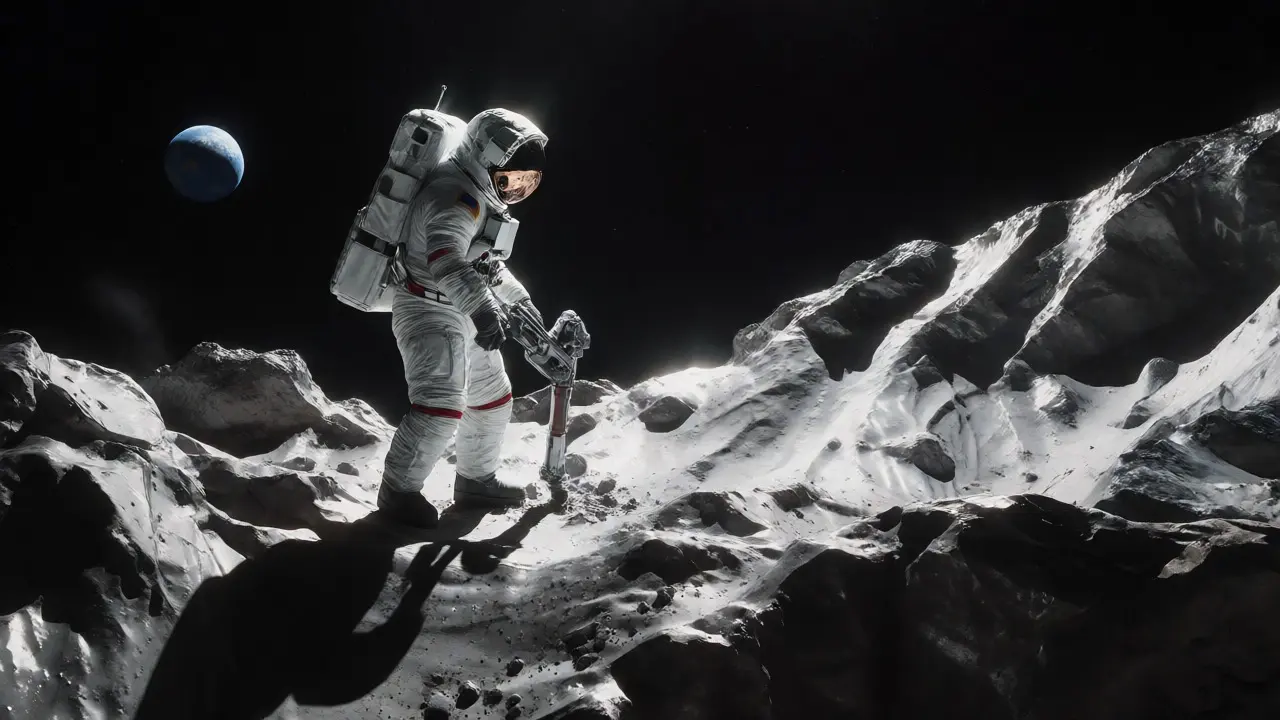
Imagine standing on a rock floating in the void, swinging a pickaxe into a chunk of platinum-rich metal. Sounds like science fiction, right? But for decades, engineers have debated whether this is the future of industry or just an expensive fantasy. The core question isn't if we can mine asteroids, but who should do it. Should we send fragile humans in bulky suits, or rely on cold, calculating robots? It’s not just a philosophical debate; it’s a math problem involving radiation doses, launch costs, and the brutal physics of low gravity.
As of October 2026, no one has actually mined an asteroid for profit. We’ve touched them, sampled them, and studied them. But commercial extraction? Still waiting. This gap between theory and reality is where the battle between crewed and robotic approaches gets interesting. One side argues that humans are essential for complex repairs and judgment calls. The other argues that sending people to deep space is a reckless waste of money when machines can work 24/7 without needing oxygen or coffee breaks. Let’s break down the safety, cost, and productivity realities to see which approach actually makes sense.
The Safety Equation: Radiation and Risk
Asteroid mining exposes operators to hazards that don’t exist on Earth. For a human crew, the biggest enemy is invisible: deep-space radiation. Unlike Earth, which has a thick atmosphere and magnetic field, space is bombarded by high-energy particles from solar flares and cosmic rays. NASA’s health analyses suggest that current permissible exposure limits could restrict a crewed mission to just three to ten months, depending on the solar cycle. That’s a tight window for a job that might take years to pay off.
| Hazard Category | Crewed Mission Impact | Robotic Mission Impact |
|---|---|---|
| Radiation Exposure | High risk of cancer, acute sickness; limits mission duration | Electronics hardening required; no biological damage |
| Life Support | Requires air, water, food, waste management systems | Minimal; only power and thermal control needed |
| Mission Failure Consequence | Potential loss of human life; rescue complexity | Loss of capital equipment; no fatalities |
| Psychological Stress | Isolation, confinement, communication delays | None |
Robots don’t care about radiation. They don’t get lonely, they don’t need sleep, and if they break, you don’t hold a funeral. A failed robot destroys hardware and data. A failed crewed mission destroys lives. This asymmetry drives most experts toward a "robot-first" strategy. NASA’s own concepts, like the Robotic Asteroid Prospector, explicitly propose using robots for initial reconnaissance and hazardous tasks before any human steps foot on a target. Why risk a $1 billion astronaut program on an asteroid that might turn out to be worthless dirt?
Cost Reality Check: Who Pays the Bill?
Money talks, and in space, it screams. Launching mass into orbit is expensive. Sending humans is exponentially more expensive because you can’t just send the worker; you have to send their habitat, their oxygen, their food, and their return vehicle. A study estimating the cost to identify and return a 500-ton asteroid to low Earth orbit pegged the price at roughly $2.6 billion. And that’s excluding the infrastructure needed to build the fleet in the first place.
Consider NASA’s OSIRIS-REx, a robotic sample-return mission to the asteroid Bennu. It cost approximately $800 million to $1.16 billion over 15 years. Now imagine scaling that up to industrial mining. If you tried to do that with humans, you’d need a station large enough to house a crew, protect them from micrometeoroids, and recycle every drop of urine. The weight penalty alone would skyrocket the launch costs. Robots, by contrast, can be smaller, expendable, and replicated. You can send ten cheap probes instead of one massive crewed ship. If one probe fails, you lose a fraction of the budget, not the entire program.
However, "cheap" is relative. A feasibility study suggested that a fleet of small robotic miners might still require over 100 spacecraft operating for five years just to break even. Another estimate put the upfront cost at around $7 billion for a similar robotic architecture. So, while robots are cheaper than humans, they aren't free. The key economic driver isn't just digging; it's transport. Moving material from an asteroid back to Earth (or to a lunar depot) costs thousands of dollars per kilogram. Until we lower those transport costs, the type of miner matters less than the logistics chain.
Productivity: Flexibility vs. Endurance
This is where the debate gets messy. Humans are incredible problem solvers. If a drill bit snaps in a way nobody predicted, an astronaut can improvise a fix with duct tape and ingenuity. A robot might just stop working until someone sends a patch code. Studies suggest humans can be one to two orders of magnitude more productive than teleoperated robots when dealing with unexpected geological challenges. Their dexterity and judgment are unmatched.
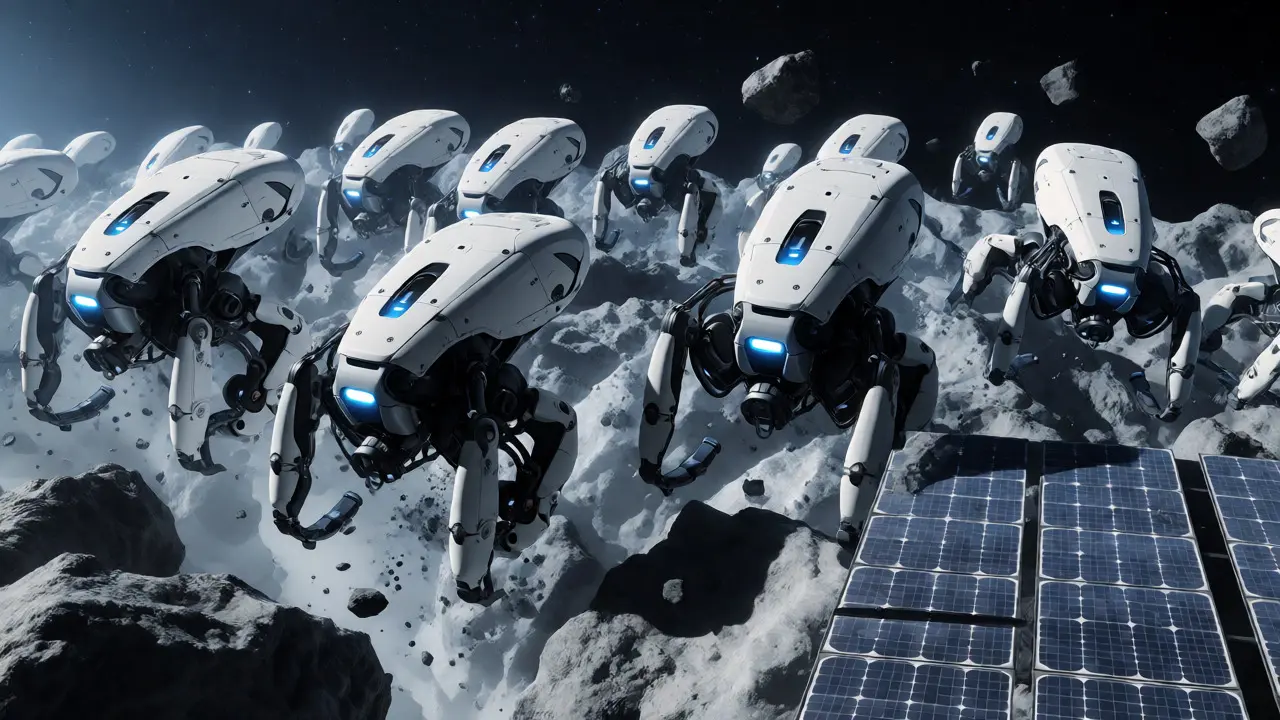
But here’s the catch: that productivity advantage shrinks rapidly in a spacesuit. Try doing fine motor skills with thick gloves on, in low gravity, while wearing a helmet that fogs up. Fatigue sets in. You need rest. You need meals. You’re limited by your body’s tolerance to radiation. In contrast, autonomous robotics can operate continuously. They don’t get tired. They can handle higher radiation levels and extreme temperatures. If you need to dig a hole, you can deploy fifty identical robots to do it simultaneously. You can’t clone astronauts easily.
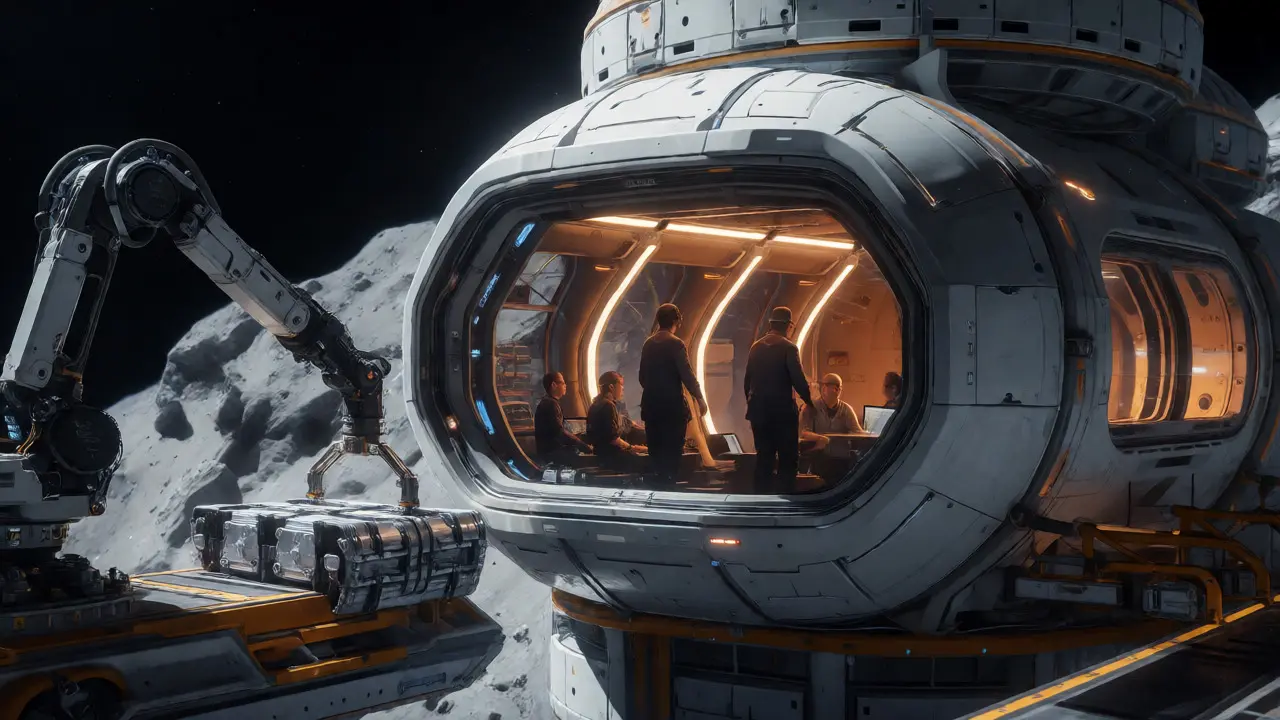
For bulk extraction-like scooping up tons of water ice or iron-nickel ore-throughput is king. A peer-reviewed analysis showed that throughput rate has the largest effect on economic viability. Robots win here simply because they can scale. You can build a swarm of autonomous excavators that work non-stop for years. Humans can’t match that sustained output without a massive support crew, which adds cost and complexity. The consensus among engineers is shifting toward a hybrid model: robots do the heavy lifting and repetitive tasks, while humans supervise and handle rare, complex maintenance issues.
The Market and Legal Landscape
We often hear headlines about trillion-dollar asteroids. While true in raw material value, that doesn't mean instant profit. The market for asteroid resources is currently pre-commercial. Companies like Planetary Resources and Deep Space Industries raised significant funding but failed to reach extraction, highlighting that technology readiness and financing are bigger hurdles than geology.
Legally, things are also unsettled. The U.S. Commercial Space Launch Competitiveness Act of 2015 allows U.S. citizens to own resources they extract. The Artemis Accords further clarify that resource extraction doesn't violate the Outer Space Treaty's ban on national appropriation. However, there is no comprehensive international regulatory framework yet. Who owns the debris left behind? What happens if two companies want the same asteroid? These questions remain open, adding risk to any investment, whether crewed or robotic.
Verdict: A Robot-Led Future
So, who wins? For now, it’s robots. Not because humans are obsolete, but because the risks and costs of sending people to uncertain targets are too high. The smartest path forward is staged: use telescopes to screen candidates, send robotic prospectors to confirm composition, then deploy robotic miners to prove throughput. Only after these steps succeed-and a steady market for space resources exists-should we consider sending humans to manage a permanent industrial base.
Humans will likely play a role eventually, especially for repair, adaptation, and managing complex processing facilities. But for the first wave of asteroid mining, keep the astronauts on Earth. Let the machines do the dirty, dangerous work. It’s safer, it’s cheaper, and frankly, it’s more practical.
Why hasn't anyone started commercial asteroid mining yet?
Several barriers exist. First, technology readiness: we haven't demonstrated large-scale extraction and processing in microgravity. Second, economics: launch costs are still high, and the market for returned materials (like platinum) is small compared to the investment. Third, legal uncertainty regarding ownership and liability remains unresolved internationally.
What resources are most valuable to mine from asteroids?
Water is arguably the most valuable near-term resource because it can be split into hydrogen and oxygen for rocket propellant, saving fuel costs for deep-space missions. Metals like platinum, gold, and cobalt are valuable for Earth markets, but their transportation costs must drop significantly to make them profitable compared to terrestrial mining.
Can robots really do all the work without human help?
Current robots struggle with unexpected problems. If a drill jams or a terrain feature is different than expected, autonomous systems may fail. Humans excel at improvisation. Therefore, a fully robotic system requires robust redundancy and advanced AI, while a human-tended system offers flexibility at a much higher cost.
How does radiation affect robotic mining operations?
Radiation can cause single-event upsets in electronics, leading to glitches or permanent damage. Robots require radiation-hardened components or shielding, which adds weight. However, unlike humans, robots can be designed to tolerate higher dose rates, allowing them to operate in environments that would be lethal to a crew.
What is the estimated cost of a robotic asteroid mining mission?
Estimates vary widely based on scope. A small-scale robotic prospecting mission might cost hundreds of millions (like OSIRIS-REx). A full industrial mining operation involving a fleet of spacecraft could range from $2.6 billion to over $7 billion in upfront capital, depending on the number of units and the distance to the target.
1 Responses
They are hiding the real tech from us.
The radiation data is skewed to justify the budget cuts. If we had proper shielding they would have sent humans years ago but the military industrial complex wants drone profits not human glory. Wake up.