

Imagine an orbit that looks like a stretched-out loop, swinging wildly close to the Moon before drifting tens of thousands of kilometers away. It doesn't look like the perfect circles we see in movies. This is the Near-Rectilinear Halo Orbit, or NRHO. It is the chosen home for NASA’s Lunar Gateway space station. But why pick such a weird path? The answer lies in the complex dance of gravity between the Earth and the Moon. Understanding these cislunar trajectories isn't just about math; it's about building a sustainable foothold in deep space.
We are moving past simple lunar flybys. We are entering the era of permanent presence. To make that work, we need orbits that save fuel, keep communication lines open with Earth, and allow easy access to the lunar surface. The NRHO delivers on all three fronts. Let’s break down how this works, who figured it out, and what it means for the future of exploration.
The Physics Behind the Halo
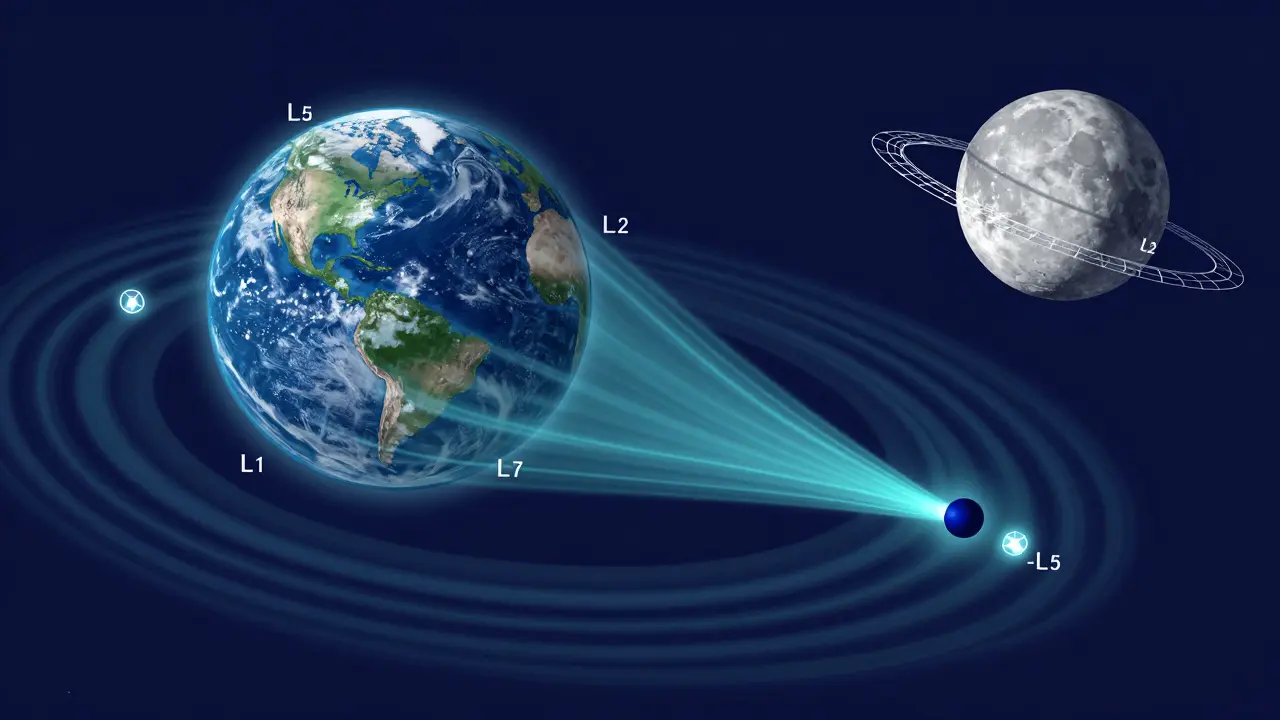
To understand the NRHO, you have to forget standard Keplerian orbits-the kind where a planet circles a star in a neat ellipse. In cislunar space, you aren't dealing with just one gravitational pull. You have two massive bodies: the Earth and the Moon. This creates a chaotic environment known as the Circular Restricted Three-Body Problem (CR3BP). In this system, there are five specific points called Lagrange Points (L1 through L5) where the gravitational forces balance out perfectly for a small object.
Halo orbits are three-dimensional paths that circle these Lagrange points. An NRHO is a special type of halo orbit located near the L2 point, which sits behind the Moon relative to Earth. Why is it "near-rectilinear"? Because when viewed from the rotating frame of the Earth-Moon system, the spacecraft moves in a nearly straight line during its fast pass by the Moon, then loops widely around at the far end. It’s not a stable orbit in the traditional sense-it’s naturally unstable. If you don’t correct it, the spacecraft will drift away. However, the instability is mild enough that only tiny amounts of fuel are needed to stay on course.
Why the Gateway Chose the NRHO
NASA didn't pick the NRHO by accident. After years of analysis, led significantly by researchers at Purdue University, this orbit emerged as the best compromise for a long-term outpost. Here is what makes it superior to low lunar orbits (LLOs) or distant retrograde orbits (DROs):
- Continuous Communication: In a low lunar orbit, the Moon blocks your view of Earth for half the time. You need relay satellites. In an NRHO, the station stays high above the lunar poles, maintaining almost constant line-of-sight with Earth. This simplifies communications drastically.
- Polar Access: The NRHO passes repeatedly over the lunar south pole. This is critical because the south pole contains water ice in permanently shadowed craters. The orbit allows landers to drop down to the surface and return with minimal fuel expenditure.
- Fuel Efficiency: Transferring from Earth to an NRHO uses less energy than going to low lunar orbit. Once there, the stationkeeping costs are incredibly low-often just a few meters per second of delta-v per year. For a multi-year mission, that adds up to significant savings.
- Safety from Debris: Because the NRHO stays at least 1,500 km above the lunar surface, it avoids the ejecta clouds kicked up by meteorite impacts on the Moon. The radiation and micrometeoroid environment here is similar to deep space, not the harsher conditions closer to the lunar ground.
From Theory to Reality: Key Contributors
The math behind these orbits was pioneered decades ago, but its application to the Gateway is relatively recent. A major breakthrough came from Kathleen Howell and her team at Purdue University. Their 2018 paper (AAS 18-406) detailed the geometry and stability of Earth-Moon NRHOs, comparing them against other options like "butterfly" orbits. They proved that the southern L2 NRHO offered the best trade-off for south polar exploration.
In 2019, researcher Lee developed a specific reference trajectory used by NASA for environmental modeling. This sample orbit has a perilune (closest approach) of about 1,500 km and an apolune (farthest point) of over 70,000 km. This extreme eccentricity defines the NRHO family used for Gateway planning.
But theory is cheap until you test it. That’s where the CAPSTONE mission comes in. Launched in 2022, this small cubesat entered an NRHO to prove that navigation and operations were possible in this complex gravitational regime. Its success validated the models and paved the way for the larger Gateway modules.
Navigating the Cislunar Highways
Getting to the Gateway isn't like driving to a store. It involves riding invisible highways in space called manifolds. These are pathways created by the natural dynamics of the Lagrange points. By injecting a spacecraft into the right manifold, you can coast from Earth orbit to the NRHO with very little thrust. This is known as a low-energy transfer.
However, these transfers take time. They might last weeks or even months. For cargo missions, this is fine. For crewed missions, speed matters more, so direct transfers are often used despite higher fuel costs. The beauty of the NRHO is that it connects well with both types of trajectories. It serves as a central hub in the cislunar transportation network.
| Orbit Type | Stability | Earth Visibility | Polar Access | Stationkeeping Cost |
|---|---|---|---|---|
| NRHO (Gateway) | Weakly Unstable | Near Continuous | Excellent (South Pole) | Low |
| Low Lunar Orbit (LLO) | Stable (mostly) | Intermittent (blocked by Moon) | Good | Moderate |
| Distant Retrograde Orbit (DRO) | Naturally Stable | Continuous | Poor | Very Low |
| L2 Butterfly Orbit | Unstable | Continuous | Variable | Moderate |
Surveillance and Space Domain Awareness
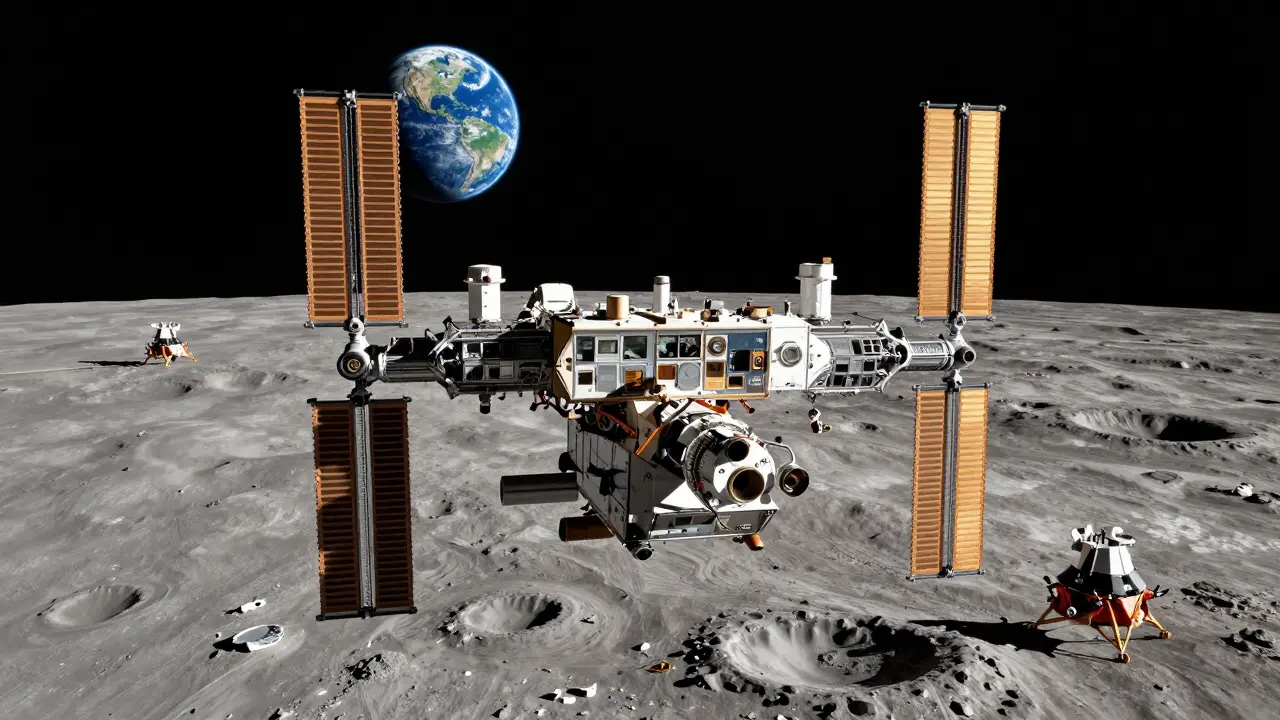
As more nations and companies enter cislunar space, knowing where everything is becomes crucial. A 2022 study by Wilmer analyzed how to monitor a spacecraft in an NRHO using other periodic orbits. The findings were clear: placing sensors in halo orbits around L1 or L2 provides exceptional visibility. An L1 halo orbit could track an NRHO target 99% of the time over a 30-day period. This suggests that future cislunar infrastructure won't just be about the Gateway itself, but a network of monitoring assets ensuring safety and traffic management.
Challenges and Future Steps
The NRHO is not without its challenges. The primary issue is precision. Because the orbit is dynamically sensitive, navigation errors can grow quickly. Missions require robust autonomous guidance systems and frequent trajectory correction maneuvers. Additionally, the long dwell time near the apolune means the spacecraft spends significant time far from the Moon, which can complicate quick-response scenarios if something goes wrong on the surface.
Despite this, the trajectory is set. With CAPSTONE validating the physics and construction of the Gateway underway, the NRHO is transitioning from a theoretical concept to a operational reality. It represents a shift from visiting the Moon to living near it. As we build out this infrastructure, our understanding of these three-body dynamics will deepen, potentially opening new corridors for commercial logistics and scientific research.
What is an NRHO?
An NRHO, or Near-Rectilinear Halo Orbit, is a highly elliptical, three-dimensional orbit around the Earth-Moon L2 Lagrange point. It appears almost straight during its close pass by the Moon and loops widely at its farthest point. It is chosen for its fuel efficiency and continuous communication with Earth.
Why is the Lunar Gateway using an NRHO instead of a circular orbit?
Circular low lunar orbits block communication with Earth frequently and require more fuel to reach. The NRHO provides near-constant line-of-sight to Earth, easier access to the lunar south pole for resource extraction, and lower fuel costs for stationkeeping compared to many other orbit families.
Is the NRHO stable?
No, the NRHO is naturally unstable. However, its instability is weak enough that it requires only small amounts of propellant (delta-v) to maintain the orbit over long periods, making it practical for a multi-year space station.
What role did the CAPSTONE mission play?
CAPSTONE was a cubesat launched in 2022 that successfully entered an NRHO. It served as a technology demonstrator to validate the navigation, operations, and orbital dynamics models used for the larger Lunar Gateway station.
How does an NRHO compare to a Distant Retrograde Orbit (DRO)?
While DROs are naturally stable and offer continuous Earth visibility, they do not provide the same level of convenient access to the lunar south pole as an NRHO. The NRHO's geometry allows for more efficient transfers to and from the lunar surface, which is critical for exploration missions.