

It is July 2026, and the race for central bank digital currency (CBDC) has shifted from theoretical debates to messy, expensive reality. For years, we watched central banks talk about replacing cash with code. Now, they are building it. But if you look closely at the data, a surprising picture emerges. While nearly every major economy is testing digital money, very few have actually launched a system that people use daily. The gap between ambition and adoption is wider than anyone expected.
This article cuts through the hype. We will look at which countries are actually running large-scale pilots, how their designs differ, and why some projects are struggling while others quietly dominate transaction volumes. Whether you are a fintech developer, a policy watcher, or just curious about the future of your wallet, understanding these timelines and technical choices is crucial. The infrastructure being built today will dictate how we pay for coffee, send remittances, and settle international trade for the next decade.
The State of Play: Who Is Actually Live?
As of mid-2026, the global landscape is fragmented. According to the Atlantic Council’s CBDC Tracker, there are roughly 41 active pilot projects worldwide, covering more than 130 economies. However, "active" does not mean "successful." Only three jurisdictions-The Bahamas, Nigeria, and Jamaica-are widely recognized as having fully launched retail CBDCs. A fourth, the Eastern Caribbean Central Bank’s DCash, exists in a limbo state, often classified as live but currently undergoing a major overhaul.
The Bank for International Settlements (BIS) reports that 91% of the 93 central banks surveyed in 2024 were exploring either retail or wholesale CBDCs. This near-universal interest suggests that CBDCs are no longer optional for modern monetary systems. Yet, the IMF warns that issuance remains uncertain. Many central banks are stuck in the "piloting" phase, conducting endless tests without committing to a nationwide launch. Why? Because the risks of disintermediating commercial banks and invading user privacy are high, and the benefits are not yet clear enough to justify the cost.
| Jurisdiction | Name | Status | Key Challenge |
|---|---|---|---|
| China | e-CNY | Pilot (Massive Scale) | Competition from Alipay/WeChat |
| Nigeria | eNaira | Launched | Low adoption, stablecoin preference |
| Jamaica | Jam-Dex | Launched | Merchant reluctance, low volume |
| Eastern Caribbean | DCash | Relaunching (2.0) | Past outages, trust issues |
| Bahamas | Sand Dollar | Launched | Small market size |
China’s e-CNY: The Quiet Giant
If you want to see what a CBDC looks like at scale, look at China. The People’s Bank of China (PBoC) started researching digital fiat in 2014 and formed a task force in 2016. By late 2019, pilots began in Shenzhen, Suzhou, Xiong’an, and Chengdu. Today, the e-CNY is arguably the largest CBDC experiment in history, even though it is technically still labeled a "pilot."
By December 2025, the e-CNY had processed over 3.4 billion transactions across more than 30 cities. It is used for public transport, government benefits, school tuition, and tax payments. The PBoC uses a two-tier distribution model: the central bank issues the currency to commercial banks, which then distribute it to users via wallets. This design protects the banking system from losing deposits directly to the central bank.
However, despite this massive volume, the Peterson Institute for International Economics notes that e-CNY penetration remains modest compared to private giants like Alipay and Tencent’s WeChat Pay. Chinese authorities are risk-averse. They fear that a full launch could disrupt financial stability or erode privacy norms too quickly. So, they keep expanding the pilot slowly, testing offline capabilities and smart contract features without making a final commitment. This cautious approach contrasts sharply with the rapid, sometimes reckless launches seen in emerging markets.
Emerging Markets: Speed vs. Adoption
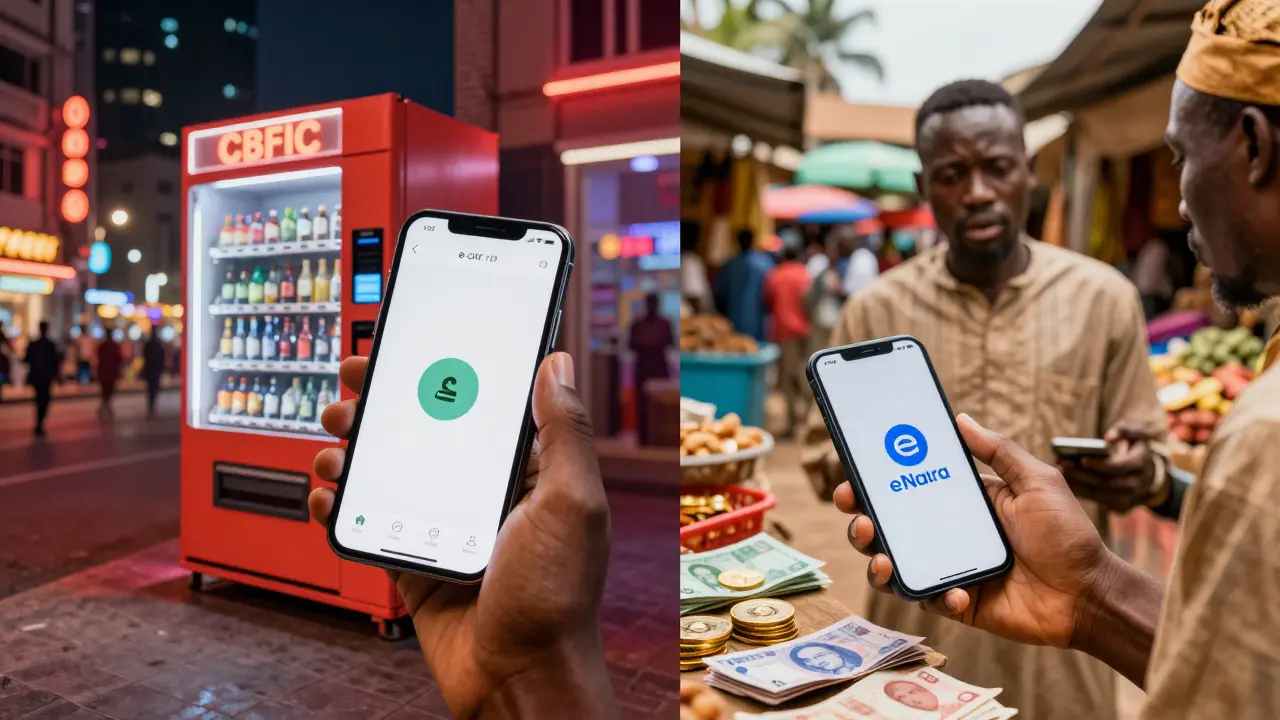
In contrast to China’s slow burn, Nigeria and Jamaica rushed to launch. Nigeria’s eNaira went live in October 2021, becoming the first retail CBDC in a large emerging market. The Central Bank of Nigeria (CBN) partnered with Bitt Inc. to build the platform. The goal was financial inclusion and reducing reliance on foreign currencies.
Reality hit hard. Adoption has been described as "modest" at best. With a population of over 220 million, only a small fraction of users have active eNaira wallets. The CBN’s own "Payments System Vision 2028" document admits that real-world uptake is low. In response, Nigeria is pivoting. Instead of trying to replace cash for everyday purchases, they are focusing eNaira on specific use cases: government-to-person payments, remittances, and trade settlement. By Q3 2026, Nigeria plans to pilot an eNaira-SWIFT corridor for UK-Nigeria remittances and test bilateral corridors with Ghana and South Africa.
Jamaica faces similar struggles. Jam-Dex launched in July 2022 as legal tender-the first CBDC to achieve this status explicitly. Yet, transaction volumes remain low. Merchants are reluctant to invest in new terminals when customer demand is weak. The government tried incentives like sign-up bonuses and merchant subsidies in 2024-2025, but usage only increased modestly. These cases prove a critical lesson: legal tender status alone does not guarantee adoption. Users need a reason to switch from existing habits.
Technical Designs: How Are They Built?
Not all CBDCs are created equal. The technical architecture determines who controls the data, how fast transactions settle, and whether the system can work offline. Most retail pilots, including e-CNY, eNaira, and Jam-Dex, use an intermediated two-tier system. In this model, the central bank does not hold accounts for individuals. Instead, commercial banks or payment service providers act as intermediaries. This preserves the traditional role of banks while adding a digital layer.
There are two main architectural approaches:
- Account-based: Tied to a verified identity. Transactions are recorded against a user account. This offers high security and easy recovery but raises privacy concerns because the central bank can potentially track all movements.
- Token-based: Functions like digital cash. Possession equals ownership. This allows for peer-to-peer transfers without intermediaries, similar to handing someone a physical bill. It supports better privacy and offline functionality but makes fraud harder to reverse.
China’s e-CNY uses a hybrid approach, combining elements of both. Wholesale CBDCs, like those tested in Project mBridge, typically use token-based architectures on distributed ledger technology (DLT). This enables instant settlement between banks, reducing liquidity needs and counterparty risk.
Cross-Border Ambitions: Project mBridge and Beyond
While retail CBDCs struggle to gain traction among consumers, wholesale CBDCs are gaining momentum in the background. The biggest player here is Project mBridge, a joint initiative by the BIS Innovation Hub, the Hong Kong Monetary Authority, the Bank of Thailand, the PBoC, and the UAE Central Bank. Launched as a minimum viable product in mid-2024, mBridge aims to create a blockchain-based platform for cross-border wholesale payments.
Why does this matter? Traditional cross-border payments are slow, expensive, and opaque. They rely on a chain of correspondent banks, each taking a cut and adding delay. mBridge allows central banks to settle transactions instantly using tokenized central bank money. By late 2024, it had reached MVP stage and supported basic real-value transactions. New participants are being invited, signaling a shift toward interoperable global standards.
Other notable wholesale projects include Switzerland’s Project Helvetia III, which issues tokenized Swiss francs, and Singapore’s Project Dunbar. These experiments focus on privacy-enhancing technologies, such as zero-knowledge proofs, to ensure that sensitive transaction data is not exposed on the public ledger. This is crucial for institutional adoption, where confidentiality is paramount.

Why Are Pilots Failing to Launch?
You might wonder: if the technology works, why aren’t more countries launching? Several factors are at play:
- Competition from Stablecoins: In many developing nations, citizens prefer US dollar-pegged stablecoins like USDT on the Tron network. These offer faster cross-border transfers and access to decentralized finance (DeFi), features that current retail CBDCs lack. Nigeria’s experience shows that eNaira plays a minor role compared to cryptoassets.
- Trust Issues: Technical failures damage credibility. The Eastern Caribbean’s DCash suffered a major outage in early 2022, leaving users unable to access funds for weeks. Poor communication from the central bank eroded trust. Although DCash 2.0 is launching in 2026, rebuilding user confidence takes time.
- Lack of Clear Value Proposition: Fast payment systems like India’s UPI or Brazil’s Pix already provide instant, low-cost domestic transfers. If a CBDC doesn’t offer something significantly better-such as offline capability or programmability-users see no reason to switch.
- Privacy Concerns: Critics, including the Human Rights Foundation, warn that CBDCs could enable unprecedented state surveillance. If citizens fear their spending habits are being monitored, they will resist adoption. Designing a CBDC that balances regulatory compliance with user privacy remains a significant technical challenge.
What Comes Next? 2026 and Beyond
The next two years will be decisive. The IMF projects that up to 15 CBDCs could be issued globally by 2030, but this assumes successful scaling of current pilots. Key milestones to watch include:
- Nigeria’s Cross-Border Corridors: The Q3 2026 launch of eNaira-SWIFT integration will test whether CBDCs can compete with traditional remittance channels.
- DCash 2.0 Relaunch: Success here would prove that multi-country CBDCs can overcome technical setbacks and regain user trust.
- mBridge Expansion: If more central banks join mBridge, it could become the backbone of global wholesale settlements, rivaling SWIFT.
- European Digital Euro: The ECB is still in the preparation phase. A decision to proceed with issuance is expected in 2027, which would mark a major shift in the euro area’s payment landscape.
For developers and businesses, the message is clear: prepare for fragmentation. There will be no single global CBDC standard anytime soon. Instead, you will encounter a patchwork of regional systems, each with different APIs, privacy rules, and interoperability protocols. Building flexible, adaptable payment infrastructure will be key to thriving in this environment.
Is CBDC safe for my money?
CBDCs are issued by central banks, making them risk-free from credit default, unlike commercial bank deposits or cryptocurrencies. However, safety also depends on cybersecurity. Past outages, like those with DCash, show that technical vulnerabilities exist. Always use official wallets and keep your credentials secure.
Will CBDC replace cash?
Most central banks do not plan to eliminate cash immediately. CBDCs are designed to coexist with physical currency and bank deposits. Cash may gradually decline in usage due to convenience, but it will likely remain available for decades, especially in rural areas or for privacy-conscious users.
How does CBDC differ from Bitcoin?
Bitcoin is decentralized, anonymous, and volatile. CBDCs are centralized, tied to national identities (often), and pegged 1:1 to the national currency. CBDCs aim to improve payment efficiency and financial inclusion, not to serve as a store of value or speculative asset.
Can I use CBDC for online shopping?
Yes, most retail CBDC pilots support online transactions. However, merchant acceptance varies. In countries like China, e-CNY is widely accepted online and offline. In others, like Jamaica or Nigeria, adoption is slower, and you may need to check if your preferred retailers support the specific CBDC wallet.
Are CBDCs private?
Privacy levels vary by design. Account-based CBDCs allow the central bank to view transaction histories, similar to bank statements. Token-based models with privacy enhancements (like zero-knowledge proofs) offer greater anonymity. Most current pilots prioritize anti-money laundering (AML) compliance, meaning some level of traceability is inevitable.