
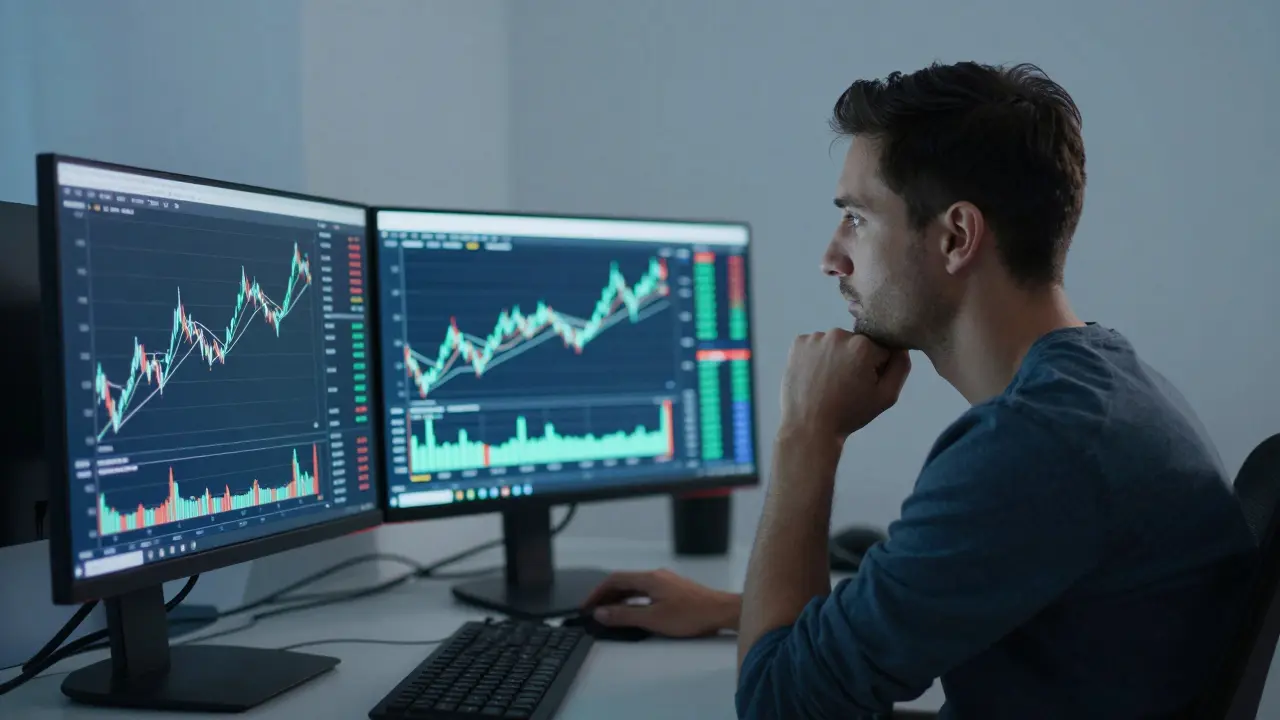
Most people lose money in cryptocurrency not because they pick the wrong coin, but because they try to predict where the price will go next. They guess tops, they catch falling knives at bottoms, and they get wrecked by volatility. There is a different way. It ignores predictions entirely. Instead, it waits for the market to show its hand, then follows the momentum until it breaks. This is the core of trend-following and breakout trading.
In 2026, with Bitcoin and Ethereum maturing into institutional assets, these strategies are more relevant than ever. They don't rely on news headlines or fundamental analysis. They rely on math, price action, and strict discipline. If you want to trade crypto without staring at charts all day, this is how you do it.
What Are Breakout and Trend-Following Strategies?
Let’s clear up the confusion between these two terms, since they often overlap. Trend Following is a strategy that buys assets when prices are rising and sells or shorts them when prices are falling, aiming to capture large moves over time. It doesn’t care if the asset is "overvalued." It only cares if the trend is up. Think of it as getting on a moving train and staying on until it stops.
Breakout Trading is a tactic that enters positions when price moves outside a defined range, such as support or resistance levels, signaling the start of a new move. It’s about catching the explosion right after a period of calm. While trend following is the philosophy, breakout trading is often the trigger mechanism used to enter those trends.
The roots of this approach go back to Richard Donchian in the 1950s, who traded commodities using simple channel breakouts. Today, firms like Man Group’s AHL division have proven that applying these same rules to cryptocurrencies yields Sharpe ratios (a measure of risk-adjusted return) above 1.0, which is exceptional compared to traditional markets. Why? Because crypto has massive momentum and volatility. When crypto moves, it moves hard.
How Trend-Following Works in Practice
You don’t need complex algorithms to start. The most common setup uses Moving Averages. Here is the standard playbook:
- The Indicators: Use a 50-period Exponential Moving Average (EMA) and a 200-period EMA on a daily or 4-hour chart.
- The Golden Cross: When the 50 EMA crosses above the 200 EMA, you go long (buy). This signals an uptrend.
- The Death Cross: When the 50 EMA crosses below the 200 EMA, you exit or short. This signals a downtrend.
This seems too simple, right? That’s the point. Complexity leads to overfitting-creating a system that looks perfect in the past but fails in the future. Simple systems survive longer. You can add confirmation tools like the Relative Strength Index (RSI) to avoid buying when the RSI is already above 70 (overbought), but the core signal remains the moving average crossover.
Another popular tool is the Donchian Channel, which plots the highest high and lowest low over a set period, typically 20 days, to identify breakout points. If price closes above the upper band, you buy. If it closes below the lower band, you sell. This links trend following directly to breakout mechanics.
Executing Breakout Trades Correctly
Breakout trading is riskier because false breakouts-where price spikes above resistance and immediately crashes back down-are common in crypto. To filter out the noise, you need strict entry rules.
- Identify the Range: Look for consolidation patterns like rectangles, triangles, or cup-and-handle shapes. Mark the key resistance level.
- Wait for the Close: Do not buy while the candle is still forming. Wait for the 1-hour or 4-hour candle to close above the resistance line. Wicks don’t count; bodies do.
- Confirm with Volume: A real breakout needs fuel. Check if the volume on the breakout candle is significantly higher than the 20-period average volume. No volume means no conviction.
- Enter on the Retest (Optional): Conservative traders wait for the price to pull back to the broken resistance level (which should now act as support) and bounce. Aggressive traders enter immediately on the close.
Using automated tools helps here. Many traders use TradingView alerts connected to bots via webhooks. When the breakout condition is met, the bot executes the order instantly. This removes emotion and ensures you don’t miss the move because you were sleeping.

Risk Management: The Real Edge
This is where most traders fail. Crypto can swing 10-20% in a single day. Without proper risk controls, one bad trade wipes out your account. Here are the non-negotiable rules:
| Rule | Recommendation | Reason |
|---|---|---|
| Leverage | 2x - 5x max | High leverage (20x+) leads to liquidation during normal volatility. Low leverage lets you hold through pullbacks. |
| Risk Per Trade | 1% - 2% of capital | If you lose 10 trades in a row, you’re only down ~13%. You stay in the game. |
| Risk-Reward Ratio | Minimum 2:1 | If you risk $100, your target profit must be at least $200. This allows profitability even with a low win rate. |
| Daily Loss Limit | Stop trading after 7% loss | Prevents emotional "revenge trading" after a bad session. |
Use trailing stops to lock in profits. For example, if you buy Bitcoin at $60,000, place your stop just below the recent swing low. As price rises to $65,000, move your stop up to the new swing low. Never move your stop down. This method, often called a Chandelier Exit or ATR-based trail, lets winners run while protecting your capital.
Building Your System: Tools and Setup
You don’t need a supercomputer. A standard laptop or a cheap cloud VPS is enough. The key is reliability and automation.
Charting & Scripting: TradingView is the industry standard. You can write custom strategies in Pine Script. For instance, a script can automatically plot Donchian channels and alert you when price breaches them. There are many free scripts available, like the “Breakout Trend Follower” by user millerrh, which handles entries and trailing stops automatically.
Execution: Connect your charting platform to your exchange via API. Use REST APIs for placing orders and WebSockets for real-time price data. Ensure your API keys are restricted to “trade only”-never enable withdrawal permissions. Store them encrypted. Security is paramount, especially given the history of exchange hacks.
Portfolio Breadth: Research from Man Group suggests that optimal performance for trend-following models occurs with a portfolio of 10-15 coins. Too few, and you lack diversification. Too many, and you dilute returns with illiquid, noisy altcoins. Stick to top-cap and mid-cap assets with high liquidity.

Trend-Following vs. Buy-and-Hold
Is it worth the effort? Let’s compare it to the classic HODL strategy.
Buy-and-hold is simple: you buy and forget. It works well in bull markets. But in bear markets, Bitcoin has dropped 70-80% multiple times. A trend-following system would have exited before those crashes, preserving capital. However, trend followers suffer in sideways markets. They get “whipsawed”-buying near the top of a range and selling near the bottom repeatedly. These small losses add up.
The academic consensus, supported by papers on SSRN and arXiv, is that systematic trend-following improves risk-adjusted returns (Sharpe ratio) compared to buy-and-hold over multi-year periods. It doesn’t necessarily make you richer in a straight-up bull run, but it keeps you alive during the crashes. In crypto, survival is the primary goal.
Pitfalls to Avoid
Even the best systems fail if you misuse them. Watch out for these traps:
- Over-optimization: Tweaking parameters to fit past data perfectly. A system that worked in 2021 might fail in 2026. Keep rules simple and robust.
- Ignoring Fees: High-frequency breakout trading incurs significant transaction costs and funding fees on perpetual futures. Factor these into your backtests. A strategy that looks profitable on paper might lose money after fees.
- Regime Changes: Crypto markets shift. Regulatory news or macroeconomic changes can alter volatility patterns. Be ready to pause trading if market structure breaks down.
- Emotional Interference: Moving your stop loss further away hoping price will turn around. This is how small losses become catastrophic ones. Trust the system.
Trend-following and breakout trading are not about being right every time. They are about being right big when you are right, and losing small when you are wrong. It’s a statistical edge, not a crystal ball. Start small, journal every trade, and let the data guide you.
What is the best timeframe for breakout trading in crypto?
For most retail traders, the 4-hour and daily timeframes offer the best balance between signal quality and frequency. Shorter timeframes like 15-minute or 1-hour generate more signals but also more false breakouts due to market noise. Longer timeframes require larger capital to manage position sizing effectively.
Can I use trend-following strategies on any cryptocurrency?
You should stick to high-liquidity assets like Bitcoin, Ethereum, and top-tier altcoins. Low-cap coins often have manipulated price action and wide spreads, which can trigger false breakouts and increase slippage costs, destroying your edge.
How much leverage should I use for trend following?
Keep leverage low, ideally between 2x and 5x. High leverage increases the risk of liquidation during normal market pullbacks. Trend following relies on holding positions through volatility, so you need room to breathe.
Do I need coding skills to implement these strategies?
No, but it helps. You can manually execute trades based on chart indicators. However, using platforms like TradingView with Pine Script or connecting to trading bots via APIs allows for automated execution, removing emotional bias and ensuring you never miss a signal.
Why do breakout strategies fail in sideways markets?
In sideways markets, price constantly breaks above resistance and below support only to reverse direction. This results in frequent small losses (whipsaws). Trend-following strategies perform best in trending markets and may require filters, such as ADX indicators, to avoid trading during low-volatility consolidation phases.
10 Responses
I've been watching the charts for years and honestly this is just common sense wrapped in fancy terms but I never thought about using a VPS for the bot execution part.
another generic guide pretending to be alpha while ignoring the fact that liquidity providers are hunting your stops like it's a sport, you think donchian channels matter when the exchange manipulates the wick? please. i see you guys getting wrecked every cycle because you treat trading like a hobby instead of a war against institutional algorithms that know exactly where your stop loss is sitting
It really breaks my heart to see people get so defensive about their trading losses when all we are trying to do is help each other understand that risk management is not optional but rather a fundamental pillar of survival in these markets because when you look at the history of crypto there are so many talented individuals who lost everything simply because they refused to accept that emotions have no place in financial decisions and if we could just take a moment to breathe and acknowledge that everyone starts somewhere perhaps we would create a more supportive community where beginners feel safe to ask questions about moving averages without being mocked for not understanding the complex interplay of market microstructure and high-frequency trading dynamics that dominate the current landscape.
The empirical evidence clearly demonstrates that systematic trend-following methodologies, particularly those utilizing exponential moving average crossovers coupled with rigorous volume confirmation protocols, significantly outperform discretionary trading strategies over multi-year horizons in emerging digital asset classes, provided that one adheres strictly to position sizing constraints derived from modern portfolio theory principles which mandate limiting exposure per trade to no more than two percent of total capital allocation thereby ensuring statistical robustness against adverse volatility regimes characteristic of speculative cryptocurrency markets during periods of macroeconomic uncertainty.
you're all idiots for thinking a 2:1 risk reward ratio saves you when the win rate is below 40% and fees eat your margin alive, i've backtested this garbage on binance data and unless you have an edge in execution speed or insider info you are just donating to the exchange makers who front run your limit orders by milliseconds, stop believing in holy grails and start accepting that retail traders are the liquidity that allows whales to exit their positions without slippage.
the tragedy of the human condition is our endless pursuit of certainty in a universe governed by chaos and entropy yet we cling to these rigid mathematical structures as if they were moral imperatives rather than mere descriptive tools for navigating stochastic processes, i find it deeply ironic that we seek salvation through trailing stops and golden crosses when the true enlightenment lies in surrendering the illusion of control and embracing the void of the market where profit and loss are merely transient shadows dancing upon the wall of cave reality, oh how we suffer beneath the weight of our own expectations.
i totally agree with the point about not staring at charts all day cause i used to do that and it was killing my productivity and mental health but now i set alerts and let the bot handle it which is way better although i still make typos in my pine script sometimes and have to debug it for hours which is annoying but overall the automation part is super helpful for people who have jobs and cant watch the screen 24/7 like some of you seem to think is necessary for success.
here in south africa we deal with load shedding so having a local vps is less reliable than cloud hosting overseas which makes the api connection part even more critical because if your power goes out your server doesn't go down but if your internet does then you miss the breakout entirely, so maybe add a note about redundant internet connections for those of us living in infrastructure-challenged regions.
From a philosophical standpoint, the concept of trend following aligns closely with Stoic principles of focusing only on what is within your control, namely your reaction to price action rather than attempting to predict the unpredictable future movements of the market, which ultimately leads to greater peace of mind and consistent results over time.
This is absolutely fantastic!!! I love how detailed this is!! It really helps me understand why I keep losing money!! Thank you so much for sharing this!!