

The Battle for Bitcoin’s Soul
Imagine a world where no single company owns the rules of the money you use. In Bitcoin, a decentralized digital currency that operates without a central authority, this is reality. But who decides how the system works? Is it the miners who secure the network? The developers who write the code? Or the users who hold the coins? These questions aren't just theoretical-they sparked some of the most intense debates in crypto history.
Two major upgrades, Segregated Witness (SegWit) and Taproot, serve as case studies in how Bitcoin evolves. One nearly broke the community apart. The other passed smoothly. Understanding why helps us see how Bitcoin actually governs itself-and what might happen next.
Why SegWit Sparked a Firestorm
In December 2015, developers Pieter Wuille and Gregory Maxwell proposed SegWit. The goal was simple: fix transaction malleability (a bug that allowed transactions to be altered) and effectively increase block capacity without changing the 1 MB limit. Technically, it was brilliant. Politically, it was a nightmare.
The activation method used was BIP9, a protocol upgrade mechanism requiring 95% miner signaling over two-week periods. This meant miners had veto power. If they didn’t signal support, the upgrade stalled. And stall it did. For months, the network sat in limbo. Some mining pools signaled; others didn’t. The community grew frustrated. Why would beneficial technology be blocked by hash power?
The tension escalated. A Reddit thread from March 2016 captured the mood: users worried that controversial soft forks might never pass under such high thresholds. Critics argued that giving miners disproportionate influence undermined Bitcoin’s user-centric ethos. After all, miners are paid to validate transactions-but should they get to decide which rules those transactions follow?
How Users Fought Back with BIP148
By early 2017, patience ran out. Enter BIP148, a User-Activated Soft Fork (UASF) proposal that threatened to enforce SegWit regardless of miner consent. Proposed in March 2017, BIP148 set a hard deadline: August 1, 2017. On that date, nodes running BIP148 software would reject any block not signaling SegWit. No more waiting. No more miner vetoes.
This wasn’t just talk. Economic nodes-exchanges, wallets, payment processors-started preparing. They knew miners needed their fees. If users rejected non-SegWit blocks, miners would lose revenue. The threat of a chain split became real. Suddenly, miners had a choice: adapt or starve.
Alongside BIP148 came BIP91, a reduced-threshold signaling mechanism that lowered the required miner support to 80%. Once 80% of hash power signaled, BIP91-enforcing nodes would ignore non-signaling blocks. It was coercion through consensus. By August 24, 2017, at block height 481,824, SegWit activated via Bitcoin Core version 0.13.1. The battle was won-but the scars remained.
Taproot: Learning from the Past
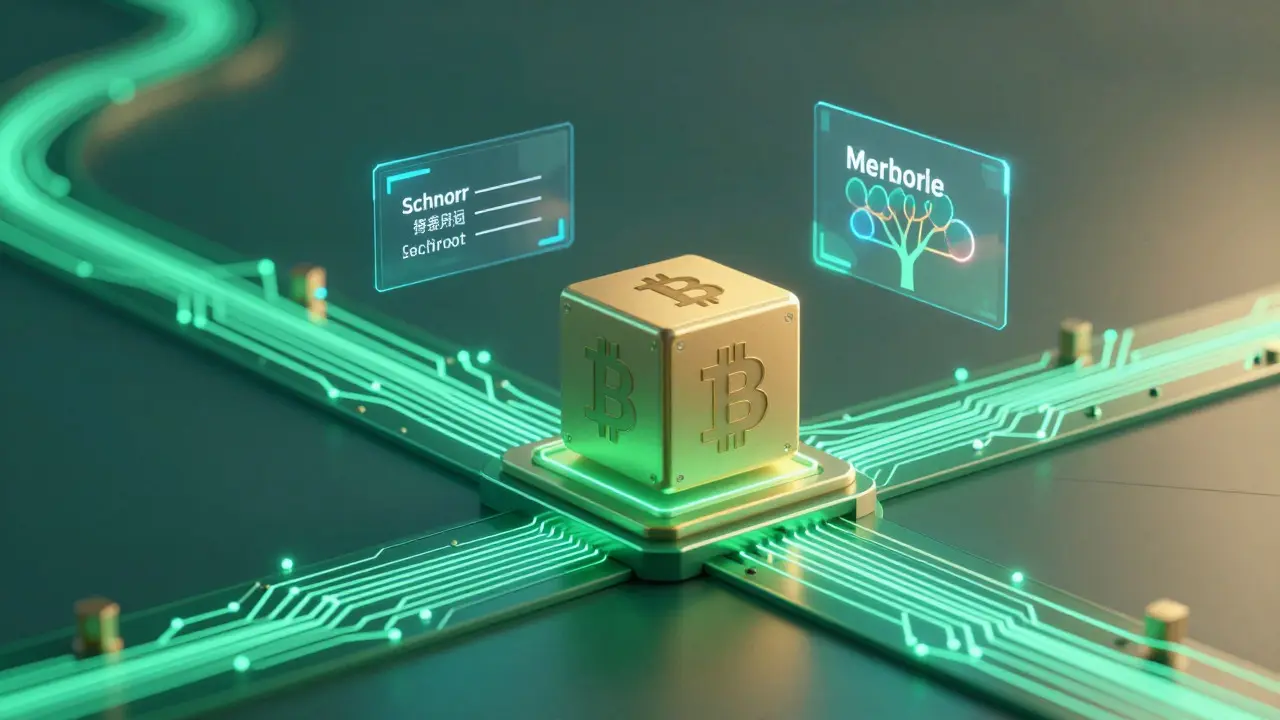
If SegWit was a war, Taproot was a peace treaty built on lessons learned. Launched in 2021, Taproot introduced Schnorr signatures and Merkleized script trees, improving privacy and enabling more flexible smart contracts. But its real innovation was in governance.
Instead of repeating the BIP9 stalemate, Taproot used Speedy Trial, a modified BIP9 variant with a 90% threshold and a three-month signaling window. Here’s how it worked:
- Shorter Window: Instead of an open-ended year-long process, miners had only three months to reach 90% support.
- Lower Threshold: Dropping from 95% to 90% made it harder for a small minority to block progress.
- Clear Expiration: If the threshold wasn’t met, the deployment expired. No indefinite limbo.
- Long Lock-In Delay: After lock-in, there was a five-month buffer before activation, giving node operators time to prepare.
Miners began signaling in April 2021. By June, over 98% of blocks were signaling support. Taproot locked in and activated on November 14, 2021, at block height 709,632, via Bitcoin Core 0.21.1. There was no drama. No UASF threats. Just smooth, coordinated progress.
Who Really Decides? Miners vs. Users
The SegWit saga proved one thing clearly: economic nodes hold ultimate power. Developers propose changes. Miners signal support. But if users don’t accept the new rules, miners earn nothing. As Upay noted in their analysis of BIP148, “User sovereignty” emerged as a core principle. Exchanges and large holders running full nodes can force miners to comply-or risk being orphaned.
ChainScore Labs’ governance comparison highlights this shift:
| Model | Threshold | Signaling Period | Power Dynamic |
|---|---|---|---|
| MASF (BIP9) | 95% | Open-ended (~1 year) | Miner veto power |
| Speedy Trial | 90% | 3 months | Balanced input |
| UASF (BIP148) | User-defined | Fixed deadline | User enforcement |
This table shows how each model allocates power. MASF relied too heavily on miner coordination. Speedy Trial balanced miner input with user control. UASF asserted user sovereignty outright. Each has trade-offs, but together they form a toolkit for future upgrades.

The Cost of Coordination
Let’s be clear: these upgrades cost nothing in terms of direct fees. Node operators simply installed updated software-v0.13.1 for SegWit, v0.21.1 for Taproot. But the real cost was coordination. Time spent debating. Energy poured into organizing. Risk of chain splits. These are invisible prices paid in trust and stability.
For example, during SegWit, users had to monitor multiple overlapping mechanisms (BIP9, BIP91, BIP148). Operational complexity increased. Mistakes could lead to lost funds or disconnected nodes. With Taproot, the process was simpler. Watch the Speedy Trial period. Upgrade when ready. Activate automatically. Less friction means fewer errors and less stress.
What Comes Next?
The debates around SegWit and Taproot haven’t ended-they’ve evolved. New proposals like LayerTwo Labs’ “Core Untouched Soft Fork” (CUSF) aim to decouple activation from Bitcoin Core maintenance. Imagine external “activator” software that enforces new rules if miners opt in, without needing maintainer approval. Permissionless development returns. Bottlenecks disappear.
Meanwhile, the “no hard fork” norm remains strong. Hard forks carry political toxicity. Soft forks remain conservative, backward-compatible, and safer. But even within soft forks, governance continues to mature. Lessons from 2017 and 2021 shape every new proposal.
As we move into 2026, expect more experimentation. More focus on reducing conflict. More emphasis on user sovereignty. Because in Bitcoin, the network doesn’t just decide-it learns.
What was the main problem with SegWit’s activation?
SegWit’s initial activation plan using BIP9 required 95% miner signaling over an open-ended period. This gave miners effective veto power, causing delays and frustration. The lack of a clear deadline allowed a small minority of hash power to stall the upgrade indefinitely.
How did BIP148 change the dynamics?
BIP148 introduced a User-Activated Soft Fork (UASF), setting a hard deadline for SegWit enforcement. Nodes running BIP148 software would reject non-signaling blocks after August 1, 2017. This created credible pressure on miners to comply, shifting power toward users.
Why was Taproot’s Speedy Trial considered better?
Speedy Trial lowered the threshold to 90%, shortened the signaling window to three months, and included a clear expiration date. This reduced the chance of prolonged stalemates while still allowing ample time for preparation after lock-in.
Do miners have final say in Bitcoin upgrades?
Not anymore. While miners signal support, economic nodes (users) ultimately enforce rules. If users reject blocks mined under old rules, miners lose revenue. The SegWit UASF demonstrated that user sovereignty overrides miner preferences when necessary.
What is the "no hard fork" norm?
It’s an unwritten rule that Bitcoin avoids hard forks due to their potential to split the community and create competing chains. Soft forks are preferred because they’re backward-compatible and less politically charged. This norm has held since the SegWit2x cancellation in 2017.
Could future upgrades bypass Bitcoin Core maintainers?
Proposals like CUSF suggest yes. By using external activator software, developers could ship upgrades without needing maintainer approval. Miners coordinate adoption, and users choose whether to run the activator. This aims to restore permissionless development.
9 Responses
It is really interesting to see how the community found a way to move forward without completely breaking apart. The shift from miner veto power to user sovereignty seems like a necessary evolution for any decentralized system. I appreciate that Taproot was able to activate so smoothly after all the drama with SegWit.
You people are delusional if you think this 'smooth' process wasn't just another form of coercion wrapped in pretty language. The miners were held hostage by economic nodes who threatened to orphan their blocks. It is not consensus. It is bullying. And yet here we are pretending it is some democratic ideal. Wake up.
Don't let them fool you!!! The whole thing is rigged from the top down! They want you to believe it's about privacy and efficiency but it's actually about centralization!! Look at who benefits from these upgrades! The big exchanges! The whales! They are watching your every move through the blockchain!!
Oh, please. Spare me the conspiracy theories. The reality is far more boring and tragic: incompetence and ego drove the SegWit war. Developers thought they knew best, miners thought they owned the network, and users just wanted fees to go down. Everyone failed to communicate effectively. Now we have a patchwork of half-measures called Speedy Trial because no one wants to admit fault. It is a disaster waiting to happen when the next hard fork proposal comes along.
I guess we will see what happens next. The technical details are impressive though.
Well, I mean, looking at the timeline, it is quite remarkable how quickly things changed once BIP148 came into play; you had this entire ecosystem bracing for impact, and then suddenly everyone just... complied? It makes you wonder if the threat of a chain split was the only thing holding it together, or if there was genuine support underneath all the noise. Either way, the coordination required to pull off something like Taproot with Speedy Trial is no small feat, considering how fragmented the mining pools can be at times. It is almost poetic in a way, isn't it? That the very mechanism designed to give miners control became the tool that stripped it away, forcing a new equilibrium where users actually matter. I suppose we should be grateful it didn't end in a permanent fork, even if the scars remain visible in the codebase and the community discourse.
finally someone said it! i always felt like the segwit debate was toxic af. glad taproot went smoother but lets keep pushing for better governance models! dont let the complacency set in peeps!
The CUSF model mentioned at the end is probably the most realistic path forward. Relying on Bitcoin Core maintainers as a bottleneck has proven to be a single point of failure for innovation. If developers can ship activator software independently, it restores the permissionless nature of the protocol. Miners will follow the money, and users will follow the utility. It is simple economics.
So basically, the lesson is that if you want something done, threaten to break the bank? Sounds like typical corporate strategy applied to crypto. But hey, at least my wallet works now. Thanks, I guess?