
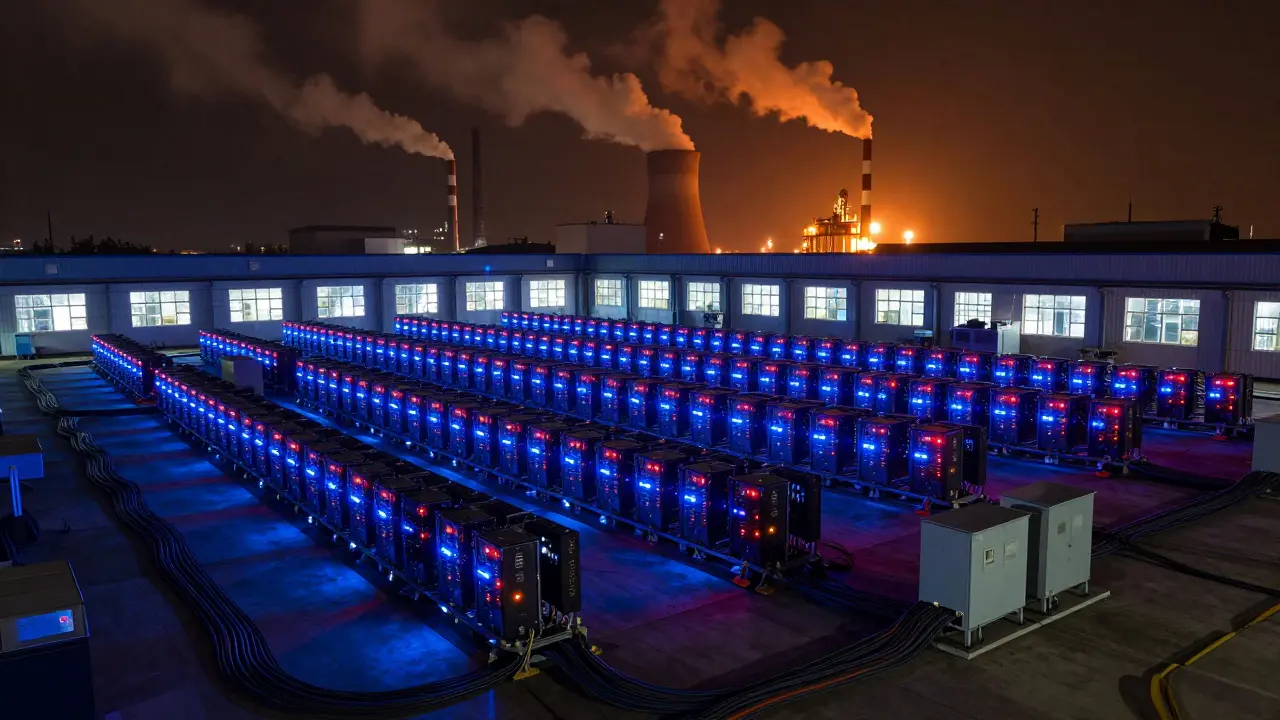
When the price of Bitcoin is a decentralized digital currency that relies on energy-intensive mining to secure its network skyrockets, something else climbs right along with it: electricity consumption. It’s not just a coincidence. The link between how much Bitcoin costs and how much pollution its network creates is direct, measurable, and often surprising to casual observers. You might think that if people stop buying, miners turn off their machines. But the reality is messier. During bull markets, when prices surge, miners don’t just run what they have-they buy more hardware, sign new power contracts, and push the global grid harder than ever before.
This dynamic creates a specific environmental problem: positive price shocks increase energy use and CO2 output far more aggressively than negative shocks reduce them. In simple terms, the damage done during a rally doesn’t fully reverse when the market cools down. Understanding this asymmetry is crucial for anyone looking at the future of cryptocurrency and climate policy.
The Engine Behind the Cost: Proof-of-Work
To understand why price drives power, you first need to look at how Bitcoin actually works. Unlike traditional banking systems that rely on centralized ledgers, Bitcoin uses a consensus mechanism called proof-of-work (PoW) is a cryptographic algorithm where miners compete to solve complex mathematical puzzles using specialized hardware. This process requires massive amounts of computational power.
Miners use specialized computers known as ASICs (Application-Specific Integrated Circuits) to guess random numbers until one matches a target set by the network. The first miner to solve the puzzle gets to add a block of transactions to the blockchain and receives a reward in Bitcoin. This reward consists of newly minted coins (the block subsidy) and transaction fees.
Here is the critical economic link: the reward is paid in Bitcoin, but the cost of mining is paid in fiat currency-dollars, euros, or yuan-for electricity and hardware. When the price of Bitcoin goes up, the revenue from each solved block increases in dollar terms, while the cost of electricity stays relatively stable. This widening margin turns mining into a highly profitable venture, incentivizing operators to consume more power.
Why Bull Markets Create an Asymmetric Energy Spike
You might assume that energy usage moves in a straight line with price: price up, energy up; price down, energy down. However, research tells a different story. Studies analyzing daily data on Bitcoin prices, hash rates, and electricity usage show a distinct asymmetry.
A 2025 study titled “Demystifying the asymmetric impact of Bitcoin price on its electricity usage” found that positive price shocks have a much larger impact on electricity consumption than negative shocks do. When Bitcoin enters a bull market, miners rapidly scale up operations. They bring idle machines online, purchase new rigs, and expand into new regions. This causes a sharp spike in global power demand.
Conversely, when the price drops, miners don’t shut everything down immediately. Hardware has a lifespan, leases must be honored, and there is hope that the price will recover. As a result, energy consumption remains high even after the initial rally fades. This means that bull markets leave a lasting legacy of increased baseline energy use and higher carbon emissions that persist well into bear markets.
| Market Phase | Miner Behavior | Energy Impact | Emission Trend |
|---|---|---|---|
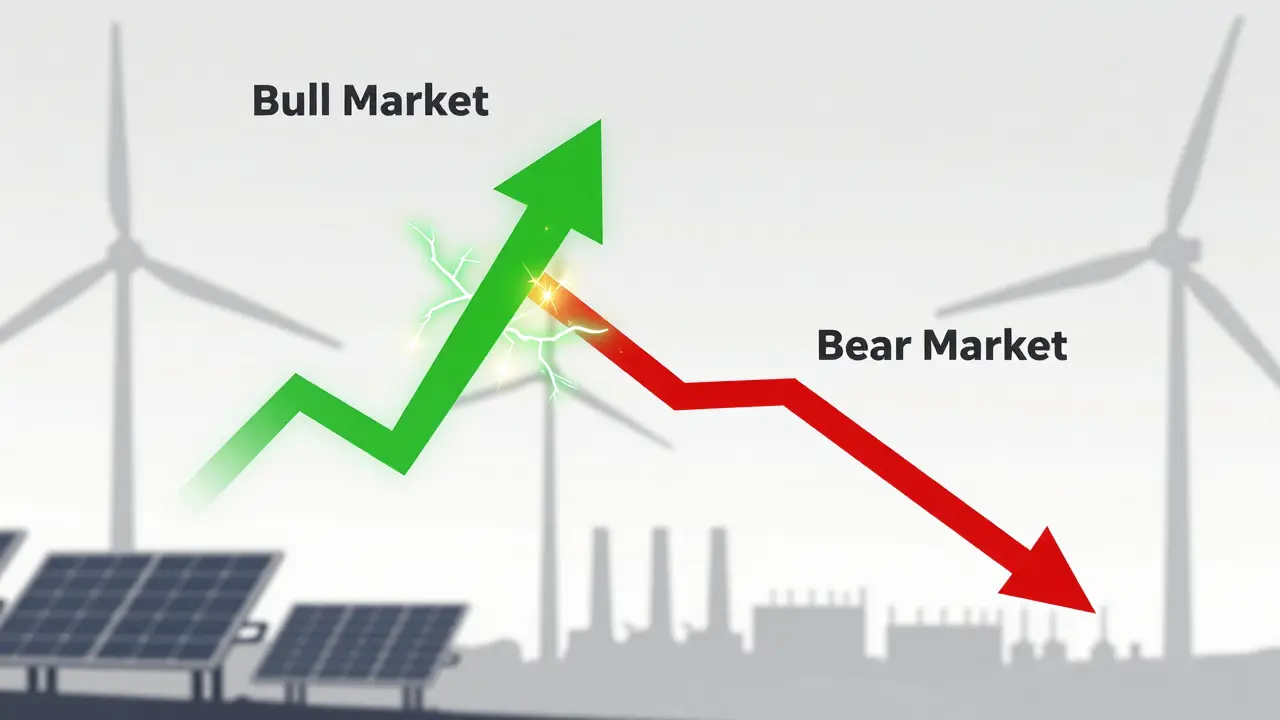
| Bull Market (Price Up) | Rapid expansion, new hardware purchases, entry of new firms | Sharp increase in global power demand | Significant rise due to scaling of fossil-fuel dependent grids |
| Bear Market (Price Down) | Inefficient miners exit, but core infrastructure remains active | Moderate decrease or plateau in power demand | Slow decline; "emissions tail" persists as efficient rigs stay online |
The Halving Cycle and Its Environmental Footprint
Bitcoin’s supply is programmed to shrink over time through events called halvings. Roughly every four years, the block reward given to miners is cut in half. The most recent halving occurred in April 2024, reducing the subsidy to 3.125 BTC per block.
Historically, these halvings precede major bull markets. Investors anticipate scarcity, driving up the price. For miners, however, the halving cuts their income in half overnight. To stay profitable, they must either find cheaper electricity or wait for the Bitcoin price to rise enough to offset the lower reward. In past cycles, the price has risen significantly, allowing miners to maintain profitability despite the reduced subsidy.
This cycle creates a predictable pattern of emissions spikes. After a halving, if a bull market follows, miners invest heavily in new, more efficient hardware to capture the available rewards. While individual machines become more efficient, the total number of machines grows so fast that the overall energy consumption of the network still increases. Data from the Cambridge Bitcoin Electricity Consumption Index (CBECI) shows that annualized consumption reached approximately 211.58 TWh by September 2025, comparable to the electricity use of mid-sized industrialized nations like Belgium or Norway.
Local Grid Stress and Social Costs
The impact of this power demand isn't just a global statistic; it hits local communities hard. When large mining operations move into a region, they can strain the local electrical grid. A University of Chicago-affiliated analysis found that during the 2016-2018 bull run, rapid expansion of mining facilities in certain U.S. regions increased local electricity demand enough to raise power prices for residential and small-business customers.
Consider the economics of a single mining rig. An Antminer S19, a common model, consumes between 3,000 and 3,500 watts continuously. At an average U.S. electricity cost of $0.11 per kWh, one machine costs roughly $250-$300 per month to run. Thousands of these units plugged into a single substation create a massive load. If the local grid relies on natural gas peaker plants to meet this sudden demand, the carbon intensity of that additional power is very high.
Furthermore, some jurisdictions have offered tax breaks or discounted industrial rates to attract miners. Investigations by Earthjustice reveal that while miners negotiated rates closer to 6.88 cents/kWh, residential customers in the same areas faced rates averaging 14.46 cents/kWh. This effectively socializes the infrastructure costs while private entities capture the profits during bull markets, raising questions about equity and long-term sustainability.
The Renewable Energy Debate
Is all this energy coming from coal? That is the subject of intense debate. Industry advocates argue that Bitcoin mining is increasingly green. A 2026 overview from Crypto.com suggests that approximately 52.4% of Bitcoin mining relies on renewable energy sources like hydro, wind, solar, and nuclear. They argue that miners are flexible loads that can help stabilize grids by using stranded or curtailed renewable energy that would otherwise go to waste.
Critics, however, point to different data. The Digiconomist Bitcoin Energy Consumption Index estimates the average carbon intensity of electricity consumed by the Bitcoin network at around 478 gCO2/kWh. This figure assumes a mix of coal-heavy and gas-heavy grids in major mining hubs like Kazakhstan, Texas, and parts of Europe. A 2025 Nature article highlighted that many U.S.-based mining operations are connected to fossil-fuel-based grids or use behind-the-meter gas-fired plants, suggesting the effective emission intensity may be higher than industry claims.
The truth likely lies in the middle, but the trend is clear: as mining migrates to new regions, the carbon footprint shifts with it. Even if the percentage of renewables grows, the absolute amount of energy used continues to climb during bull markets, meaning total emissions still rise unless the growth in renewables outpaces the growth in hash rate-a scenario that has not yet been consistently proven at a global scale.
Future Outlook: Can We Decouple Price from Pollution?
Looking ahead to 2030, projections suggest that without significant changes, Bitcoin mining could generate up to 76.40 million tonnes of CO2 emissions annually. The NBER working paper noted earlier estimated that at a Bitcoin price of $69,000, a $1 increase in price leads to $3.11-$6.79 in external damages from carbon emissions alone. This implies that the social cost of the environmental impact can exceed the marginal value added by the mining activity itself.
However, there are pathways to mitigate this. Regulatory frameworks in the EU and various U.S. states are beginning to require stricter environmental reviews for new mining facilities. Additionally, advancements in hardware efficiency mean that newer generations of ASICs perform more calculations per watt. If miners are forced or incentivized to locate only in regions with abundant, low-carbon energy, future bull markets might raise power demand without proportionally increasing emissions.
Until then, the correlation remains strong. As long as Bitcoin relies on proof-of-work, its price will act as a throttle for global energy consumption. Every rally brings a surge in power demand, and every surge leaves a carbon footprint that takes years to fade.
Does Bitcoin mining really use more energy than people think?
Yes. Estimates vary, but the Cambridge Bitcoin Electricity Consumption Index (CBECI) reported annualized consumption of roughly 211.58 TWh in late 2025. This is comparable to the total electricity usage of countries like Belgium or Norway. The energy use is driven by the competitive nature of proof-of-work mining, where miners constantly upgrade hardware to stay profitable.
Why does a Bitcoin bull market increase carbon emissions?
During a bull market, the price of Bitcoin rises, making mining more profitable. Miners respond by buying more hardware and running existing machines at full capacity. This increases the network's hash rate and total electricity demand. Since a significant portion of the global grid still relies on fossil fuels, this increased demand translates directly into higher CO2 emissions.
Do miners switch off their machines when the price drops?
Some do, particularly those with inefficient hardware or high electricity costs. However, studies show an asymmetric response: energy usage drops much less during bear markets than it rose during bull markets. Many miners keep operations running due to long-term contracts, hardware depreciation, or expectations of future price recovery, leading to a persistent "emissions tail."
How much of Bitcoin mining uses renewable energy?
Estimates are contested. Industry sources like Crypto.com claim over 50% of mining uses renewables as of 2026. Independent indices like Digiconomist estimate a higher carbon intensity, suggesting a heavier reliance on fossil fuels. The mix varies significantly by region, with some mines powered by hydroelectricity and others by natural gas or coal.
What is the impact of Bitcoin halvings on energy use?
Halvings cut miner rewards in half, which historically precedes bull markets as prices rise to compensate. These post-halving rallies drive massive investment in new mining infrastructure. Consequently, periods following halvings often see the steepest increases in both hash rate and electricity consumption, linking the four-year cycle directly to spikes in energy demand.