
Choosing a crypto exchange in 2026 feels less like picking a tool and more like choosing a bank. You are handing over your money to a platform that promises safety, speed, and low costs. But which one actually delivers? The landscape has shifted significantly since the industry’s turbulent years. Today, we have clear winners based on rigorous data from CoinGecko, Money magazine, and independent security firms.
If you want the short answer: Kraken is currently the best overall platform for most traders due to its balance of low fees and top-tier security. For absolute beginners who need hand-holding, Coinbase remains the standard. If you prioritize self-custody and decentralized finance, Uniswap is your go-to. And if you are an advanced trader seeking deep liquidity and altcoin variety, Binance still dominates global volume.
Quick Summary: Top Picks for 2026
- Best Overall: Kraken offers the best mix of low maker/taker fees, robust cold storage, and a clean security record.
- Best for Beginners: Coinbase provides the simplest interface and educational tools, though at a higher fee cost.
- Most Trusted Brand: Binance leads in user trust and volume, ideal for non-US users wanting maximum asset choice.
- Most Secure Perception: Crypto.com ranks highest in perceived security and insurance coverage among surveyed investors.
- Best Decentralized Option: Uniswap allows you to trade without giving up control of your private keys.
How We Compare Exchanges: The Three Pillars
To pick the right platform, you need to look past marketing slogans. In 2026, every serious evaluation rests on three pillars: Security Standards, Trading Fees, and Feature Set. Let’s break down what these actually mean for your wallet.
Security is no longer just about having two-factor authentication (2FA). It is about proof-of-reserves. This is a cryptographic audit that proves the exchange holds 100% or more of customer deposits in real-time. Platforms that do not publish these audits are major red flags. Additionally, look for high "cold storage" ratios-meaning most funds are kept offline, away from hackers.
Fees determine how much you keep. Most exchanges use a "maker-taker" model. Makers (those who place limit orders that sit in the order book) pay less because they add liquidity. Takers (those who buy/sell immediately at market price) pay more because they remove liquidity. Understanding this difference can save you thousands over time.
Features include the range of coins available, access to derivatives (futures/perpetuals), staking options, and ease of fiat on-ramps (buying with USD, EUR, etc.). A beginner might prioritize simplicity, while a pro needs API access and deep liquidity.
Kraken: The Best Overall Platform
Money magazine named Kraken the "Best Overall" crypto exchange in June 2026, and the data backs it up. Kraken has been around for over a decade, surviving multiple market crashes and hacks that took down competitors. Its reputation is built on transparency and security.
The standout feature here is the fee structure on Kraken Pro, their advanced trading interface. Standard retail fees start around 0.16% for makers and 0.26% for takers. However, as your volume increases, these drop significantly. High-volume traders can see maker fees fall close to 0% and taker fees drop toward 0.10%. This is incredibly competitive compared to simpler interfaces.
On the security front, Kraken keeps the vast majority of customer funds in offline cold storage. They also support hardware security keys (like YubiKey) for 2FA, which is far more secure than SMS codes. Crucially, Kraken publishes regular proof-of-reserves attestations, allowing users to verify that their assets are actually there. If you value peace of mind alongside decent fees, Kraken is the logical choice.
Binance: The Global Volume Leader
You cannot talk about crypto trading without mentioning Binance. AVG’s 2026 report calls it the "world’s most popular cryptocurrency exchange," and it handles billions in daily volume. For many traders, especially outside the United States, Binance is the default because of its sheer scale.
Why do people choose it? Variety and liquidity. Binance lists hundreds of altcoins, often before other exchanges do. If you want to trade obscure tokens or engage in complex strategies like margin trading and futures, the depth of the order book here is unmatched. According to Beyond Identity’s 2026 survey, nearly 40% of crypto investors name Binance as their most trusted exchange, highlighting its strong brand loyalty despite past regulatory scrutiny.
Fees on Binance are aggressive. Spot trading starts at 0.10% for both makers and takers. But if you hold BNB (their native token) and use it to pay fees, you get a discount. High-volume traders can push spot fees down to the 0.02%-0.04% range. Derivatives fees are also competitive, starting around 0.055% for takers and 0.02% for makers.
The catch? Regulatory restrictions. Binance is not fully available to US residents, and KYC (Know Your Customer) requirements can be strict depending on your region. If you are in the US, you will need to look elsewhere. If you are elsewhere and want the widest selection of assets with deep liquidity, Binance remains hard to beat.
Coinbase: The Beginner’s Safe Haven
If you are new to crypto, Coinbase is likely where you started, and for good reason. Money magazine awards it the "Best for Beginners" title. The interface is clean, intuitive, and free of the cluttered charts and complex menus that scare off newcomers.
Coinbase is a publicly traded company in the US, which adds a layer of regulatory comfort for American investors. It offers excellent educational resources, including "Learn and Earn" modules where you can earn small amounts of crypto by reading about them. This helps demystify the technology.
However, convenience comes at a price. Coinbase’s standard retail interface charges higher fees than Kraken or Binance. These fees are often hidden in wider spreads (the difference between the buy and sell price) rather than explicit transaction percentages. For large trades, this adds up quickly. That said, Coinbase does offer a professional interface called "Coinbase Advanced Trade" which lowers fees, but it lacks some of the seamless simplicity of the main app.
If your priority is ease of use, regulatory compliance in the US, and learning the ropes, Coinbase is worth the extra cost. Once you gain confidence and volume, you might migrate to a lower-fee platform like Kraken Pro.
Crypto.com: Security and Lifestyle Integration
Crypto.com has carved out a unique niche by combining trading with lifestyle rewards. Their Visa debit card, which gives cashback in CRO tokens, is a major draw. But beyond perks, their security posture is impressive.
In Beyond Identity’s 2026 study, Crypto.com was rated the most secure platform overall. This ranking considers technical safeguards, insurance coverage, and user perceptions. They maintain a $500 million customer protection fund, which provides an additional safety net against potential breaches or insolvency events. For users worried about the "what if" scenarios of exchange failures, this insurance layer is significant.
The trading experience on Crypto.com is mobile-first. The app is sleek and easy to navigate. However, some power users find the fee structure less transparent than competitors. While they offer competitive rates for high-volume traders, the average user may encounter variable fees depending on whether they use the basic app or the advanced "Pro" version. If security and integrated rewards are your top priorities, Crypto.com is a strong contender.
Uniswap: The Decentralized Alternative
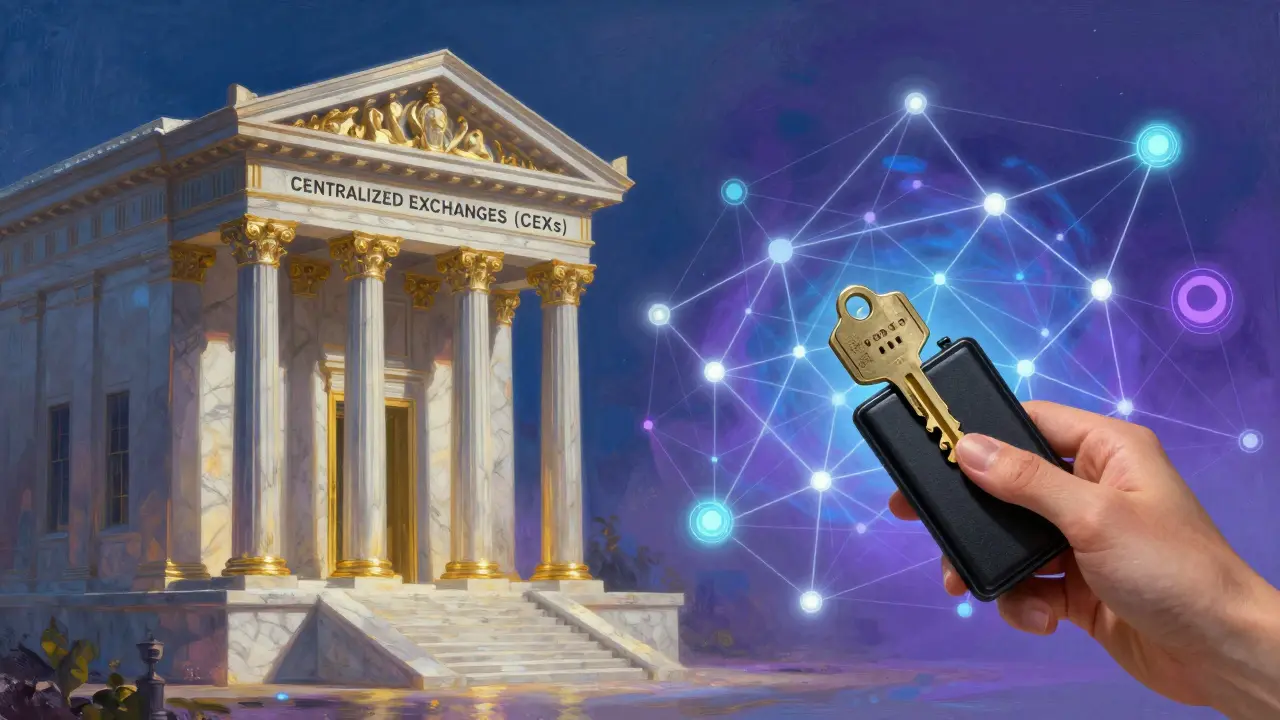
All the platforms above are Centralized Exchanges (CEXs). They hold your funds for you. Uniswap is different. It is a Decentralized Exchange (DEX) that runs on the Ethereum blockchain. Money magazine calls it the "go-to choice" for decentralized trading.
With Uniswap, you never deposit funds into an exchange account. Instead, you connect your own wallet (like MetaMask) and trade directly via smart contracts. This eliminates custodial risk-if Uniswap gets hacked, your funds in your personal wallet remain safe. This is the core promise of DeFi (Decentralized Finance): "Not your keys, not your coins."
The trade-off is complexity and cost. You must understand gas fees (transaction fees on Ethereum), which can spike during network congestion. Fees on Uniswap vary by pool, typically ranging from 0.01% to 1%. There is no customer support chat to help you if you send funds to the wrong address. You are on your own.
Use Uniswap if you are comfortable managing private keys, want access to new tokens listed before CEXs, and prioritize sovereignty over convenience. Most serious traders in 2026 use a hybrid approach: a CEX for buying with fiat and moving large sums, and a DEX like Uniswap for specific DeFi strategies.
Fee Comparison Table: Who Costs Less?
Understanding the exact cost of trading is crucial. Below is a comparison of base spot trading fees for standard retail users on major platforms in 2026. Note that these fees decrease significantly with higher monthly volume or holding native tokens.
| Platform | Maker Fee | Taker Fee | Best For |
|---|---|---|---|
| Kraken Pro | 0.16% | 0.26% | Overall Balance |
| Binance | 0.10% | 0.10% | High Volume/Altcoins |
| Coinbase (Advanced) | 0.40% | 0.60% | US Beginners |
| OKX | 0.08% | 0.10% | Derivatives/Advanced |
| Crypto.com | 0.40% | 0.40% | Lifestyle/Rewards |
Note: Maker fees apply when you place a limit order that does not execute immediately. Taker fees apply when you buy/sell instantly at the current market price. Always check the latest fee schedules on each platform's website, as they change frequently.
Security Checklist: What to Look For
Before you deposit a single dollar, run any exchange through this security checklist. If a platform fails any of these points, consider looking elsewhere.
- Proof of Reserves: Does the exchange publish regular, verifiable audits showing they hold 1:1 reserves for all user assets? (Kraken, Coinbase, and Binance do this).
- Cold Storage Policy: What percentage of funds are kept offline? The higher the percentage, the safer your assets are from online hacks.
- 2FA Options: Do they support authenticator apps (Google Authenticator) or hardware keys (YubiKey)? Avoid platforms that only offer SMS verification, which is vulnerable to SIM-swapping attacks.
- Insurance Fund: Does the exchange have an emergency fund or insurance policy to cover losses in case of a breach? (Crypto.com highlights this strongly).
- Regulatory Compliance: Is the exchange licensed in reputable jurisdictions? This matters for legal recourse if things go wrong.
Which Platform Should You Choose?
Your choice depends entirely on your experience level and goals.
If you are a beginner: Start with Coinbase. The higher fees are a small price to pay for a smooth onboarding experience and educational tools. Once you understand how orders work, move to Coinbase Advanced Trade to reduce costs.
If you are an intermediate trader: Kraken is your best bet. It offers a professional environment with reasonable fees and top-notch security. It is regulated enough to feel safe but flexible enough to offer useful tools.
If you are an advanced trader or institutional investor: Binance or OKX provide the deepest liquidity and lowest fees for high volumes. If you are in the US, stick to Kraken or Coinbase Institutional.
If you are a DeFi enthusiast: Use Uniswap for swapping tokens directly from your wallet. Combine this with a CEX for initial fiat purchases.
Is Kraken better than Binance?
It depends on your location and needs. Kraken is generally considered safer and more transparent regarding reserves, making it better for US users and those prioritizing security. Binance offers lower fees and a wider selection of altcoins but faces stricter regulatory limitations in the US and some other regions. For most global users seeking a balance, Kraken is the preferred choice in 2026.
Are crypto exchanges safe in 2026?
Major exchanges like Kraken, Coinbase, and Binance are much safer now than in previous years due to mandatory proof-of-reserves audits and improved cold storage practices. However, no platform is 100% immune to risk. Always enable 2FA, use strong passwords, and consider withdrawing large holdings to a personal hardware wallet for long-term storage.
What is the cheapest crypto exchange for trading?
For high-volume traders, Binance and OKX offer the lowest fees, with maker fees dropping below 0.05% for top tiers. For average retail traders, Kraken Pro offers a very competitive balance with maker fees starting at 0.16%. Coinbase is generally the most expensive for standard retail transactions due to spread markups.
Can I use Binance in the USA?
No, Binance.com is not available to US residents due to regulatory actions. US users must use Binance.US, which has a smaller selection of coins and different fee structures, or switch to fully compliant alternatives like Coinbase or Kraken.
Should I use a DEX like Uniswap instead of a CEX?
Use Uniswap if you already own crypto and want to swap tokens without giving up custody of your funds. Use a CEX (Centralized Exchange) like Kraken or Coinbase if you need to buy crypto with fiat currency (USD, EUR) or want easier access to customer support. Many traders use both: a CEX for onboarding and a DEX for advanced DeFi activities.
14 Responses
the nature of trust is shifting from institutions to code yet we still cling to the comfort of centralized entities because true freedom requires a level of responsibility most are unwilling to bear
you guys really believe kraken is safe? its just another bank with better marketing. the whole proof of reserves thing is a joke because they can easily manipulate the data behind closed doors. i stick to cash under my mattress and frankly it keeps me safer than any digital ledger ever could
I have been trading in Europe for years and the regulatory landscape there is completely different from what you describe here in the US. Binance has always been our go-to because the liquidity is unmatched and the fees are genuinely lower. It is fascinating how geography dictates your financial tools so drastically. The cultural shift towards decentralized finance is happening faster in Asia and parts of Europe than in America where regulation stifles innovation.
i noticed that coinbase advanced trade lowers fees but does anyone actually use it or do people just stay on the basic app out of habit?
It is imperative that we understand the distinction between maker and taker fees as this knowledge empowers the individual trader to navigate the market with greater precision and confidence. Many users overlook this critical detail and end up paying significantly more than necessary which undermines their long-term profitability. By utilizing limit orders one can contribute liquidity to the market while simultaneously reducing transaction costs thereby fostering a more efficient ecosystem for all participants involved in these exchanges.
The article fails to mention the superior infrastructure available in India compared to these Western platforms. Our fintech integration is lightyears ahead and local exchanges offer better KYC compliance without the bureaucratic red tape seen in the US. The jargon-heavy analysis here is typical of American-centric views that ignore global realities. You need to look at how blockchain is being adopted in emerging markets for real utility rather than just speculative trading on outdated CEXs.
oh please spare me the lecture on security protocols when half of you cant even secure your own email accounts against phishing scams. uniswap is fine if you have a brain but most people here are just gambling addicts looking for validation. the drama around fees is pathetic considering the volatility will wipe you out anyway
From South Africa, I can tell you that access to these platforms is a nightmare due to banking restrictions. We rely heavily on P2P networks because our banks treat crypto like a disease. The 'best' platform is useless if you cannot deposit rand into it without triggering an investigation. Your guide is very privileged in its assumptions about fiat on-ramps.
The moral decay of society is evident in our obsession with optimizing fractions of a percent in trading fees while ignoring the ethical implications of energy consumption. We dance on the grave of the environment seeking digital gold. Is it truly worth it? The soul of the market is lost in the cold calculation of maker-taker spreads. We are mere cogs in a machine designed to extract value from our attention and capital.
i totally agree with the point about kraken being solid for intermediate traders but i think the interface can be a bit confusing at first glance especially if you are coming from a traditional stock brokerage background. it takes some time to get used to the layout and the order book dynamics but once you do it feels much more professional than the gamified apps that are so popular right now. also the customer support is surprisingly responsive which is rare in this industry
let's cut the crap about security audits. every exchange claims to be safe until they aren't. ftx was the poster child for transparency before it imploded. i don't care about your proof of reserves if the CEO can move funds at will. the only safe place is a hardware wallet and even then you might lose your seed phrase. stop trusting corporations with your money
You need to stop making excuses for bad security practices! If you are not using a hardware key you are doing it wrong. Stop blaming the platform for your lack of personal responsibility. Get off your butt and set up proper 2FA today or don't complain when you get hacked tomorrow!
The institutionalization of cryptocurrency is inevitable and those who resist it are merely delaying the obvious. The integration of staking options and derivatives within regulated frameworks like Coinbase Advanced Trade demonstrates a maturation of the asset class. We are moving away from the wild west era into a period of sophisticated financial engineering where risk management tools are paramount. Ignoring these developments is akin to refusing to use electronic trading in the stock market decades ago.
I completely understand why beginners feel overwhelmed by the sheer number of choices available in the current market landscape, and it is perfectly normal to start with a platform that offers extensive educational resources and a user-friendly interface, such as Coinbase, because the learning curve can be quite steep for those who are new to the concept of digital assets and blockchain technology, and taking the time to familiarize oneself with the basics of order types and fee structures is essential for building a solid foundation that will serve you well as you progress to more complex trading strategies and potentially migrate to platforms with lower fees and higher functionality.