
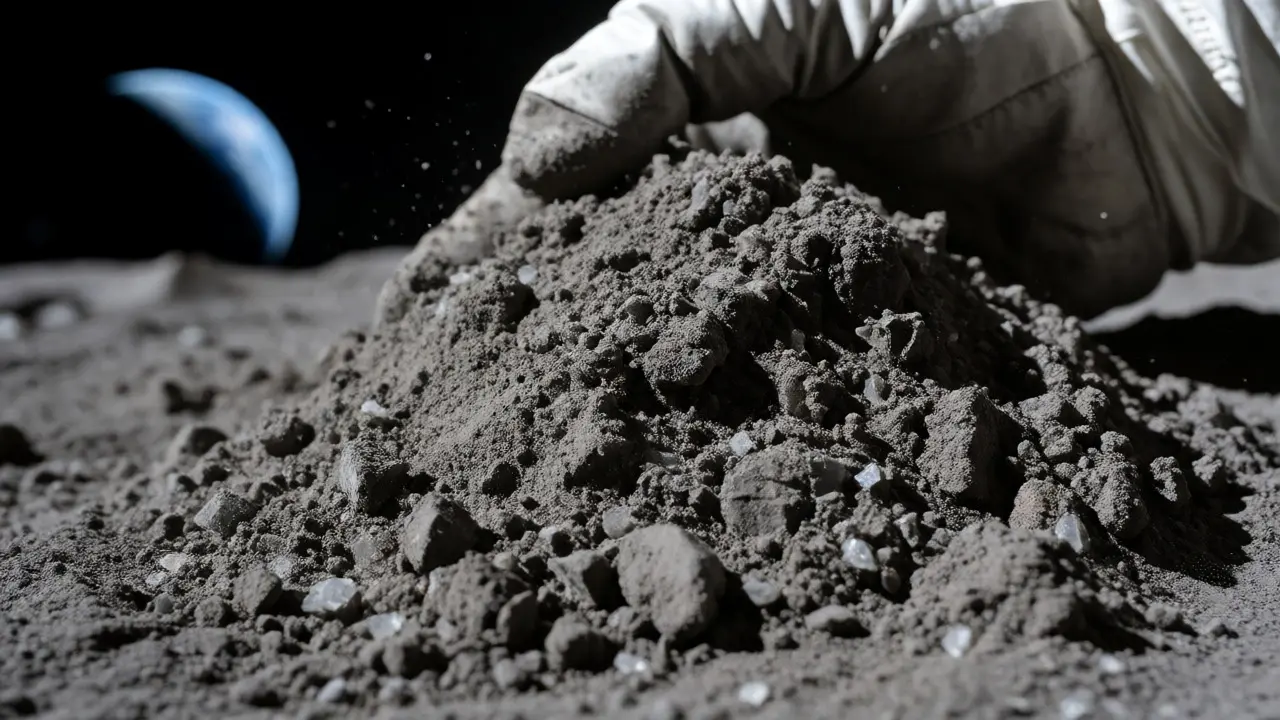
Imagine digging up a bucket of gray dust on the Moon. It looks like ordinary dirt, but hidden inside are oxygen atoms locked tight within mineral crystals. The problem? That dust is messy. It’s a chaotic mix of valuable ilmenite, worthless glassy agglutinates, metallic iron specks, and fine powder. If you try to process this raw mess directly into a chemical reactor, you’re burning energy and hydrogen to process mostly waste. This is where beneficiation comes in. It’s the art of separating the good stuff from the junk before any heavy chemistry begins.
For decades, we’ve known how to do this on Earth using water and gravity. But space doesn’t play by those rules. There’s no water to wash with, and gravity is only one-sixth of what we’re used to. So, how do engineers plan to upgrade lunar soil? They rely on physics that works in a vacuum: magnetism and density differences. As of late 2026, this isn’t just theory. Labs at NASA, the European Space Agency (ESA), and universities like Missouri S&T are testing dry separators that could power future lunar bases. Let’s break down how these machines actually work and why they matter for the next generation of space exploration.
Why Raw Regolith Won’t Work
Lunar regolith isn’t uniform. It varies wildly depending on whether you’re standing on the dark, basalt-rich "maria" or the bright, highland crust. In the maria, you find ilmenite (an iron-titanium oxide mineral, FeTiO3), which is gold for oxygen production because it releases water when heated with hydrogen. In the highlands, you find anorthite (a calcium-rich feldspar useful for aluminum and glass). But neither mineral exists in pure form. They’re mixed with silicates, volcanic glass, and microscopic beads of metallic iron created by billions of years of micrometeorite impacts.
If you feed raw regolith into an oxygen extraction plant, you dilute your yield. You end up with low-grade output and clogged machinery. Beneficiation solves this by creating a concentrated feedstock. Think of it like washing gold nuggets out of river sand. You don’t melt the whole pile of sand; you separate the dense metal first. On the Moon, we can’t use water, so we have to use other forces. The goal is simple: increase the grade (percentage of target mineral) while keeping enough recovery (total amount captured) to make the process worth the energy cost.
Magnetic Separation: Pulling Iron Out of the Mix
Magnetism is the most mature technology for space beneficiation. Why? Because it’s dry, passive (if using permanent magnets), and highly effective against the specific contaminants found on the Moon. Lunar soil contains agglutinates (glassy particles fused by meteorite impacts, often containing metallic iron). These are strongly magnetic. Meanwhile, valuable minerals like ilmenite are only weakly paramagnetic, and anorthite is diamagnetic (slightly repelled by magnets).
Recent experiments confirm this approach works. A 2024 study by researchers at Missouri University of Science and Technology tested 28 different lunar simulants using a dual-belt separator equipped with powerful neodymium N52 magnets. They achieved over 72% separation between aluminum-bearing and iron-bearing minerals in every run. The key was optimizing grain size and reducing free iron content, which tends to clump together and confuse the sensors.
| Mineral Type | Magnetic Susceptibility | Separation Behavior |
|---|---|---|
| Metallic Iron / Agglutinates | Ferromagnetic (Strong) | Pulled directly to magnet drum |
| Ilmenite | Paramagnetic (Weak) | Retained in non-magnetic stream or slightly attracted |
| Anorthite | Diamagnetic (Very Weak) | Passes through unaffected |
| Pyroxene | Paramagnetic (Moderate) | Often ends up in middlings (unclear fraction) |
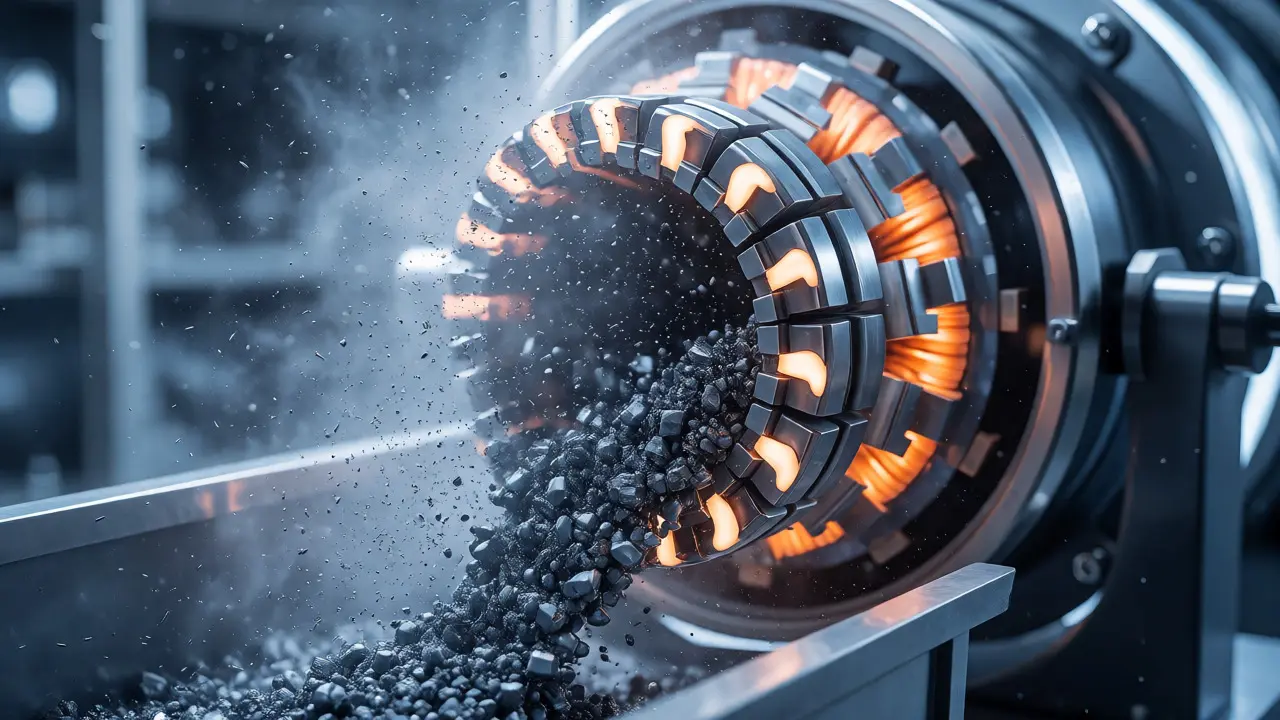
The German Aerospace Center (DLR) has built a testbed that uses a rotating cylinder lined with arc-shaped neodymium-iron-boron magnets. It spins at 794 RPM to strip away ferromagnetic contaminants. In tests with LMS-1 simulant, the non-magnetic stream ended up with 2.23-2.85 weight percent ilmenite, while the magnetic stream had less than 0.8%. This proves you can effectively clean the feedstock before it hits the expensive chemical reactors.
Density and Gravity: The Low-G Challenge
On Earth, we shake tables or use water columns to sort materials by density. Ilmenite is dense (specific gravity ~4.7), while typical lunar dust is light (~1.5 g/cm³ bulk density). This difference should make sorting easy. But here’s the catch: the Moon’s gravity is only 1.62 m/s². That’s about 1/6th of Earth’s.
Low gravity makes traditional settling slow. Particles don’t sink quickly; they float and drift. Water-based methods are also off the table because water is too precious to waste as a slurry medium. Instead, engineers are looking at dry vibratory screening (mechanical sieving without fluid assistance) and centrifugal force. By spinning material in a drum or vibrating a screen at high frequency, you can mimic higher gravity effects locally.
A 2025 study highlighted that vibration-induced segregation works well in vacuum conditions. Piezoelectric conveyors can bounce particles, causing larger grains to rise and smaller fines to settle-a phenomenon known as the "Brazil nut effect." However, screens clog easily under low gravity because dust doesn’t fall away cleanly. Engineers now design self-cleaning mechanisms, like air pulses or mechanical taps, to keep mesh sizes open. Apollo data shows that the richest ilmenite grains are tiny (45-75 micrometers), so precise size classification is critical before any density sorting can begin.
The Hybrid Approach: Size, Magnetism, and Static
No single method wins. The best results come from combining techniques. The DLR TRL-4 testbed demonstrates this perfectly. It’s a three-stage machine: first, it vibrates the soil to remove oversized rocks (>200 micrometers); second, it runs the dust past a magnetic drum to pull out iron-rich agglutinates; third, it uses electrostatic separation to sort remaining particles by chargeability.
Electrostatics might seem odd, but lunar dust charges easily due to solar wind and UV radiation. In a vacuum, triboelectric charging (charging by friction) becomes very predictable. By applying a voltage field, you can deflect conductive minerals differently from insulating ones. In DLR tests, running the system at 14 kV yielded an ilmenite grade of 11.95%, nearly triple the original concentration. The trade-off? Recovery rates dropped to about 32%. You get cleaner product, but you lose some volume. For oxygen plants, purity often matters more than total mass, making this compromise acceptable.
Real-World Limitations and Risks
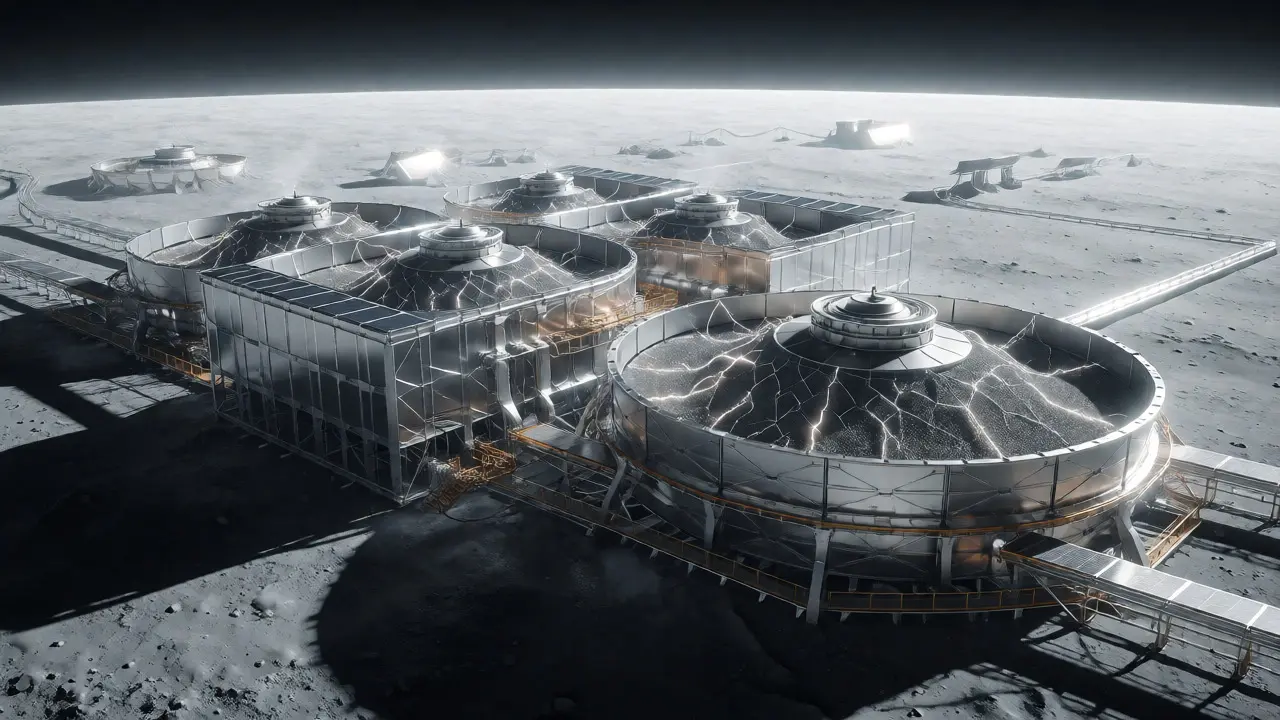
We aren’t mining asteroids yet. Most evidence comes from ground labs using simulants-synthetic soils made to mimic lunar properties. These simulants aren’t perfect. They lack the exact angularity and electrostatic history of real Moon dust. Real regolith is abrasive, sharp, and sticky. It wears down gears and jams motors.
Power is another hurdle. While permanent magnets need no electricity, moving parts do. Drums, vibrators, and fans consume watts that must be generated by solar panels or nuclear reactors. Mass is also critical. Launching heavy iron cores into space costs thousands of dollars per kilogram. Future designs will likely use lightweight superconducting magnets or optimized geometry to reduce weight.
Furthermore, throughput remains low. Current prototypes process grams, not tons. Scaling up to industrial levels-processing several tons per day-requires robust, maintenance-free machinery. Dust infiltration is a constant threat in vacuum environments, where lubricants behave differently and seals fail faster. Until we see continuous operation in reduced-gravity flight tests (like NASA’s LuSTR project parabolic flights), we must treat these results as promising lab science, not ready-for-deployment tech.
What Comes Next?
The trajectory is clear: move toward gravity-independent systems. Centrifugal separators, which use rotation instead of planetary gravity, are gaining traction. NASA’s TechPort initiatives are exploring centrifugal sieves that work equally well in 1/6-g, 3/8-g (Mars), or microgravity (asteroids). This versatility makes them ideal for multi-planetary operations.
Next steps involve validating these flowsheets with actual returned lunar samples, not just simulants. We need to know how real agglutinates behave after decades of solar exposure. We also need better sensors to monitor grade in real-time, allowing automated adjustments to feed rates and voltages. Asteroid mining adds another layer of complexity, as asteroid materials vary widely in composition compared to the relatively consistent lunar surface. But if we master lunar beneficiation, the skills transfer directly to near-Earth objects.
Ultimately, beneficiation is the bridge between digging holes and building cities. Without efficient separation, space resource utilization remains a costly experiment. With it, we turn gray dust into breathable air, structural metals, and rocket fuel. The physics is sound; the engineering challenge is now about durability, scale, and autonomy.
Why can't we use water for separation on the Moon?
Water is extremely scarce on the lunar surface and expensive to transport from Earth. Using it as a medium for wet flotation or gravity separation would consume resources needed for life support and chemical reactions. Dry methods like magnetic and electrostatic separation avoid this dependency entirely.
How does low gravity affect density separation?
Low gravity reduces the settling velocity of particles, making traditional shaking tables and hydrocyclones inefficient. Particles take longer to stratify, and fines remain suspended longer. Engineers compensate by using vibratory motion, centrifugal force, or air-assisted conveyance to enhance particle movement.
Is magnetic separation effective for all lunar minerals?
No. It is highly effective for removing ferromagnetic contaminants like metallic iron and agglutinates. However, many valuable minerals like ilmenite are only weakly paramagnetic, requiring stronger fields or hybrid approaches (like adding electrostatics) to achieve high-purity concentrates.
What are lunar simulants?
Lunar simulants are synthetic soils engineered to match the physical and chemical properties of actual lunar regolith. Examples include JSC-1, LMS-1, and TUBS-M. They allow researchers to test equipment on Earth without the cost of returning samples, though they may not perfectly replicate natural variability.
Can these methods work on asteroids?
Yes, but with modifications. Asteroids have even lower gravity than the Moon, sometimes approaching microgravity. Centrifugal and electrostatic methods are preferred there because they rely less on gravitational settling. Composition also varies, so sensor calibration must adapt to different mineral mixes.
13 Responses
Finally someone admits that the US is leading this charge while everyone else plays catch up. The DLR stuff is cool but we built the Apollo program and we're building the Artemis infrastructure now. It's about damn time people stop pretending other countries are equal partners in space tech when they're just tagging along for the ride. We have the nuclear reactors and the launch capability, end of story.
They don't want you to know this but the 'simulants' are fake. Real moon dust has a specific electrostatic signature that changes based on solar cycle activity which isn't accounted for in these lab tests. I bet NASA is hiding data from the 1970s because they found something in the agglutinates that messes with magnetic fields. They keep talking about oxygen but what are they really mining? The energy costs mentioned are suspiciously low for vacuum operations. Wake up sheeple.
The analysis here is superficial at best. You mention Missouri S&T achieving 72% separation but fail to contextualize that against industrial benchmarks which require >90% purity for economic viability. Furthermore, ignoring the abrasive nature of real regolith makes the durability claims laughable. This reads like a press release summary rather than a technical breakdown. The omission of cost-per-kilogram metrics for launching the separators themselves is a glaring oversight that undermines the entire feasibility argument.
Great overview! It helps to remember that beneficiation is just one step in the ISRU chain. While the physics of magnetic separation is sound, the integration with downstream chemical processing (like hydrogen reduction) is where the real complexity lies. We need to ensure the feedstock consistency matches the reactor tolerances exactly. Keep up the good work explaining the dry methods; it's crucial for public understanding of why water isn't an option.
It’s all so dramatic, isn’t it? We look at the stars and see hope, but down here we’re just fighting over rocks. The idea that we can turn gray dust into breathable air feels like alchemy. But then again, isn’t all science just magic that works? I wonder if the soul of the machine matters more than the efficiency rate. Maybe we should be asking not how much oxygen we can get, but how much meaning we extract from the struggle itself.
this is fascinating i think we often forget that gravity is just a force we can manipulate or ignore if we use enough kinetic energy. the centrifugal approach seems most promising long term because it scales better to microgravity environments like asteroids. also curious about the sensor tech needed for real-time grade monitoring in such a dusty environment. would love to see more on the feedback loops between separation and extraction
Weak article. Lacks depth on power consumption vs output ratio.
Brother, listen carefully. Why do you think they are testing simulants? Because the real sample is classified. The Chinese Chang'e missions brought back samples too, did we hear about their separation results? No. Silence. There is a race happening right now and the data flow is controlled by whoever holds the launch pads. Don't believe everything you read in these open-source journals. The military applications of lunar iron extraction are obvious to those who pay attention.
One must consider the geopolitical implications of resource independence. If the United States achieves high-efficiency beneficiation, it effectively monopolizes the supply chain for off-world fuel. This is not merely engineering; it is strategic dominance. The reliance on simulants introduces a variable of uncertainty that could delay deployment by decades, thereby preserving the current status quo. We should remain skeptical of optimistic timelines until verified by independent third-party audits.
What a beautifully articulated piece! The distinction between paramagnetic ilmenite and diamagnetic anorthite is explained with such clarity. It truly highlights the ingenuity required to adapt terrestrial mining principles to the harsh vacuum of space. One might ponder the ethical responsibilities of extracting resources from a celestial body that belongs to no single nation, yet the technical prowess displayed here is undeniably impressive.
Wait, hold on!!! You are saying we are going to mine the Moon with magnets?!?! That sounds like a bad sci-fi movie plot!! What happens when the magnet fails??? Do we just leave the junk there?? And who pays for the electricity??? The American taxpayer does, that's who!!! We need to protect our interests out there, not give away the farm to international collaborators who don't pull their weight!!! This is exciting but terrifying!!!
I feel like you guys are missing the bigger picture here. Everyone is obsessed with the mechanics, but nobody talks about the human element. How will astronauts cope with the isolation of running these machines? Are we sure this technology won't cause social friction among the crew? I'm just worried about the mental health aspects of lunar mining operations. We need to prioritize emotional well-being over raw tonnage!
Its morally wrong to strip mine another world before fixing ours. Also typos in title?