
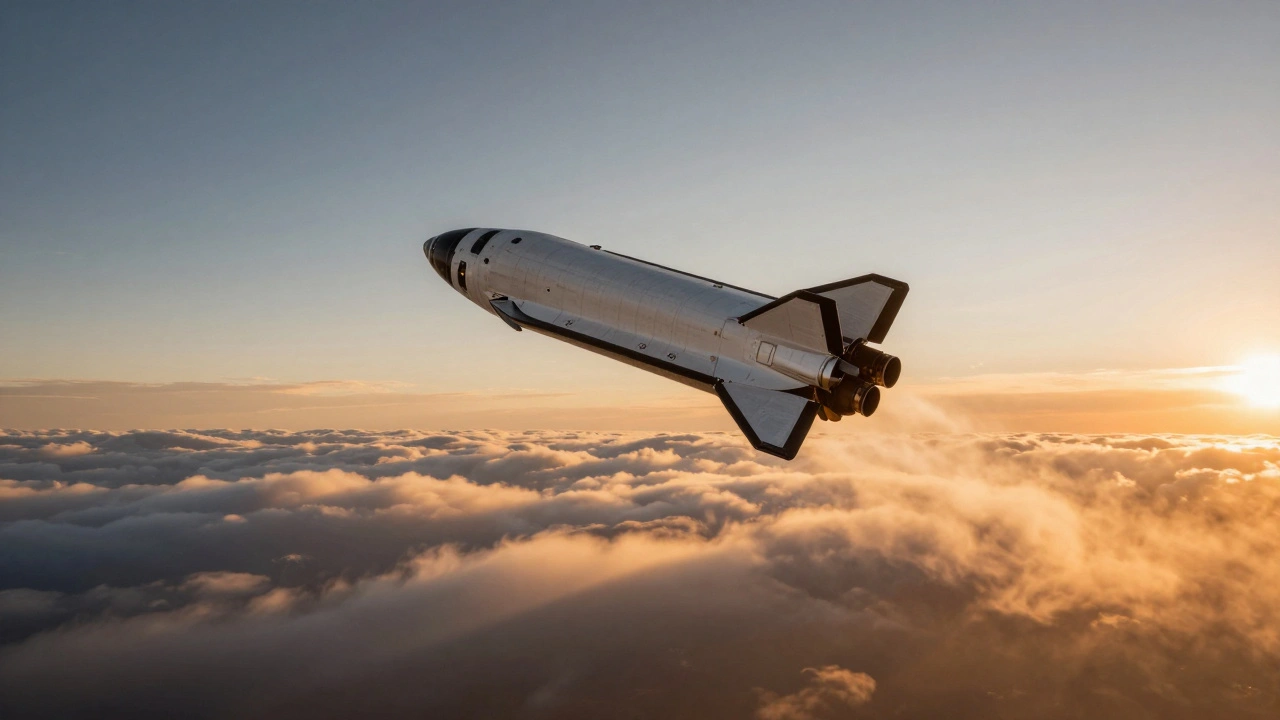
When a rocket lands, you expect it to come down straight, engines blazing, like a jet touching down on a runway. That’s how Falcon 9 does it. But Starship? It doesn’t land. It belly flops.
Picture this: a 50-meter-tall spacecraft, falling through the sky at 27,000 km/h, suddenly flips sideways. It’s not spinning out of control. It’s doing it on purpose. For nearly a minute, it glides horizontally, like a skydiver spreading their arms wide to slow down. Then, at exactly 550 meters above the ground, it flips upright again, ignites its engines, and lands softly. This isn’t science fiction. It’s how Starship comes home.
Why Belly Flop? The Physics Behind the Flip
Why not just keep pointing down and burn fuel the whole way? Because that would require way too much propellant. Landing from orbital speed - 17,000 mph - using only engines would need nearly twice the fuel SpaceX can carry. The belly flop changes everything.
By presenting its broad, flat side to the atmosphere, Starship turns itself into a giant air brake. Its 9-meter-wide body creates massive drag, slowing it down without using a single drop of fuel. Think of it like holding your hand out the window of a moving car. The bigger the surface, the more resistance. At its peak, this maneuver cuts Starship’s speed from 7,500 m/s to just 65-70 m/s - roughly 230 km/h - before the engines even fire.
That’s a 40% reduction in the delta-v needed for landing. In real terms, that means Starship saves 1,200 to 1,500 kilograms of methane per mission. At current prices, that’s $1,800 to $2,250 saved every time it lands. Multiply that by dozens of flights a year, and you’re talking millions in savings - and more room for cargo, fuel, or people.
The Flip: A 5-Second Dance with Disaster
Slowing down is only half the battle. The real challenge? Turning upright without crashing.
At 550 meters, Starship triggers a sequence that lasts less than five seconds. Four aerodynamic flaps - two in front, two in back - shift position. Two or three Raptor engines ignite simultaneously, gimbaling hard to one side to create torque. The rear flaps retract, the front ones angle sharply. The whole vehicle rotates 90 degrees in a controlled, rapid spin.
It’s not a gentle roll. It’s a violent, precise maneuver. If the engines fire half a second too early, Starship starts rising again. Too late, and it’s a crater. The margin for error? About 50 meters in altitude and 0.5 seconds in timing. One failed engine, one stuck flap, one misread sensor - and the vehicle explodes.
Early prototypes didn’t make it. SN8, SN9, SN10, SN11 - all crashed during the flip. SN8’s landing burn was too weak. SN9’s engines didn’t light properly. SN10 landed but tipped over. SN11? A methane leak mid-flip turned it into a fireball. Then, on May 5, 2021, SN15 flipped, landed, and stood still. No explosion. No fire. Just silence on the feed, then cheers from the SpaceX control room.
Not Like the Space Shuttle - Even Though It Looks Similar
People often compare Starship’s belly flop to the Space Shuttle’s reentry. They’re wrong.
The Shuttle used its wings to generate lift. It glided, turned, and flew like a plane - all to cover long distances sideways during reentry. Starship doesn’t care about cross-range. It doesn’t glide. It falls. Hard. It’s not trying to fly. It’s trying to brake.
As former Shuttle program manager Wayne Hale put it: "The Shuttle was a glider. Starship is a brick with flaps."
That’s the key difference. The Shuttle needed lift to survive. Starship needs drag. And drag is simpler. No wings. No complex control surfaces beyond flaps. No thermal tiles over the whole body - just reinforced heat shielding on the belly and edges.

How SpaceX Got It Right - Through Failure
There’s no manual for this. No textbook. No previous example. SpaceX built this from scratch - and broke dozens of prototypes to learn how.
From December 2020 to May 2021, they flew six Starship prototypes. Four exploded. One landed hard. Only SN15 succeeded. Each failure fed data into the next. Sensors recorded every vibration, every temperature spike, every engine delay. Engineers adjusted flap timing. They changed how the engines ignited. They tweaked the software that decides exactly when to flip.
By November 2023, during Starship’s second integrated flight test, the flip worked perfectly - at 548 meters, just 2 meters off target. The vehicle completed the rotation, fired its engines, and held steady. It didn’t land because it lost comms during ascent, but the belly flop? Flawless.
Today, the success rate for the maneuver is around 60%. That’s not good enough for astronauts - but it’s good enough to keep improving. SpaceX’s next move? Adaptive flip altitude. Starship Ship 28 and later versions will adjust the flip height between 450 and 600 meters based on real-time weather, mass, and speed. No more fixed numbers. No more guesswork.
What This Means for the Future of Space Travel
Starship’s belly flop isn’t just a cool trick. It’s the foundation of a new space economy.
Blue Origin’s New Glenn and Rocket Lab’s Neutron? They land vertically, like Falcon 9. They’re great for suborbital hops. But they can’t come back from orbit without carrying massive amounts of fuel. Starship can. That’s why it’s the only rocket designed to go to Mars.
Every kilogram saved on landing fuel is a kilogram that can carry life support, science gear, or construction materials to the Moon. For Artemis IV - NASA’s planned crewed lunar landing in 2028 - Starship will be the lander. And that means the belly flop will carry humans home from the Moon.
And it’s already changing how others design rockets. According to Euroconsult’s 2023 report, 62% of new reusable launch systems now include some form of aerodynamic deceleration. But only SpaceX is doing the full flip.

Is It Safe for Passengers?
Some wonder: what’s it like to ride through a belly flop?
During the horizontal phase, you’d feel about half a G of drag - like a strong wind pushing you back in your seat. Then, during the flip, you’d get slammed sideways with 2 to 3 Gs as the vehicle rotates. It’s not pleasant, but it’s brief. And it’s nothing compared to the 4-5 Gs astronauts feel during launch.
Aerospace consultant Dr. Laura Combs summed it up best: "We’re past the point of ‘Can this work?’ They’re just fine-tuning things, getting the details sorted out."
For now, the belly flop is still risky. But it’s also the most efficient way to bring a massive spacecraft back from space. And as SpaceX keeps refining it, that risk keeps shrinking.
What’s Next?
Starship’s next test flight will likely include a full landing on the Gulf of Mexico. After that? Orbital refueling. Moon landings. Mars missions.
The belly flop isn’t just a landing technique. It’s a statement: that we don’t have to copy old ways to reach new places. Sometimes, the best path is the one no one else dared to try.
Why does Starship flip sideways instead of landing vertically like Falcon 9?
Starship is designed to return from orbit, where it’s traveling at nearly 27,000 km/h. Landing vertically from that speed would require far too much fuel. The belly flop lets it use atmospheric drag to slow down naturally, cutting the fuel needed for landing by about 40%. Falcon 9 only returns from suborbital speeds - around 8,000 km/h - so it can land with engines alone.
What happens if the belly flop flip fails?
If the flip fails - whether due to engine ignition delay, flap malfunction, or control system error - Starship can’t slow down enough before hitting the ground. Early prototypes like SN8, SN9, and SN11 exploded during this phase because they either didn’t flip in time or couldn’t generate enough thrust to stabilize. SpaceX learned from each failure, refining timing, engine sequencing, and software to improve reliability.
How precise does the flip timing need to be?
The flip must start between 500 and 550 meters above ground - a 50-meter window. The rotation must complete in under 5 seconds. If it starts too early, Starship stops descending and starts climbing. Too late, and there’s not enough altitude to complete the burn before impact. During Flight Test 2 in November 2023, Starship flipped at 548 meters - just 2 meters off target.
Is the belly flop maneuver used by any other rocket?
No. While other rockets like New Glenn and Neutron use vertical landing like Falcon 9, none have attempted the full horizontal flip. Starship is the only spacecraft designed to reenter from orbital velocity using this technique. Some new designs now include aerodynamic drag features, but none replicate the full belly flop sequence.
Will the belly flop be used for Mars landings?
Yes. Mars has a thin atmosphere, but it’s enough for drag-based deceleration. Starship will use the same belly flop technique to slow down before landing on Mars - just with adjusted flap angles and engine timing for lower gravity and thinner air. It’s the only proven method that scales from Earth to Mars without requiring massive fuel reserves.
How many times has the belly flop maneuver been successfully completed?
As of November 2023, the belly flop maneuver has been successfully completed in six test flights: SN15 (May 2021), and Flight Tests 1 and 2 (April and November 2023). While Flight Test 1 ended in a controlled explosion after liftoff, the flip itself was executed perfectly. Flight Test 2 completed the flip, landing burn, and ascent - though it lost communication before touchdown. The success rate is currently around 60% across all test flights.
12 Responses
man this belly flop thing is wild. i watched sn15 land and i swear my jaw hit the floor. no engines, just air and guts. SpaceX is playing 4d chess while everyone else is still learning checkers.
theyre not telling you the whole truth. this isnt about fuel savings. its about testing reentry tech for military applications. you think nasa gave them this freedom? think again. the government owns this tech now. they just let elon take the credit.
sooo the rocket just flips like a pancake?? i love it. its like watching a cat land on its feet but its a 50 meter metal beast. also who else thinks the flaps look like giant metal eyelashes??
Correction: It's 'belly-flop,' not 'belly flop.' And 'Raptor engines' are capitalized. Also, '550 meters' is metric, so you should specify 'approximately 1,804 feet' for American readers. This matters.
american engineering at its finest. no other country could pull this off. china’s rockets still crash like drunk toddlers. europe? they’re still debating whether to use screws or bolts. we built a space brick that flips itself. pride.
what fascinates me isn’t just the tech-it’s the mindset. most organizations would’ve given up after SN8 exploded. SpaceX didn’t just keep going-they treated each failure like a lesson written in fire. that’s not engineering. that’s devotion.
think about it… this isn’t a landing. it’s a ritual. the rocket submits to the sky, lets the atmosphere strip away its speed, then-after the silence-commands itself back into being. it’s not physics. it’s alchemy. we’re witnessing a machine become alive.
Let’s be real: this maneuver is incredibly dangerous. People are acting like it’s a magic trick, but one small sensor glitch, one misfired engine, and you’ve got a 50-meter bomb hitting the ground. And now we’re talking about putting humans on this thing? We’re not ready. We’re just excited.
the government implanted a chip in every raptor engine to track your emotions during landing. that’s why sn15 succeeded-because the system detected the engineers were calm. they’ve been doing this since 2016. they just never told you.
i get the fear but honestly? if you look at the data, the flip is becoming more reliable every time. sn15 was a miracle, flight test 2 was textbook. i think we’re past the ‘will it work’ phase. now it’s just ‘how good can it get?’
you people act like this is some miracle of science. it’s not. it’s just corporate greed dressed up as innovation. they’re cutting corners to make more money. someone’s going to die on this thing and then they’ll say ‘it’s just part of the process.’
so… it just flips? like… really? no wires? no help? just… air?