
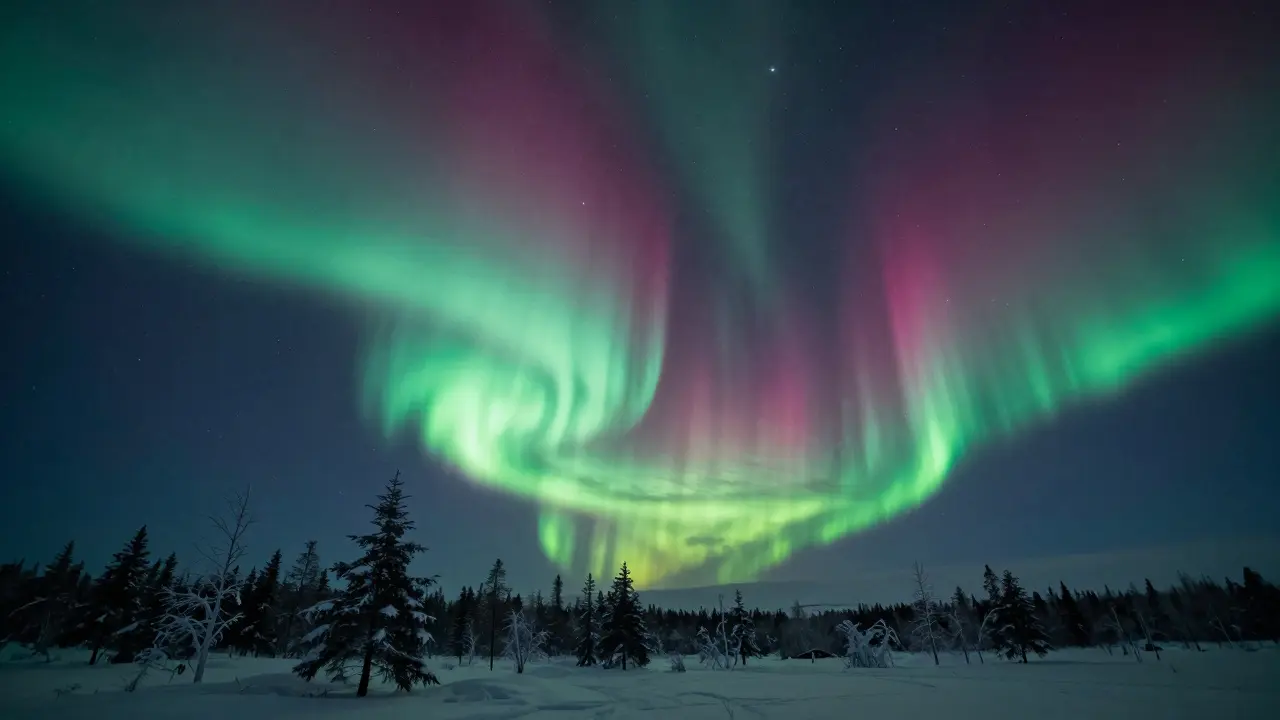
When the sky turns green, pink, or violet in the dead of night, it’s not magic-it’s space weather. The Aurora Borealis and Aurora Australis aren’t just beautiful displays; they’re the visible side of a constant battle between the Sun and Earth’s magnetic field. These lights happen every single day, but most of us never see them. Why? Because they’re usually hidden far above the Arctic and Antarctic circles. But when the Sun gets angry-when solar storms blast out charged particles at millions of miles per hour-those lights stretch farther, sometimes even reaching Adelaide, where I live. And when they do, the sky doesn’t just glow-it dances.
What Actually Causes the Northern and Southern Lights?
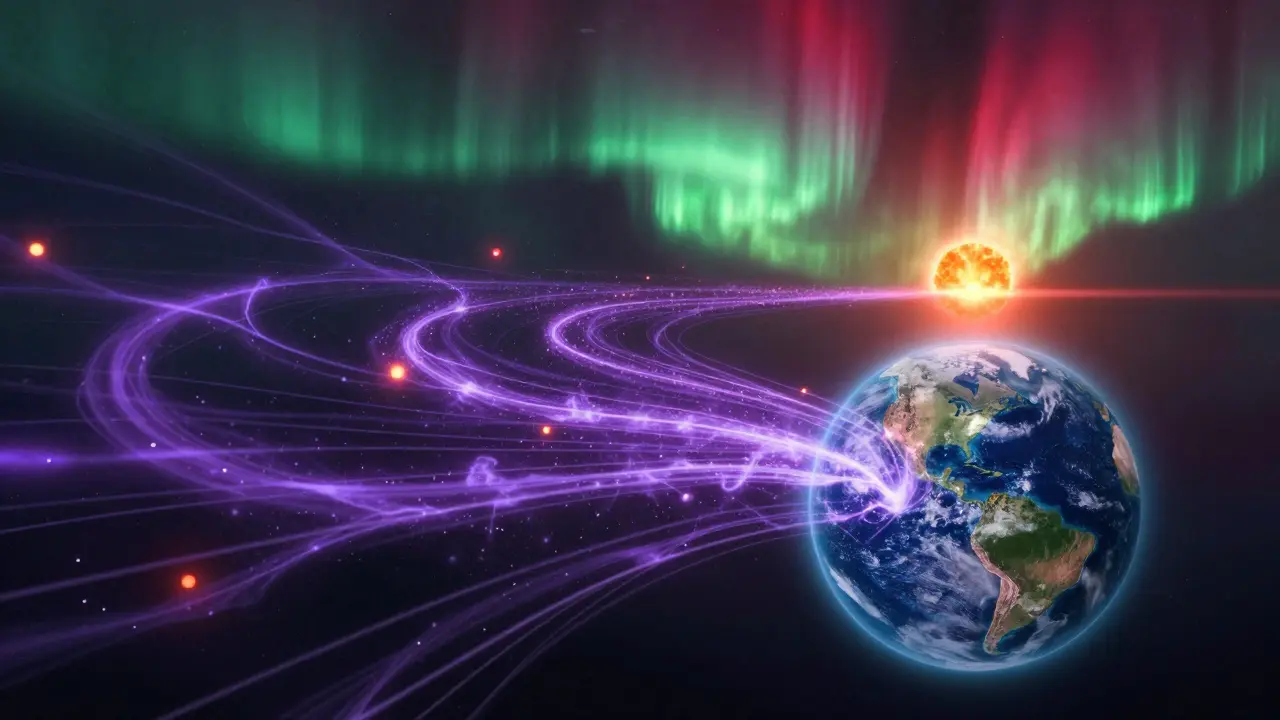
It starts with the Sun. Every day, it spits out a stream of charged particles called the solar wind. Most of the time, Earth’s magnetic field deflects it like a shield. But when the Sun throws out a big burst-like during a solar flare or coronal mass ejection-those particles rush toward Earth at speeds over 500 kilometers per second. They don’t hit the ground. They hit the top of our atmosphere, 80 miles up, and slam into oxygen and nitrogen atoms.
Think of it like this: when you heat up a gas, it glows. That’s what’s happening here. The solar particles excite the atoms in the air, and when those atoms calm down, they release light. Oxygen gives off green (most common) and red (higher up). Nitrogen gives blue, purple, and pink. The colors aren’t random-they’re physics in action. Green shows up between 100 and 240 km. Red appears above 240 km. Blue and purple? That’s nitrogen, between 100 and 200 km. And if you see a deep crimson glow near the horizon? That’s nitrogen molecules below 100 km, getting hit hard.
And the shapes? The curtains, waves, and ribbons? Those follow Earth’s magnetic field lines. The particles don’t fly straight down-they spiral along invisible magnetic threads, tracing out the patterns we see. It’s like the planet is drawing with light, using the Sun’s energy as its brush.
Aurora Borealis vs. Aurora Australis: Same Phenomenon, Different Locations
Here’s the simple truth: the Northern Lights and Southern Lights are twins. Identical physics. Same colors. Same cause. The only difference? Where you stand.
The Aurora Borealis is visible from places like Norway, Iceland, Canada, and Alaska-places with lots of land near the North Magnetic Pole. That’s why it’s more famous. More people live where it’s visible. The Aurora Australis? It happens over Antarctica and the southern oceans. There’s barely any land down there. Fewer people. Fewer photos. Fewer tours.
But there’s a twist. Earth’s magnetic field isn’t perfectly centered. It’s tilted. And that tilt means Tasmania-my home state-is one of the best places on Earth to see the Southern Lights. Not because it’s closer to the pole, but because the magnetic field bends just right here. During strong geomagnetic storms, the auroral oval expands, and Tasmania gets front-row seats. In May 2024, during the strongest storm since 2003, people in Hobart saw auroras so bright they lit up the streets. That’s rare. But it’s not impossible.
And here’s something most people don’t know: the aurora isn’t just a sky show. It’s a warning. When you see it, you’re seeing the effects of space weather that can knock out satellites, mess with GPS, and even overload power grids. The same solar storm that made the lights visible in Tasmania also caused radio blackouts across the Pacific. The aurora is nature’s alert system.
When and Where to See Them-Realistic Expectations
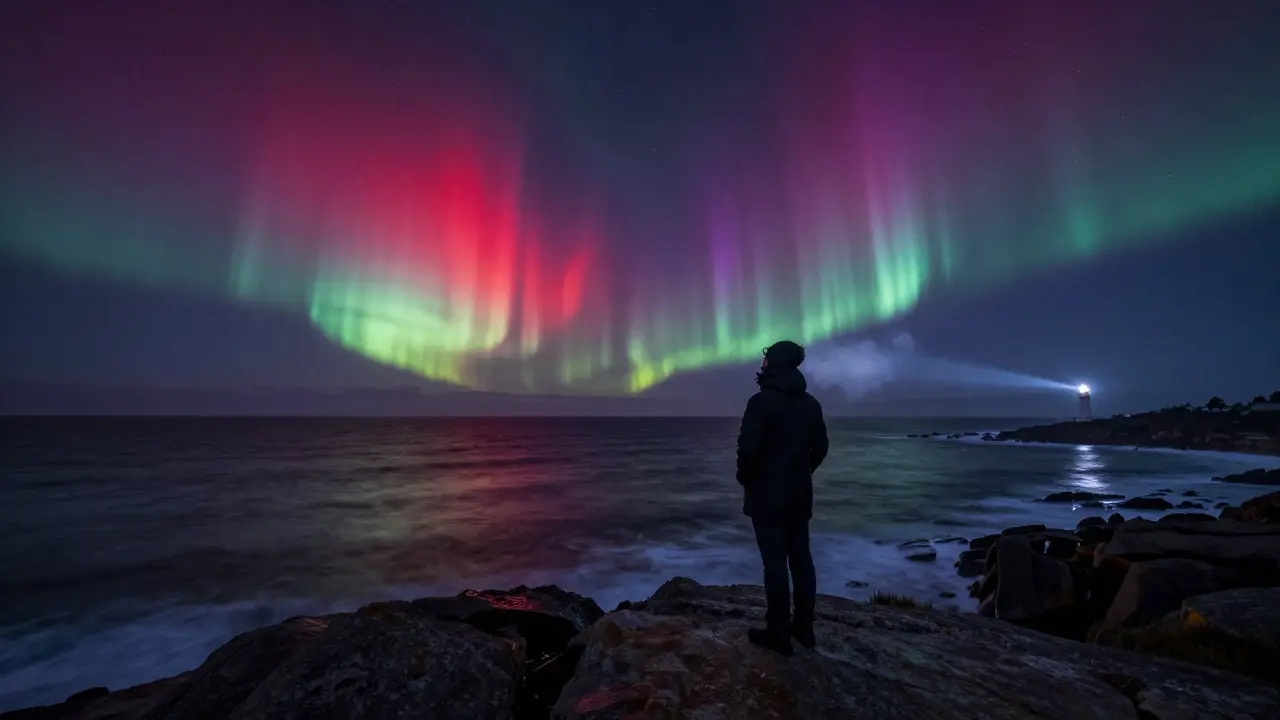
If you’re planning a trip to see the aurora, forget Instagram. Those glowing green swirls with stars in the background? They’re usually long-exposure photos. What you’ll see with your eyes is often fainter, more like a pale green glow-sometimes just a shimmer. That’s normal. Don’t expect fireworks. Expect patience.
Best time to see the Aurora Borealis? September to March. For the Aurora Australis? March to September. The equinoxes-March and September-are the most active. Why? Earth’s tilt lines up with the solar wind, making it easier for particles to punch through.
And location matters. You need darkness. No moon. No city lights. The Bortle scale measures light pollution. Aim for level 4 or lower. In Tasmania, that means heading to the Tasman Peninsula, Bruny Island, or the south coast. In Norway, it’s the Lofoten Islands or Tromsø. But even then, clouds ruin 65% of predicted aurora nights. That’s not a typo. Sixty-five percent of the time, the forecast says ‘yes,’ but the sky is covered. You need clear skies AND a KP index of 4 or higher. And you need to be outside between 10 PM and 2 AM.
Professional aurora photographer Chad Blakely says you’ll wait an average of 3.7 hours for one good display during moderate activity. Most first-timers give up after 22 minutes. That’s why so many people come home disappointed. They didn’t know what they were signing up for.
What You Need to Actually See Them
You don’t need a fancy camera. You need warmth, patience, and a plan.
- Warmth: Temperatures drop to -30°C in aurora zones. Wear thermal layers. Wool is better than synthetic. Gloves that let you use your phone? Essential.
- Light: Use a red-light headlamp. White light kills your night vision. You’ll need it to read your forecast app or adjust your tripod.
- App: Download the Aurora Forecast app by the University of Alaska Fairbanks. It uses real-time data from the ACE satellite. It’s 78% accurate. Other apps? Most are just guesses.
- Patience: Stay out. Even if you see nothing for an hour. The aurora doesn’t follow your schedule. It follows the Sun’s.
And don’t bring your kids expecting a light show. If they’re under 10, they’ll be asleep before it starts. Bring adults. Bring a thermos of hot tea. Bring a blanket. And bring your sense of wonder.
Why This Matters Beyond the Beauty
People think auroras are just pretty. But they’re a live feed from space. Every flash, every ripple, tells scientists what’s happening 150 million kilometers away. The May 2024 storm gave us the first high-res video of ‘auroral beads’-a pattern scientists had theorized for decades but never captured. That’s how we learn to predict solar storms that could knock out power grids.
And it’s not just science. It’s money. Northern Norway makes $637 million a year from aurora tourism. Iceland gets $1.2 billion. Tasmania saw 37,000 aurora visitors in 2023-up 63% from the year before. Companies like HelioLogic now sell aurora forecasts to tour operators for $1,200 a month. NASA spent $187 million on aurora research in 2024. Why? Because when a solar storm hits, it doesn’t just make pretty lights. It can disable satellites, scramble radio signals, and shut down transformers. The aurora is our early warning system.
Even climate change is changing the game. New research shows the upper atmosphere is cooling, which could shift the auroral oval southward by 1 to 2 degrees every decade. That means in 20 years, places like Melbourne or even Adelaide might see auroras more often. We’re not talking about daily displays. But maybe once a year? That’s not science fiction. It’s happening.
The Future of Seeing the Lights
By 2029, the European Space Agency will launch a satellite called Vigil, parked at the L5 Lagrange point-far enough from Earth to see solar storms coming three to four days in advance. That’s a game-changer. Right now, we get about 30 minutes’ notice. With Vigil, we’ll have days. Tour operators will know exactly when to book trips. Scientists will get better data. And you? You’ll know when to step outside.
Meanwhile, citizen science is growing. Projects like Aurorasaurus have collected over 214,000 verified sightings from people around the world since 2014. Every photo, every report, helps refine the models. You don’t need to be a scientist to help. Just go out, look up, and report what you see.
The aurora isn’t going away. In fact, with Solar Cycle 25 peaking in mid-2025, we’re entering the most active period in over a decade. Sunspot numbers are forecast to hit 115.2-higher than the last peak. More storms. More auroras. More chances to see them.
So if you’ve ever wanted to see the Northern or Southern Lights-don’t wait for a perfect moment. Wait for the right conditions. Dress warm. Be patient. And when the sky starts to glow, remember: you’re not just watching light. You’re watching the Sun reach out and touch Earth.
Are the Northern and Southern Lights the same thing?
Yes. The Aurora Borealis and Aurora Australis are identical phenomena-just mirrored across the globe. Both are caused by charged particles from the Sun hitting Earth’s atmosphere near the magnetic poles. The only difference is location: one happens in the north, the other in the south. The colors, shapes, and physics are exactly the same.
Can you see the Southern Lights from Australia?
Yes, but only in the far south. Tasmania is the best place in Australia to see the Aurora Australis. On rare occasions, during strong geomagnetic storms, it’s visible from Victoria and South Australia. Adelaide, where I live, has seen it a few times in the last decade-but only when the KP index hits 7 or higher. It’s not common, but it’s possible.
Why do auroras have different colors?
The color depends on which gas is hit and how high up it happens. Green comes from oxygen at 100-240 km. Red comes from oxygen above 240 km. Blue and purple come from ionized nitrogen between 100-200 km. Pink or crimson appears when nitrogen molecules below 100 km are excited. Oxygen doesn’t make blue-that’s a myth. Nitrogen does.
Do auroras make sounds?
Yes, some people report hearing faint crackling or popping sounds during strong auroras. Scientists think this happens when static electricity builds up in a temperature inversion layer about 80 meters above the ground. It’s rare and only happens under very specific weather conditions-cold, calm nights with clear skies. You won’t hear it every time, but it’s real.
How accurate are aurora forecasts?
The best forecasts, like the Aurora Forecast app from the University of Alaska Fairbanks, are about 78% accurate. They use real-time data from satellites that monitor solar wind. But even the best forecast can’t predict clouds. That’s why 65% of aurora alerts end with no visible display. Always check the local weather too.
Is now a good time to see auroras?
Yes. Solar Cycle 25 is peaking in mid-2025, with sunspot numbers expected to reach 115.2-the highest in over a decade. That means more solar storms, more auroras, and more chances to see them. The next two years will be the best window for aurora viewing in over 10 years.
15 Responses
Auroras are proof the government isn't hiding aliens - they're just solar particles. Duh.
They say it's solar wind but what if it's HAARP testing the atmosphere? They've been doing this for decades and nobody talks about it.
It's fascinating how humanity continues to romanticize natural phenomena while ignoring the fact that we're literally living on a planet that's constantly being bombarded by cosmic radiation. We should be terrified, not Instagramming it.
You wrote 'auroral oval' but forgot to capitalize 'Oval'. It's a proper noun when referring to the specific magnetic phenomenon. Fix your grammar.
I mean, if you're not crying during an aurora, you're not truly alive. I sat in a frozen field in Tromsø for 8 hours, wrapped in a silk scarf my grandmother knitted, and I swear I felt the universe whisper my name. You haven't lived until you've wept under the sky's electric sigh.
I think what's beautiful is how this connects us across the globe. Someone in Tasmania and someone in Alaska are both looking up at the same invisible force, just from different sides of the planet. It's a quiet reminder we're all part of the same system.
So you saying if I go to Tasmania I'll see it? I live in Ohio. Can I just drive there?
Canada sees way better auroras than the US. You guys are just too busy with your city lights to notice.
I love how this post just lays it out without hype. I saw one in Minnesota last winter and it was just this faint green smear. Took me 3 hours to realize it wasn't a cloud. Worth it though
You mention 'nitrogen makes blue' but you didn't cite the source. I checked the NASA database and the peak emission for ionized nitrogen is at 427.8 nm, not 450. You're wrong. Again.
I don't understand why people think they deserve to see the aurora. It's not a reward for showing up. It's a gift from the sun that most of us aren't worthy of.
So you're telling me I need to drive to the Tasman Peninsula, freeze my butt off, and pray to the aurora gods... just to see a blurry green smear? And I thought my Netflix subscription was a commitment.
The aurora isn't just light. It's the soul of the Earth screaming back at the Sun. Every ripple is a memory of every human who's ever looked up and wondered if they mattered. I wept when I saw it. Not because it was beautiful. But because I realized I'm just a speck in a cosmic conversation I didn't even know was happening.
Your post contains several factual inaccuracies regarding the altitude ranges of nitrogen emissions. According to the 2023 Geophysical Research Letters paper by K. L. S. Peterson et al., the primary blue emission band from N₂⁺ occurs at 95–110 km, not 100–200 km. Additionally, the KP index threshold for visibility in Adelaide is consistently reported as 7+ in peer-reviewed geomagnetic studies, not merely '7 or higher' as a vague descriptor. Your lack of citation undermines the credibility of your entire argument.
People act like auroras are some divine miracle. They're just solar particles hitting our atmosphere. We're not special. The universe doesn't care if you see it. Stop acting like you earned it.