
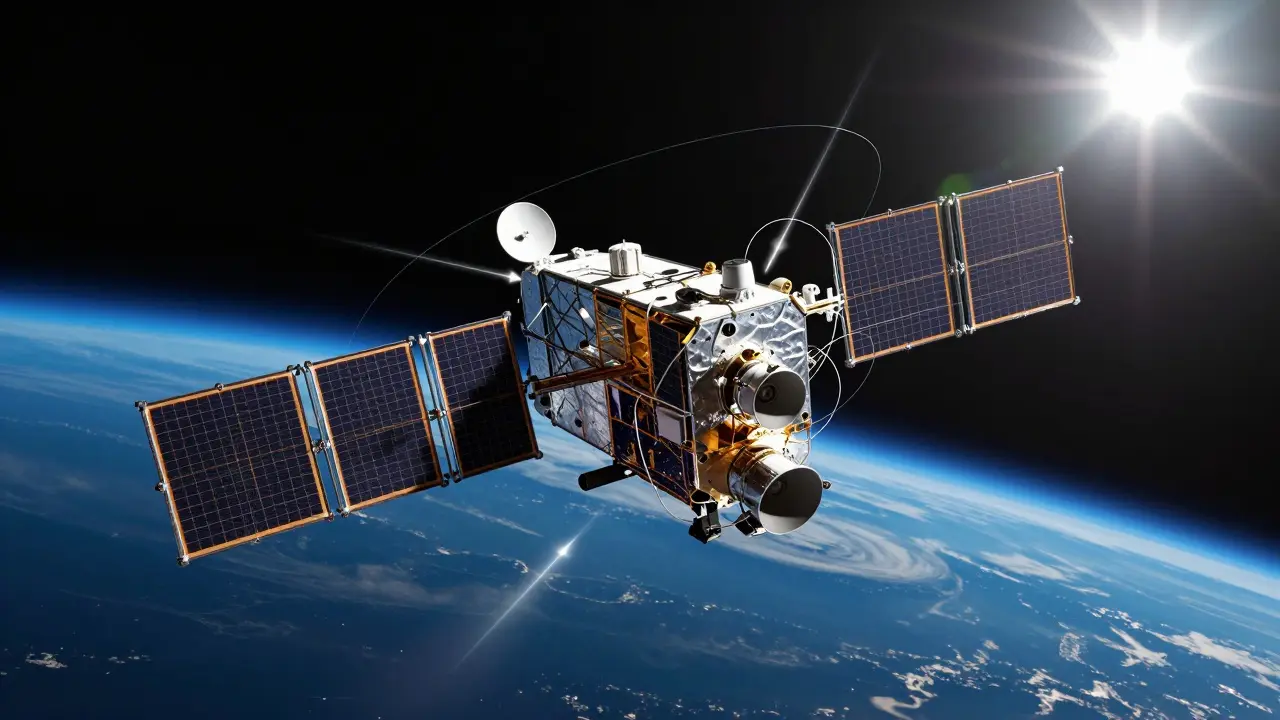
Imagine you are holding a camera in the middle of a hurricane. Your goal is to keep the lens perfectly steady on a single bird flying nearby. If your hands shake even slightly, the image blurs. Now, shrink that camera down to the size of a shoebox, send it into space where there is no air to slow it down, and expect it to stay pointed at Earth for years without human help. That is exactly what an Attitude Control System, or ADCS (Attitude Determination and Control System), does every second.
Satellites do not just float around aimlessly. They need to point their solar panels at the Sun to charge batteries, aim antennas at Earth to send data, and orient cameras precisely to capture images. Without an ADCS, a satellite would tumble uncontrollably due to tiny forces like gravity gradients, magnetic fields, and solar radiation pressure. In this article, we break down how these complex systems work, the hardware involved, and why keeping a satellite stable is one of the hardest engineering challenges in space.
The Core Problem: Why Satellites Tumble
In space, things don't just stop moving because there is nothing to push against. Newton’s laws still apply. A satellite launched into orbit often has residual spin from the rocket fairing separation. Once in orbit, several invisible forces constantly try to rotate it:
- Gravity Gradient: The side of the satellite closer to Earth feels a slightly stronger pull than the side further away, creating a torque that tries to align the satellite vertically.
- Solar Radiation Pressure: Photons from the Sun hit the satellite’s surface, pushing it like wind pushes a sail.
- Aerodynamic Drag: Even in low-Earth orbit (LEO), there are trace amounts of atmosphere that create friction and uneven forces.
- Magnetic Torque: Earth’s magnetic field interacts with any magnetic materials inside the satellite.
If left unchecked, these forces cause the satellite to tumble. This is bad news. A tumbling satellite cannot generate power efficiently, cannot communicate reliably, and cannot take useful pictures. The ADCS exists to fight these disturbances continuously.
How ADCS Works: The Sense-Think-Act Loop
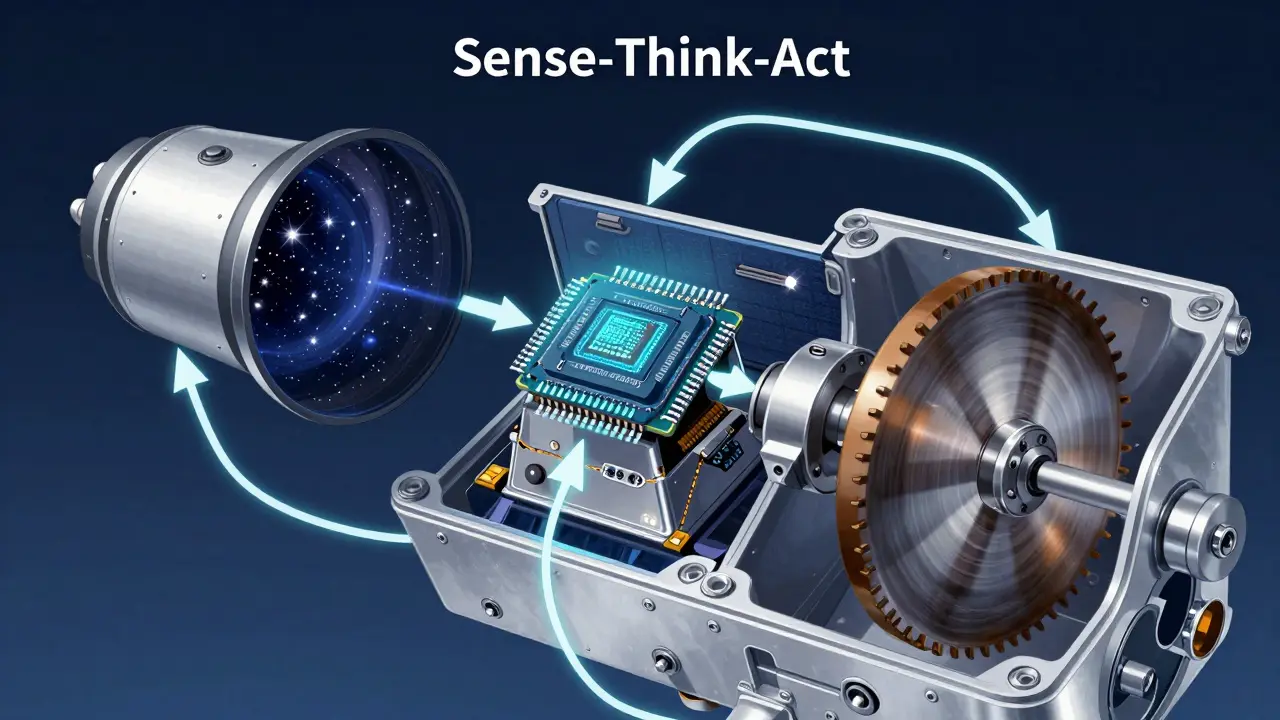
An attitude control system operates on a simple but rigorous feedback loop known as "sense-think-act." This cycle repeats hundreds of times per minute throughout the satellite's life.
- Sense: Sensors measure the satellite’s current orientation (attitude) and its rate of rotation.
- Think: Onboard computers process this data, compare it to the desired orientation, and calculate the necessary correction using control algorithms.
- Act: Actuators apply physical torque to rotate the satellite back into position.
This isn't a one-time fix. It is a continuous battle against physics. For example, if a star tracker sees the satellite has drifted 0.1 degrees off-target, the computer commands a reaction wheel to spin up faster, which slows the satellite's body rotation by conservation of angular momentum.
Sensors: The Eyes of the Satellite
To know where it is pointing, a satellite needs precise references. Engineers use a hierarchy of sensors, ranging from coarse to fine accuracy.
| Sensor Type | Function | Accuracy Level |
|---|---|---|
| Sun Sensor | Detects the direction of the Sun | Coarse (degrees) |
| Earth Horizon Sensor | Detects the edge of Earth’s atmosphere | Medium (tenths of a degree) |
| Magnetometer | Measures local magnetic field vector | Coarse/Medium |
| Gyroscope (IMU) | Measures rate of rotation | High precision for rates |
| Star Tracker | Identifies star patterns to determine absolute orientation | Very High (arcseconds) |
Sun sensors are cheap and reliable. They tell the satellite roughly where the Sun is, which helps keep solar panels aligned. Magnetometers act like digital compasses, helping the satellite understand its orientation relative to Earth’s magnetic field. However, neither is precise enough for high-resolution imaging.
For that, engineers rely on star trackers. These are essentially small telescopes with cameras. They take a picture of the sky, match the stars to an onboard catalog, and calculate the satellite’s exact orientation in three-dimensional space. Star trackers can achieve accuracies better than 0.01 degrees, making them essential for Earth observation and scientific missions.
Gyroscopes, often part of an Inertial Measurement Unit (IMU), measure how fast the satellite is spinning. They provide continuous data between star tracker updates, ensuring smooth control even when the stars are obscured by the Earth or Sun.
Actuators: The Muscles of the Satellite
Once the computer knows the error, it needs to correct it. This requires generating torque. There are four main types of actuators used in modern satellites.
Reaction Wheels
Reaction wheels are electric motors attached to heavy flywheels inside the satellite. When the motor spins the wheel faster, the satellite body rotates in the opposite direction due to conservation of angular momentum. They are silent, fuel-free, and extremely precise, making them ideal for fine-pointing tasks like telescope stabilization.
However, reaction wheels have a limit. As they absorb angular momentum from external disturbances (like drag), they eventually reach maximum speed. At this point, they are "saturated" and can no longer provide torque. To fix this, satellites must "desaturate" the wheels, usually by firing thrusters or using magnetorquers to dump the excess momentum.
Control Moment Gyroscopes (CMGs)
Control Moment Gyroscopes are similar to reaction wheels but more powerful. Instead of changing the spin speed of the wheel, CMGs change the angle of the spinning axis. This generates much larger torques, allowing large satellites like the International Space Station to reorient quickly without using propellant.
Magnetorquers
Magnetorquers are electromagnetic coils that create a magnetic dipole. When this dipole interacts with Earth’s magnetic field, it produces torque. They are popular in small satellites (CubeSats) because they require no fuel and are mechanically simple. However, they are only effective in Low Earth Orbit (LEO) where the magnetic field is strong, and they cannot provide rapid or precise adjustments.
Thrusters
Cold gas thrusters or chemical rockets fire short bursts of gas to create direct torque. They are used for large maneuvers, initial detumbling after launch, or desaturating reaction wheels. The downside is fuel consumption. Once the propellant is gone, the thrusters are useless, limiting the satellite's operational lifespan.
Control Modes: From Detumbling to Precision Pointing
A satellite doesn’t operate in just one mode. Its ADCS switches strategies depending on the mission phase.
- Detumbling: Immediately after deployment, a satellite may be spinning wildly. The first job of the ADCS is to kill this rotation. Magnetorquers or thrusters are often used here because they can handle large angular rates.
- Stabilization: Once calm, the satellite enters a stabilized mode, typically three-axis stabilization, where it maintains a fixed orientation relative to Earth or inertial space.
- Pointing: For specific tasks, such as taking a photo of a city, the satellite slews to a new target and holds it steady with sub-degree accuracy using reaction wheels and star trackers.
- Tracking: Some satellites need to follow a moving target, like another satellite or a weather system. This requires continuous adjustment of the attitude.
Challenges in Modern Satellite Design
As satellites become smaller and more numerous, ADCS design faces new pressures. CubeSats, which fit in a 10x10x10 cm box, have severe mass and power constraints. Engineers cannot simply scale down large satellite systems; they must innovate.
One major challenge is sensor noise. Small sensors are less accurate, so control algorithms must be smarter to filter out errors. Another issue is single-point failures. If a star tracker fails, the satellite might lose its primary reference. Modern ADCS designs include redundancy, using multiple sensor types to cross-check data.
Additionally, the rise of mega-constellations means satellites must avoid collisions. This requires precise knowledge of both attitude and orbit, linking the ADCS closely with the Orbit Determination and Control System (ODCS). Errors in attitude can lead to errors in orbital calculations, increasing collision risk.
Future Trends in Attitude Control
Looking ahead, we see a shift toward software-defined control. Instead of relying solely on hardware improvements, engineers are developing advanced algorithms that can fuse data from imperfect sensors to maintain stability. Machine learning techniques are being explored to predict disturbance torques and optimize actuator usage, extending battery life and reducing wear on mechanical parts.
We also see increased autonomy. Future satellites will be able to diagnose ADCS faults and switch to backup modes without ground intervention. This is critical for deep-space missions where communication delays make real-time control impossible.
What happens if a satellite loses its attitude control?
If a satellite loses attitude control, it begins to tumble. This disrupts communication links, prevents solar panels from charging effectively, and renders optical payloads useless. In severe cases, uncontrolled tumbling can lead to structural stress or premature deorbiting due to increased atmospheric drag.
Why do satellites use reaction wheels instead of just thrusters?
Reaction wheels provide precise, continuous torque without consuming fuel. Thrusters use propellant, which is limited and expensive to launch. Reaction wheels allow satellites to maintain fine pointing for years, while thrusters are reserved for occasional large maneuvers or wheel desaturation.
How accurate are star trackers compared to other sensors?
Star trackers are the most accurate attitude sensors, capable of determining orientation within arcseconds (fractions of a degree). Sun sensors and magnetometers are coarser, providing accuracy in degrees or tenths of a degree, which is sufficient for basic stabilization but not for high-resolution imaging.
Can a satellite survive if its gyroscope fails?
It depends on the redundancy built into the system. Many satellites carry multiple gyroscopes. If one fails, others can take over. If all fail, the satellite might rely on star trackers and sun sensors, though control performance may degrade, especially during rapid maneuvers or when stars are not visible.
What is the difference between active and passive attitude control?
Active control uses sensors, computers, and actuators (like wheels and thrusters) to dynamically adjust orientation. Passive control relies on physical properties, such as gravity-gradient booms or magnetic rods, to naturally stabilize the satellite without moving parts or power. Most modern satellites use active control for precision.