
Is Space Mining Actually Profitable?
Asteroid mining sounds like science fiction, but the math behind it is getting serious. We are standing in April 2026, and while we haven't yet returned mountains of platinum to Earth, the economic models are finally catching up to the technology. The core question isn't just whether we can reach a rock floating around the sun anymore. It is whether the return on investment makes sense for shareholders. If you look at older plans from the 1980s, they demanded an Internal Rate of Return exceeding 30% per year just to offset the massive risks involved. That benchmark set by experts like Meinel & Parks is still the gold standard today. We need to understand the money before we fire the engines.
The Money Metrics: NPV and IRR Explained
To evaluate any mining project, you need two main numbers. First, there is Net Present Value. This tells us the total profit of a mission adjusted for the fact that money available today is worth more than money received years later. Think of it as the "real" value of the cargo once it hits the bank account, minus all the upfront costs. The formula is simple in theory: sum up all future revenues, discount them by the risk rate, and subtract your initial spend. A positive number means you're making money; a negative one means you're burning cash.
The second metric is the Internal Rate of Return (IRR). This is the annual growth rate the project generates. If you get 33% IRR on an asteroid mission, that beats almost any hedge fund on Wall Street, but you have to wait five or seven years for the payout. This delay is why time is the enemy of profitability. Dr. Martin Elvis noted in 2020 that many models fail because they assume static markets. If you mine for ten years and prices drop during that time, your IRR plummets. Sensitivity analysis shows that reducing throughput by half destroys profitability faster than increasing spacecraft mass does.
Launch Costs: The Great Equalizer
For decades, launch costs were the biggest blocker. Historically, sending a kilogram into orbit cost upwards of $10,000. At that price, asteroid mining is impossible. However, the landscape shifted dramatically with commercial providers like SpaceX entering the arena. Current estimates place the Falcon 9 launch cost around $2,720 per kilogram. Even more importantly, the projected cost for Starship has dropped to roughly $1,200 per kilogram, with some optimistic models suggesting it could hit $100 per kilogram or less in the coming years.
| Vehicle Type | Cost Per kg (Est.) | Economic Impact |
|---|---|---|
| Historical Rocketry | $10,000+ | Mining Impossible |
| SpaceX Falcon 9 | $2,720 | Marginal Viability |
| SpaceX Starship | $1,200 (Projected) | High Potential Viability |
Does cheaper launch mean success? Not necessarily. Recent studies, including the University of Glasgow thesis from 2022, suggest that launch cost is not actually the critical parameter anymore. Once launch costs fall below a certain threshold, processing efficiency and market demand become the limiting factors. This surprises many people. You might think getting to the asteroid is the hard part, but moving the ore back to customers is where the real margin lives.
What Are We Actually Mining?
The type of resource changes the entire economic model. There are two main contenders right now: metals and volatiles.
Metals: The Platinum Problem
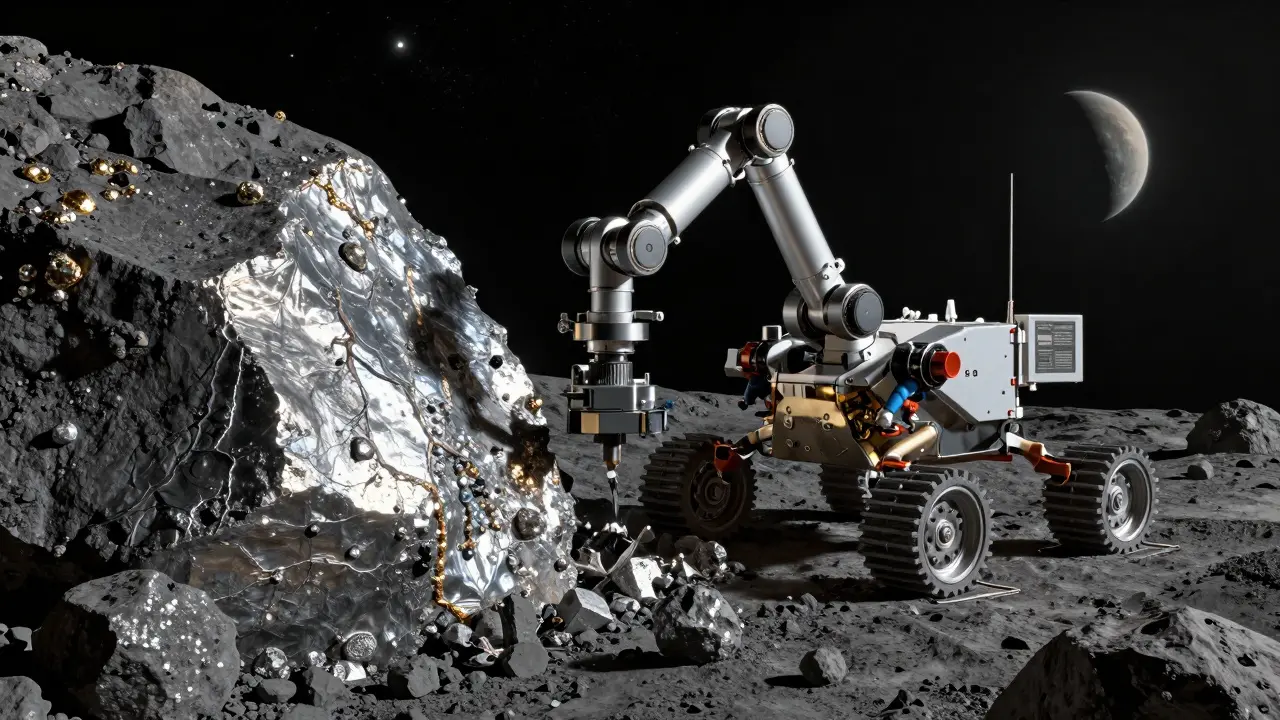
We often hear about platinum group metals. An asteroid like Psyche is thought to be rich in precious metals. On Earth, these fetch high prices, sometimes topping $30,000 per kilogram. However, dumping even 10 tonnes of platinum annually from space could crash terrestrial prices by 5-10%. Andrews et al.'s 2018 modeling showed that market saturation is a real threat. If you bring back too much too soon, you destroy the asset value. This requires a delicate strategy where production ramps up slowly to maintain price stability.
Volatiles: Water and Fuel
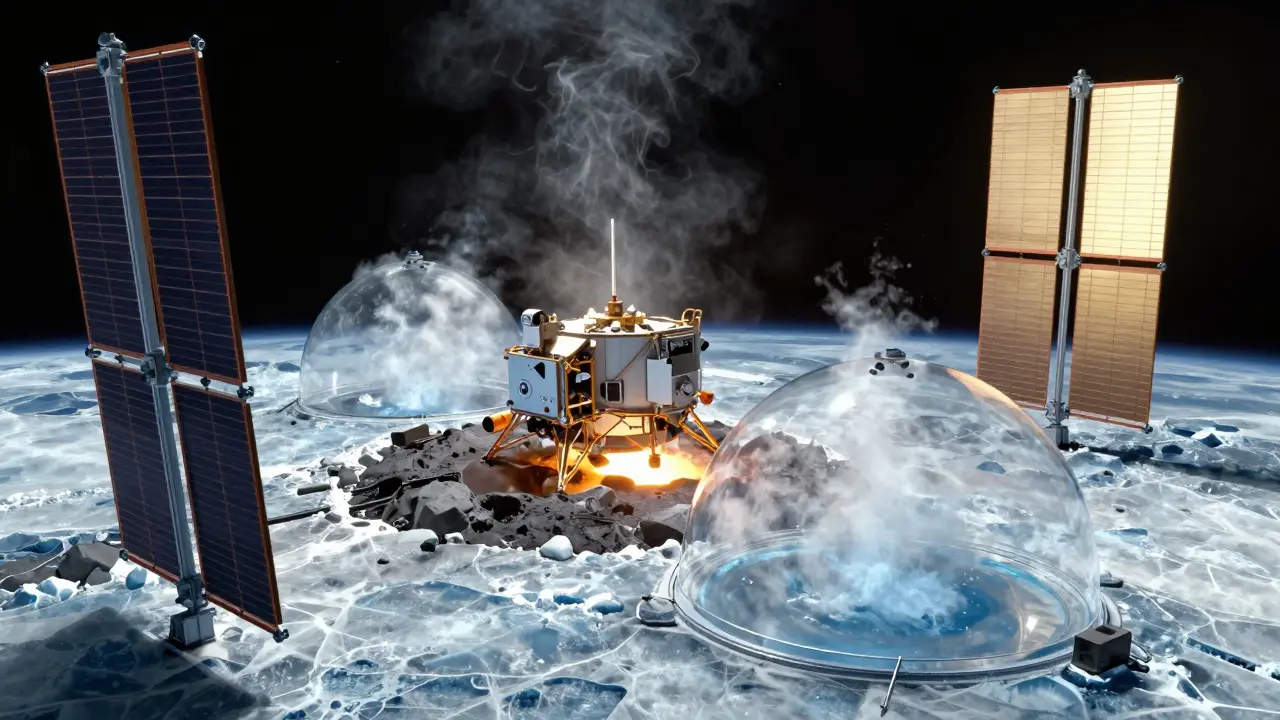
Water mining offers a different path. Instead of selling ice cubes on Earth, you sell water in orbit. As demand grows for In-Space Infrastructure, particularly for NASA's Artemis program and commercial stations, the need for propellant increases. Estimates suggest a demand of 500 to 1,000 tonnes of water annually by 2030, priced between $500 and $1,000 per kilogram delivered to lunar orbit. Because this fuel stays in space, you avoid fighting terrestrial launch costs directly. It turns the mined resource into fuel for deep space missions rather than jewelry for Earth buyers. Sonter's 2005 framework suggested this path was technically feasible in the near term, and recent 2023 NSS reports agree.
Propulsion Technology Trade-offs
How you get to the rock matters as much as the rock itself. Different propulsion systems change the mission duration, which hurts or helps your NPV. Chemical rockets are fast. They can transport resources to Earth orbit in 1-2 years. The downside is heavy fuel requirements. On the other hand, solar sails eliminate propellant needs entirely. But the University of Glasgow thesis (2022) found they take 3-5 years to complete a trip. That extra time kills the internal rate of return because of discounting effects.
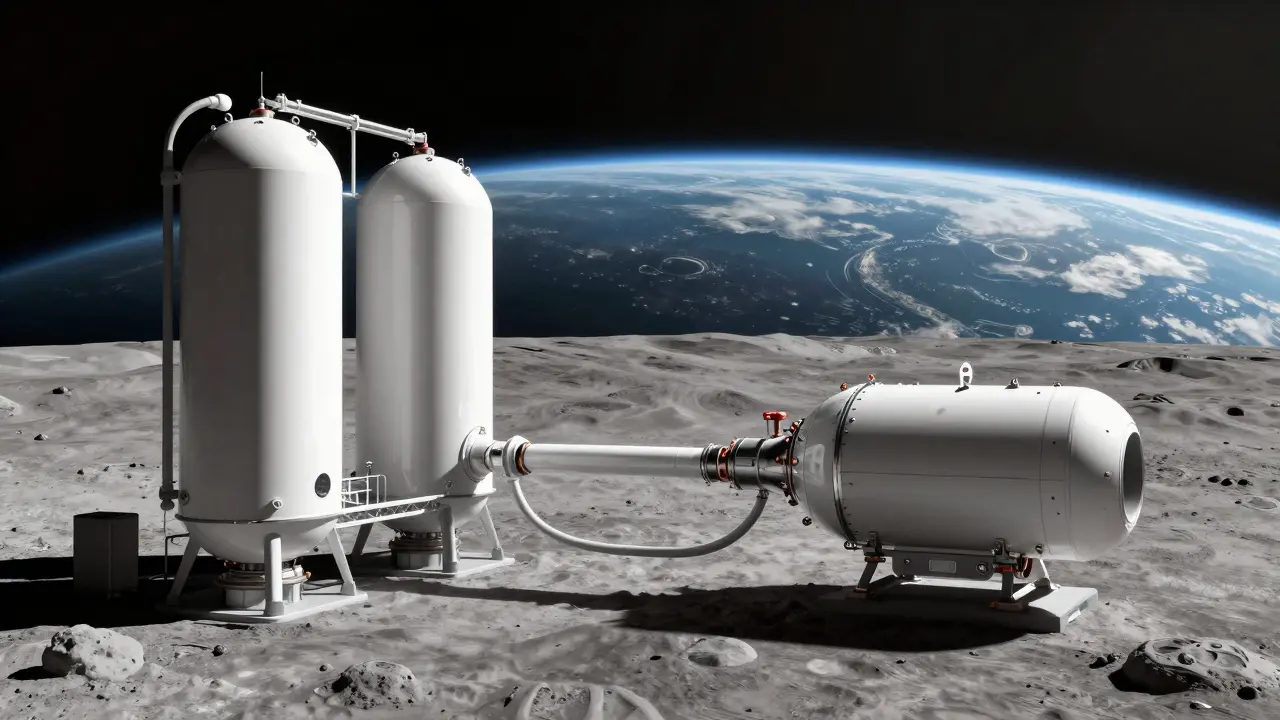
Current viable architectures restrict choices. According to the NSS 2023 report, economically sound missions likely require specific systems: solar thermal steam rockets, solar photovoltaic arcjets, or solar massdrivers. You want high thrust without carrying tons of gas. Small CubeSat-class systems are gaining traction. These weigh only 10-100 kg compared to traditional 500-2000 kg spacecraft. Reducing the dry mass lowers the launch bill, but throughput capacity remains the king. If a small ship processes regolith slower, the project fails.
Market Scenarios and Risk Factors
Investors aren't just looking at engineering; they are looking at legal frameworks and customer bases. Right now, regulatory grey areas exist regarding space resource ownership. Without clear laws, capital stays in tech development instead of full-scale operations. However, momentum is building. Luxembourg has committed €200 million to support development. NASA allocated $15 million specifically for utilization studies in their 2023 budget.
Commercial players are stepping in too. Companies like AstroForge and TransAstra are raising money and chasing contracts. AstroForge raised $13 million in Series A funding recently. TransAstra secured NASA SBIR contracts. Yet, the verdict remains cautious. Andrews et al. (2018) concluded that while specific M-type NEAs show potential, a venture targeting 1986 DA would currently be too risky due to market volatility. You need established customers. In-space infrastructure acts as a prerequisite. We cannot rely on Earth sales alone until launch costs collapse further.
The Path to Positive Cash Flow
So, what does a winning scenario look like? It combines low launch costs ($1,200/kg or better) with robotic systems that process 50kg of volatiles daily. It targets an IRR above 30%. It avoids flooding the Earth market with platinum. Instead, it focuses on becoming the gas station of the Moon and Mars. The Mass Payback Ratio used to be the standard metric-returning more mass than you launched. But modern economists reject this. Oxnevad demonstrated that MPBR ignores development costs and time-value-of-money. We must use NPV. Realistically, mission durations should stay under five years. Anything longer compounds interest payments and erodes profits before the first sale.
Can asteroid mining compete with Earth mining?
Only for high-value metals if you manage supply carefully. For general materials, Earth mining is cheaper due to lower overheads unless you are serving in-space customers.
What is the break-even timeframe for a mining mission?
Typically, project cycle times must remain between 5 to 7 years. Beyond that, the time-cost of money makes the project unviable regardless of gross revenue.
Which asteroid type is most profitable?
C-type asteroids containing volatiles (water/ice) are considered more viable for near-term projects than M-type metallic asteroids due to lower market risk.
Why is launch cost not the most critical factor?
Once launch costs drop below a threshold, throughput rates and resource pricing become the primary drivers of profitability, according to sensitivity analyses.
Are there legal barriers to ownership?
Yes. Without established regulatory frameworks for space resource ownership, investment often remains limited to technology development rather than commercial extraction.
Looking ahead, the economics are tightening. We are seeing a shift from dreaming to calculating. By focusing on in-space utilization, specifically water for life support and fuel, the business case stabilizes. Volatiles offer demand certainty through government programs like Artemis. Metals remain a gamble dependent on managing global price shocks. As we move through 2026, expect more announcements on demonstration units. The physics works. Now the finance sector needs to trust the numbers enough to write the checks.
15 Responses
It seems suspicious that everyone agrees on these numbers without asking who funds the research labs behind them.
The corporate narrative keeps shifting away from public ownership of resources.
We are told launch costs dropped but why do private valuations stay high?
Something doesn't add up when shareholders demand thirty percent returns constantly.
I get where you are coming from regarding the hidden funding sources.
However the published papers cite independent university studies extensively.
Maybe the skepticism helps keep the industry honest in the long run.
We just need to verify the data before dismissing the whole economic model entirely.
This breakdown makes the feasibility look way better than previous estimates suggested.
Focusing on water ice near the moon creates immediate cash flow potential.
We can build the infrastructure gradually without flooding terrestrial markets.
Keeps the pressure low while validating the technology stack first.
While the financial models are undeniably complex we must consider the broader philosophical implications of resource extraction in vacuum.
The shift from Earth-centric economies to orbital logistics represents a fundamental change in human commerce.
Historically scarcity drives value yet space mining introduces abundance which destabilizes current pricing structures completely.
Net Present Value calculations assume rational markets that may not exist during a supply shock event.
Internal Rate of Return fails to account for geopolitical conflicts triggered by space claims.
Legal frameworks remain dangerously vague regarding sovereignty over celestial bodies despite treaties.
The cost per kilogram metric improves significantly but ignores insurance liabilities during transit.
Safety protocols for deep space processing require international cooperation that does not currently exist.
Technological maturity indices for solar sails still show risks that discount rates cannot cover fully.
Volatiles offer a safer entry point but demand relies heavily on government subsidies for now.
Without consumer markets beyond defense agencies private capital remains hesitant to deploy fully.
Ethical considerations include environmental contamination of lunar surfaces during processing phases.
Social implications of wealth concentration among aerospace conglomerates warrant serious discussion today.
Future generations may judge our rush to exploit these assets based on ecological impact alone.
We need sustainable practices established before the first shipment of platinum arrives.
Your sentence structure lacks proper parallelism in the fourth paragraph specifically.
It is unethical to present such a lengthy argument without correcting grammatical errors first.
The misuse of commas undermines the seriousness of the ethical points you raised.
We cannot have meaningful discourse if basic linguistic standards are ignored repeatedly.
The distinction between volatile extraction and metallic mining is crucial for accurate forecasting.
Demand certainty for propellant provides a stable baseline unlike fluctuating commodity prices.
Logistics chains for in-space fueling simplify the delivery model significantly compared to Earth descent.
The assumption of a thirty percent return is excessively optimistic given current risk profiles.
Capital allocation towards such ventures often neglects opportunity costs effectively.
Economic projections fail when external variables shift unexpectedly during development cycles.
I think the optimism is balanced well enough by the sensitivity analysis shown here :)
It helps to see the table comparing launch vehicle costs clearly !
Water mining feels like the safest bet for getting started early :)
The drama surrounding who gets to own the rocks is absolutely ruining the business case right now !
Imagine spending billions on ships and having legal disputes stop everything mid-flight !!
Investors are scared stiff by the lack of clear regulations on property rights out there.
We need governments to sign contracts before anyone writes a single check for hardware.
The uncertainty is killing any chance of positive cash flow in the near term sadly.
Everyone talks about platinum prices dropping but no one discusses the legal nightmare ahead of time.
It is heartbreaking how much progress could happen if lawyers just agreed on something finally.
Regulatory grey areas mean we lose valuable years while committees debate ownership definitions endlessly.
Companies are sitting on cash waiting for clarity that never seems to come from Geneva meetings.
This stagnation hurts innovation more than technical challenges ever could possibly manage.
We deserve better than bureaucratic gridlock holding back technological advancement like this.
Hope springs eternal even when the reality of litigation looks bleak and scary though.
Someone please write a law book for space so we can stop arguing about physics !!
The frustration with legal delays is understandable given the technical momentum building elsewhere.
Patience is required while international bodies establish necessary frameworks for resource utilization.
Collaboration between nations will eventually create the safety nets investors need.
Progress continues even if regulatory steps take longer than engineering milestones suggest.
Money changes hands faster than laws do in modern society unfortunately.
We live in a time where profit moves quicker than policy writers can draft rules.
The philosophy of space commerce evolves through action rather than debate alone.
Nature dictates the timeline regardless of how much legislation is written down.
Action.. yes.. but.. what kind of action exactly??.... Maybe less talk more mining..... hahahaha.
The irony of waiting for laws is pretty thick isn't it..... ? (just kidding).. ok I will stop asking stuff.. seriously.
The data presented suggests a correlation between launch cost reduction and viability that is statistically weak.
Intrinsic risks associated with long-duration missions invalidate standard NPV formulas used here.
Market saturation scenarios have been underestimated by a factor of three in recent studies.
Critical failure modes in propulsion systems require higher contingency reserves than proposed models allow.
Without addressing these analytical gaps any investment decision remains fundamentally unsound.
Your assertion about statistical weakness is invalid because the cited sources are peer reviewed journals.
Using terms like unsound requires evidence that contradicts the referenced NSS report findings.
Correct your terminology before making sweeping claims about the entire sector.