
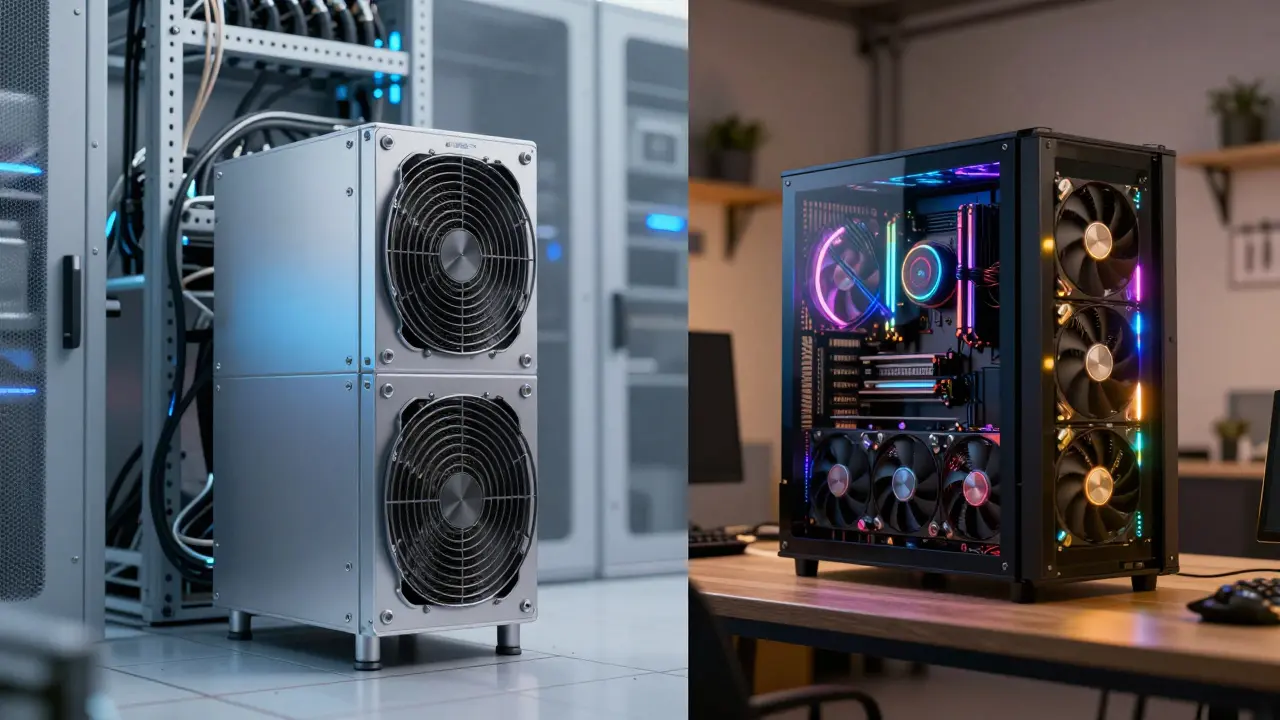
Imagine buying a specialized drill that only works on one type of wood. Now imagine buying a Swiss Army knife that can cut, screw, and saw, but does none of those things as well as the dedicated tool. This is the exact dilemma facing anyone looking into cryptocurrency mining today. The choice isn't just about which machine makes more noise or costs more upfront; it’s about deciding whether you want to be an industrial-scale producer focused on a single commodity or a flexible artisan chasing multiple opportunities.
In 2026, the landscape has shifted dramatically from the early days of mining on laptops. We are now in an era where ASIC mining is the dominant force for major cryptocurrencies like Bitcoin, offering unmatched efficiency at the cost of flexibility, while GPU mining is a versatile approach using graphics cards to mine various altcoins, offering lower entry barriers and secondary resale value. Choosing between them depends entirely on your electricity costs, your risk tolerance, and how much control you want over what you mine.
The Core Difference: Specialization vs. Flexibility
To understand why these two technologies exist side-by-side, you have to look at their origins. ASIC (Application-Specific Integrated Circuit) miners are chips designed to perform a single mathematical task with extreme precision and speed. Companies like Bitmain, founded in 2013 by Jihan Wu and Micree Zhan, built these machines specifically to solve the SHA-256 algorithm used by Bitcoin. They don't browse the web. They don't render videos. They do one thing, and they do it billions of times faster than any general-purpose computer.
On the other hand, GPU (Graphics Processing Unit) mining uses general-purpose processors originally designed for gaming and professional graphics rendering. Developed by giants like NVIDIA and AMD, these cards were never meant for mining. However, their parallel processing power made them perfect for hashing algorithms that aren't optimized for ASICs. Because they are general-purpose tools, you can switch the software to mine different coins depending on which is most profitable that day.
| Feature | ASIC Miner | GPU Rig |
|---|---|---|
| Primary Use Case | Mining specific coins (e.g., Bitcoin) | Mining various altcoins (e.g., Ravencoin, ETC) |
| Flexibility | None (locked to one algorithm) | High (switchable via software) |
| Efficiency | Extremely High (16-30 J/TH) | Lower (150-500+ J/TH equivalent) |
| Noise Level | Very Loud (70-85 dB) | Moderate (65-75 dB) |
| Resale Value | Low (loses 80-90% value in 2 years) | Medium-High (retains 40-60% value) |
| Entry Cost | High ($3,000 - $10,000+) | Low-Medium ($500 - $2,000 for basic rigs) |
Performance and Efficiency: The Numbers Don't Lie
If you care purely about raw output per watt of electricity, ASICs win by a landslide. As of late 2025, modern ASICs like the Bitmain Antminer S21 Hydraulic deliver 335 TH/s (terahashes per second) while consuming 5,360W. That translates to an efficiency of 16 joules per terahash (J/TH). In contrast, a high-end GPU like the NVIDIA RTX 4090 might hash at 120 MH/s for certain algorithms, but its energy efficiency for Bitcoin-equivalent work would be hundreds of times worse.
This efficiency gap is why ASICs hold 99.8% of the Bitcoin network's hash rate. If you try to mine Bitcoin with GPUs in 2026, you will likely lose money every single day because the electricity cost will exceed your earnings. ASICs are the only viable option for Bitcoin because they squeeze maximum performance out of every kilowatt-hour.
However, efficiency isn't everything. GPUs shine in algorithms designed to resist ASICs, such as RandomX (used by Monero) or KawPow (used by Ravencoin). In these spaces, the flexibility of a GPU allows you to pivot quickly. If Ravencoin's price drops, you can switch to Ethereum Classic or Zcash overnight. An ASIC miner cannot do this. It is stuck mining whatever coin it was built for, regardless of market conditions.
Profitability and Return on Investment
Let's talk about the bottom line. Profitability in mining is a function of three variables: hardware cost, electricity cost, and coin price. For ASIC miners, electricity is the kingmaker. According to industry models from MineTheASIC in November 2025, ASIC operations become economically viable only when electricity costs remain below $0.08/kWh. Ideally, you want rates closer to $0.05/kWh to see healthy margins.
A typical Antminer S21 might cost around $7,999 at launch. At $0.06/kWh, it could achieve a return on investment (ROI) in 8-10 months. But if your electricity costs $0.15/kWh, that ROI stretches to infinity-you will never break even. This is why large-scale ASIC farms are located in places with cheap hydroelectric power or stranded energy resources.
GPU mining has a different financial profile. A rig with six RTX 4090s might cost around $12,000. While the initial outlay is similar to a few ASICs, the daily revenue is lower. However, the breakeven point is less sensitive to electricity costs because the total power draw is often lower for smaller setups. More importantly, the exit strategy is better. If you decide to stop mining, you can sell your GPUs on eBay or to gamers. You might recoup 40-60% of your initial investment. Selling an ASIC is harder; they depreciate rapidly, often losing 80-90% of their value within 18-24 months as newer, faster models arrive.
Operational Realities: Noise, Heat, and Space
You cannot ignore the physical reality of running these machines. ASICs are loud. Really loud. Models like the Antminer S19 XP operate at 70-85 decibels, comparable to a vacuum cleaner or a busy highway. Running one in your living room is impossible. Most home users who buy ASICs end up putting them in garages, basements, or renting space in colocation facilities. These facilities charge $150-$250 per machine monthly and handle the cooling and electrical infrastructure for you.
Cooling is another major factor. Enterprise ASIC operations increasingly use immersion cooling systems, submerging the machines in dielectric fluid to dissipate heat efficiently. This technology saw a 30% adoption rate in large facilities by Q3 2025. For home users, this is not an option. You need robust air conditioning or ventilation.
GPU rigs are quieter, typically running at 65-75 dB, which is more tolerable for a garage or shed setup. They also generate less concentrated heat, making them easier to manage with standard case fans and room ventilation. Furthermore, setting up a GPU rig is simpler for beginners. You can plug it into a standard 120V outlet (depending on the number of cards), whereas ASICs usually require dedicated 220V circuits and professional electrical installation.
Who Should Choose What?
So, which path is right for you? Here is a simple decision tree based on your situation:
- Choose ASIC Mining if:
- You have access to very cheap electricity (below $0.07/kWh).
- You are committed to mining Bitcoin or other ASIC-dominated coins long-term.
- You have a suitable location (garage, warehouse, or colocation contract) to handle noise and heat.
- You view mining as an industrial business operation rather than a hobby.
- Choose GPU Mining if:
- Your electricity costs are moderate to high ($0.10/kWh or above).
- You want the flexibility to switch between different cryptocurrencies.
- You plan to sell the hardware later to offset losses.
- You are a beginner wanting to learn the mechanics of mining without massive upfront risk.
- You want to run the hardware in a semi-residential area due to noise constraints.
Expert opinions reflect this divide. Dr. Alex de Vries of Digiconomist notes that ASICs represent the "industrialization" of mining, concentrating power among those with capital and cheap energy. Conversely, Michael Padolsky of MiningStore argues that for serious Bitcoin miners, ASICs are mandatory for survival in 2026's competitive landscape. Meanwhile, community leaders in GPU mining emphasize the strategic advantage of agility-switching algorithms daily to chase profitability spikes.
Future Outlook: Where Is the Industry Heading?
The trend lines are clear. ASIC efficiency continues to improve, with Bernstein analysts projecting a 15% annual increase through 2027. By then, we expect to see ASICs achieving 10-12 J/TH, further squeezing out inefficient operators. This means the barrier to entry for Bitcoin mining will only get higher.
GPU mining faces a different challenge. As new coins emerge, many are designing ASIC-resistant algorithms to decentralize mining. Coins like Monero and projects like Abelian explicitly support hybrid or GPU-friendly models. Additionally, NVIDIA has shifted focus toward data center GPUs (like the H100) with mining limitations, though consumer cards like the upcoming RTX 5090 may reintroduce gaming-focused capabilities. Regulatory pressures are also mounting, with 27 U.S. states imposing additional tariffs on mining operations and the EU requiring registration for large facilities under MiCA regulations starting January 2026.
Ultimately, there is no "best" hardware. There is only the best hardware for your specific constraints. If you treat mining as a speculative tech hobby, GPUs offer a safer, more flexible entry. If you treat it as a utility-scale energy arbitrage business, ASICs are the only tool that gets the job done.
Can I mine Bitcoin with a GPU in 2026?
Technically yes, but financially no. ASIC miners dominate 99.8% of the Bitcoin network hash rate. Their efficiency is so far superior that mining Bitcoin with a GPU will result in electricity costs that far exceed your earnings. You will lose money every day.
What is the best electricity rate for ASIC mining?
To be profitable with modern ASICs like the Antminer S21, you generally need electricity rates below $0.08/kWh. Ideally, rates should be closer to $0.05-$0.06/kWh to ensure a healthy margin and reasonable return on investment.
Do GPUs retain value after mining?
Yes, significantly better than ASICs. Used GPUs can retain 40-60% of their original value because they have a strong secondary market in gaming, video editing, and AI development. ASICs typically lose 80-90% of their value within two years due to rapid technological obsolescence.
Is GPU mining still profitable in 2026?
It depends on your electricity costs and the coins you choose. GPU mining remains viable for altcoins like Ravencoin, Ethereum Classic, and privacy coins like Monero. However, profits are thinner than in previous years, and success requires actively switching between coins to maximize daily returns.
How loud are ASIC miners compared to GPUs?
ASIC miners are very loud, operating at 70-85 decibels, similar to a vacuum cleaner. GPU rigs are quieter, typically running at 65-75 decibels. Neither is suitable for a bedroom or living room, but GPUs are more manageable in a garage or office space.