
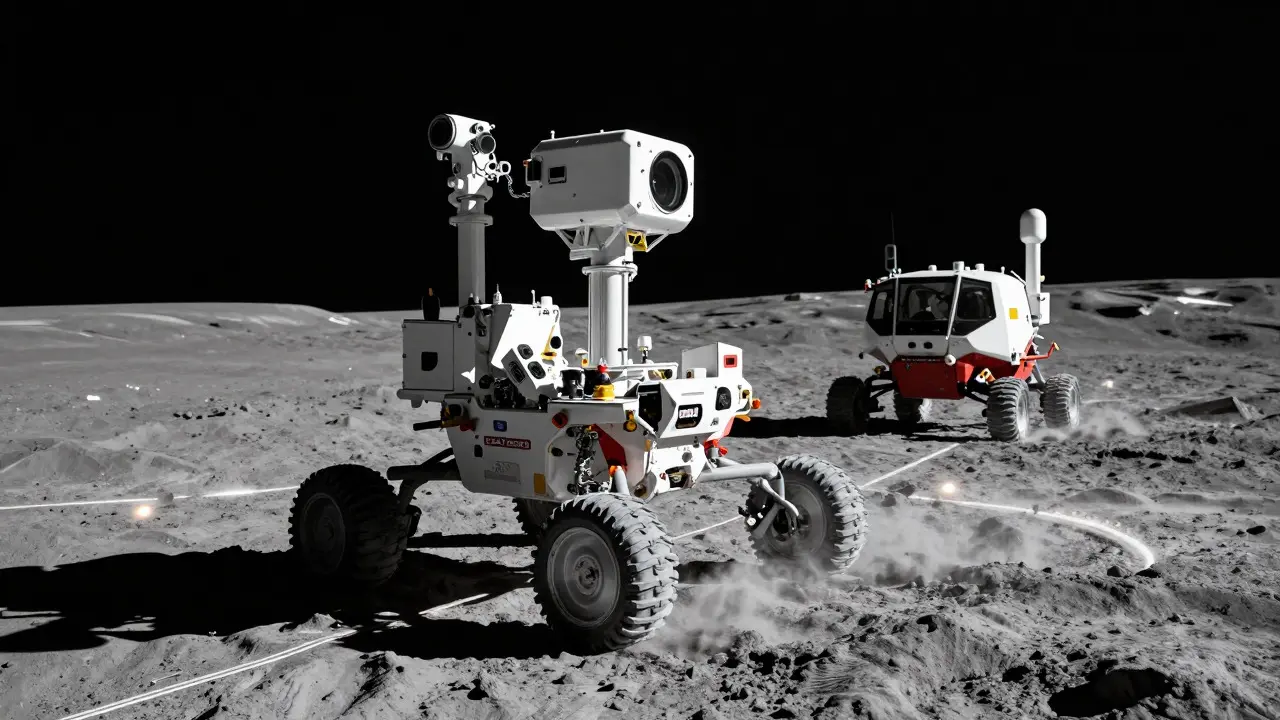
Imagine you’re building a house on the Moon. You’ve spent billions getting there. You set up your solar panels and start digging for water ice. Suddenly, another nation’s rover shows up right next to your drilling site. Who owns that ice? Does the other guy have to stay away? What if he crashes into your equipment?
This isn’t just science fiction anymore. As of mid-2026, we are actively planning permanent human bases on the lunar surface. The rules for this new era aren’t written in a single global treaty like the old days. Instead, they’re found in the Artemis Accords, a set of principles drafted by NASA and the U.S. State Department in 2020.
The Accords have grown from eight founding signatories in October 2020 to 68 countries by June 2026. But they are also controversial. Critics call them "space colonialism," while supporters say they are the only practical way to keep space safe and open for business. Let’s break down what these accords actually mean for the future of space exploration, who is playing along, and why Russia and China are sitting out.
What Are the Artemis Accords?
First, let’s clear up a common misconception. The Artemis Accords are not a binding international treaty. They don’t require ratification by parliaments or congresses. They are a "non-binding political commitment." Think of them as a club rulebook rather than a law passed by the United Nations.
Drafted by the United States, the Accords are bilateral agreements between the U.S. and each partner country. When a country signs, it agrees to follow ten specific principles for civil space exploration. These principles build upon existing international laws, primarily the 1967 Outer Space Treaty, which declares space the "province of all mankind" and bans national sovereignty claims on celestial bodies.
The goal is simple: reduce uncertainty. If everyone follows the same playbook for transparency, safety, and resource use, missions can proceed without constant diplomatic friction. NASA describes the Accords as a framework to enhance governance through best practices, not legal mandates.
The Ten Core Principles Breakdown
You might think space law is boring, but these ten principles dictate how we’ll behave on the Moon and Mars. Here is what they cover:
- Peaceful Purposes: All activities must be peaceful. However, the Accords don’t explicitly ban military personnel from participating in scientific roles, leaving some ambiguity about passive military uses like reconnaissance.
- Transparency: Countries must publish their policies and mission plans. This helps others know where you are going and what you’re doing.
- Interoperability: Encouraging common standards so different nations’ hardware and software can work together. Think of it like USB-C for space stations.
- Emergency Assistance: If an astronaut is in trouble, other signatories should help. This builds on the 1968 Rescue and Return Agreement.
- Registration of Space Objects: You must register your satellites and landers with the UN, keeping track of who owns what debris.
- Release of Scientific Data: Science belongs to everyone. Signatories agree to share data openly.
- Preservation of Heritage: Protect historical sites, like the Apollo landing spots. Don’t park your rover on Neil Armstrong’s footprints.
- Deconfliction via Safety Zones: This is the big one. We’ll discuss this more below.
- Space Resources: Clarifying that extracting resources (like water or minerals) doesn’t count as claiming territory.
- Orbital Debris Mitigation: Clean up your trash. Limit long-lived debris to protect future missions.
Safety Zones and Moon Mining: The Controversy
The most debated parts of the Accords are Principle 8 (Safety Zones) and Principle 9 (Space Resources). These two concepts try to solve a major problem: How do you mine the Moon without starting a war?
Under the 1967 Outer Space Treaty, no country can claim ownership of the Moon. You can’t plant a flag and say, "This crater is mine." But the Artemis Accords introduce the idea of "safety zones."
A safety zone is a temporary area around an active operation-like a mining site or a landing pad. Other actors agree not to interfere with activities in that zone to avoid harmful interference. It’s not a property line; it’s a construction cone. If you’re digging for water ice at the Shackleton Crater, you need a buffer zone so another rover doesn’t accidentally drive over your cables.
Here is where it gets tricky. The Accords state that extracting resources is legal. If you dig up lunar regolith or water ice, you own that material. But you don’t own the ground underneath it. Scholars argue this creates a loophole. By controlling the access to valuable resources through safety zones, a company or nation could effectively control a region indefinitely, even if they don’t legally "own" the land.
Critics, including Russia and China, argue this violates the spirit of the Outer Space Treaty. They see it as a way for technologically advanced nations to monopolize the best locations on the Moon. Supporters counter that without safety zones, operations would be chaotic and dangerous. You can’t have safe mining without defined operational areas.
Who Is Signing and Who Is Boycotting?
The membership list tells a story of geopolitical alignment. As of June 25, 2026, there are 68 signatories. This includes traditional allies like Australia, Canada, Japan, and the UK, but also emerging space nations like Botswana, Malaysia, and the Philippines.
| Group | Status | Key Members / Notes |
|---|---|---|
| Founding Signatories | Joined Oct 2020 | USA, Australia, Canada, Italy, Japan, Luxembourg, UK, UAE |
| Recent Joiners | Joined 2024-2026 | Panama, Austria, Oman, Ireland, Botswana |
| Major Non-Signatories | Boycotting | Russia, China |
Russia and China have refused to join. In March 2021, they launched their own alternative: the International Lunar Research Station (ILRS). They criticize the Artemis Accords as a U.S.-led tool to bypass the United Nations and impose unilateral rules. Chinese state media has compared the Accords to European colonial enclosure movements, suggesting they are designed to lock out competitors.
This split creates a two-tiered system in space. On one side, you have the Artemis coalition with its focus on commercial viability and safety zones. On the other, you have the ILRS partnership, which emphasizes multilateralism and state-led exploration. For now, cooperation between these two blocs is minimal.
Why This Matters for the Global Economy
Space isn’t just about science anymore; it’s a massive economic engine. The global space economy reached $613 billion in 2024 and is projected to exceed $1 trillion by the early 2030s. A huge chunk of this growth comes from commercial activity, including satellite internet, Earth observation, and increasingly, in-situ resource utilization (ISRU).
ISRU means using local resources-like making fuel from lunar water ice-instead of hauling everything from Earth. This market alone is expected to grow from $1.2 billion in 2025 to nearly $12 billion by 2034. Investors need certainty. They want to know that if they build a refinery on the Moon, their assets will be protected and their rights respected.
The Artemis Accords provide that framework for companies operating under signatory nations. If you’re a U.S., Japanese, or Australian company, the Accords give you a clearer path to monetize space resources. If you’re operating under a non-signatory regime, you face more legal ambiguity.

Criticisms and Legal Gaps
Even among supporters, there are concerns. Legal scholars point out several weaknesses:
- No Enforcement Mechanism: Since the Accords are non-binding, there’s no penalty for breaking them. If a country ignores a safety zone, what happens? Reputation damage, perhaps, but no fines or sanctions.
- Militarization Ambiguity: While the Accords stress "peaceful purposes," they don’t explicitly ban weapons in space. This leaves room for passive military uses, such as spy satellites or dual-use technology.
- Exclusion of the Global South: Some critics argue the Accords favor wealthy nations with advanced tech. Developing countries may find themselves excluded from the benefits of space resources, reinforcing existing inequalities.
There is also the issue of the 1979 Moon Agreement, a UN treaty that declares space resources the "common heritage of mankind." Only 18 countries have ratified it, and none are major space powers. The Artemis Accords largely ignore this treaty, opting instead for a free-market approach to resources. This divergence highlights the lack of a unified global consensus on space law.
What Comes Next?
We are entering a critical decade. NASA’s Artemis program aims to return humans to the Moon in the late 2020s and establish a sustained presence. Private companies are already testing landers and rovers. The rules we set now will shape space exploration for generations.
The Artemis Accords are likely here to stay. With 68 signatories, they represent the dominant framework for Western-aligned space activities. However, the tension with Russia and China remains unresolved. Will we see parallel systems coexist? Or will pressure force a convergence toward a more inclusive UN-led framework?
For now, the Accords serve as a practical guide for those willing to play by the U.S.-led rules. They offer clarity on safety and resources, but they also deepen geopolitical divides. As we move toward Mars, these questions won’t go away-they’ll only become more urgent.
Are the Artemis Accords legally binding?
No, the Artemis Accords are not legally binding treaties. They are a set of non-binding political commitments and best practices. Signatories agree to follow the principles, but there are no legal penalties for non-compliance. They rely on diplomatic goodwill and reputational incentives rather than court enforcement.
Can countries claim ownership of land on the Moon under the Accords?
Technically, no. The Accords reaffirm the 1967 Outer Space Treaty, which prohibits national appropriation of celestial bodies. However, they allow for "safety zones" around active operations. Critics argue these zones could function like de facto property rights by excluding others from valuable areas, even if formal ownership isn’t claimed.
Why did Russia and China refuse to join the Artemis Accords?
Russia and China view the Accords as a U.S.-led attempt to bypass the United Nations and create exclusive rules that favor American commercial interests. They argue the safety zone concept violates the principle of space as the "province of all mankind." Instead, they formed their own partnership, the International Lunar Research Station, to promote a multilateral approach.
How many countries have signed the Artemis Accords as of 2026?
As of June 25, 2026, there are 68 signatories. This number has grown rapidly from the initial eight founding members in October 2020, including recent additions like Botswana and Ireland. The list includes a mix of established space powers and emerging space nations across Europe, Asia, Africa, and the Americas.
What is the difference between the Artemis Program and the Artemis Accords?
The Artemis Program is NASA’s series of missions to return humans to the Moon. The Artemis Accords are the diplomatic framework and set of principles governing how international partners collaborate within that program. The Accords apply to any civil mission aligned with these principles, regardless of whether it uses NASA hardware.
Do the Artemis Accords allow private companies to mine the Moon?
Yes. Principle 9 of the Accords clarifies that states and their commercial entities can extract and use space resources. While they cannot claim sovereignty over the land itself, they retain rights to the materials they extract. This provides legal clarity for private investment in lunar resource utilization.
12 Responses
The concept of ownership in a vacuum is inherently paradoxical. We project terrestrial legal frameworks onto the celestial void, assuming that property rights are universal constants rather than social constructs bound by gravity and atmosphere. It is fascinating how we cling to the idea of 'mine' when standing on a rock that belongs to no one and everyone simultaneously.
Actually, Robert, you’re missing the nuance of the non-binding political commitment aspect. The Artemis Accords aren’t trying to rewrite the Outer Space Treaty; they are operationalizing it through bilateral agreements. It’s not about sovereignty, it’s about deconfliction via safety zones. If you don’t understand the difference between a treaty and a memorandum of understanding, maybe stick to reading sci-fi novels instead of international space law. It’s basic diplomatic protocol 101.
Yeah right like safety zones stop anyone from just showing up with a bigger rocket. Its basically a club for rich countries to say 'stay away' while pretending its for safety. Total BS.
I find the geopolitical split quite illuminating when viewed through the lens of historical exploration patterns. Just as the Age of Discovery created spheres of influence, we are witnessing a digital and physical partitioning of the lunar surface. It is dramatic, yes, but also inevitable given the lack of a central enforcing authority in the UN system. The US-led coalition offers clarity, even if it feels exclusionary to some.
It is important to remember that these accords provide a necessary framework for commercial viability. Without clear rules on resource extraction and safety zones, investors would hesitate to pour billions into lunar infrastructure. The goal is not colonization, but sustainable utilization. Let us focus on the potential for scientific advancement and economic growth that this structure enables for all participating nations.
While I appreciate the economic perspective, we must consider the ethical implications of excluding developing nations from these resources. The argument that space is the province of all mankind rings hollow when only those with advanced technological capabilities can access it. We need a more inclusive approach that ensures the benefits of space exploration are shared globally, not just among the wealthy few who can afford to sign these accords. It is crucial that we do not repeat the mistakes of terrestrial colonialism on an interplanetary scale.
The Western-centric view of these accords is deeply problematic from a Global South perspective. India has always advocated for multilateralism and equitable access to space resources. The Artemis Accords seem designed to create a monopoly for US and European corporations under the guise of 'safety.' We need a UN-led framework that respects the sovereignty of all nations and prevents the neo-colonial exploitation of celestial bodies. India’s stance remains firm on keeping space open for all.
oh look another lecture on morality from someone who probably thinks the moon is made of cheese. the reality is power dictates rules. if you cant build a rocket you dont get a seat at the table. simple as that. stop whining about fairness in a universe that owes you nothing.
From South Africa, we see this as a missed opportunity for true global cooperation. While we have joined the accords, the tension with Russia and China creates a dangerous dichotomy. It reminds one of the Cold War, but now over ice and helium-3. Perhaps we should be less concerned with who owns the crater and more concerned with ensuring we don’t turn the Moon into a shooting gallery.
The moral decay of humanity is evident in our rush to commodify the heavens. We treat the Moon not as a sacred mirror reflecting our own souls, but as a mine to be stripped bare for profit. This greed will consume us long before any asteroid does. The silence of space is being drowned out by the clatter of cash registers. A tragic spectacle indeed.
I think people are overreacting slightly to the whole safety zone thing. Its basically just saying dont crash your rover into my drill site. Its common sense really. The fact that Russia and China are boycotting makes me wonder if they are just jealous of the tech progress or if there is a genuine legal concern. Either way, having some rules is better than chaos. Hope we can figure out a way to make it work for everyone eventually though.
we are digging graves for ourselves in the dirt of another world