
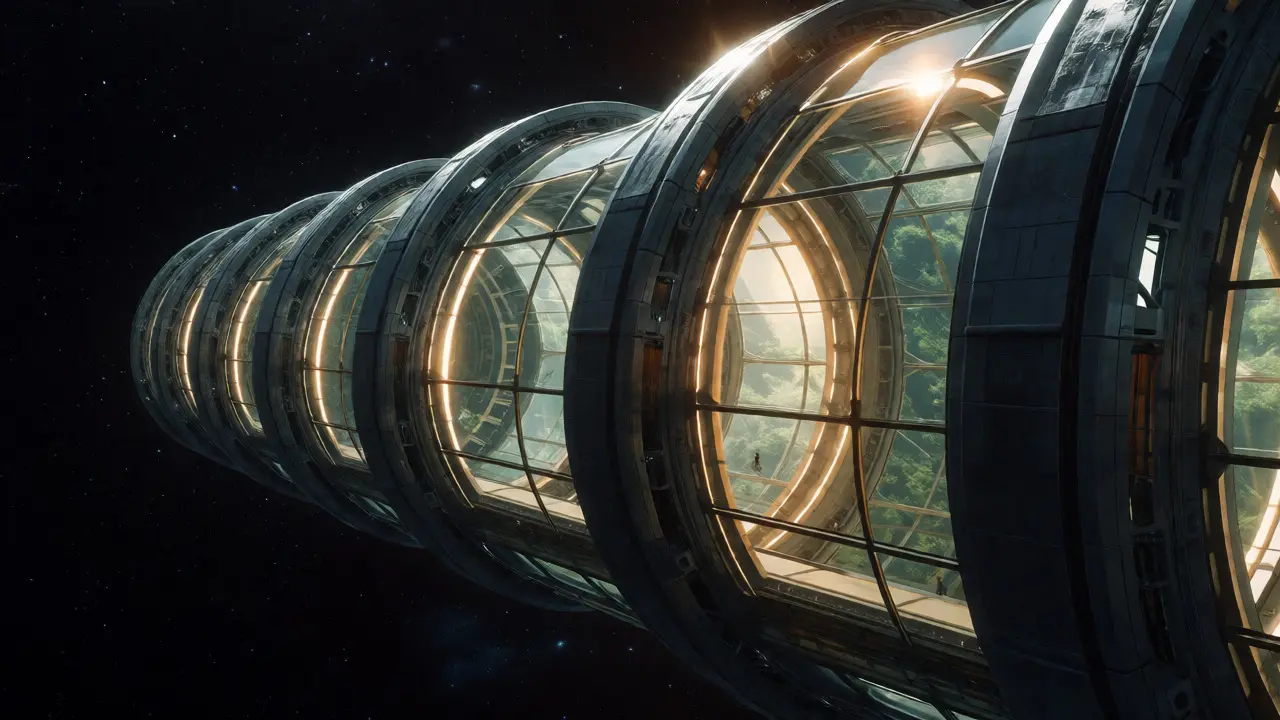
Imagine being born on a metal cylinder spinning through the void, never seeing a horizon, and dying without ever setting foot on solid ground. Your great-grandchildren might eventually land on a new planet, but for you, the ship is the entire universe. This isn't just a plot device from a sci-fi movie; it's the core concept behind ark ships, also known as generation ships or worldships. These hypothetical vessels are designed to carry humans across light-years, relying on multiple generations to complete the journey because the trip takes longer than a single human lifespan.
The idea has been around since 1928, when Russian rocket pioneer Konstantin Tsiolkovsky proposed "Noah's Arks" traveling at a fraction of the speed of light. As of September 2026, no such ship has left Earth. We haven't even sent humans to Mars yet. But engineers, ethicists, and sociologists are actively designing these vessels, trying to solve problems that seem impossible today. How do you keep 100,000 people alive for a thousand years? What happens to society when everyone is stuck in a tube for centuries? Let's break down what an ark ship actually looks like and why we're still talking about them.
What Exactly Is an Ark Ship?
Not all starships are created equal. When experts talk about ark ships, they usually mean something specific. Andreas Hein, a leading researcher in this field, defines a worldship as a vessel carrying more than 100,000 people, capable of self-sufficiency for thousands of years, and traveling at speeds below 1% of the speed of light (0.01c). That last part is key. If you go faster, you need less time, but you face different engineering nightmares. Slower speeds mean you have more time to fix things, but you also have more generations who didn't choose to be there.
There's a tension in the design community. On one end, you have the massive, slow-moving city-ships described by Hein. On the other, you have concepts like the Chrysalis, a blueprint that won the Project Hyperion competition in 2025. Chrysalis envisions a smaller crew-about 1,000 to 1,500 steady-state residents-in a 58-kilometer-long ship cruising at 0.10c (10% the speed of light) toward Proxima Centauri. The trade-off is stark: bigger populations offer genetic diversity and social stability but require insane amounts of resources. Smaller crews are easier to feed and house but risk inbreeding and social collapse if things go wrong.
| Feature | Hein Worldship Model | Chrysalis Concept | MGAM Framework |
|---|---|---|---|
| Population Size | >100,000 people | 1,000-1,500 steady-state | 50-200 operational adults |
| Cruise Speed | <0.01c (slower) | ~0.10c (faster) | Variable (Solar System focus) |
| Mission Duration | ~1,000 years | ~400 years cruise | Decades to centuries |
| Reproduction Strategy | Natural reproduction | Natural with management | Cryogenic embryo archive |
| Primary Goal | Mobile civilization backup | Rapid colonization | Genetic expansion efficiency |
The Engineering Nightmare: Keeping People Alive
Building a spaceship is hard. Building a self-contained ecosystem that lasts for millennia is harder. Think about the International Space Station (ISS). It supports seven people for six months. Now scale that up to 100,000 people for 1,000 years. That’s roughly 100 billion person-days of life support. You can’t just pack enough food and water; you have to recycle everything. Air, water, waste, even industrial materials must cycle continuously.
Propulsion is another beast. To reach Proxima Centauri, our nearest stellar neighbor at 4.24 light-years away, in a reasonable timeframe, you need speeds between 0.01c and 0.10c. Current chemical rockets max out at tiny fractions of that. We’re looking at nuclear fusion or beamed sails. Nuclear propulsion gives us energy density, while beamed sails (like those proposed for Breakthrough Starshot) use lasers from home to push lightweight craft. For an ark ship, however, you need to accelerate millions of tons. This requires industrializing space itself-mining asteroids for fuel and building orbital shipyards that don’t exist yet.
Then there’s radiation. In deep space, outside Earth’s magnetic shield, astronauts get bombarded by cosmic rays. The National Academies report that chronic exposure increases risks of cancer, cataracts, and heart disease. For a mission lasting decades, shielding needs to be meters thick-think layers of water or regolith (moon soil) surrounding the living quarters. Microgravity is equally deadly over long periods, causing bone loss and muscle atrophy. The solution? Artificial gravity. Most serious designs feature huge rotating cylinders or rings to simulate 1g gravity. Without this, your crew will arrive at their destination too frail to walk.

Society in a Bottle: The Human Factor
Here’s where it gets weird. Physics is predictable; humans aren’t. A mission lasting 400 years means 10 to 20 generations live and die on board. The first generation remembers Earth. The tenth generation knows only the ship. How do you maintain cultural continuity? How do you prevent a revolution in year 300?
Psychologist Marc Cohen argues that isolation and confinement are major stressors. On the ISS, crews sometimes clash. Imagine that tension amplified over centuries. Sociologists warn of "total institution" dynamics, where the ship becomes a prison-like environment with strict rules. Authoritarian regimes could easily emerge. Who decides who gets to have children? Who controls the oxygen supply? If the ship’s governance fails, the mission dies.
Education becomes critical. Technical knowledge must be passed down accurately. If the generation responsible for maintaining the nuclear reactor forgets how it works, everyone burns or freezes. Schools on board wouldn’t just teach math and history; they’d teach survival engineering. Cultural institutions would need to reinforce the mission’s purpose, otherwise, descendants might ask, "Why are we doing this?" and decide to stop caring.

Ethics: Did They Consent?
This is the question keeping philosophers up at night. The original crew signed up. They knew the risks. But their great-great-grandchildren? They were born into a metal tube with no choice. Ethicists call this "intergenerational autonomy." Do current planners have the moral right to commit thousands of future individuals to lives in transit?
Consider the health risks. Unborn generations will face cumulative radiation doses exceeding current NASA career limits. They’ll live their entire 70-90 year lives under artificial lights. Some bioethicists suggest genetic modification-editing embryos for radiation resistance-to mitigate this. But modifying the germline of an entire population raises huge ethical red flags. Are we creating a new subspecies of human? And what if the modifications go wrong?
There’s also the issue of fairness. Who gets selected for the crew? Is it based on merit, wealth, or genetics? The Maternal Genetic Ark Missions (MGAM) framework proposes a radical solution: send an all-female crew with a cryogenic archive of embryos. Reproduction is controlled via gestation of selected embryos, deferring male births until landing. This minimizes onboard population size but centralizes control over reproduction in the hands of mission planners.
Is It Actually Possible?
Technically, yes. Biologically, maybe. Politically, not yet. No space agency has funded a full-scale ark ship study beyond conceptual phases. The cost is astronomical-likely requiring several percent of global GDP invested over decades. We need breakthroughs in closed-loop life support, reliable fusion propulsion, and large-scale space manufacturing.
Some analysts see ark ships as insurance policies. If Earth faces extinction-level threats, a few worldships launched every century ensure humanity survives. Others argue that faster, smaller missions using hibernation or suspended animation might be more practical. Or perhaps we’ll upload human consciousness to digital substrates and beam ourselves to the stars, leaving the meat sacks behind.
For now, ark ships remain blueprints on paper. But as we develop technologies for Mars colonization and asteroid mining, the gap between fiction and reality narrows. The challenge isn’t just building the ship; it’s deciding if we want to become a multi-planetary species the hard way-one generation at a time.
How long would a trip to Proxima Centauri take on an ark ship?
It depends on the speed. At 0.01c (1% light speed), it would take about 424 years. At 0.10c (10% light speed), like the Chrysalis design, it would take roughly 42 years plus acceleration and deceleration time, totaling around 400-450 years. Faster speeds reduce duration but increase energy requirements exponentially.
Do ark ships have artificial gravity?
Yes, most serious designs include artificial gravity generated by rotation. Long-term microgravity causes severe health issues like bone density loss and muscle atrophy. Rotating habitats, often cylindrical or ring-shaped, spin to create centrifugal force that simulates Earth-like gravity, which is essential for crew health over centuries.
How do they handle food and waste?
Ark ships rely on closed-loop ecological systems. This involves hydroponic agriculture for food, bioreactors for waste processing, and advanced recycling for water and air. Essentially, the ship mimics Earth’s biosphere, ensuring that almost nothing is wasted and resources are regenerated continuously for thousands of years.
What prevents inbreeding on small crew sizes?
Large worldships (>100,000 people) have enough genetic diversity to avoid immediate inbreeding. Smaller crews, like those in the MGAM framework, use cryogenic archives of embryos and gametes from Earth. Controlled breeding programs select genetically diverse pairs from the archive to maintain healthy gene pools over generations.
Who governs an ark ship?
This is an open question. Designs vary from democratic councils to technocratic elites. Some propose rotating leadership roles to prevent power concentration. Others suggest AI-assisted governance to manage resources impartially. The risk of authoritarianism is high due to the confined environment and limited options for dissent.
9 Responses
Another day, another sci-fi fantasy that ignores basic economics. We can't even agree on a budget for the ISS, let alone fund a 100-year project with zero ROI. It's just expensive procrastination.
It’s not about ROI, it’s about survival. If we don’t spread out, one asteroid hits and humanity is done. That’s American grit, figuring it out before we need to. The Europeans would just form a committee to discuss the ethics of breathing recycled air while we’d already be building the hull.
Actually, the genetic diversity issue is huge. With only 1000 people you get bottlenecks fast. You really need like 10k minimum for long term viability without massive gene editing. Also, radiation shielding adds so much mass its crazy.
The closed loop systems are key though, nothing gets wasted. Its basically a giant terrarium in space.
I must express my profound concern regarding the sociological implications outlined here. To subject generations to such confinement without their explicit consent borders on the dystopian. One cannot simply engineer society as one engineers a reactor core; human dignity requires autonomy, which this model severely compromises. It is, quite frankly, an ethical nightmare wrapped in titanium.
consent is tricky when you don't exist yet
but also what does identity mean if you never see earth do you owe earth anything or do you owe the ship everything
philosophy of space travel is wild
I think the cultural drift is the biggest risk. After 200 years, Earth becomes mythology. Do they still care about the mission? Or do they just want to stay on the ship because it's all they know?
Oh, absolutely. Because nothing says 'fun vacation' like being trapped in a metal tube for 400 years with no internet and bad food. Can't wait to meet my great-grandkids who hate me for bringing them into this mess.
I appreciate the detailed breakdown but I worry about the mental health aspect more than the engineering. Isolation studies on Earth show severe psychological impacts after months. Centuries seems... unmanageable.
This whole concept is morally bankrupt!!! Who decided these poor unborn children should suffer?!
We are playing God with no guarantee of success. It is arrogant, selfish, and frankly, stupid to assume we have the right to condemn thousands of souls to a life in transit. Shameful.