

When Ethereum gets busy, transaction fees spike and wait times stretch. You’ve felt it: paying $50 to send a simple token, or waiting 10 minutes for a trade to confirm. That’s not how crypto was supposed to work. Enter Arbitrum and Optimism-two Layer 2 solutions that quietly fixed Ethereum’s biggest problem without breaking anything.
They don’t replace Ethereum. They don’t compete with it. They work on top of it. Both use something called Optimistic Rollups, a clever trick that bundles hundreds of transactions into one single batch and sends it back to Ethereum’s main chain. Think of it like carpooling: instead of 500 cars driving separately to the city, you pack them into 10 vans. The road (Ethereum) isn’t crowded anymore. The cost drops. The speed jumps.
How Rollups Actually Work
Here’s the simple version: when you send ETH or swap tokens on Arbitrum or Optimism, the transaction doesn’t go straight to Ethereum. It gets processed off-chain-on a separate, high-speed network built just for this. That network keeps a full record of every transaction, but only sends a tiny summary back to Ethereum. That summary includes a cryptographic proof that says: "These transactions are valid. If you doubt me, check the data we’re publishing."
That’s the "optimistic" part. Both platforms assume everything is fine unless someone says otherwise. If a bad actor tries to sneak in a fake transaction, anyone can challenge it. The system then runs a mini-trial on Ethereum to prove who’s lying. This keeps the network honest without needing every single transaction to be verified on the main chain.
Because of this, fees on Arbitrum and Optimism are typically under $0.10. Sometimes they’re pennies. Transactions settle in seconds, not minutes. And because they’re built on Ethereum’s security, you’re not trading safety for speed. You’re just making it more efficient.
Arbitrum: The High-Performance Workhorse
Arbitrum has been ahead in adoption for a reason. It’s faster. It handles more transactions per second. And it’s built to scale without breaking.
Where most Layer 2s try to copy Ethereum’s Virtual Machine (EVM), Arbitrum built its own: the Arbitrum Virtual Machine (AVM). It’s not just a clone-it’s an upgrade. Developers don’t need to rewrite their smart contracts. They just deploy them like normal. The AVM automatically translates them into a format that runs smoother, cheaper, and faster. It’s like upgrading your car’s engine without changing the steering wheel.
Arbitrum also has a universal bridge. If you have ETH, USDC, DAI, or even some obscure token, you can move it between Ethereum and Arbitrum without swapping or wrapping. No extra steps. No middlemen. Just drag and drop your assets. That’s why big DeFi protocols like Uniswap, Curve, and Aave moved here first. They needed reliability. Arbitrum delivered it.
And then there’s the fraud-proof system. Arbitrum uses multi-round interactive proofs. What does that mean? If someone disputes a transaction, the system doesn’t re-run the whole thing on Ethereum. It narrows down the dispute step by step, like a lawyer cross-examining a witness. This cuts gas costs during disputes by over 80% compared to Optimism’s method. For a network handling billions in daily volume, that’s not a small detail-it’s a game-changer.
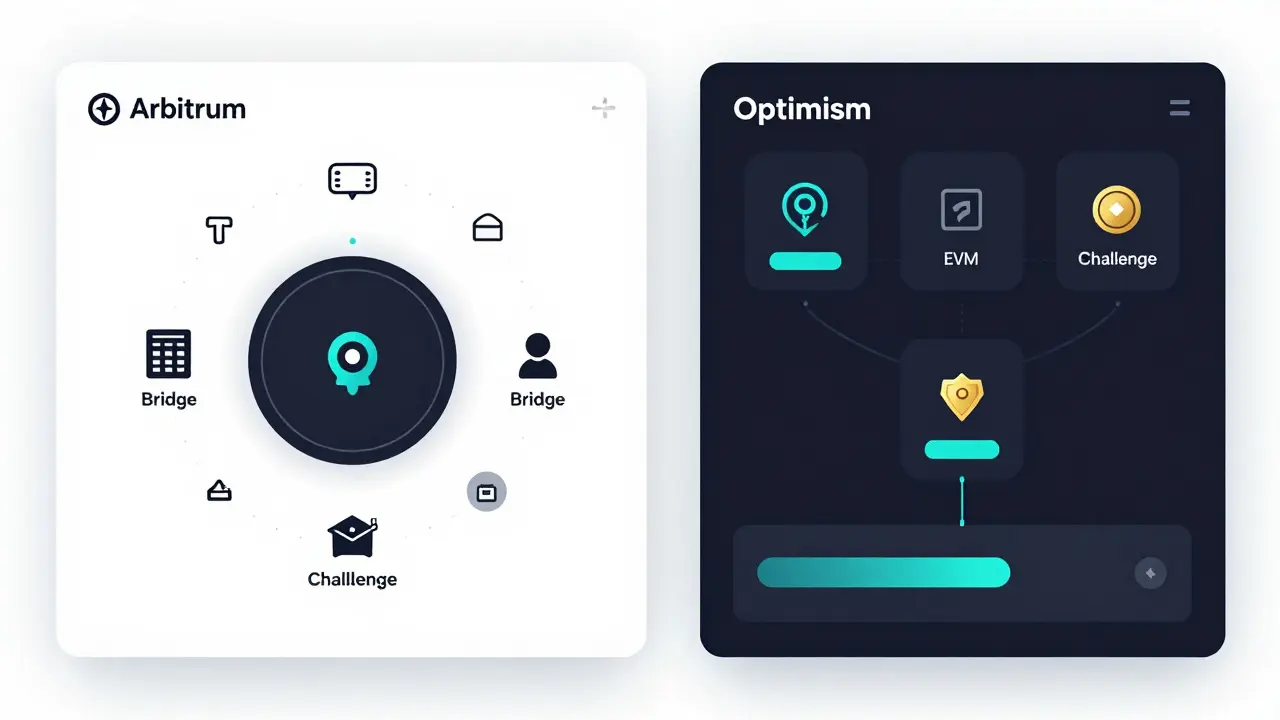
Optimism: The Developer-Friendly Simplicity
Optimism took a different path. Instead of building a new virtual machine, it stuck close to Ethereum’s original EVM. That means if you’ve coded a smart contract in Solidity for Ethereum, you can drop it onto Optimism with almost no changes. No rewrites. No learning curve. Just deploy and go.
That simplicity made Optimism a favorite among startups and smaller projects. You don’t need a team of blockchain engineers to get started. You just need a wallet and a GitHub repo. It’s why projects like Synthetix and Frax moved here early. They wanted to move fast, not rewrite their code.
But Optimism’s bridge works differently. Instead of a universal one, it builds custom bridges for each token. Need to move WETH? There’s a bridge. USDC? Another one. It’s not as seamless as Arbitrum’s, but it gives Optimism more control. Each bridge can be fine-tuned for security, speed, or cost depending on the token’s needs.
Its fraud-proof system is simpler too-single-round. When someone challenges a transaction, the entire batch gets re-run on Ethereum. That’s more expensive. It uses more gas. But it’s faster to resolve. For smaller users who don’t expect disputes, this trade-off makes sense.
Optimism also leads in governance. It was one of the first Layer 2s to hand control to its community through the $OP token. Users vote on upgrades, treasury spending, and even how fees are distributed. That’s not just technical-it’s political. And it’s built trust.
Who Wins? It Depends on What You Need
Arbitrum is the pick for heavy users. If you’re running a DeFi protocol that handles thousands of trades per minute, Arbitrum’s efficiency, lower dispute costs, and universal bridge give it the edge. It’s the truck that hauls the cargo. It doesn’t break under pressure.
Optimism is the pick for builders. If you’re a developer launching a new NFT project or a DeFi app and you want to get live in a week, Optimism’s EVM compatibility and straightforward tools make it easier. It’s the toolkit that fits in your backpack.
For regular users? Both are great. Gas fees are low on both. Speed is fast on both. The difference isn’t in what you can do-it’s in how smoothly you can do it.
Arbitrum has more users. More TVL (total value locked). More protocols. But Optimism has more innovation in governance, more partnerships with traditional finance, and a clearer path to long-term decentralization. Neither is "better." They’re just different tools for different jobs.

Why This Matters for Ethereum’s Future
Ethereum’s goal has always been to be the world’s financial infrastructure. But it can’t do that if every transaction costs $10 and takes 15 seconds. Rollups changed that.
Arbitrum and Optimism didn’t just make Ethereum usable-they made it scalable without compromising security. They’re the reason Ethereum can now handle millions of daily users, not just thousands. They’re why you can trade NFTs, lend crypto, or stake ETH without waiting in line.
And they’re just the beginning. More rollups are coming. ZK-rollups, modular chains, even Ethereum-native ones. But Arbitrum and Optimism are the ones that proved it could work. They’re the proof of concept that turned theory into reality.
If you’re still using Ethereum mainnet for daily transactions, you’re paying too much. You’re waiting too long. The tools to fix that are here. And they’re not hiding.
Are Arbitrum and Optimism safe to use?
Yes. Both platforms are secured by Ethereum’s mainnet. Even though transactions happen off-chain, the data is publicly stored on Ethereum, and any fraudulent activity can be challenged and corrected by the network. Your funds are protected by the same cryptographic rules that secure Ethereum itself.
Can I use the same wallet for Arbitrum and Optimism?
Absolutely. You use the same wallet-MetaMask, Coinbase Wallet, or any EVM-compatible one-on both networks. You just need to add their network details to your wallet. Once set up, you can switch between Ethereum, Arbitrum, and Optimism with a single click.
Do I need to convert my ETH to use these rollups?
No. You send ETH directly from Ethereum to Arbitrum or Optimism using their bridges. On Arbitrum, ETH moves as-is. On Optimism, ETH becomes Wrapped ETH (WETH) temporarily, but it’s still 1:1 backed and fully redeemable. No need to swap or trade.
Which one has lower fees right now?
Arbitrum usually has slightly lower fees, especially during high traffic. Its multi-round fraud proofs reduce the cost of dispute resolution, which keeps overall network costs down. But both are consistently under $0.10 per transaction-far cheaper than Ethereum mainnet.
Will these rollups replace Ethereum?
No. They rely on Ethereum. They’re not competitors-they’re extensions. Ethereum remains the anchor for security, finality, and decentralization. Arbitrum and Optimism just make it faster and cheaper to use. Without Ethereum, they wouldn’t exist.
What’s Next?
If you’re still using Ethereum mainnet for swaps, NFTs, or lending, try moving a small amount to either Arbitrum or Optimism. See how fast it is. See how cheap. Then decide which one fits your workflow.
There’s no rush. Both are live. Both are stable. And both are here to stay.
15 Responses
Been using Arbitrum for months now and honestly? Life changed. Used to stress about gas fees like they were electricity bills. Now I just swap, stake, or send NFTs like it’s nothing. Feels like crypto was supposed to be.
Arbitrum? More like Arbi-bloat. Optimism’s way cleaner. Why do we need some custom VM when Ethereum already works? This whole thing is overengineered corporate nonsense.
lol at people acting like rollups are some revolutionary breakthrough. We’ve had sidechains for years. This is just Ethereum’s way of pretending it’s not broken. They’re just patching a sinking ship with duct tape and hope.
Just wanted to say thanks for the clear breakdown. I’ve been confused about the difference between Arbitrum and Optimism for months. This helped me finally pick one to use for my small DeFi trades.
The fact that you’re still comparing these two like they’re equally valid options is telling. Arbitrum dominates in volume, liquidity, and developer adoption. Optimism is a boutique experiment for people who like slow bridges and governance theater.
While the article presents a compelling narrative, it fails to address the fundamental economic asymmetry inherent in optimistic rollups: the assumption of honesty creates a latent risk surface that is only mitigated by the costly and latency-inducing challenge mechanism. One must ask: is the reduction in per-transaction cost truly a net gain when the systemic burden of dispute resolution is externalized?
OMG I JUST SWAPPED MY ETH ON OPTIMISM AND IT WAS LIKE $0.03 AND INSTANT?? I THOUGHT I WAS STILL ON MAINNET. THIS IS THE FUTURE. I’M CRYING. I’M SO HAPPY. I JUST MOVED MY WHOLE PORTFOLIO. NO MORE $50 FEES. I CAN’T BELIEVE I WAITED THIS LONG.
Hey everyone! Just wanted to share a quick tip: if you’re new to Arbitrum or Optimism, go to chainlist.org and add the networks there. It’s way easier than manually typing in RPCs. Also, always double-check the contract addresses before bridging-scams love new users. You got this! 💪
It is my understanding that both Arbitrum and Optimism operate under the same fundamental principle: off-chain computation with on-chain verification. This methodology significantly reduces congestion on the Ethereum mainnet. Therefore, it is reasonable to conclude that both solutions fulfill their intended purpose.
Let me tell you something. The real reason Ethereum hasn’t collapsed yet is because these Layer 2s are being secretly funded by the same institutions that crashed the global economy in 2008. They want you to think you’re free, but you’re just moving your money from one gated community to another. The blockchain is a distraction. The real power is still centralized. You think you’re using a decentralized network? You’re using a puppet show with fancy code.
Optimism’s governance is actually a big deal. People dismiss it as ‘token voting,’ but it’s one of the first real attempts to let users decide how the infrastructure evolves. That’s not just tech-that’s politics. And politics matters.
While I acknowledge the technical merits of Arbitrum’s AVM, I find the aesthetic of its implementation to be overly aggressive. The proprietary architecture, while efficient, lacks the elegance of Ethereum’s original design philosophy. It feels… industrial.
Wait till the government cracks down on these rollups. They’ll shut down Arbitrum first because it’s too popular. They know it’s the real threat. The banks are already preparing. They’ll say it’s ‘money laundering’ or ‘tax evasion.’ They always do. Just wait. Your funds will be frozen. You think you’re safe? You’re not.
What’s fascinating isn’t just the tech-it’s the emergent culture around it. Arbitrum attracts the builders who want to move fast and break things. Optimism draws the thinkers who care about how things are governed. Both are valid. Neither is superior. It’s like choosing between a Swiss watch and a Japanese utility knife. One is precision. The other is reliability. You don’t need to hate one to love the other.
Yeah I saw that too. Optimism’s governance is cool, but I’d rather have lower fees and faster trades than vote on a treasury proposal every month.