
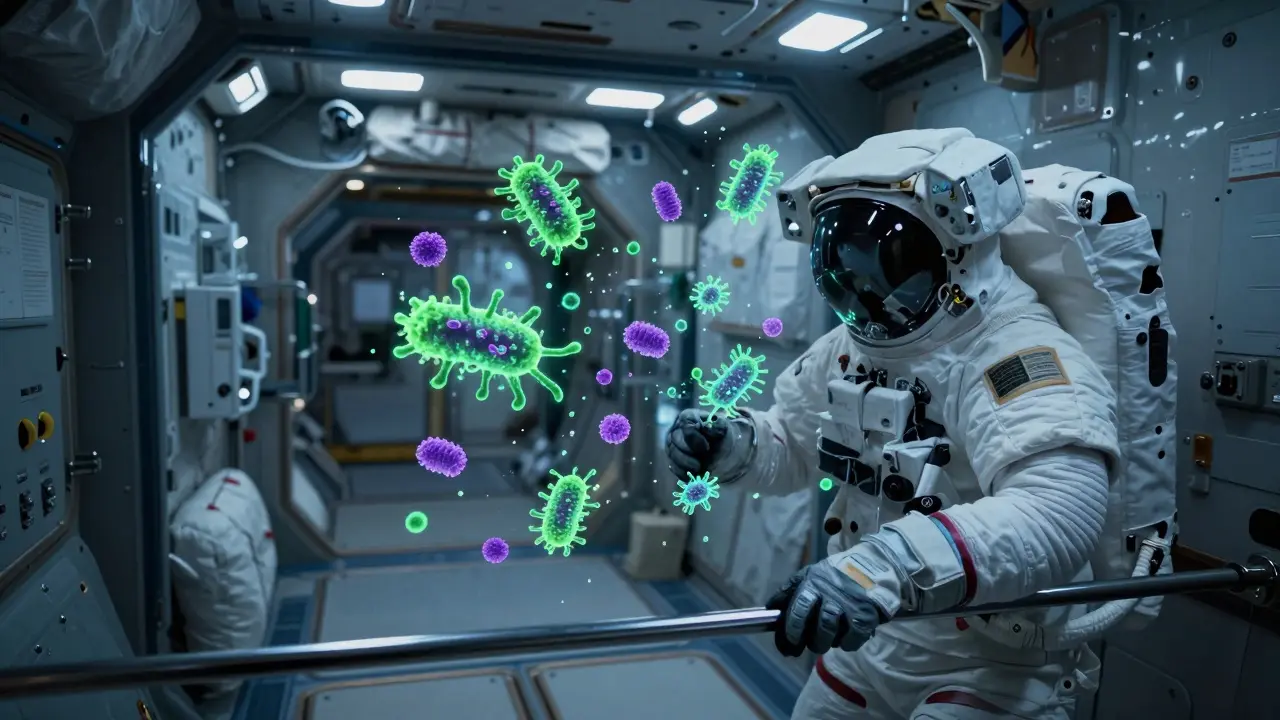
Imagine living in a sealed metal box for six months. You breathe the same recycled air, touch the same handrails hundreds of times a day, and sleep in a bag attached to the wall. Now imagine that every surface you touch is covered in invisible microbes waiting for a chance to make you sick or eat through your equipment. This isn't science fiction; it's daily life aboard the International Space Station (ISS). As we plan missions to Mars that could last nearly three years, keeping these cabins clean is no longer just about comfort-it's a matter of survival.
The solution isn't just more cleaning wipes. It's smarter surfaces. Engineers are developing antimicrobial materials and coatings designed to suppress bacteria, fungi, and viruses right on the walls, panels, and handles of spacecraft. These technologies aim to reduce microbial loads by up to 99.99% without requiring constant human intervention. But creating a coating that works in microgravity, survives radiation, and doesn't poison the crew is incredibly difficult. Let's look at how these materials work, why they're necessary, and what hurdles remain before they become standard on every spaceship.
Why Spacecraft Get Dirty Faster Than Homes
You might think a spaceship is sterile because it's built with precision engineering. In reality, the interior of a spacecraft is a warm, humid, closed ecosystem perfect for microbial growth. On the ISS, routine surveys have found bacterial loads ranging from 10 to 10,000 colony-forming units (CFU) per 100 square centimeters on high-touch surfaces like laptop keyboards and exercise equipment. Common culprits include Staphylococcus aureus, Bacillus, and fungi like Aspergillus.
These numbers sound similar to a well-maintained home, but there’s a catch. In space, microbes behave differently. Studies show that under microgravity conditions, some bacteria form thicker, stickier biofilms and develop increased tolerance to antibiotics. Back in the 1990s, investigators on the Russian space station Mir found severe corrosion behind equipment racks caused by microbial mats thriving in condensate. That experience taught agencies a hard lesson: passive contamination can damage hardware and threaten crew health over long durations.
Currently, crews fight this with HEPA filters, humidity control, and weekly manual cleaning using disinfectant wipes. But for a mission to Mars, where resupply ships won’t arrive for months, relying solely on manual labor is inefficient. Cleaning takes valuable crew time and requires storing hundreds of wipe packs. Antimicrobial surfaces offer a "set it and forget it" layer of defense that works 24/7.
How Antimicrobial Coatings Work
Not all antimicrobial surfaces kill germs the same way. Researchers categorize them into several main types, each with unique mechanisms and trade-offs.
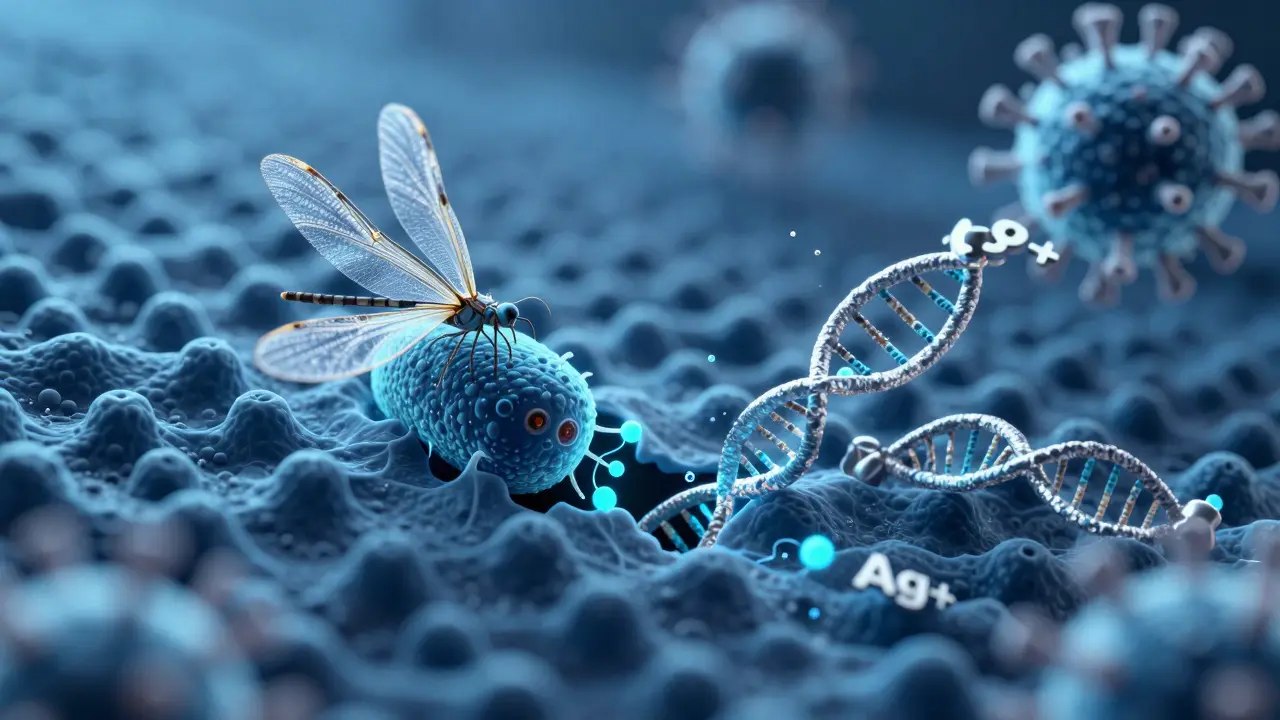
- Metallic Ion-Release (Silver, Copper, Zinc): These materials slowly release biocidal ions (like Ag⁺ or Cu²⁺) when they come into contact with moisture. The ions disrupt cell membranes and interfere with DNA replication. Silver-doped polymers are common in terrestrial healthcare settings. In space, however, scientists must ensure these metals don’t accumulate in water reclamation systems or exceed toxicity limits.
- Photocatalytic Coatings (Titanium Dioxide): Titanium dioxide (TiO₂) generates reactive oxygen species when exposed to UV light, which oxidizes organic contaminants and damages microbes. The challenge? Spacecraft cabins use low-UV lighting to protect crew eyes and circadian rhythms. Newer versions are being doped to activate under visible LED light, but performance varies.
- Contact-Active Polymers: These coatings, often based on quaternary ammonium compounds (QACs), carry a positive charge that attracts and ruptures negatively charged bacterial membranes. They don’t necessarily leach chemicals into the environment but require high surface charge density to be effective. A risk here is that repeated exposure might select for resistant strains if the killing power drops too low.
- Non-Fouling Surfaces: Instead of killing microbes, these hydrophilic polymer brushes prevent them from sticking in the first place. By reducing initial attachment by up to 90%, they slow biofilm formation, making eventual cleaning easier. They’re best used as a complement to other biocidal methods.
- Micro-Topographical Surfaces: Inspired by dragonfly wings, these surfaces feature tiny nanopillars that physically puncture bacterial cells upon contact. While promising in labs, scaling this texture to large, abrasion-resistant panels that survive launch vibrations remains a significant engineering hurdle.
The Harsh Reality of Space Environment Constraints
A coating that works in a hospital doesn't automatically qualify for spaceflight. Space imposes strict constraints that ground-based manufacturers rarely face.
First is outgassing. In the vacuum of space, materials release trapped gases. If an antimicrobial coating releases volatile organic compounds (VOCs), those gases will accumulate in the sealed cabin, potentially damaging optics or harming the crew. Standards like ASTM E595 require total mass loss to be below 1.0% and collected volatile condensable materials below 0.1%. Many organic binders used in commercial coatings fail this test.
Second is radiation and atomic oxygen resistance. Even inside the station, materials receive cumulative radiation doses over multi-year missions. An antimicrobial agent must remain chemically stable and effective after years of exposure, without breaking down into toxic byproducts.
Third is mechanical durability. A handrail on the ISS gets touched thousands of times a day. A coating must withstand years of friction, sweat, and cleaning agents without peeling or losing its biocidal properties. Finally, flammability is critical. Any new material must pass rigorous fire tests, ensuring it doesn't generate excessive smoke or toxic gases in a worst-case scenario.
Lessons from Aviation and Healthcare
While space-specific antimicrobial materials are still emerging, we can look to commercial aviation for clues. Companies like Airbus have been integrating antimicrobial treatments into aircraft cabins since around 2021. They use two main approaches: retrofit polishes applied during maintenance that last up to a year, and embedded additives in seat fabrics and laminates that last up to 10 years.
Aviation shares some constraints with space-weight limits, safety certifications, and enclosed environments-but operates in an open atmosphere with regular ventilation. This means outgassing is less of a concern for planes than for spaceships. However, the core actives, such as silver-based additives and QAC coatings, are the same. Data from aviation shows that these treatments can significantly reduce pathogen transfer on tray tables and armrests. For space agencies, the goal is to adapt these proven chemistries while stripping away any components that fail space-grade toxicity or outgassing tests.
| Technology Type | Mechanism | Key Advantage | Space-Specific Challenge |
|---|---|---|---|
| Metallic Ions (Ag/Cu) | Ion release disrupts cells | Broad-spectrum efficacy | Metal accumulation in water systems |
| Photocatalytic (TiO₂) | Light-activated oxidation | No chemical leaching | Requires specific light wavelengths |
| Contact-Active Polymers | Electrostatic membrane rupture | Fast action time | Risk of resistance development |
| Non-Fouling Brushes | Prevents adhesion | Reduces biofilm buildup | Does not kill existing microbes |

The Path to Flight Qualification
Getting an antimicrobial material onto a spacecraft is a marathon, not a sprint. The process typically spans several years and involves multiple stages of validation.
It starts with laboratory screening against representative spacecraft isolates, not just standard lab bacteria. Then comes environmental simulation: thermal cycling from -20°C to +60°C, humidity changes, and radiation exposure. Only then do engineers test for materials compatibility, including outgassing and flammability.
Next is prototype integration. Coatings are applied to small sections of handrails or panels and subjected to automated wear tests simulating years of crew interaction. Finally, in-flight demonstrations occur. Paired samples-one coated, one uncoated-are placed side-by-side on the ISS for months. Microbiological sampling at various intervals reveals real-world performance. If the data shows consistent benefit without adverse effects, the material may be baselined for future vehicles like the Lunar Gateway or Mars transit habitats.
Future Outlook: Smart Surfaces
As we look toward multi-year missions, the vision for space cabin hygiene is evolving. Experts anticipate interiors that integrate multiple functionalities at the material level. Imagine composites that are not only antimicrobial but also fire-safe, radiation-tolerant, and capable of self-monitoring. Embedded sensors could detect biofouling status via impedance changes, alerting crews exactly when and where cleaning is needed.
While these "smart" surfaces are still conceptual, research priorities are shifting toward testing candidates directly against ISS-derived microbial communities and understanding the interplay between antimicrobial surfaces and the human microbiome. The goal is a multi-barrier strategy: combining air filtration, controlled humidity, and passive antimicrobial surfaces to create a resilient habitat that protects both the crew and the ship.
Are antimicrobial coatings currently used on the International Space Station?
As of the mid-2020s, dedicated antimicrobial interior coatings are not yet standard baseline components across all ISS modules. Most hygiene relies on HEPA filtration, humidity control, and manual cleaning with disinfectant wipes. However, limited-area demonstration experiments are ongoing to test candidate materials in situ.
Why can't we just use the same antimicrobial sprays used in hospitals?
Hospital sprays often contain volatile organic compounds (VOCs) that would accumulate in a sealed spacecraft cabin, posing toxicity risks. Additionally, many commercial products rely on mechanisms that require gravity for drainage or open-air ventilation, which aren't available in space. Space-grade materials must meet strict outgassing and flammability standards.
Do microbes become resistant to antimicrobial surfaces?
There is a risk. If an antimicrobial surface delivers sublethal stress-meaning it inhibits but doesn't kill microbes-it can select for more tolerant strains. To mitigate this, researchers aim for designs that achieve high, sustained activity (multi-log reductions) and often combine different mechanisms (e.g., physical disruption plus chemical action) to prevent adaptation.
What is the biggest challenge in developing space antimicrobial materials?
The primary challenge is balancing efficacy with safety and durability. A material must kill microbes effectively while surviving radiation, extreme temperature cycles, and mechanical wear, all without releasing toxic gases or particles into the closed cabin environment. No single commercially available technology currently meets all these criteria simultaneously for long-duration missions.
How long do antimicrobial coatings last in space?
Durability varies by technology. Embedded metallic additives in polymers may last the lifetime of the component (up to 10+ years in theory), but their effectiveness can degrade due to wear or soiling. Contact-active coatings may lose potency faster if the surface is heavily abraded. Long-term validation data for multi-year space missions is still being gathered.