

Most people look at a cryptocurrency’s price chart and stop there. They see the green candles, hear the hype, and buy in. But if you want to separate long-term winners from short-lived scams, you need to look past the price tag. You need to understand the engine under the hood. That engine is tokenomics.
Token economics, or tokenomics, isn't just about how much money a project raised. It's the study of the economic rules that govern a digital asset. Think of it as the constitution for a new country. Who gets the land? How are taxes collected? What happens when the population grows? If these rules are broken, the economy collapses. In the world of blockchain and even artificial intelligence, understanding these mechanics is the difference between holding an asset that appreciates and one that goes to zero.
The Core Question: Does This Token Actually Do Anything?
Before you worry about charts, ask yourself: why does this token exist? Many projects create tokens simply because they needed a way to raise capital during their initial coin offering (ICO). Once the money is in, the token has no job. This is a red flag.
A healthy token needs a clear utility. It should serve a specific function within its ecosystem. Generally, tokens fall into a few categories:
- Utility Tokens: These are used to pay for services, access features, or cover transaction fees (gas) on a network.
- Governance Tokens: Holding these gives you voting rights on protocol changes, like adjusting interest rates or upgrading software.
- Security or Staking Tokens: Users lock these up to secure the network or provide liquidity, earning rewards in return.
If a token is not strictly necessary for the platform to function-if the same service could be paid for with dollars or euros-then its value proposition is weak. Look for projects where the token is integral to the daily operations, creating durable demand rather than just speculative interest.
Supply Dynamics: Scarcity vs. Inflation
You can’t analyze a token without looking at its supply model. Is there a limit to how many will ever exist, or can the creators print more forever? This determines scarcity.
First, check the Maximum Supply. Some tokens, like Bitcoin, have a hard cap. Others have no limit. Neither is inherently bad, but they behave differently. A fixed supply relies on scarcity to drive value. An inflationary supply uses new tokens to reward participants, like validators or developers.
Next, look at the Emission Schedule. Are new tokens released predictably, block by block? Or does a central team decide when to release them? Predictability builds trust. Discretionary issuance creates fear that insiders might dump tokens on the market whenever they feel like it.
Also, watch for burn mechanisms. Some protocols automatically destroy a portion of transaction fees, reducing the total supply over time. This deflationary pressure can support the price if usage remains high. If issuance outpaces burning, the token is inflating, which dilutes your holdings unless demand grows faster than the supply.
Distribution and Vesting: Who Holds the Cards?
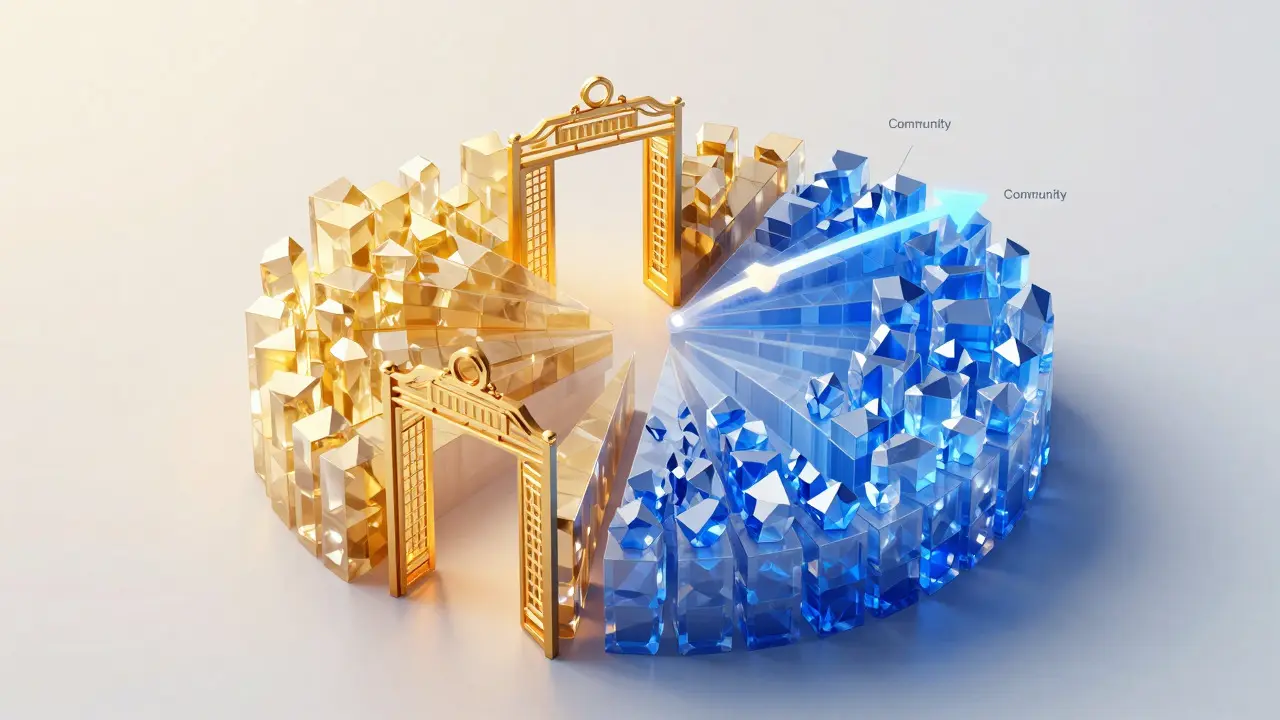
Even if a token has great utility, it can fail if the distribution is unfair. Imagine buying a house only to find out the developer owns 80% of the neighborhood and plans to sell everything next month. That’s what poor allocation looks like in crypto.
Break down the allocation percentages. Typically, you’ll see shares for:
- Founders and team
- Investors (Venture Capitalists)
- Treasury (for future development)
- Community (airdrops, rewards)
If too much supply is held by insiders, the community has little power. More importantly, look at the Vesting Schedule. This is the timeline over which locked tokens become available for sale. If founders’ tokens unlock all at once after six months, expect massive sell pressure then. Good projects use long vesting periods (two to four years) with gradual cliffs. This aligns the team’s incentives with the long-term success of the project, ensuring they don’t just cash out and leave.
Incentives and Behavioral Design
Tokenomics is essentially game theory applied to finance. The system must incentivize the right behaviors. Do the rewards encourage people to build, secure, and use the network? Or do they attract "mercenary capital"-users who farm rewards quickly and then dump the tokens?
Look for alignment. If a liquidity provider earns rewards, do those rewards decrease as the network matures? Static, high yields often lead to instability. Dynamic incentives that adjust based on real-time data are healthier. Also, consider the time horizon. Front-loaded rewards (high payouts early on) often signal a rush to get users before the model becomes unsustainable. Smoother, longer-term reward structures suggest a focus on durability.
Governance: Can the System Adapt?
No economic model is perfect from day one. Markets change, exploits happen, and user behavior shifts. A rigid tokenomic structure will break. You need governance mechanisms that allow the community to adapt.
Ask who holds the voting power. Is it proportional to token holdings? If so, large investors dominate. Some projects use quadratic voting or delegated models to give smaller holders a voice. Check the scope of governance too. Can voters change emission rates, fee structures, or treasury spending? If critical parameters are hard-coded and unchangeable, the project lacks resilience. However, beware of governance capture, where a single entity controls enough votes to pass self-serving proposals.

Beyond Crypto: Token Economics in AI
Interestingly, the concept of token economics is expanding beyond blockchain. In the enterprise AI sector, "tokens" refer to the units of computation processed by large language models. Here, tokenomics is about cost efficiency and resource allocation.
For businesses using AI, every prompt costs money based on the number of input and output tokens. The "economics" here involve optimizing prompts to reduce token count, choosing efficient models, and monitoring spend via FinOps practices. While different from crypto assets, the principle is the same: tokens represent value and work. Understanding how they are consumed and priced is crucial for sustainability in both domains.
| Aspect | Key Questions to Ask | Red Flags |
|---|---|---|
| Purpose | Is the token essential for utility, governance, or security? | Token exists only for fundraising; no clear use case. |
| Supply | Is there a max supply? Is inflation predictable? | Unlimited supply with no burn mechanism; discretionary issuance. |
| Distribution | Are allocations fair? Are vesting schedules long? | High insider concentration; short or unclear vesting periods. |
| Incentives | Do rewards align with long-term network health? | Unsustainably high yields; rewards front-loaded heavily. |
| Governance | Can parameters be adjusted? Is voting power distributed? | Centralized control; inability to respond to market changes. |
Risk Management and Compliance
Finally, consider the regulatory landscape. A token design that promises guaranteed returns may be classified as a security in many jurisdictions, bringing legal risks that could shut down the project. Look for transparency in compliance efforts. Does the team acknowledge regulatory constraints? Do they have mechanisms to handle market stress, such as circuit breakers or treasury reserves? Robust tokenomics includes risk mitigation strategies, not just growth hacks.
Analyzing token economics takes time, but it pays off. By scrutinizing purpose, supply, distribution, incentives, and governance, you move beyond speculation. You start seeing the actual economic forces at play. Whether you’re evaluating a decentralized finance protocol or managing AI compute costs, understanding the value of the token is key to making smart decisions.
What is the most important factor in tokenomics?
The most critical factor is utility. If a token doesn't solve a real problem or provide essential access, fees, or governance within its ecosystem, it lacks fundamental demand. Without utility, value relies entirely on speculation, which is volatile and risky.
How do I know if a token's supply is too inflationary?
Compare the emission rate to the burn rate or usage rate. If new tokens are created faster than they are being used or destroyed, the supply dilutes. Look for a declining inflation trajectory over time, similar to Bitcoin's halving events, which signals increasing scarcity.
Why are vesting schedules important for investors?
Vesting schedules prevent early insiders from dumping large amounts of tokens on the market immediately. Long vesting periods align the interests of founders and investors with the long-term success of the project, reducing sudden sell-side pressure and stabilizing the price.
What is the difference between a utility token and a security token?
A utility token provides access to a product or service, like paying for cloud storage or voting on upgrades. A security token represents ownership or shares in a company, often promising profits from managerial efforts. Security tokens face stricter regulations and compliance requirements.
How does tokenomics apply to AI and machine learning?
In AI, tokens represent units of text or data processed by models. Tokenomics here refers to managing the cost and efficiency of these computations. Businesses optimize token usage to reduce expenses, similar to how crypto projects manage supply and demand to maintain value.
What are "burn mechanisms" in tokenomics?
Burn mechanisms permanently remove tokens from circulation, usually by sending them to an inaccessible address. This reduces the total supply, potentially increasing scarcity and supporting the token's price if demand remains constant or grows.
Can a token with unlimited supply still be valuable?
Yes, if the demand for the token grows faster than the supply increases. For example, Ethereum has no hard cap, but its value is driven by its extensive utility and network effects. The key is whether the inflation serves a purpose, such as rewarding validators, and is balanced by usage.
12 Responses
The entire premise of tokenomics is a philosophical farce wrapped in blockchain jargon. We are essentially watching the death of trust as we speak, replacing it with lines of code that can be altered by anonymous wizards in basements. It is not an economy, it is a casino where the house changes the rules every time you win a hand.
While Bineesh is busy having an existential crisis about the nature of reality, there is actually some meat here regarding vesting schedules. Most retail investors ignore this completely until their bags get dumped on them. The key is looking for long cliffs and linear vesting over 2-4 years. If the team unlocks everything in month 6, run. Also, the point about AI tokens being different from crypto tokens is crucial context that often gets lost in the hype cycle.
Oh darling, please. You think reading a checklist makes you a financial guru? In South Africa, we have learned the hard way that when the big men talk about 'utility', they usually mean 'how much can we extract before leaving'. This article reads like a brochure for a timeshare in Dubai. Very informative, very soulless.
i totally agree with jeanene though i spelt it wrong sorry my keyboard is sticky but the bit about governance is so important because if one whale controls 40 percent of the votes then its not really decentralized is it more like a dictatorship with extra steps and i find that quite alarming really especially when you consider how many projects just copy paste the same whitepaper templates
Look, nobody cares about your feelings or the 'soul' of the market. It's math. If the inflation rate exceeds the growth in network usage, you lose money. Period. Stop romanticizing the scam and start looking at the burn mechanisms. If there's no sink, it's a faucet draining your wallet. Simple as that.
typical american optimism thinking any of this applies outside of silicon valley bubble. real value comes from tangible assets not digital air. but sure keep telling yourself that this 'utility' means something when the servers go down
Wait! Wait wait wait!! Did someone say BURN MECHANISMS?! That is literally the coolest thing I have ever heard!!! Like, they just delete the money?! Gone! Poof! Into the void! It’s like magic but with spreadsheets! I need to know more about this deflationary pressure immediately!!! Is it true??? Tell me everything!!!
Marissa calm down girl you sound like a toddler who found a new toy. But yeah the burn thing is kinda neat if you look at it from a pure supply shock perspective. Although most burns are tiny fractions of a percent so dont get too excited. Its marketing fluff mostly. But still better than nothing i guess.
You people are missing the forest for the trees. The single most important metric is not the burn, nor the vesting, but the liquidity depth. Without deep liquidity, all these tokenomic models are theoretical fantasies. A token with perfect economics but no buyers is worthless paper. Focus on volume and spread, not the fairy tales written by founders.
I just sit back and watch everyone argue about which metric matters more. It’s fascinating how quickly people turn into experts after reading one blog post. I wonder if anyone actually checks the smart contract audits or if we’re all just trusting the charts.
The silence of the auditors speaks volumes. We assume safety because a logo exists. Yet the code is open source. Why do we outsource our skepticism to firms that charge for rubber stamps? Perhaps the answer lies in our own desire for permission to gamble.
just another day in the matrix